

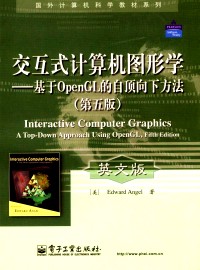
Interactive computer graphics a top-down approach using openGL, fifth edition
副标题:无
作 者:(美)Edward Angel著
分类号:
ISBN:9787121072376
微信扫一扫,移动浏览光盘
简介
在广泛结合OpenGL并注重图形应用编程的基础上,本书向读者介绍了计
算机图形学的核心概念。书中代码采用C和C++语言,并使用了自顶向下和面
向编程的方法,使读者能够迅速地创建自己的三维图形。在结构安排上,本
书在读者学会了编写交互式图形程序之后再介绍底层的算法,如线段的绘制
以及多边形填充等算法。
本书覆盖了计算机图形学基础课程中的所有主题,包括光与材质的相互
作用、明暗绘制、建模、曲线和曲面、反走样、光栅化、纹理映射和图像合
成等内容。
本书可作为计算机及相关专业本科生和研究生的计算机图形学教材,也
适合作为相关程序员、工程技术人员及科研人员的参考书。
目录
CHAPTER 1 GRAPHICS SYSTEMS AND MODELS .
1.1 Applications of Computer Graphics
1.2 A Graphics System
1.3 Images: Physical and Synthetic
1.4 Imaging Systems
1.5 The Synthetic-Camera Model
1.6 The Programmers Interface
1.7 Graphics Architectures
1.8 Programmable Pipelines
1.9 Performance Characteristics
CHAPTER 2 GRAPHICS PROG
2.1 The Sierpinski Gasket
2.2 Programming Two-Dimensional Applications
2.3 The OpenGL APl
2.4 Primitives and Attributes
2.5 Color
2.6 Viewing
2.7 Control Functions
2.8 The Gasket Program
2.9 Polygons and Recursion
2.10 The Three-Dimensional Gasket
2.11 Plotting Implicit Functions
CHAPTER 3 INPUT AND INTERACTION
3.1 Interaction
3.2 Input Devices
3.3 Clients and Servers
3.4 Display Lists
3.5 Display Lists and Modeling
3.6 Programming Event-Driven Input
3.7 Menus
3.8 Picking
3.9 A Simple CAD Program
3.10 Building Interactive Models
3.11 Animating Interactive Programs
3.12 Design of Interactive Programs
3.13 Logic Operations
CHAPTER 4 GEOMETRIC OBJECTS AND TRANSFORMATIONS
4.1 Scalars, Points, and Vectors
4.2 Three-Dimensional Primitives
4.3 Coordinate Systems and Frames
4.4 Frames in OpenGL
4.5 Modeling a Colored Cube
4.6 Affine Transformations
4.7 Translation, Rotation, and Scaling
4.8 Transformations in Homogeneous Coordinates
4.9 Concatenation of Transformations
4.10 OpenGL Transformation Matrices
4.11 Interfaces to Three-Dimensional Applications
4.12 Quaternions
CHAPTER 5 VEIWING
5.1 Classical and Computer Viewing
5.2 Viewing with a Computer
5.3 Positioning of the Camera
5.4 Simple Projections
5.5 Projections in OpenGL
5.6 Hidden-Surface Removal
5.7 Interactive Mesh Displays
5.8 Parallel-Projection Matrices
5.9 Perspective-Projection Matrices
5.10 Projections and Shadows
CHAPTER 6 LIGHTING AND SHADING
6.1 Light and Matter
6.2 Light Sources
6.3 The Phong Lighting Model
6.4 Computation of Vectors
6.5 Polygonal Shading
6.6 Approximation of a Sphere by Recursive Subdivision
6.7 Light Sources in OpenGL
6.8 Specification of Materials in OpenGL
6.9 Shading of the Sphere Model
6.10 Global Illumination
CHAPTER 7 FROM VERTICES TO FRAGMENTS
7.1 Basic Implementation Strategies
7.2 Four Major Tasks
7.3 Clipping
7.4 Line-Segment Clipping
7.5 Polygon Clipping
7.6 Clipping of Other Primitives
7.7 Clipping in Three Dimensions
7.8 Rasterization
7.9 Bresenhams Algorithm
7.10 Polygon Rasterization
7.11 Hidden-Surface Removal
7.12 Antialiasing
7.13 Display Considerations
CHAPTER 8 DISCETE TECHNIQUES
8.1 Buffers
8.2 Digital Images
8.3 Writing into Buffers
8.4 Bit and Pixel Operations in OpenGL
8.5 Examples
8.6 Mapping Methods
8.7 Texture Mapping
8.8 Texture Mapping in OpenGL
8.9 Texture Generation
8.10 Environment Maps
8.11 Compositing Techniques
8.12 Multirendering and the Accumulation Buffer
8.13 Sampling and Aliasing
CHAPTER 9 PROGRAMMABLE SHADERS ..
9.1 Programmable Pipelines
9.2 Shading Languages
9.3 Extending OpenGL
9.4 The OpenGL Shading Language
9.5 The OpenGL Shading Language
9.6 Linking Shaders with OpenGL Programs
9.7 Moving Vertices
9.8 Vertex Lighting with Shaders
9.9 Fragment Shaders
9.10 Per-Vertex Versus Per-Fragment Lighting
9.11 Samplers
9.12 Cube Maps
9.13 Bump Mapping
CHAPTER 10 MODELING AND HIERARCHY
10.1 Symbols and Instances
10.2 Hierarchical Models
10.3 A Robot Arm
10.4 Trees and Traversal
10.5 Use of Tree Data Structures
10.6 Animation
10.7 Graphical Objects
10.8 Scene Graphs
10.9 A Simple Scene Graph APl
10.10 Open Scene Graph
10.11 Graphics and the Internet
10.12 Other Tree Structures
CHAPTER 11 PROCEDURAL METHODS
11.1 Algorithmic Models
11.2 Physically-Based Models and Particle Systems
11.3 Newtonian Particles
11.4 Solving Particle Systems
11.5 Constraints
11.6 A Simple Partial System
11.7 Language-Based Models
11.8 Recursive Methods and Fractals
11.9 Procedural Noise
CHAPTER 12 CURVES AND SURFACES
12.1 Representation of Curves and Surfaces
12.2 Design Criteria
12.3 Parametric Cubic Polynomial Curves
12.4 Interpolation
12.5 Hermite Curves and Surfaces
12.6 Bezier Curves and Surfaces
12.7 Cubic B-Splines
12.8 General B-Splines
12.9 Rendering Curves and Surfaces
12.10 The Utah Teapot
12.11 Algebraic Surfaces
12.12 Curves and Surfaces in OpenGL
CHAPTER 13 ADVANCED RENDERING
13.1 Going Beyond Pipeline Rendering
13.2 Ray Tracing
13.3 Building a Simple Ray Tracer
13.4 The Rendering Equation
13.5 Radiosity
13.6 RenderMan
13.7 Parallel Rendering
13.8 Image-Based Rendering
APENDIX A SAMPLE PROGRAMS
A.1 Sierpinski Gasket Program
A.2 Recursive Generation of Sierpinski Gasket
A.3 Recursive Three-Dimensional Sierpinski Gasket
A.4 Marching Squares
A.5 Polygon Modeling Program
A.6 Double-Buffering program
A.7 Selection-Mode Picking Program
A.8 Rotating-Cube Program
A.9 Rotating Cube Using Vertex Arrays
A.10 Rotating Cube with a Virtual Trackball
A.11 Moving Viewer
A.12 Sphere Program
A.13 Mandelbrot Set Program
A.14 Bresenhams Algorithm
A.15 Rotating Cube with Texture
A.16 GLSL Example
A.17 Scene Graph Program
A.18 Particle System Program
A.19 Program for Drawing Bezier Curves
APENDIX B SPACES
B.1 Scalars
B.2 Vector Spaces
B.3 Affine Spaces
B.4 Euclidean Spaces
B.5 Projections
B.6 Gram-Schmidt Orthogonalization
APENDIX C MATRICES
C.1 Definitions
C.2 Matrix Operations
C.3 Row and Column Matrices
C.4 Rank
C.5 Change of Representation
C.6 The Cross Product
C.7 Eigenvalues and Eigenvectors
APENDIX D SYNOPSIS OF OPENGL FUNCTIONS
D.1 Specifying Simple Geometry
D.2 Attributes
D.3 Working with the Window System
D.4 Interaction
D.5 Enabling Features
D.6 Transformations
D.7 Viewing
D.8 Defining Discrete Primitives
D.9 Display Lists
D.10 Picking
D.11 Lighting
D.12 Texture Mapping
D.13 State and Buffer Manipulation
D.14 Vertex Arrays
D.15 Blending Functions
D.16 Query Functions
D.17 Curve and Surface Functions
D.18 GLU Quadrics
D.19 GLSL Functions
References
OpenGL Function Index
Subject Index ...
1.1 Applications of Computer Graphics
1.2 A Graphics System
1.3 Images: Physical and Synthetic
1.4 Imaging Systems
1.5 The Synthetic-Camera Model
1.6 The Programmers Interface
1.7 Graphics Architectures
1.8 Programmable Pipelines
1.9 Performance Characteristics
CHAPTER 2 GRAPHICS PROG
2.1 The Sierpinski Gasket
2.2 Programming Two-Dimensional Applications
2.3 The OpenGL APl
2.4 Primitives and Attributes
2.5 Color
2.6 Viewing
2.7 Control Functions
2.8 The Gasket Program
2.9 Polygons and Recursion
2.10 The Three-Dimensional Gasket
2.11 Plotting Implicit Functions
CHAPTER 3 INPUT AND INTERACTION
3.1 Interaction
3.2 Input Devices
3.3 Clients and Servers
3.4 Display Lists
3.5 Display Lists and Modeling
3.6 Programming Event-Driven Input
3.7 Menus
3.8 Picking
3.9 A Simple CAD Program
3.10 Building Interactive Models
3.11 Animating Interactive Programs
3.12 Design of Interactive Programs
3.13 Logic Operations
CHAPTER 4 GEOMETRIC OBJECTS AND TRANSFORMATIONS
4.1 Scalars, Points, and Vectors
4.2 Three-Dimensional Primitives
4.3 Coordinate Systems and Frames
4.4 Frames in OpenGL
4.5 Modeling a Colored Cube
4.6 Affine Transformations
4.7 Translation, Rotation, and Scaling
4.8 Transformations in Homogeneous Coordinates
4.9 Concatenation of Transformations
4.10 OpenGL Transformation Matrices
4.11 Interfaces to Three-Dimensional Applications
4.12 Quaternions
CHAPTER 5 VEIWING
5.1 Classical and Computer Viewing
5.2 Viewing with a Computer
5.3 Positioning of the Camera
5.4 Simple Projections
5.5 Projections in OpenGL
5.6 Hidden-Surface Removal
5.7 Interactive Mesh Displays
5.8 Parallel-Projection Matrices
5.9 Perspective-Projection Matrices
5.10 Projections and Shadows
CHAPTER 6 LIGHTING AND SHADING
6.1 Light and Matter
6.2 Light Sources
6.3 The Phong Lighting Model
6.4 Computation of Vectors
6.5 Polygonal Shading
6.6 Approximation of a Sphere by Recursive Subdivision
6.7 Light Sources in OpenGL
6.8 Specification of Materials in OpenGL
6.9 Shading of the Sphere Model
6.10 Global Illumination
CHAPTER 7 FROM VERTICES TO FRAGMENTS
7.1 Basic Implementation Strategies
7.2 Four Major Tasks
7.3 Clipping
7.4 Line-Segment Clipping
7.5 Polygon Clipping
7.6 Clipping of Other Primitives
7.7 Clipping in Three Dimensions
7.8 Rasterization
7.9 Bresenhams Algorithm
7.10 Polygon Rasterization
7.11 Hidden-Surface Removal
7.12 Antialiasing
7.13 Display Considerations
CHAPTER 8 DISCETE TECHNIQUES
8.1 Buffers
8.2 Digital Images
8.3 Writing into Buffers
8.4 Bit and Pixel Operations in OpenGL
8.5 Examples
8.6 Mapping Methods
8.7 Texture Mapping
8.8 Texture Mapping in OpenGL
8.9 Texture Generation
8.10 Environment Maps
8.11 Compositing Techniques
8.12 Multirendering and the Accumulation Buffer
8.13 Sampling and Aliasing
CHAPTER 9 PROGRAMMABLE SHADERS ..
9.1 Programmable Pipelines
9.2 Shading Languages
9.3 Extending OpenGL
9.4 The OpenGL Shading Language
9.5 The OpenGL Shading Language
9.6 Linking Shaders with OpenGL Programs
9.7 Moving Vertices
9.8 Vertex Lighting with Shaders
9.9 Fragment Shaders
9.10 Per-Vertex Versus Per-Fragment Lighting
9.11 Samplers
9.12 Cube Maps
9.13 Bump Mapping
CHAPTER 10 MODELING AND HIERARCHY
10.1 Symbols and Instances
10.2 Hierarchical Models
10.3 A Robot Arm
10.4 Trees and Traversal
10.5 Use of Tree Data Structures
10.6 Animation
10.7 Graphical Objects
10.8 Scene Graphs
10.9 A Simple Scene Graph APl
10.10 Open Scene Graph
10.11 Graphics and the Internet
10.12 Other Tree Structures
CHAPTER 11 PROCEDURAL METHODS
11.1 Algorithmic Models
11.2 Physically-Based Models and Particle Systems
11.3 Newtonian Particles
11.4 Solving Particle Systems
11.5 Constraints
11.6 A Simple Partial System
11.7 Language-Based Models
11.8 Recursive Methods and Fractals
11.9 Procedural Noise
CHAPTER 12 CURVES AND SURFACES
12.1 Representation of Curves and Surfaces
12.2 Design Criteria
12.3 Parametric Cubic Polynomial Curves
12.4 Interpolation
12.5 Hermite Curves and Surfaces
12.6 Bezier Curves and Surfaces
12.7 Cubic B-Splines
12.8 General B-Splines
12.9 Rendering Curves and Surfaces
12.10 The Utah Teapot
12.11 Algebraic Surfaces
12.12 Curves and Surfaces in OpenGL
CHAPTER 13 ADVANCED RENDERING
13.1 Going Beyond Pipeline Rendering
13.2 Ray Tracing
13.3 Building a Simple Ray Tracer
13.4 The Rendering Equation
13.5 Radiosity
13.6 RenderMan
13.7 Parallel Rendering
13.8 Image-Based Rendering
APENDIX A SAMPLE PROGRAMS
A.1 Sierpinski Gasket Program
A.2 Recursive Generation of Sierpinski Gasket
A.3 Recursive Three-Dimensional Sierpinski Gasket
A.4 Marching Squares
A.5 Polygon Modeling Program
A.6 Double-Buffering program
A.7 Selection-Mode Picking Program
A.8 Rotating-Cube Program
A.9 Rotating Cube Using Vertex Arrays
A.10 Rotating Cube with a Virtual Trackball
A.11 Moving Viewer
A.12 Sphere Program
A.13 Mandelbrot Set Program
A.14 Bresenhams Algorithm
A.15 Rotating Cube with Texture
A.16 GLSL Example
A.17 Scene Graph Program
A.18 Particle System Program
A.19 Program for Drawing Bezier Curves
APENDIX B SPACES
B.1 Scalars
B.2 Vector Spaces
B.3 Affine Spaces
B.4 Euclidean Spaces
B.5 Projections
B.6 Gram-Schmidt Orthogonalization
APENDIX C MATRICES
C.1 Definitions
C.2 Matrix Operations
C.3 Row and Column Matrices
C.4 Rank
C.5 Change of Representation
C.6 The Cross Product
C.7 Eigenvalues and Eigenvectors
APENDIX D SYNOPSIS OF OPENGL FUNCTIONS
D.1 Specifying Simple Geometry
D.2 Attributes
D.3 Working with the Window System
D.4 Interaction
D.5 Enabling Features
D.6 Transformations
D.7 Viewing
D.8 Defining Discrete Primitives
D.9 Display Lists
D.10 Picking
D.11 Lighting
D.12 Texture Mapping
D.13 State and Buffer Manipulation
D.14 Vertex Arrays
D.15 Blending Functions
D.16 Query Functions
D.17 Curve and Surface Functions
D.18 GLU Quadrics
D.19 GLSL Functions
References
OpenGL Function Index
Subject Index ...
Interactive computer graphics a top-down approach using openGL, fifth edition
- 名称
- 类型
- 大小
光盘服务联系方式: 020-38250260 客服QQ:4006604884
云图客服:
用户发送的提问,这种方式就需要有位在线客服来回答用户的问题,这种 就属于对话式的,问题是这种提问是否需要用户登录才能提问
Video Player
×
Audio Player
×
pdf Player
×
