

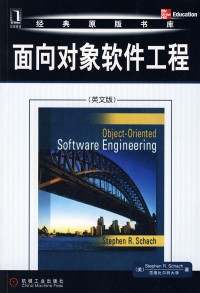
Object-oriented software engineering
副标题:无
分类号:
ISBN:9787111265269
微信扫一扫,移动浏览光盘
简介
《面向对象软件工程 (英文版)》是英文影印版系列,SteDhen R.Schach:Object.Oriented Software Engineering(ISBN 978—0-07—352333—0) Copyright@2008 by The McGraw—Hill Companies,Inc
Original language published by The McGraw—Hill Companies,Inc.A11 rights reserved-No part of this publication may be reproduced or distributed in any means,or stored in adatabase or retrieval system,without the prior written permission of the publisher.
Authorized English language reprint edition jointly published by McGraw—Hill EducationrAsial Co.and China Machine Press.This edition is authorized for sale in the People's Republic ofChina 0nIu excluding Hong Kong,Macao SARs and Taiwan.Unauthorized export ofthis edition is aviolation 0fthe Copyright Act.Violation ofthis Law is subject to Civil and Criminal Penalties.
目录
part one.
introduction to object-
oriented software
engineering 1
chapter 1
the scope of object-oriented software
engineering 3
学习目标 3
1.1 historical aspects 4
1.2 economic aspects 7
1.3 maintenance aspects 8
1.4 requirements, analysis, and
design aspects 13
1.5 team development aspects 15
1.6 why there is no planning phase 16
1.7 why there is no testing phase 17
1,8 why there is no documentation phase 18
1.9 the object-oriented paradigm 18
1.10 terminology 20
1.11 ethical issues 24
.chapter review 25
for further reading 25
key terms 26
习题 27
references 28
chapter 2
software life-cycle models 32
学习目标 32
2.1 software development in theory 32
2.2 winburg mini case study 33
2.3 lessonsofthewinburgmiaicasestudy 37
2.4 teal tractors mini case study 37
2.5 iteration and incrementation 38
2.6 winburg mini case study revisited 42
2.7 risks and other aspects of iteration
and incrementation 43
2.8 managing iteration and incrementation 46
2.9 other life-cycle models 47
2.10 comparison of[,ife-'cycle models 61
chapter review 62
for further reading 63
key terms 64
习题 64
references 65
chapter 3
the software process 68
学习目标 68
3.1 the unified process 70
3.2 iteration and lncrementation 72
3.3 the requirements workfiow 73
3.4 the analysis workflow 74
3.5 the design workfiow 76
3.6 the implementation workflow 77
3.7 the test workfiow 78
3.8 postdelivery maintenance 81
3.9 retirement 82
3.10 the phases of the unified process 82
3.11 one; versus two-dimensional life-cycle models 87
3.12 improving the software process 89
3.13 capability maturity models 89
3.14 other software process improvement initiatives 92
3.15 costs and benefits of software process improvement 93
chapter review 95
for further reading 95
key terms 96
习题 97
references 97
chapter 4
teams 101
学习目标 101
4.1 team organization 101
4.2 democratic team approach 103
4.3 chief programmer team approach 104
4.4 beyond chief programmer and democratic teams 107
4.5 synchronize-and-stabilize teams 111
4.6 teams for agile processes 112
4.7 open-sourceprogramming teams 112
4.8 people capability maturity model 113
4.9 choosing an appropriate team
organization 114
chapter review 115
for further readifig 115
key terms 115
problems 116
习题 116
chapter 5
the tools of the trade 118
学习目标 118
5.1 stepwise refinement 118
5.2 cost-benefit analysis 124
5.3 software metrics 126
5.4 case 127
5.5 taxonomy of case 128
5.6 scope of case 130
5.7 software versions 133
5.8 configuration control 135
5.9 build tools -138
5.10 productivity gains with case
technology 139
chapter review 141
for further reading 141
key terms 141
习题 142
references 143
chapter 6
testing 145
学习目标 145
6.1 quality issues 146
6.2 non-execution-based testing 148
6.3 execution-based testing 153
6.4 what should be tested? 154
6.5 testing versus correctness proofs 158
6.6 who should perform execution-basedtesting? 166
6.7 when testing stops 167
chapter review 167
for further reading 168
key terms 168
习题 169
references 170
chapter 7
from modules to objects 173
学习目标 173
7.1 whatlsamodule? 174
7.2 cohesion 176
7.3 coupling 181
7.4 data encapsulation 189
7.5 abstract datatypes 197
7.6 information hiding 199
7.7 objecls 201
7.8 inheritance, polymorphism, and dynamic binding 205
7.9 the object-oriented paradigm 207
chapter review 210
for further reading 211
key terms 211
习题 212
references 212
chapter 8
reusability and portability 215
学习目标 215
8.1 reuse concepts 216
8.2 lmpediments to reuse 218
8.3 reuse case studies 219
8.4 objects and reuse 222
8.5 reuse during design and
8.6 more on design patterns 227
8.7 categories of design patterns 235
8.8 strengths and weaknesses of design patterns 237
8.9 reuse and postdelivery maintenance
8.10 portability 239
8.11 why portability? 244
8.12 techniques for achieving portability 245
chapter review 249
for further reading 249
key terms 250
习题 250
references 252
chapter 9
planning and estimating 256
学习目标 256
9.1 planning and the software process 257
9.2 estimating duration and cost 258
9.3 estimation issues 270
9.4 components of a software project management plan 271
9.5 software project management plan framework 272
9.6 ieee software project management plan 274
9.7 planning testing.. 277
9.8 training requirements 278
9.9 documentation standards 279
9.10 case tools for planning and estimating 279
9.11 testing the software project
management plan 280
chapter review 280
for further reading 280
key terms 281
习题 282
references 283
part two
the workflows of the
software life cycle 286
chapter 10
the requirementsworkfiow 287
学习目标 287
10.1 determining what the client needs 288
10.2 overview of the requirements workflow 289
10.3 understanding the domain 283
10.4 the business model 290
10.4.1 interviewing 290
10.4.20thertechniques 291
10.4.3 use cases 292
10.5 initial requirements 293
10.6 initial understanding of the domain: the msg foundation case study 294
10.7 initial business model: the msg foundation case study 297
10.8 initial requirements: the msg foundatipon case study 300
10.9 continuing the requirements workflow the msg foundation case study 302
10.10 revising the requirements: the msg foundation case study 304
10.11 the test workfiow: the msg foundation case study 312
10.12 what are object-oriented requirements? 321
10.13 rapid prototyping 321
10.14 human factors 322
10.15 reusing the rapid prototype 324
10.16 case tools for the requirements workflow 324
10.17 metrics for the requirements workflow 325
10.18 challenges of the requirements workflow 325
chapter review 327
for further reading 327
key terms 327
case study key terms 328
习题 328
references 329
chapter 11
the analysis workfiow 331
学习目标 331
11.1 the specification document 332
11.2 informal specifications 333
11.3 correctness proof mini case study redux 334
11.4 the analysis worktlow 335
11.5 extracting the entity classes 337
11.6 the elevator problem 338
11.7 functional modeling: the elevator problem case study 338
11.8 entity class modeling: the elevator problem case study 340
11.8.1 noun extraction 341
11.8.2 crc cards 343
11.9 dynamic modeling: the elevator problem case study 344
11.10 the test workflow: the elevator problem case study 347
11.11 extracting the boundary and control classes 351
11.12 the initial functional model: the msg foundation case study 352
11.13 the initial class diagram: the msg foundation case study 354
11.14 the initial dynamic model: the msg foundation case study 357
11.15 revising the entity classes: the msg foundation case study 359
11.16 extracting the boundary classes: the msg foundation case study 360
11.17 extracting the control classes: the msg foundation case study 361
11.18 use-case realization: the msg foundation case study 362
11.19 incrementing the class diagram: the msg foundation case study 380
11.20 the software project management plan: the msg foundation case study 382
11.21 the test workflow: the msg foundation case study 382
11.22 the specification document in the unified process 382
11.23 more on actors and use cases 383
11.24 case tools for the analysis workfiow 385
11.25 challenges of the analysis workflow 385
chapter review 386
for further reading 386
key terms 387
case study key terms 387
习题 387
references 389
chapter 12
the design workfiow 392
学习目标 392
12.1 object-oriented design 393
12.2 object-oriented design: the elevator problem case study 397
12.3 object-oriented design: the msg foundation case study 400
12.4 the design workflow 402
12.5 the test workflow: design 404
12.6 the test workfiow: the msg foundation case study 405
12.7 formal techniques for detailed design 405
12.8 real-time design techniques 406
12.9 case tools for design 407
12.10 metrics for design 408
12.11 challenges of the design workflow 409
chapter review 410
for further reading 410
key terms 411
习题 411
references 412
chapter 13
the implementation workflow 414
学习目标 414
13.1 choice of programming language 414
13.2 good programming practice 417
13.3 coding standards 422
13.4 code reuse 423
13.5 integration 423
13.6 the implementation workflow 429
13.7 the implementation workflow: the msg foundation case study 429
13.8 the test workflow: implementation 429
13.9 test case selection 430
13.10 black-box unit-testing techniques 433
13.11 black-box test cases: the msg foundation case study 436
13.12 glass-box unit-testing techniques 436
13.13 code walkthroughs and inspections 441
13.14 comparison of unit-testing techniques 441
13.15 cleanroom 442
13.16 testing issues 443
13.17 management aspects of unit testing 445
13.18 when to rewrite rather than debug a code artifact 446
13.19 integration testing 447
13.20 product testing 448
13.21 acceptance testing 449
13.22 the test workflow: the msg foundation case study 450
13:23 case tools,for implementation 450
13.24 case tools for the test workflow 453
13.25 metrics for the implementation workfiow 453
13.26 challenges of the implementation workflow 454
chapter review 455
for further reading 455
key terms 456
习题 457
references 459
chapter 14
postdelivery maintenance 462
学习目标 462
14.1 development and maintenance 462
14.2 why postdelivery maintenance is necessary 464
14.3 what is required of postdelivery maintenance programmers? 465
14.4 post&livery maintenance mini case study 467
14.5 management of postdelivery maintenance 468
14.6 maintenance issues 471
14.7 postdelivery maintenance skills versus development skills 474
14.8 reverse engiheering 474
14.9 testing during postdelivery maintenance 475
14.10 case tools for postdelivery maintenance 476
14.11 metrics for postdelivery maintenance 477
14.12 postdelivery maintenance: the msg foundation case study 477
14.13 challenges of postdelivery maintenance 477
chapter review 478
for further reading 478
key terms 479
习题 479
references 480
chapter 15
more on uml 482
学习目标 482
15.1 uml is not a methodology 483
15.2 class diagrams 483
15.3 notes 488
15.4 use-case diagrams 488
15.5 stereotypes 488
15.6 interaction diagrams 489
15.7 statecharts 491
15.8 activity diagrams 494
15.9 packages 496
15.10 component diagrams 497
15.11 deployment diagrams 497
15.12 review of uml diagrams 498
15.13 umland iteration 498
chapter review 498
for further reading 499
key terms 499
习题 499
references 500
bibliography 501
appendix a
term project: osric's office appliances and decor 524
appendix b
software engineering resources 528
appendix c
the requirements workflow: the msg
foundation case study 530
appendix d
the analysis workflow: the msg
foundation case study 531
appendix e
software project management plan:
the msg foundation case study 532
appendix f
the design workflow: the msg
foundation case study 537
appendix g
the implementation workflow: the msg
foundation case study (c++ version) 542
appendix h
the implementation workflow: the msg
foundation case study (java version) 543
appendix i
the test workflow' the msg foundation case study... 544
introduction to object-
oriented software
engineering 1
chapter 1
the scope of object-oriented software
engineering 3
学习目标 3
1.1 historical aspects 4
1.2 economic aspects 7
1.3 maintenance aspects 8
1.4 requirements, analysis, and
design aspects 13
1.5 team development aspects 15
1.6 why there is no planning phase 16
1.7 why there is no testing phase 17
1,8 why there is no documentation phase 18
1.9 the object-oriented paradigm 18
1.10 terminology 20
1.11 ethical issues 24
.chapter review 25
for further reading 25
key terms 26
习题 27
references 28
chapter 2
software life-cycle models 32
学习目标 32
2.1 software development in theory 32
2.2 winburg mini case study 33
2.3 lessonsofthewinburgmiaicasestudy 37
2.4 teal tractors mini case study 37
2.5 iteration and incrementation 38
2.6 winburg mini case study revisited 42
2.7 risks and other aspects of iteration
and incrementation 43
2.8 managing iteration and incrementation 46
2.9 other life-cycle models 47
2.10 comparison of[,ife-'cycle models 61
chapter review 62
for further reading 63
key terms 64
习题 64
references 65
chapter 3
the software process 68
学习目标 68
3.1 the unified process 70
3.2 iteration and lncrementation 72
3.3 the requirements workfiow 73
3.4 the analysis workflow 74
3.5 the design workfiow 76
3.6 the implementation workflow 77
3.7 the test workfiow 78
3.8 postdelivery maintenance 81
3.9 retirement 82
3.10 the phases of the unified process 82
3.11 one; versus two-dimensional life-cycle models 87
3.12 improving the software process 89
3.13 capability maturity models 89
3.14 other software process improvement initiatives 92
3.15 costs and benefits of software process improvement 93
chapter review 95
for further reading 95
key terms 96
习题 97
references 97
chapter 4
teams 101
学习目标 101
4.1 team organization 101
4.2 democratic team approach 103
4.3 chief programmer team approach 104
4.4 beyond chief programmer and democratic teams 107
4.5 synchronize-and-stabilize teams 111
4.6 teams for agile processes 112
4.7 open-sourceprogramming teams 112
4.8 people capability maturity model 113
4.9 choosing an appropriate team
organization 114
chapter review 115
for further readifig 115
key terms 115
problems 116
习题 116
chapter 5
the tools of the trade 118
学习目标 118
5.1 stepwise refinement 118
5.2 cost-benefit analysis 124
5.3 software metrics 126
5.4 case 127
5.5 taxonomy of case 128
5.6 scope of case 130
5.7 software versions 133
5.8 configuration control 135
5.9 build tools -138
5.10 productivity gains with case
technology 139
chapter review 141
for further reading 141
key terms 141
习题 142
references 143
chapter 6
testing 145
学习目标 145
6.1 quality issues 146
6.2 non-execution-based testing 148
6.3 execution-based testing 153
6.4 what should be tested? 154
6.5 testing versus correctness proofs 158
6.6 who should perform execution-basedtesting? 166
6.7 when testing stops 167
chapter review 167
for further reading 168
key terms 168
习题 169
references 170
chapter 7
from modules to objects 173
学习目标 173
7.1 whatlsamodule? 174
7.2 cohesion 176
7.3 coupling 181
7.4 data encapsulation 189
7.5 abstract datatypes 197
7.6 information hiding 199
7.7 objecls 201
7.8 inheritance, polymorphism, and dynamic binding 205
7.9 the object-oriented paradigm 207
chapter review 210
for further reading 211
key terms 211
习题 212
references 212
chapter 8
reusability and portability 215
学习目标 215
8.1 reuse concepts 216
8.2 lmpediments to reuse 218
8.3 reuse case studies 219
8.4 objects and reuse 222
8.5 reuse during design and
8.6 more on design patterns 227
8.7 categories of design patterns 235
8.8 strengths and weaknesses of design patterns 237
8.9 reuse and postdelivery maintenance
8.10 portability 239
8.11 why portability? 244
8.12 techniques for achieving portability 245
chapter review 249
for further reading 249
key terms 250
习题 250
references 252
chapter 9
planning and estimating 256
学习目标 256
9.1 planning and the software process 257
9.2 estimating duration and cost 258
9.3 estimation issues 270
9.4 components of a software project management plan 271
9.5 software project management plan framework 272
9.6 ieee software project management plan 274
9.7 planning testing.. 277
9.8 training requirements 278
9.9 documentation standards 279
9.10 case tools for planning and estimating 279
9.11 testing the software project
management plan 280
chapter review 280
for further reading 280
key terms 281
习题 282
references 283
part two
the workflows of the
software life cycle 286
chapter 10
the requirementsworkfiow 287
学习目标 287
10.1 determining what the client needs 288
10.2 overview of the requirements workflow 289
10.3 understanding the domain 283
10.4 the business model 290
10.4.1 interviewing 290
10.4.20thertechniques 291
10.4.3 use cases 292
10.5 initial requirements 293
10.6 initial understanding of the domain: the msg foundation case study 294
10.7 initial business model: the msg foundation case study 297
10.8 initial requirements: the msg foundatipon case study 300
10.9 continuing the requirements workflow the msg foundation case study 302
10.10 revising the requirements: the msg foundation case study 304
10.11 the test workfiow: the msg foundation case study 312
10.12 what are object-oriented requirements? 321
10.13 rapid prototyping 321
10.14 human factors 322
10.15 reusing the rapid prototype 324
10.16 case tools for the requirements workflow 324
10.17 metrics for the requirements workflow 325
10.18 challenges of the requirements workflow 325
chapter review 327
for further reading 327
key terms 327
case study key terms 328
习题 328
references 329
chapter 11
the analysis workfiow 331
学习目标 331
11.1 the specification document 332
11.2 informal specifications 333
11.3 correctness proof mini case study redux 334
11.4 the analysis worktlow 335
11.5 extracting the entity classes 337
11.6 the elevator problem 338
11.7 functional modeling: the elevator problem case study 338
11.8 entity class modeling: the elevator problem case study 340
11.8.1 noun extraction 341
11.8.2 crc cards 343
11.9 dynamic modeling: the elevator problem case study 344
11.10 the test workflow: the elevator problem case study 347
11.11 extracting the boundary and control classes 351
11.12 the initial functional model: the msg foundation case study 352
11.13 the initial class diagram: the msg foundation case study 354
11.14 the initial dynamic model: the msg foundation case study 357
11.15 revising the entity classes: the msg foundation case study 359
11.16 extracting the boundary classes: the msg foundation case study 360
11.17 extracting the control classes: the msg foundation case study 361
11.18 use-case realization: the msg foundation case study 362
11.19 incrementing the class diagram: the msg foundation case study 380
11.20 the software project management plan: the msg foundation case study 382
11.21 the test workflow: the msg foundation case study 382
11.22 the specification document in the unified process 382
11.23 more on actors and use cases 383
11.24 case tools for the analysis workfiow 385
11.25 challenges of the analysis workflow 385
chapter review 386
for further reading 386
key terms 387
case study key terms 387
习题 387
references 389
chapter 12
the design workfiow 392
学习目标 392
12.1 object-oriented design 393
12.2 object-oriented design: the elevator problem case study 397
12.3 object-oriented design: the msg foundation case study 400
12.4 the design workflow 402
12.5 the test workflow: design 404
12.6 the test workfiow: the msg foundation case study 405
12.7 formal techniques for detailed design 405
12.8 real-time design techniques 406
12.9 case tools for design 407
12.10 metrics for design 408
12.11 challenges of the design workflow 409
chapter review 410
for further reading 410
key terms 411
习题 411
references 412
chapter 13
the implementation workflow 414
学习目标 414
13.1 choice of programming language 414
13.2 good programming practice 417
13.3 coding standards 422
13.4 code reuse 423
13.5 integration 423
13.6 the implementation workflow 429
13.7 the implementation workflow: the msg foundation case study 429
13.8 the test workflow: implementation 429
13.9 test case selection 430
13.10 black-box unit-testing techniques 433
13.11 black-box test cases: the msg foundation case study 436
13.12 glass-box unit-testing techniques 436
13.13 code walkthroughs and inspections 441
13.14 comparison of unit-testing techniques 441
13.15 cleanroom 442
13.16 testing issues 443
13.17 management aspects of unit testing 445
13.18 when to rewrite rather than debug a code artifact 446
13.19 integration testing 447
13.20 product testing 448
13.21 acceptance testing 449
13.22 the test workflow: the msg foundation case study 450
13:23 case tools,for implementation 450
13.24 case tools for the test workflow 453
13.25 metrics for the implementation workfiow 453
13.26 challenges of the implementation workflow 454
chapter review 455
for further reading 455
key terms 456
习题 457
references 459
chapter 14
postdelivery maintenance 462
学习目标 462
14.1 development and maintenance 462
14.2 why postdelivery maintenance is necessary 464
14.3 what is required of postdelivery maintenance programmers? 465
14.4 post&livery maintenance mini case study 467
14.5 management of postdelivery maintenance 468
14.6 maintenance issues 471
14.7 postdelivery maintenance skills versus development skills 474
14.8 reverse engiheering 474
14.9 testing during postdelivery maintenance 475
14.10 case tools for postdelivery maintenance 476
14.11 metrics for postdelivery maintenance 477
14.12 postdelivery maintenance: the msg foundation case study 477
14.13 challenges of postdelivery maintenance 477
chapter review 478
for further reading 478
key terms 479
习题 479
references 480
chapter 15
more on uml 482
学习目标 482
15.1 uml is not a methodology 483
15.2 class diagrams 483
15.3 notes 488
15.4 use-case diagrams 488
15.5 stereotypes 488
15.6 interaction diagrams 489
15.7 statecharts 491
15.8 activity diagrams 494
15.9 packages 496
15.10 component diagrams 497
15.11 deployment diagrams 497
15.12 review of uml diagrams 498
15.13 umland iteration 498
chapter review 498
for further reading 499
key terms 499
习题 499
references 500
bibliography 501
appendix a
term project: osric's office appliances and decor 524
appendix b
software engineering resources 528
appendix c
the requirements workflow: the msg
foundation case study 530
appendix d
the analysis workflow: the msg
foundation case study 531
appendix e
software project management plan:
the msg foundation case study 532
appendix f
the design workflow: the msg
foundation case study 537
appendix g
the implementation workflow: the msg
foundation case study (c++ version) 542
appendix h
the implementation workflow: the msg
foundation case study (java version) 543
appendix i
the test workflow' the msg foundation case study... 544
Object-oriented software engineering
- 名称
- 类型
- 大小
光盘服务联系方式: 020-38250260 客服QQ:4006604884
云图客服:
用户发送的提问,这种方式就需要有位在线客服来回答用户的问题,这种 就属于对话式的,问题是这种提问是否需要用户登录才能提问
Video Player
×
Audio Player
×
pdf Player
×
