

微信扫一扫,移动浏览光盘
简介
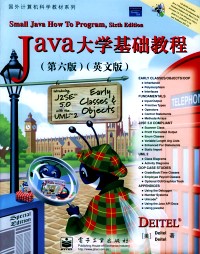
本书是“java how to program, 6/e”[java大学教程(第六版)]的最新简明版本,它针对java 2平台标准版5.0,向读者详细介绍了如何使用java语言进行面向对象编程。本书主要包括以下内容:首先,它全面介绍了java语言的基础知识,包括输入/输出、基本类型、运算符、控制语句和方法/数组等;与“java how to program, 6/e”相比,较早地引入了类、对象和面向对象编程的概念,即继承、多态和接口等;同时,针对j2se 5.0的特点,描述了java语言中许多新的功能与特性,例如格式化输出printf,scanner类,enum类和可变长参数列表等;除此之外,本书还引入了通用建模语言uml 2.0,以便帮助读者打下良好的面向对象设计基础;本书通过多个详尽的案例分析,使读者能够尽快地掌握面向对象的编程技巧;最后在附录中,还介绍了如何使用调试器、java api文档等多个有用的工具。 本书可作为高等院校进行编程语言和java教学的教材,也可作为软件设计人员进行java程序开发的参考资料。
目录
1 introduction to computers, the lnternet and the world wide web
1.1 introduction
1.2 what is a computer?
1.3 computer organization
1.4 early operating systems
1.5 personal, distributed and client/server computing
1.6 the internet and the world wide web
1.7 machine languages, assembly languages and high-level languages
1.8 history of c and c++
1.9 history of java
1.10 java class libraries
1.11 fortran, cobol, pascal and ada
1.12 basic, visual basic, visual c++, c# and .net
1.13 typical java development environment
1.14 notes about java and small java how to program, sixth edition
1.15 test-driving a java application
1.16 introduction to object technology and the uml
1.17 wrap-up
1.18 web resources
2 introduction to java applications
.2.1 introduction
2.2 first program in java: printing a line of text
2.3 modifying our first java program
2.4 displaying text with program
2.5 another java application: adding integers
2.6 memory concepts
2.7 arithmetic
2.8 decision making: equality and relational operators
2.9 wrap-up
3 introduction to classes and objects
3.1 introduction
3.2 classes, objects, methods and instance variables
3.3 declaring a class with a method and instantiating an object of a class
3.4 declaring a method with a parameter
3.5 instance variables, set methods and get methods
3.6 primitive types vs. reference types
3.7 initializing objects with constructors
3.8 floating-point numbers and type double
3.9 (optional) gui and graphics case study: using dialog boxes
3.10 wrap-up
4 control statements: part 1
4.1 introduction
4.2 algorithms
4.3 pseudocode
4.4 control structures
4.5 if single-selection statement
4.6 if...el se double-selection statement
4.7 while repetition statement
4.8 formulating algorithms: counter-controlled repetition
4.9 formulating algorithms: sentinel-controlled repetition
4.10 formulating algorithms: nested control statements
4.11 compound assignment operators
4.12 increment and decrement operators
4.13 primitive types
4.14 (optional) gui and graphics case study: creating simple drawings
4.15 wrap-up
5 control statements: part 2
5.1 introduction
5.2 essentials of counter-controlled repetition
5.3 for repetition statement
5.4 examples using the for statement
5.5 do...while repetition statement
5.6 switch multiple-selection statement
5.7 break and continue statements
5.8 logical operators
5.9 structured programming summary
5.10 (optional) gui and graphics case study: drawing rectangles and ovals
5.11 wrap-up
6 methods:a deeper look
6.1 introduction
6.2 program modules in java
6.3 static methods, stati c fields and class math
6.4 declaring methods with multiple parameters
6.5 notes on declaring and using methods
6.6 method call stack and activation records
6.7 argument promotion and casting
6.8 java api packages
6.9 case study: random-number generation
6.9.1 generalized scaling and shifting of random numbers
6.9.2 random-number repeatability for testing and debugging
6.10 case study: a game of chance (introducing enumerations)
6.11 scope of declarations
6.12 method overloading
6.13 (optional) gui and graphics case study: colors and filled shapes
6.14 wrap-up
7 arrays
7.1 introduction
7.2 arrays
7.3 declaring and creating arrays
7.4 examples using arrays
7.5 case study: card shuffling and dealing simulation
7.6 enhanced for statement
7.7 passing arrays to methods
7.8 case study: class gradebook using an array to store grades
7.9 multidimensional arrays
7.10 case study: class gradebook using a two-dimensional array
7.11 variable-length argument lists
7.12 using command-line arguments
7.13 (optional) gui and graphics case study: drawing arcs
7.14 wrap-up
8 classes and objects:a deeper look
8.1 introduction
8.2 time class case study
8.3 controlling access to members
8.4 referring to the current object's members with the thi s reference
8.5 time class case study: overloaded constructors
8.6 default and no-argument constructors
8.7 notes on set and get methods
8.8 composition
8.9 enumerations
8.10 garbage collection and method finalize
8.11 static class members
8.12 static import
8.13 final instance variables
8.14 software reusability
8.15 data abstraction and encapsulation
8.16 time class case study: creating packages
8.17 package access
8.18 (optional) gui and graphics case study: using objects with graphics
8.19 wrap-up
9 object-oriented programming: inheritance
9.1 introduction
9.2 superclasses and subclasses
9.3 protected members
9.4 relationship between superclasses and subclasses
9.4.1 creating and using a commissi onemployee class
9.4.2 creating a 8asepluscommi ssi onemployee class without using inheritance
9.4.3 creating a commi ssi onempl oyee-basepl uscommi ssi onempl oyee inheritance hierarchy
9.4.4 commi ssi onempl oyee-basepl uscommi ssi onempl oyee inheritance hierarchy using protected instance variables
9.4.5 commi ssi onempl oyee-basep1 uscommi ssi onempl oyee inheritance hierarchy using private instance variables 393
9.5 constructors in subclasses
9.6 software engineering with inheritance
9.7 object class
9.8 (optional) gui and graphics case study: displaying text and images using labels
9.9 wrap-up
10 object-oriented programming: polymorphism
10.1 introduction
10.2 polymorphism examples
10.3 demonstrating polymorphic behavior
10.4 abstract classes and methods
10.5 case study: payroll system using polymorphism
10.5.1 creating abstract superclass employee
10.5.2 creating concrete subclass sal ari edempl oyee
10.5.3 creating concrete subclass hourlyempl oyee
10.5.4 creating concrete subclass commissionemployee
10.5.5 creating indirect concrete subclass baseplus commission employee
10.5.6 demonstrating polymorphic processing, operator instanceof and downcasting
10.5.7 summary of the allowed assignments between superclass and subclass variables
10.6 final methods and classes
10.7 case study: creating and using interfaces
10.7.1 developing a payable hierarchy
10.7.2 declaring interface payable
10.7.3 creating class invoice
10.7.4 modifving class employee to implement interface payable
10.7.5 modifying class salariedemployee for use in the payable hierarchy
10.7.6 using interface payable to process invoices and employees polymorphically
10.7.7 declaring constants with interfaces
10.7.8 common interfaces of the java api
10.8 (optional) gui and graphics case study: drawing with polymorphism
10.9 wrap-up
a operator precedence chart
a.1 operator precedence
b ascii character set
c keywords and reserved words
d primitive types
e number systems
e.1 introduction
e.2 abbreviating binary numbers as octal and hexadecimal numbers
e.3 converting octal and hexadecimal numbers to binary numbers
e.4 converting from binary, octal or hexadecimal to decimal
e.5 converting from decimal to binary, octal or hexadecimal
e.6 negative binary numbers: two's complement notation
f unicode
f.1 introduction
f.2 unicode transformation formats
f.3 characters and glyphs
f.4 advantages/disadvantages of unicode
f.5 unicode consortium's web site
f.6 using unicode
f.7 character ranges
g using the java api documentation
g. 1 introduction
g.2 navigating the java api
h creating documentation with j avadoc
h.1 introduction
h.2 documentation comments
h.3 documenting java source code
h.4 javadoc
h.5 files produced by javadoc
i labeled break and continue statements
i.1 introduction
i.2 labeled break statement
i.3 labeled contihue statement
j using the debugger
j.1 introduction
j.2 breakpoints and the run, stop, cont and pint commands
j.3 the print and set commands
j.4 controlling execution using the step, step up and next commands
j.5 the watch command
j.6 the clear command
j.7 wrap-up
index
1.1 introduction
1.2 what is a computer?
1.3 computer organization
1.4 early operating systems
1.5 personal, distributed and client/server computing
1.6 the internet and the world wide web
1.7 machine languages, assembly languages and high-level languages
1.8 history of c and c++
1.9 history of java
1.10 java class libraries
1.11 fortran, cobol, pascal and ada
1.12 basic, visual basic, visual c++, c# and .net
1.13 typical java development environment
1.14 notes about java and small java how to program, sixth edition
1.15 test-driving a java application
1.16 introduction to object technology and the uml
1.17 wrap-up
1.18 web resources
2 introduction to java applications
.2.1 introduction
2.2 first program in java: printing a line of text
2.3 modifying our first java program
2.4 displaying text with program
2.5 another java application: adding integers
2.6 memory concepts
2.7 arithmetic
2.8 decision making: equality and relational operators
2.9 wrap-up
3 introduction to classes and objects
3.1 introduction
3.2 classes, objects, methods and instance variables
3.3 declaring a class with a method and instantiating an object of a class
3.4 declaring a method with a parameter
3.5 instance variables, set methods and get methods
3.6 primitive types vs. reference types
3.7 initializing objects with constructors
3.8 floating-point numbers and type double
3.9 (optional) gui and graphics case study: using dialog boxes
3.10 wrap-up
4 control statements: part 1
4.1 introduction
4.2 algorithms
4.3 pseudocode
4.4 control structures
4.5 if single-selection statement
4.6 if...el se double-selection statement
4.7 while repetition statement
4.8 formulating algorithms: counter-controlled repetition
4.9 formulating algorithms: sentinel-controlled repetition
4.10 formulating algorithms: nested control statements
4.11 compound assignment operators
4.12 increment and decrement operators
4.13 primitive types
4.14 (optional) gui and graphics case study: creating simple drawings
4.15 wrap-up
5 control statements: part 2
5.1 introduction
5.2 essentials of counter-controlled repetition
5.3 for repetition statement
5.4 examples using the for statement
5.5 do...while repetition statement
5.6 switch multiple-selection statement
5.7 break and continue statements
5.8 logical operators
5.9 structured programming summary
5.10 (optional) gui and graphics case study: drawing rectangles and ovals
5.11 wrap-up
6 methods:a deeper look
6.1 introduction
6.2 program modules in java
6.3 static methods, stati c fields and class math
6.4 declaring methods with multiple parameters
6.5 notes on declaring and using methods
6.6 method call stack and activation records
6.7 argument promotion and casting
6.8 java api packages
6.9 case study: random-number generation
6.9.1 generalized scaling and shifting of random numbers
6.9.2 random-number repeatability for testing and debugging
6.10 case study: a game of chance (introducing enumerations)
6.11 scope of declarations
6.12 method overloading
6.13 (optional) gui and graphics case study: colors and filled shapes
6.14 wrap-up
7 arrays
7.1 introduction
7.2 arrays
7.3 declaring and creating arrays
7.4 examples using arrays
7.5 case study: card shuffling and dealing simulation
7.6 enhanced for statement
7.7 passing arrays to methods
7.8 case study: class gradebook using an array to store grades
7.9 multidimensional arrays
7.10 case study: class gradebook using a two-dimensional array
7.11 variable-length argument lists
7.12 using command-line arguments
7.13 (optional) gui and graphics case study: drawing arcs
7.14 wrap-up
8 classes and objects:a deeper look
8.1 introduction
8.2 time class case study
8.3 controlling access to members
8.4 referring to the current object's members with the thi s reference
8.5 time class case study: overloaded constructors
8.6 default and no-argument constructors
8.7 notes on set and get methods
8.8 composition
8.9 enumerations
8.10 garbage collection and method finalize
8.11 static class members
8.12 static import
8.13 final instance variables
8.14 software reusability
8.15 data abstraction and encapsulation
8.16 time class case study: creating packages
8.17 package access
8.18 (optional) gui and graphics case study: using objects with graphics
8.19 wrap-up
9 object-oriented programming: inheritance
9.1 introduction
9.2 superclasses and subclasses
9.3 protected members
9.4 relationship between superclasses and subclasses
9.4.1 creating and using a commissi onemployee class
9.4.2 creating a 8asepluscommi ssi onemployee class without using inheritance
9.4.3 creating a commi ssi onempl oyee-basepl uscommi ssi onempl oyee inheritance hierarchy
9.4.4 commi ssi onempl oyee-basepl uscommi ssi onempl oyee inheritance hierarchy using protected instance variables
9.4.5 commi ssi onempl oyee-basep1 uscommi ssi onempl oyee inheritance hierarchy using private instance variables 393
9.5 constructors in subclasses
9.6 software engineering with inheritance
9.7 object class
9.8 (optional) gui and graphics case study: displaying text and images using labels
9.9 wrap-up
10 object-oriented programming: polymorphism
10.1 introduction
10.2 polymorphism examples
10.3 demonstrating polymorphic behavior
10.4 abstract classes and methods
10.5 case study: payroll system using polymorphism
10.5.1 creating abstract superclass employee
10.5.2 creating concrete subclass sal ari edempl oyee
10.5.3 creating concrete subclass hourlyempl oyee
10.5.4 creating concrete subclass commissionemployee
10.5.5 creating indirect concrete subclass baseplus commission employee
10.5.6 demonstrating polymorphic processing, operator instanceof and downcasting
10.5.7 summary of the allowed assignments between superclass and subclass variables
10.6 final methods and classes
10.7 case study: creating and using interfaces
10.7.1 developing a payable hierarchy
10.7.2 declaring interface payable
10.7.3 creating class invoice
10.7.4 modifving class employee to implement interface payable
10.7.5 modifying class salariedemployee for use in the payable hierarchy
10.7.6 using interface payable to process invoices and employees polymorphically
10.7.7 declaring constants with interfaces
10.7.8 common interfaces of the java api
10.8 (optional) gui and graphics case study: drawing with polymorphism
10.9 wrap-up
a operator precedence chart
a.1 operator precedence
b ascii character set
c keywords and reserved words
d primitive types
e number systems
e.1 introduction
e.2 abbreviating binary numbers as octal and hexadecimal numbers
e.3 converting octal and hexadecimal numbers to binary numbers
e.4 converting from binary, octal or hexadecimal to decimal
e.5 converting from decimal to binary, octal or hexadecimal
e.6 negative binary numbers: two's complement notation
f unicode
f.1 introduction
f.2 unicode transformation formats
f.3 characters and glyphs
f.4 advantages/disadvantages of unicode
f.5 unicode consortium's web site
f.6 using unicode
f.7 character ranges
g using the java api documentation
g. 1 introduction
g.2 navigating the java api
h creating documentation with j avadoc
h.1 introduction
h.2 documentation comments
h.3 documenting java source code
h.4 javadoc
h.5 files produced by javadoc
i labeled break and continue statements
i.1 introduction
i.2 labeled break statement
i.3 labeled contihue statement
j using the debugger
j.1 introduction
j.2 breakpoints and the run, stop, cont and pint commands
j.3 the print and set commands
j.4 controlling execution using the step, step up and next commands
j.5 the watch command
j.6 the clear command
j.7 wrap-up
index
Java大学基础教程(第6版)(英文版)
- 名称
- 类型
- 大小
光盘服务联系方式: 020-38250260 客服QQ:4006604884
云图客服:
用户发送的提问,这种方式就需要有位在线客服来回答用户的问题,这种 就属于对话式的,问题是这种提问是否需要用户登录才能提问
Video Player
×
Audio Player
×
pdf Player
×
亲爱的云图用户,
光盘内的文件都可以直接点击浏览哦
无需下载,在线查阅资料!
