

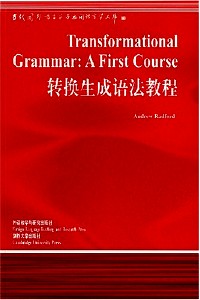
Transformational Grammar:A First Course
副标题:无
分类号:
ISBN:9787560020099
微信扫一扫,移动浏览光盘
简介
Andrew Radford's new textbook is principally for students with little or no background in syntax who need a lively and up-to-date introduction to contemporary work on transformational grammar. It covers four main topies-the function of transformations and the principles governingtheir application. The framework takes into account the major works such as Chomsky's Knowledge of Language and Barriers wirtten since the publication of Radford's widely acclaimed Transformational Syntax in 1981. Not only does the present book use a more recent theoretical framework. but at the descriptive level it covers a wider range of constructions and rules than its predecessor. Andrew Radford is well known for his effective pedagogical approach, and in this book even more care has been devoted to providing a sympathetic and non-technical introduction to the field. At the end of each chapter are exercises which reinforce the text, enable sutdents to apply the various concepts, etc. discussed, or encourage them to look more critically at some of the saaumptions and analyses presented. The book also has a detailed bibliographical background section and an extensive bibliography which will be a useful source of reference to the primary literature. Although intended principally as a coursebookfor students of syntax or English grammar. Transformational Grammar will be invaluable to any reader who needs a straightforward and comprehensive introduction to the latest developments in this field.
目录
preface by halliday
prologue
acknowledgments
1 goals
1.1 overview
1.2 grammatical competence
1.3 basic concepts and fundamental misconceptions
1.4 competence as infinite rule-governed creativity
1.5 discovering the rules
1.6 levels of adequacy
1.7 constraining grammars
1.8 constraints, universals, and acquisition
1.9 markedness and core grammar
1.10 summary
exercises
2 structure
2.1 overview
2.2 intuitions about structure
2.3 word-level categories
2.4 phrasal categories: nonsyntactic evidence
. 2.5 phrasal categories: distributional evidence
2.6 phrasal categories: other syntactic evidence
2.7 words used as phrases
2.8 testing the structure
2.9 summary
exercises
3 phrase-markers
3.1 overview
3.2 the nature of phrase-markers
3.3 c-command
3.4 constraining phrase-markers
3.5 generating phrase-markers
3.6 another look at categories
3.7 conflating categories
3.8 the nature of categories
3.9 summary
exercises
4 noun phrases
4.1 overview
4.2 small nominal phrases
4.3 evidence for n-bar
4.4 complements and adjuncts
4.5 optional constituents of the noun phrase
4.6 more differences between complements and adjuncts
4.7 nominal premodifiers
4.8 adjectival premodifiers
4.9 summary
exercises
5 other phrases
5.1 overview
5.2 verb phrases
5.3 adjectival phrases
5.4 prepositional phrases
5.5 cross-categorial structural symmetry
5.6 constraining categorial rules
5.7 generalising categorial rules
5.8 eliminating categorial rules
5.9 summary
exercises
6 clauses
6.1 overview
6.2 finite and nonfinite clauses
6.3 constituent structure of clauses
6.4 structure of main clauses
6.5 internal structure of s
6.6 clauses with empty subjects
6.7 exceptional clauses
6.8 small clauses
6.9 summary
exercises
7 the lexicon
7.1 overview
7.2 categorial information
7.3 subcategorisation
7.4 prepositional complements
7.5 complement order
7.6 clausal complements
7.7 subcategorising adjectives, nouns, and prepositions
7.8 eliminating redundancy
7.9 selection restrictions
7.10 thematic relations
7.11 correlating thematic and syntactic structure
7.12 theta-marking of subjects
7.13 selection restrictions and thematic structure
7.14 constraints on theta-marking
7.15 summary
exercises
8 transformations
8.1 overview
8.2 v movement
8.3 i movement
8.4 np movement in passive structures
8.5 np movement in raising structures
8.6 np movement in ergative and middle structures
8.7 extrapos1t1on
8.8 summary
exercises
9 wh movement
9.1 overview
9.2 question types
9.3 syntactic arguments
9.4 morphological arguments
9.5 phonological arguments
9.6 semantic arguments
9.7 wh movement in relative clauses
9.8 other wh-constructions
9.9 targets for wh movement
9.10 the landing-site for moved wh-phrases
9.11 re-examining the status of s
9.12 re-examining the status of small clauses
9.13 summary
exercises
10 alpha movement
10.1 overview
10.2 other movement rules
10.3 alpha movement
10.4 structure-preserving principle
10.5 explaining the structure-preserving principle
10.6 traces
10.7 c-command condition on traces
10.8 bounding
10.9 rule interaction
10.10 summary
exercises
bibliographical background
bibliography
index
prologue
acknowledgments
1 goals
1.1 overview
1.2 grammatical competence
1.3 basic concepts and fundamental misconceptions
1.4 competence as infinite rule-governed creativity
1.5 discovering the rules
1.6 levels of adequacy
1.7 constraining grammars
1.8 constraints, universals, and acquisition
1.9 markedness and core grammar
1.10 summary
exercises
2 structure
2.1 overview
2.2 intuitions about structure
2.3 word-level categories
2.4 phrasal categories: nonsyntactic evidence
. 2.5 phrasal categories: distributional evidence
2.6 phrasal categories: other syntactic evidence
2.7 words used as phrases
2.8 testing the structure
2.9 summary
exercises
3 phrase-markers
3.1 overview
3.2 the nature of phrase-markers
3.3 c-command
3.4 constraining phrase-markers
3.5 generating phrase-markers
3.6 another look at categories
3.7 conflating categories
3.8 the nature of categories
3.9 summary
exercises
4 noun phrases
4.1 overview
4.2 small nominal phrases
4.3 evidence for n-bar
4.4 complements and adjuncts
4.5 optional constituents of the noun phrase
4.6 more differences between complements and adjuncts
4.7 nominal premodifiers
4.8 adjectival premodifiers
4.9 summary
exercises
5 other phrases
5.1 overview
5.2 verb phrases
5.3 adjectival phrases
5.4 prepositional phrases
5.5 cross-categorial structural symmetry
5.6 constraining categorial rules
5.7 generalising categorial rules
5.8 eliminating categorial rules
5.9 summary
exercises
6 clauses
6.1 overview
6.2 finite and nonfinite clauses
6.3 constituent structure of clauses
6.4 structure of main clauses
6.5 internal structure of s
6.6 clauses with empty subjects
6.7 exceptional clauses
6.8 small clauses
6.9 summary
exercises
7 the lexicon
7.1 overview
7.2 categorial information
7.3 subcategorisation
7.4 prepositional complements
7.5 complement order
7.6 clausal complements
7.7 subcategorising adjectives, nouns, and prepositions
7.8 eliminating redundancy
7.9 selection restrictions
7.10 thematic relations
7.11 correlating thematic and syntactic structure
7.12 theta-marking of subjects
7.13 selection restrictions and thematic structure
7.14 constraints on theta-marking
7.15 summary
exercises
8 transformations
8.1 overview
8.2 v movement
8.3 i movement
8.4 np movement in passive structures
8.5 np movement in raising structures
8.6 np movement in ergative and middle structures
8.7 extrapos1t1on
8.8 summary
exercises
9 wh movement
9.1 overview
9.2 question types
9.3 syntactic arguments
9.4 morphological arguments
9.5 phonological arguments
9.6 semantic arguments
9.7 wh movement in relative clauses
9.8 other wh-constructions
9.9 targets for wh movement
9.10 the landing-site for moved wh-phrases
9.11 re-examining the status of s
9.12 re-examining the status of small clauses
9.13 summary
exercises
10 alpha movement
10.1 overview
10.2 other movement rules
10.3 alpha movement
10.4 structure-preserving principle
10.5 explaining the structure-preserving principle
10.6 traces
10.7 c-command condition on traces
10.8 bounding
10.9 rule interaction
10.10 summary
exercises
bibliographical background
bibliography
index
Transformational Grammar:A First Course
- 名称
- 类型
- 大小
光盘服务联系方式: 020-38250260 客服QQ:4006604884
云图客服:
用户发送的提问,这种方式就需要有位在线客服来回答用户的问题,这种 就属于对话式的,问题是这种提问是否需要用户登录才能提问
Video Player
×
Audio Player
×
pdf Player
×
