

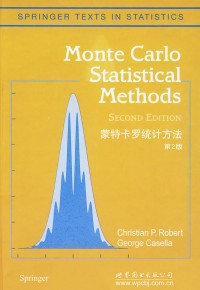
Monte Carlo statistical methods = 蒙特卡罗统计方法 / 2nd ed.
副标题:无
作 者:Christian P. Robert, George Casella.
分类号:
ISBN:9787510005114
微信扫一扫,移动浏览光盘
简介
It is a tribute to our profession that a textbook that was current in 1999 is starting to feel old. The work for the first edition of Monte Carlo Statistical Methods (MCSM1) was finished in late 1998, and the advances made since then, as well as our level of understanding of Monte Carlo methods, have grown a great deal. Moreover, two other things have happened. Topics that just made it into MCSM1 with the briefest treatment (for example, perfect sampling) have now attained a level of importance that necessitates a much more thorough treatment. Secondly, some other methods have not withstood the test of time or, perhaps, have not yet been fully developed, and now receive a more appropriate treatment.
When we worked on MCSM1 in the mid-to-late 90s, MCMC algorithms were already heavily used, and the flow of publications on this topic was atsuch a high level that the picture was not only rapidly changing, but also necessarily incomplete. Thus, the process that we followed in MCSM1 was that of someone who was thrown into the ocean and was trying to grab onto the biggest and most seemingly useful objects while trying to separate the flotsam from the jetsam. Nonetheless, we also felt that the fundamentals of many of these algorithms were clear enough to be covered at the textbook alevel, so we" swam on.
目录
Preface to the Second Edition
Preface to the First Edition
1 Introduction
1.1 Statistical Models
1.2 Likelihood Methods
1.3 Bayesian Methods
1.4 Deterministic Numerical Methods
1.4.1 Optimization
1.4.2 Integration
1.4.3 Comparison
1.5 Problems
1.6 Notes
1.6.1 Prior Distributions
1.6.2 Bootstrap Methods
2 Random Variable Generation
2.1 Introduction
2.1.1 Uniform Simulation
2.1.2 The Inverse Transform
2.1.3 Alternatives
2.1.4 Optimal Algorithms
2.2 General Transformation Methods
2.3 Accept-Reject Methods
2.3.1 The Fundamental Theorem of Simulation
2.3.2 The Accept-Reject Algorithm
2.4 Envelope Accept-Reject Methods
2.4.1 The Squeeze Principle
2.4.2 Log-Concave Densities
2.5 Problems
2.6 Notes
2.6.1 The Kiss Generator
2.6.2 Quasi-Monte Carlo Methods
2.6.3 Mixture RepresentatiOnS
3 Monte Carlo Integration
3.1 IntroduCtion
3.2 Classical Monte Carlo Integration
3.3 Importance Sampling
3.3.1 Principles
3.3.2 Finite Variance Estimators
3.3.3 Comparing Importance Sampling with Accept-Reject
3.4 Laplace Approximations
3.5 Problems
3.6 Notes
3.6.1 Large Deviations Techniques
3.6.2 The Saddlepoint Approximation
4 Controling Monte Carlo Variance
4.1 Monitoring Variation with the CLT
4.1.1 Univariate Monitoring
4.1.2 Multivariate Monitoring
4.2 Rao-Blackwellization
4.3 Riemann Approximations
4.4 Acceleration Methods
4.4.1 Antithetic Variables
4.4.2 Contr01 Variates
4.5 Problems
4.6 Notes
4.6.1 Monitoring Importance Sampling Convergence
4.6.2 Accept-Reject with Loose Bounds
4.6.3 Partitioning
5 Monte Carlo Optimization
5.1 Introduction
5.2 Stochastic Exploration
5.2.1 A Basic Solution
5.2.2 Gradient Methods
5.2.3 Simulated Annealing
5.2.4 Prior Feedback
5.3 Stochastic Approximation
5.3.1 Missing Data Models and Demarginalization
5.3.2 Thc EM Algorithm
5.3.3 Monte Carlo EM
5.3.4 EM Standard Errors
5.4 Problems
5.5 Notes
5.5.1 Variations on EM
5.5.2 Neural Networks
5.5.3 The Robbins-Monro procedure
5.5.4 Monte Carlo Approximation
6 Markov Chains
6.1 Essentials for MCMC
6.2 Basic Notions
6.3 Irreducibility,Atoms,and Small Sets
6.3.1 Irreducibility
6.3.2 Atoms and Small Sets
6.3.3 Cycles and Aperiodicity
6.4 Transience and Recurrence
6.4.1 Classification of Irreducible Chains
6.4.2 Criteria for Recurrence
6.4.3 Harris Recurrence
6.5 Invariant Measures
6.5.1 Stationary Chains
6.5.2 Kac’s Theorem
6.5.3 Reversibility and the Detailed Balance Condition
6.6 Ergodicity and Convergence
6.611 Ergodicity
6.6.2 Geometric Convergence
6.6.3 Uniform Ergodicity
6.7 Limit Theorems
6.7.1 Ergodic Theorems
6.7.2 Central Limit Theorems
6.8 Problems
6.9 Notes
6.9.1 Dri允Conditions
6.9.2 Eaton’S Admissibility Condition
6.9.3 Alternative Convergence Conditions
6.9.4 Mixing Conditions and Central Limit Theorems
6.9.5 Covariance in Markov Chains
7 The Metropolis-Hastings Algorithm
7.1 The MCMC Principle
7.2 Monte Carlo Methods Based on Markov Chains
7.3 The Metropolis-Hastings algorithm
7.3.1 Definition
7.3.2 Convergence Properties
7.4 The Independent Metropolis-Hastings Algorithm
7.4.1 Fixed Proposals
7.4.2 A Metropolis-Hastings Version of ARS
7.5 Random walks
7.6 Optimization and Contr01
7.6.1 Optimizing the Acceptance Rate
7.6.2 Conditioning and Accelerations
7.6.3 Adaptive Schemes
7.7 Problems
7.8 Nores
7.8.1 Background of the Metropolis Algorithm
7.8.2 Geometric Convergence of Metropolis-Hastings Algorithms
7.8.3 A Reinterpretation of Simulated Annealing
7.8.4 RCference Acceptance Rates
7.8.5 Langevin Algorithms
8 The Slice Sampler
8.1 Another Look at the Fundamental Theorem
8.2 The General Slice Sampler
8.3 Convergence Properties of the Slice Sampler
8.4 Problems
8.5 Notes
8.5.1 Dealing with Di伍cult Slices
9 The Two-Stage Gibbs Sampler
9.1 A General Class of Two-Stage Algorithms
9.1.1 From Slice Sampling to Gibbs Sampling
9.1.2 Definition
9.1.3 Back to the Slice Sampler
9.1.4 The Hammersley-Clifford Theorem
9.2 Fundamental Properties
9.2.1 Probabilistic Structures
9.2.2 Reversible and Interleaving Chains
9.2.3 The Duality Principle
9.3 Monotone Covariance and Rao-Btackwellization
9.4 The EM-Gibbs Connection
9.5 Transition
9.6 Problems
9.7 Notes
9.7.1 Inference for Mixtures
9.7.2 ARCH Models
10 The Multi-Stage Gibbs Sampler
10.1 Basic Derivations
10.1.1 Definition
10.1.2 Completion
……
11 Variable Dimension Models and Reversible Jump Algorithms
12 Diagnosing Convergence
13 Perfect Sampling
14 Iterated and Sequential Importance Sampling
A Probability Distributions
B Notation
References
Index of Names
Index of Subjects
Preface to the First Edition
1 Introduction
1.1 Statistical Models
1.2 Likelihood Methods
1.3 Bayesian Methods
1.4 Deterministic Numerical Methods
1.4.1 Optimization
1.4.2 Integration
1.4.3 Comparison
1.5 Problems
1.6 Notes
1.6.1 Prior Distributions
1.6.2 Bootstrap Methods
2 Random Variable Generation
2.1 Introduction
2.1.1 Uniform Simulation
2.1.2 The Inverse Transform
2.1.3 Alternatives
2.1.4 Optimal Algorithms
2.2 General Transformation Methods
2.3 Accept-Reject Methods
2.3.1 The Fundamental Theorem of Simulation
2.3.2 The Accept-Reject Algorithm
2.4 Envelope Accept-Reject Methods
2.4.1 The Squeeze Principle
2.4.2 Log-Concave Densities
2.5 Problems
2.6 Notes
2.6.1 The Kiss Generator
2.6.2 Quasi-Monte Carlo Methods
2.6.3 Mixture RepresentatiOnS
3 Monte Carlo Integration
3.1 IntroduCtion
3.2 Classical Monte Carlo Integration
3.3 Importance Sampling
3.3.1 Principles
3.3.2 Finite Variance Estimators
3.3.3 Comparing Importance Sampling with Accept-Reject
3.4 Laplace Approximations
3.5 Problems
3.6 Notes
3.6.1 Large Deviations Techniques
3.6.2 The Saddlepoint Approximation
4 Controling Monte Carlo Variance
4.1 Monitoring Variation with the CLT
4.1.1 Univariate Monitoring
4.1.2 Multivariate Monitoring
4.2 Rao-Blackwellization
4.3 Riemann Approximations
4.4 Acceleration Methods
4.4.1 Antithetic Variables
4.4.2 Contr01 Variates
4.5 Problems
4.6 Notes
4.6.1 Monitoring Importance Sampling Convergence
4.6.2 Accept-Reject with Loose Bounds
4.6.3 Partitioning
5 Monte Carlo Optimization
5.1 Introduction
5.2 Stochastic Exploration
5.2.1 A Basic Solution
5.2.2 Gradient Methods
5.2.3 Simulated Annealing
5.2.4 Prior Feedback
5.3 Stochastic Approximation
5.3.1 Missing Data Models and Demarginalization
5.3.2 Thc EM Algorithm
5.3.3 Monte Carlo EM
5.3.4 EM Standard Errors
5.4 Problems
5.5 Notes
5.5.1 Variations on EM
5.5.2 Neural Networks
5.5.3 The Robbins-Monro procedure
5.5.4 Monte Carlo Approximation
6 Markov Chains
6.1 Essentials for MCMC
6.2 Basic Notions
6.3 Irreducibility,Atoms,and Small Sets
6.3.1 Irreducibility
6.3.2 Atoms and Small Sets
6.3.3 Cycles and Aperiodicity
6.4 Transience and Recurrence
6.4.1 Classification of Irreducible Chains
6.4.2 Criteria for Recurrence
6.4.3 Harris Recurrence
6.5 Invariant Measures
6.5.1 Stationary Chains
6.5.2 Kac’s Theorem
6.5.3 Reversibility and the Detailed Balance Condition
6.6 Ergodicity and Convergence
6.611 Ergodicity
6.6.2 Geometric Convergence
6.6.3 Uniform Ergodicity
6.7 Limit Theorems
6.7.1 Ergodic Theorems
6.7.2 Central Limit Theorems
6.8 Problems
6.9 Notes
6.9.1 Dri允Conditions
6.9.2 Eaton’S Admissibility Condition
6.9.3 Alternative Convergence Conditions
6.9.4 Mixing Conditions and Central Limit Theorems
6.9.5 Covariance in Markov Chains
7 The Metropolis-Hastings Algorithm
7.1 The MCMC Principle
7.2 Monte Carlo Methods Based on Markov Chains
7.3 The Metropolis-Hastings algorithm
7.3.1 Definition
7.3.2 Convergence Properties
7.4 The Independent Metropolis-Hastings Algorithm
7.4.1 Fixed Proposals
7.4.2 A Metropolis-Hastings Version of ARS
7.5 Random walks
7.6 Optimization and Contr01
7.6.1 Optimizing the Acceptance Rate
7.6.2 Conditioning and Accelerations
7.6.3 Adaptive Schemes
7.7 Problems
7.8 Nores
7.8.1 Background of the Metropolis Algorithm
7.8.2 Geometric Convergence of Metropolis-Hastings Algorithms
7.8.3 A Reinterpretation of Simulated Annealing
7.8.4 RCference Acceptance Rates
7.8.5 Langevin Algorithms
8 The Slice Sampler
8.1 Another Look at the Fundamental Theorem
8.2 The General Slice Sampler
8.3 Convergence Properties of the Slice Sampler
8.4 Problems
8.5 Notes
8.5.1 Dealing with Di伍cult Slices
9 The Two-Stage Gibbs Sampler
9.1 A General Class of Two-Stage Algorithms
9.1.1 From Slice Sampling to Gibbs Sampling
9.1.2 Definition
9.1.3 Back to the Slice Sampler
9.1.4 The Hammersley-Clifford Theorem
9.2 Fundamental Properties
9.2.1 Probabilistic Structures
9.2.2 Reversible and Interleaving Chains
9.2.3 The Duality Principle
9.3 Monotone Covariance and Rao-Btackwellization
9.4 The EM-Gibbs Connection
9.5 Transition
9.6 Problems
9.7 Notes
9.7.1 Inference for Mixtures
9.7.2 ARCH Models
10 The Multi-Stage Gibbs Sampler
10.1 Basic Derivations
10.1.1 Definition
10.1.2 Completion
……
11 Variable Dimension Models and Reversible Jump Algorithms
12 Diagnosing Convergence
13 Perfect Sampling
14 Iterated and Sequential Importance Sampling
A Probability Distributions
B Notation
References
Index of Names
Index of Subjects
Monte Carlo statistical methods = 蒙特卡罗统计方法 / 2nd ed.
- 名称
- 类型
- 大小
光盘服务联系方式: 020-38250260 客服QQ:4006604884
云图客服:
用户发送的提问,这种方式就需要有位在线客服来回答用户的问题,这种 就属于对话式的,问题是这种提问是否需要用户登录才能提问
Video Player
×
Audio Player
×
pdf Player
×
