

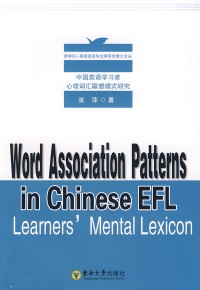
Word association patterns in Chinese EFL learners’ mental lexcicon
副标题:无
作 者:张萍著
分类号:
ISBN:9787564117849
微信扫一扫,移动浏览光盘
简介
《中国英语学习者心理词汇联想模式研究(Word Association Patterns in Chinese EFL Learners'Mental Lexicon)(英文版)》内容简介:是一门全球语言。在全球化给世界带来巨大影响的同时,英语作为一门语言,已然成为了全球化传播和影响的有力工具之一,成为了东西方文化交流与对话的纽带。在东西方的文化认同之路上,抑或是文化冲突之路上,英语不可或缺。
学,乃效法。识,乃辨别。在英语语言与文学研究领域,不断有新的知识需要探索,需要“学”与“识”。
新学识·英语语言与文学研究博士文丛,意在为大家呈现出近年来江苏高校教师在英语语言学与文学研究方面的最新成果,为此收录了一批具有代表性的博士论文,内容涵盖了语言学、语言教学、文学、文化以及翻译等领域,以兹为从事英语语言与文学研究的学者、教师以及学生提供参考。
目录
ABSTRACT中文摘要LIST OF TABLESLIST OF FIGURESABBREVIATIONSChapter One INTRODUCTION 1.1 Introduction 1.2 Need for the Study 1.3 Significance of the Study 1.3.1 Theoretical significance 1.3.2 Methodological significance 1.3.3 Pedagogical significance 1.4 Organization of the Thesis Chapter Two WORD ASSOCTATION IN THE MENTAL IEXICON: A REVIEW OF LITERATURE .. 2.1 Introduction 2.2 Definitions of Key Terms 2.2.1 Mental lexicon 2.2.2 Word association (WA) 2.2.2.1 Semantically-Related (SR) type 2.2.2.2 Non-Semantically-Related (non-SR) type 2.2.3 Word-Related variables 2.2.3.1 Word class 2.2.3.2 Concreteness 2.2.3.3 Word frequency 2.3 Theories and Studies on the L1 Mental Lexicon 2.3.1 Theories of word associations in the L! mental lexicon 2.3.2 Theories related to WA patterns and word type effects 2.3.3 Word association studies on the L1 mental lexicon 2.3.3.1 Findings of the WA general patterns in the L! mental lexicon 2.3.3.2 Previous findings about WA patterns related to word types 2.3.3.2.1 Word class 2.3.3.2.2 Concreteness 2.3.3.2.3 Frequency 2.4 Theories and Studies on the L2 Mental Lexicon 2.4.1 Theories on the L2 mental lexicon 2.4.1.1 Compound vs. Coordinate 2.4.1.2 Word-Connected vs. Concept-Mediated 2.4.1.3 Shared vs. Distributed Conceptual Features 2.4.2 Empirical studies on WAs in the L2 mental lexicon 2.4.2.1 Controversial findings of the WA patterns in the L2 mental lexicon 2.4.2.1.1 Phonologically-Associated organization 2.4.2.1.2 Semantically-Dominated organization 2.4.2.2 Findings related to word type effects 2.4.2.2.1 Word class effect 2.4.2.2.2 Concreteness effect 2.4.2.2.3 Word frequency effect 2.5 Unsettled Issues 2.5.1 Theoretical issues remained unsolved 2.5.1.1 Biased understandings towards the nature of L2 mental lexicon 2.5.1.2 Unclear understandings towards the role of paradigmatic and syntagmatic responses in L2 word associations 2.5.1.3 Incomplete theories to account for word type effects 2.5.2 Methodological issues remained unsolved 2.5.2.1 Lacking a carefully-designed stimulus word list 2.5.2.2 Inconsistent classification of WA responses 2.6 SummaryChapter Three RESEARCH DESIGN 3.1 Introduction 3.2 Research Questions 3.3 Methodology 3.3.1 Participants 3.3.2 Instruments 3.3.2.1 WAtest 3.3.2.2 Stimulus word selection 3.3.2.3 Familiarity judgment test of SWS 3.3.3 Data analysis procedures 3.3.3.1 Data collecting process 3.3.3.2 Data encoding process 3.3.3.2.1 WA response lemmatizing 3.3.3.2.2 WA response classifying 3.3.3.2.3 WA response labeling 3.3.3.3 Data analyzing 3.4 SummaryChapter Four L2 MENTAL LEXICON (Ⅰ) : AN OVERALL PICTURE 4.1 Introduction 4.2 Overall WA Patterns in the L1 and L2 Mental Lexicons 4.2.1 The L1 and L2 overall response patterns 4.2.2 Comparison with other studies 4.2.3 Commonality analysis of non-SR responses 4.2.3.1 Derivational responses 4.2.3.2 Phonological/Orthographical responses 4.2.3.3 Responses to words of high-frequency-and-familiarity 4.3 Overall SR Patterns of the L1 and L2 Mental Lexicons 4.3.1 The L1 and L2 overall SRS 4.3.2 Commonality analysis of the L1 and L2 SR associations 4.4 SummaryChapter Five L2 MENTAL LEXICON (Ⅱ) : WORD TYPE EFFECTS 5.1 Introduction 5.2 Word Class Effects on the WA Patterns 5.2.1 Overall WA patterns of words of different classes 5.2.2 Word class effects on the SR patterns 5.2.3 Analysis of word class effect on the mental lexicons 5.3 Concreteness Effect 5.3.1 Overall WA patterns of concrete and abstract words 5.3.2 Concreteness effect on the SR patterns 5.3.3 Further analysis of concreteness effect 5.4 Word Frequency Effect 5.4.1 Synopsis of the WA results with respect to word frequency 5.4.2 Word frequency effect on the SR patterns 5.4.3 Commonality analysis of the frequency effect on L2 WAS 5.5 SummaryChapter Six L2 MENTAL LEXICON (Ⅲ) : PROFICIENCY EFFECTS 6.1 Introduction 6.2 Variations in WA Patterns with the Increase of Proficiency 6.2.1 Synopsis of the overall results 6.2.1.1 Comparison of overall association patterns 6.2.1.2 Word class effect 6.2.1.3 Concreteness effect 6.2.1.4 Frequency effect 6.3 Synopsis of Changes in SRs with the L2 Proficiency 6.3.1 Comparison of overall semantic responses 6.3.2 Word class effect 6.3.3 Concreteness effect 6.3.4 Frequency effect 6.4 Analysis on the Role of Syntagmatic Knowledge 6.5 SummaryChapter Seven WORD ASSOCIATIONS IN THE L2 MENTAL LEXICON: CONCLUSION 7.1 Introduction 7.2 Major Findings on the L2 Mental Lexicon 7.3 Implications of the Findings 7.3.1 Theoretical implications 7.3.1.1 Setting the tune: Diversity over similarity 7.3.1.2 Clarifying the role of syntagmatic and paradigmatic relations 7.3.1.3 Enriching the theoretical models on L2 mental lexicon and word type effects 7.3.2 Methodological implications 7.3.3 Pedagogical implications 7.3.3.1 Restructuring the L2 mental lexicon 7.3.3.2 Teaching and learning L2 vocabulary 7.3.3.3 Dictionaries to represent the mental organization 7.4 Limitations of the Study 7.5 Recommendations for Future Research 7.6 SummaryReferencesAppendixes Appendix A Result of Concreteness Rating Appendix B Stimulus Word List Appendix C Frequency Check Result Through Nation's Range 32 of the 60 SWs Appendix D Sample Test of English WA Appendix E Sample Test of Chinese WA Appendix F Sample Test of FJT Appendix G Top Three Responses of L1-E and L2-E Appendix H Paradigmatic and Syntagmatic Responses among the Top Three Responses
Word association patterns in Chinese EFL learners’ mental lexcicon
- 名称
- 类型
- 大小
光盘服务联系方式: 020-38250260 客服QQ:4006604884
云图客服:
用户发送的提问,这种方式就需要有位在线客服来回答用户的问题,这种 就属于对话式的,问题是这种提问是否需要用户登录才能提问
Video Player
×
Audio Player
×
pdf Player
×
