

微信扫一扫,移动浏览光盘
简介
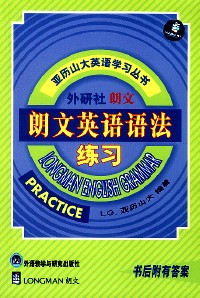
《朗文英语语法练习》是专为学生和各行业人士学习英 语语法而编写的参考书和练习,也是英语教师理想的 辅助教材。书中的内容丰富而全面,概括了英语语法 的全部重要领域,并为语法教学提供了有力的辅助和 补充。它经专门设计,解释准确,易于掌握,适合中 级英语程度的学生和自学者。
每个学习要点介绍适量的语法知识,内容简明扼 要,后面紧接练习题(书后有答案),帮助读者 理解和加深印象。
所有的学习要点都标有一个至三个星号,表明内容 的深浅程度,以适应不同程度读者的需要。
除了附有目录和完备的索引外,还有大量参照前后 章节的指引,方便读者迅速查出要学习的内容。
每个项目都有相互参照说明,指示读者可参阅语法 理论的专门著作《胡文英语语法》的有关章节。读 者如需更详细了解某一要点时,很容易就可找到详 尽而权威的解释。
每一单元都有“根据文意做练习”的项目,其内容 幽默有趣,并附有漫画,摆脱了语法练习严肃沉闷 的俗套。
目录
致读者
1 句子the sentence
1.1 句子的词序(sentence word order)
1.2 简单句(simple sentence):带和不带宾语的动词
1.3 简单句:直接和间接宾语(direct and indirect objects)
1.4 并列句(compound sentence)
1,5 复合句(complex sentence):名词从句(noun clause)
1.6 复合句:关系代词及关系从句(relative pronoun and clause)
1.7 复合句:whose;限定性/非限定性从句(defining/non-defining clause)
1.8 复合句:时间、地点、方式
1.9 复合句:原因和对比
1,10 复合句:目的、结果和比较
1.11 复合句:现在分词结构(present participle construction)
1.12 复合句:完成时/过去分词结构(perfect/pastparticiple construction)
2 名词nouns
2.1 单一名词(one-word noun)
2,2 复合名词(compound noun)
2.3 可数名词和不可数名词(countable and uncountable nouns)(1)
2.4 可数名词和不可数名词(2)
2.5 数(number)(单数与复数)(1)
. 2.6 数(单数与复数)(2)
2.7 性(gender)
2.8 所有格(genitive)
3 冠词anicdes
3. 1 不定冠词(indefinite article):‘a/an’(1)
3.2 不定冠词:‘a/an’(2)
3.3 定冠词(definite article):‘the’(1)
3.4 定冠词:‘the’(2)
3.5 零冠词(zero article)(1)
3.6 零冠词(2)
4 代词pronouns
4.1 人称代词(personal pronoun)
4.2 one
4.3 it和one/some/any/none
4.4 所有格形容词和所有格代词(possesslve adjective and possessive
pronoun)(‘my/mine’)
4.5 反身代词(reflexive pronoun)(‘myself’)
4.6 指示形容词/代词(demonstrative adjective/pronoun)(‘this’等)
5 数量quantity
5.1 数量词(quantifier)+可数和不可数名词’
5.2 泛指和特指数量
5. 3 some,any,no和none的用法
5.4 much,many,a,lot of,(a)few,(a)little,fewer,less
5. 5 both和al,
5. 6 all(the),(a/the)whole,each和every
5.7 another,(the)other(s),either,neither,each(one of)
6 形容词adjectives
6.1 形容词的构成
6.2 形容词的位置
6.3 名词性形容词;以-ed/-ing结尾的作形容词用的分词
6.4 在be,seem等后的形容词;形容词的词序
6.5 形容词的比较级(comparison)
7 副词adverbs
7.1 方式副词(adverb of manner)
7.2 时间副词(adverb of time)
7.3 表示持续时间的副词短语(adverbial phrase of duration)
7.4 频度副词(adverb of frequency)
7.5 程度副词(adverb of degree)
7.6 强调成分(intensifier)
7,7 焦点副词(focus adverb)
7. 8 观点副词、连接副词和倒装(viewpoint adverb,connecting adverb and
inversion)
8 介词、副词小品词和短语动词prepositions,adverb
particles and phrasal verbs
8.1 介词、副词小品词和连词(conjunction)
8.2 表示动作和位置的介词:表示时间的介词
8.3 特殊的介词、小品词(particle):对比(1)
8.4 特殊的介词、小品词:对比(2)
8.5 特殊的介词、小品词:对比(3)
8.6 短语动词(phrasal verb):第1类,动词+介词(及物)
8.7 短语动词:第2类,动词+小品词(及物)
8.8 短语动词:第3类,动词+小品词(不及物)
第4类,动词+小品词+介词(及物)
9 动词、动词时态、祈使语气verbs,verb tenses,imperatives
9.1 一般现在时和现在进行时(simp,epresent and present progressive
tenses)(1)
9.2 一般现在时和现在进行时(2)
9.3 一般过去时(simple past tense)
9. 4 一般过去时和过去进行时(past progressive tense)
9. 5 一般现在完成时和现在完成进行时(simple present perfect and present
perfect progressive tenses)
9.6 一般过去完成时和过去完成进行时(simple past perfect and past
perfect progressive tenses)
9. 7 一般将来时(simple future tense)
9.8 一般将来时、将来进行时(future progressive tense)、将来完成时(future
perfect tense)
9. 9 用going to和其他形式表示将来
9. 10 祈使语气(imperative)
10 动词be,have,do
10.1 完全动词(full verb)be(1)
10. 2 完全动词be(2)
10.3 there+be
10.4 在意义上与be相近的动词
10.5 have作为完全动词二“具有”;have got=“具有”
10.6 have作为完全动词表示“吃”、“享受”等
10.7 完全动词do
11 情态助动词和有关动词moda,auxilieries and related
verbs
11. 1 情态动词(modal verb)的两种用法
11. 2 情态动词等表示能力或无能力的用法
11. 3 表示允许和禁止的情态动词等的用法
11.4 表示肯定和可能的情态动词的用法
11.5 表示推论的情态动词的用法
11. 6 表示提供、请求和建议的情态动词的用法
11. 7 用i wish,if only,it's(high)time表示愿望等
11. 8 用would rather和would sooner表示宁愿
11. 9 宜于…/必须
11. 10 不宜…/不必要…/禁止…
11. 11 表示习惯的情态动词:used to,will和would
11.12 need和dare作为情态动词和完全动词
11.13 would/wouldn't;“that...should;there+情态动词
12 被动语态和使役式the passive and the causative
12.1 被动语态概说
12.2 被动语态的用法
12.3 使役式的形式和用法
13 疑问句、答语、否定句questions,answers,negatives
13.1 一般疑问句(yes/no question),否定陈述句(negative statement),
简略答语(yes/noanswer)
13.2 其它否定形式和否定疑问句(negative question)
13.3 附加疑问句(tagquestion)和反问附加疑问句(echo tag)
13.4 补充句(addition)及反应句(response)
13.5 疑问词疑问句(question-wordquestion)(1):‘who(m)...?”what...?’
13.6 疑问词疑问句(2):‘when?’,‘where?’,‘which?’,‘whose?’
13.7 疑问词疑问句(3):‘why?’,‘how?’
13.8 主语疑问句(3):‘who?’,‘what?’,‘which?’,‘whose?’
13.9 选择疑问句(questionaboutalternatives);带有ever的强调疑问句
(emphaticquestion)
14 条件句conditional sentences
14.1 第1类条件句
14.2 第2类条件句
14.3 第3类条件句
14.4 混合条件句:‘unless/if...not’等
15 直接引语和间接引语direct and indirect speech
15.1 直接引语(directspeech)
15.2 say,tell和ask
15.3 改变时态的间接陈述句(indirect statement)
15.4 间接疑问句(indirect question)的时态变化
15.5 间接引语中带to的不定式(to-infinitive)用法
15.6 何时使用间接引语
16 不定式和“-ing”形式the infinitive and the‘-ing’form
16.1 不带to的不定式和带to的不定式
16.2 用不带to的不定式还是用“-ing”形式;带to的不定式
16.3 动词(+名词/代词)+带to的不定式
16.4 形容词和名词+带to的不定式
16.5 “-ing”形式
16.6 动词+“-ing”形式
16.7 形容词、名词和介词+“-ing”形式
16.8 带to的不定式还是“-ing”形式?
索引
答案
1 句子the sentence
1.1 句子的词序(sentence word order)
1.2 简单句(simple sentence):带和不带宾语的动词
1.3 简单句:直接和间接宾语(direct and indirect objects)
1.4 并列句(compound sentence)
1,5 复合句(complex sentence):名词从句(noun clause)
1.6 复合句:关系代词及关系从句(relative pronoun and clause)
1.7 复合句:whose;限定性/非限定性从句(defining/non-defining clause)
1.8 复合句:时间、地点、方式
1.9 复合句:原因和对比
1,10 复合句:目的、结果和比较
1.11 复合句:现在分词结构(present participle construction)
1.12 复合句:完成时/过去分词结构(perfect/pastparticiple construction)
2 名词nouns
2.1 单一名词(one-word noun)
2,2 复合名词(compound noun)
2.3 可数名词和不可数名词(countable and uncountable nouns)(1)
2.4 可数名词和不可数名词(2)
2.5 数(number)(单数与复数)(1)
. 2.6 数(单数与复数)(2)
2.7 性(gender)
2.8 所有格(genitive)
3 冠词anicdes
3. 1 不定冠词(indefinite article):‘a/an’(1)
3.2 不定冠词:‘a/an’(2)
3.3 定冠词(definite article):‘the’(1)
3.4 定冠词:‘the’(2)
3.5 零冠词(zero article)(1)
3.6 零冠词(2)
4 代词pronouns
4.1 人称代词(personal pronoun)
4.2 one
4.3 it和one/some/any/none
4.4 所有格形容词和所有格代词(possesslve adjective and possessive
pronoun)(‘my/mine’)
4.5 反身代词(reflexive pronoun)(‘myself’)
4.6 指示形容词/代词(demonstrative adjective/pronoun)(‘this’等)
5 数量quantity
5.1 数量词(quantifier)+可数和不可数名词’
5.2 泛指和特指数量
5. 3 some,any,no和none的用法
5.4 much,many,a,lot of,(a)few,(a)little,fewer,less
5. 5 both和al,
5. 6 all(the),(a/the)whole,each和every
5.7 another,(the)other(s),either,neither,each(one of)
6 形容词adjectives
6.1 形容词的构成
6.2 形容词的位置
6.3 名词性形容词;以-ed/-ing结尾的作形容词用的分词
6.4 在be,seem等后的形容词;形容词的词序
6.5 形容词的比较级(comparison)
7 副词adverbs
7.1 方式副词(adverb of manner)
7.2 时间副词(adverb of time)
7.3 表示持续时间的副词短语(adverbial phrase of duration)
7.4 频度副词(adverb of frequency)
7.5 程度副词(adverb of degree)
7.6 强调成分(intensifier)
7,7 焦点副词(focus adverb)
7. 8 观点副词、连接副词和倒装(viewpoint adverb,connecting adverb and
inversion)
8 介词、副词小品词和短语动词prepositions,adverb
particles and phrasal verbs
8.1 介词、副词小品词和连词(conjunction)
8.2 表示动作和位置的介词:表示时间的介词
8.3 特殊的介词、小品词(particle):对比(1)
8.4 特殊的介词、小品词:对比(2)
8.5 特殊的介词、小品词:对比(3)
8.6 短语动词(phrasal verb):第1类,动词+介词(及物)
8.7 短语动词:第2类,动词+小品词(及物)
8.8 短语动词:第3类,动词+小品词(不及物)
第4类,动词+小品词+介词(及物)
9 动词、动词时态、祈使语气verbs,verb tenses,imperatives
9.1 一般现在时和现在进行时(simp,epresent and present progressive
tenses)(1)
9.2 一般现在时和现在进行时(2)
9.3 一般过去时(simple past tense)
9. 4 一般过去时和过去进行时(past progressive tense)
9. 5 一般现在完成时和现在完成进行时(simple present perfect and present
perfect progressive tenses)
9.6 一般过去完成时和过去完成进行时(simple past perfect and past
perfect progressive tenses)
9. 7 一般将来时(simple future tense)
9.8 一般将来时、将来进行时(future progressive tense)、将来完成时(future
perfect tense)
9. 9 用going to和其他形式表示将来
9. 10 祈使语气(imperative)
10 动词be,have,do
10.1 完全动词(full verb)be(1)
10. 2 完全动词be(2)
10.3 there+be
10.4 在意义上与be相近的动词
10.5 have作为完全动词二“具有”;have got=“具有”
10.6 have作为完全动词表示“吃”、“享受”等
10.7 完全动词do
11 情态助动词和有关动词moda,auxilieries and related
verbs
11. 1 情态动词(modal verb)的两种用法
11. 2 情态动词等表示能力或无能力的用法
11. 3 表示允许和禁止的情态动词等的用法
11.4 表示肯定和可能的情态动词的用法
11.5 表示推论的情态动词的用法
11. 6 表示提供、请求和建议的情态动词的用法
11. 7 用i wish,if only,it's(high)time表示愿望等
11. 8 用would rather和would sooner表示宁愿
11. 9 宜于…/必须
11. 10 不宜…/不必要…/禁止…
11. 11 表示习惯的情态动词:used to,will和would
11.12 need和dare作为情态动词和完全动词
11.13 would/wouldn't;“that...should;there+情态动词
12 被动语态和使役式the passive and the causative
12.1 被动语态概说
12.2 被动语态的用法
12.3 使役式的形式和用法
13 疑问句、答语、否定句questions,answers,negatives
13.1 一般疑问句(yes/no question),否定陈述句(negative statement),
简略答语(yes/noanswer)
13.2 其它否定形式和否定疑问句(negative question)
13.3 附加疑问句(tagquestion)和反问附加疑问句(echo tag)
13.4 补充句(addition)及反应句(response)
13.5 疑问词疑问句(question-wordquestion)(1):‘who(m)...?”what...?’
13.6 疑问词疑问句(2):‘when?’,‘where?’,‘which?’,‘whose?’
13.7 疑问词疑问句(3):‘why?’,‘how?’
13.8 主语疑问句(3):‘who?’,‘what?’,‘which?’,‘whose?’
13.9 选择疑问句(questionaboutalternatives);带有ever的强调疑问句
(emphaticquestion)
14 条件句conditional sentences
14.1 第1类条件句
14.2 第2类条件句
14.3 第3类条件句
14.4 混合条件句:‘unless/if...not’等
15 直接引语和间接引语direct and indirect speech
15.1 直接引语(directspeech)
15.2 say,tell和ask
15.3 改变时态的间接陈述句(indirect statement)
15.4 间接疑问句(indirect question)的时态变化
15.5 间接引语中带to的不定式(to-infinitive)用法
15.6 何时使用间接引语
16 不定式和“-ing”形式the infinitive and the‘-ing’form
16.1 不带to的不定式和带to的不定式
16.2 用不带to的不定式还是用“-ing”形式;带to的不定式
16.3 动词(+名词/代词)+带to的不定式
16.4 形容词和名词+带to的不定式
16.5 “-ing”形式
16.6 动词+“-ing”形式
16.7 形容词、名词和介词+“-ing”形式
16.8 带to的不定式还是“-ing”形式?
索引
答案
Longman English Grammar Practice
- 名称
- 类型
- 大小
光盘服务联系方式: 020-38250260 客服QQ:4006604884
云图客服:
用户发送的提问,这种方式就需要有位在线客服来回答用户的问题,这种 就属于对话式的,问题是这种提问是否需要用户登录才能提问
Video Player
×
Audio Player
×
pdf Player
×
