

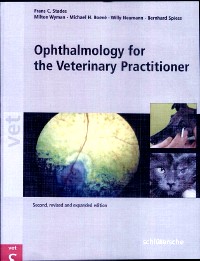
Ophthalmology for the veterinary practitioner / 2nd rev. and expanded ed.
副标题:无
作 者:Frans C. Stades ... [et al.]
分类号:
ISBN:9783899930115
微信扫一扫,移动浏览光盘
简介
The standard work for ophthalmology in veterinary practise - now completely revised and extended. This book provides especially general veterinary practitioners and students with a concrete guide to diagnosis and therapy of all important eye diseases in small animals. It also gives practical tips for determining a diagnosis without highly specialised instruments. At the same time, it helps to answer two important questions: When should an eye patient be referred to a specialist? Which preparations are necessary for doing this? In this second English edition, the present day developments in ophthalmological diagnostics and therapy have been comprehensively supplemented throughout the book. Features specific to veterinary medicine are discussed comparatively with respect to pet animals, horses, birds and farm animals. A special chapter dedicated to ophthalmological emergencies enables quick and assured actions to be undertaken in emergency situations.
目录
Authors p. X
Abbreviations p. XI
Origin of Plates and Figures p. XII
1 Introduction p. 1
2 Clinical and Differential Diagnostic Procedures
2.1 Description of the patient p. 5
2.2 Patient history p. 5
2.3 Animal handling, equipment, and instruments p. 8
2.3.1 Restraint and sedation p. 8
2.3.2 Materials and instruments p. 8
2.4 Examination of the eye and its adnexa p. 8
2.4.1 Head, skull, and orbital area p. 8
2.4.2 Tear film and tear production p. 9
2.4.3 Ocular discharge p. 10
2.4.4 Eyelids (palpebrae) p. 10
2.4.5 Conjunctiva p. 11
2.4.6 Globe (bulbus) p. 12
2.4.7 Sclera p. 13
2.4.8 Cornea p. 13
2.4.9 Anterior and posterior chambers p. 13
2.4.10 Pupil and ins p. 14
2.4.11 Lens p. 14
2.4.12 Vitreous p. 14
2.4.13 Fundus p. 14
2.4.14 Additional and specific examinations p. 15
2.5 Differential diagnosis p. 16
2.5.1 Introduction p. 16
2.5.2 The "red" eye p. 16
2.5.3 Epiphora without distinct blepharospasm p. 16
2.5.4 Blepharospastic / painful eye (Schirmer tear test not decreased) p. 16
2.5.5 Protrusion of the nictitating membrane with enophthalmos p. 16
2.5.6 Exophthalmos p. 16
2.5.7 The "blue-white" cornea p. 17
2.5.8 The "pigmented" eye p. 17
2.5.9 The "blind" eye p. 17
3 Diagnostics and Therapeutics for Eye Diseases
3.1 Introduction p. 19
3.1.1 Into the conjunctival sac p. 19
3.1.2 Subconjunctival p. 21
3.1.3 Retrobulbar p. 21
3.1.4 Intraocular p. 21
3.1.5 General rules p. 22
3.2 Ocular therapeutic agents p. 22
3.2.1 Vasoconstrictors p. 22
3.2.2 Antihistamines (nowadays mostly replaced by corticosteroids) p. 22
3.2.3 Antiglaucoma agents p. 23
3.2.3.1 Miotics. Facilitating drainage of aqueous p. 23
3.2.3.2 Moderating production of aqueous: carbonic anhydrase inhibitors p. 23
3.2.3.3 Osmotic agents p. 23
3.2.3.4 Other agents used to reduce ocular pressure p. 23
3.2.4 Mydriatics p. 23
3.2.5 Antimicrobial agents p. 24
3.2.5.1 "Initial choice" antibacterials p. 24
3.2.5.2 Antimycotics p. 25
3.2.5.3 Antiviral drugs: DNA-synthesis inhibitors p. 25
3.2.6 Corticosteroids p. 25
3.2.6.1 Topical, into the conjunctival sac p. 25
3.2.6.2 Subconjunctival p. 25
3.2.6.3 Oral p. 25
3.2.7 Non-steroidal anti-inflammatory drugs (NSAIDs) p. 25
3.2.7.1 Prostaglandin synthesis inhibitors p. 25
3.2.8 Local anesthetics p. 26
3.2.9 Vitamins, epithelializing agents, and neutral agents p. 26
3.2.10 Collyria p. 26
3.2.11 Other "drugs" for ocular use p. 26
3.2.11.1 Diagnostic agents p. 26
3.2.11.2 Chemical cauterizing agents p. 27
3.2.11.3 (Discharge-)dissolving agents p. 27
3.2.11.4 Anti-hypertensive agents (in secondary retinopathy) p. 27
3.2.11.5 Other drugs used on the eye p. 27
3.2.12 Radiation p. 27
3.2.13 Protective devices p. 27
3.3 Surgical possibilities p. 27
3.3.1 Anesthesia p. 27
3.3.2 Preparation of the operative field p. 28
3.3.3 Positioning on the operating table p. 28
3.3.4 Draping p. 28
3.3.5 Magnification equipment p. 28
3.3.6 Surgical equipment p. 28
3.3.7 Suture material p. 28
3.3.8 Hemostasis p. 29
3.3.9 Cryosurgery p. 29
3.3.10 Laser techniques p. 29
4 Ocular Emergencies 7
4.1 Introduction p. 31
4.2 Luxation or proptosis of the globe p. 31
4.3 Chemical burns p. 34
4.4 Blunt trauma p. 34
4.4.1 Orbital fractures p. 34
4.4.2 Contusion of the globe p. 35
4.4.2.1 Suffusion (hyposphagma) p. 35
4.4.2.2 Traumatic corneal edema p. 35
4.4.2.3 Hyphema p. 35
4.4.2.4 Trauma with deeper penetration p. 36
4.5 Penetrating or perforating trauma p. 37
4.5.1 Lid lacerations and conjunctival sac wounds p. 37
4.5.1.1 Lacerations of the lid edge including the lacrimal canaculus p. 39
4.5.1.2 Lacerations with loss of tissue p. 39
4.5.2 Conjunctival lacerations p. 39
4.5.3 Corneal lacerations p. 40
4.5.3.1 General rules of treatment p. 40
4.5.3.2 Non-perforating corneal wounds p. 40
4.5.3.3 Perforating corneal defects p. 43
5 Orbital and Periorbital Structures
5.1 Introduction p. 47
5.2 Congenital abnormalities p. 48
5.3 Trauma p. 48
5.4 Enophthalmos p. 48
5.4.1 Enophthalmos due to loss of support p. 48
5.4.2 Enophthalmos due to Horner's syndrome p. 49
5.5 Exophthalmos p. 49
5.5.1 Exophthalmos due to swelling of the temporal muscles p. 50
5.5.2 Exophthalmos due to retrobulbar processes p. 50
5.6 Enucleation of the globe including the conjunctiva p. 53
5.7 Evisceration of the globe p. 56
5.8 Enucleation of the globe p. 56
5.9 Exenteration of the orbit p. 56
5.10 Orbitotomy p. 56
6 Lacrimal Apparatus
6.1 Introduction p. 59
6.2 Keratoconjunctivitis sicca (KCS) p. 61
6.3 (Sialo)dacryoadenitis p. 64
6.4 Tear stripe formation p. 65
6.4.1 Micropunctum or stenosis of the lacrimal punctum p. 65
6.4.2 Atresia and secondary closure of the punctum p. 66
6.5 Dacryocystitis p. 67
6.6 Lacerations p. 70
6.7 Cysts and neoplasia p. 70
7 Eyelids
7.1 Introduction p. 73
7.2 Ankyloblepharon p. 74
7.3 Aplasia palpebrae p. 74
7.4 Dermoids/dysplasia of the lid p. 76
7.5 Distichiasis p. 76
7.6 Entropion p. 78
7.6.1 Entropion in sheep and horses p. 86
7.7 Ectropion and/or oversized palpebral fissure (macroblepharon) (Ect/OPF) p. 86
7.7.1 Shortening of the lower palpebral conjunctiva p. 87
7.7.2 V-Y Method p. 87
7.7.3 Simple wedge resection p. 87
7.7.4 Kuhnt-Szymanowski method, Blaskovic's modification p. 87
7.7.5 Kuhnt-Szymanowski method p. 87
7.7.6 Z-plasty / free transplants p. 88
7.7.7 Total fissure shortening methods p. 88
7.8 Trichiasis p. 89
7.8.1 Nasal fold trichiasis p. 89
7.8.1.1 Removal of nasal folds p. 89
7.8.1.2 Medial canthoplasty p. 90
7.8.2 Upper eyelid trichiasis p. 90
7.8.3 Caruncle trichiasis and trichiasis in other locations p. 91
7.9 Blepharophimosis p. 94
7.10 Oversized / overlong palpebral fissure p. 94
7.11 Injuries p. 94
7.12 Ptosis p. 94
7.13 Lagophthalmos p. 95
7.13.1 Medial canthoplasty p. 95
7.13.2 Lateral canthoplasty p. 95
7.14 Blepharitis p. 95
7.14.1 Non-specific blepharitis p. 95
7.14.2 Chronic blepharitis p. 95
7.14.3 Specific blepharitis p. 96
7.14.3.1 Chalazion / hordeolum p. 96
7.14.3.2 Blepharitis adenomatosa (meibomianitis) p. 96
7.14.3.3 Juxtapalpebral defects/ granulomatous changes p. 96
7.14.3.4 Eosinophilic granuloma p. 96
7.14.3.5 Blepharitis in birds p. 99
7.14.3.6 Blepharitis in horses p. 99
7.15 Neoplasia of the eyelids p. 99
7.15.1 Sarcoids in horses p. 103
8 Conjunctiva and Nictitating Membrane
8.1 Introduction p. 105
8.2 Non-pigmented margin of the nictitating membrane p. 106
8.3 Dermoid p. 106
8.4 Ectopic cilia p. 106
8.5 Protrusion of the nictitating membrane p. 107
8.6 Cysts p. 108
8.7 Eversion/inversion of the nictitating membrane p. 108
8.8 Hyperplasia/hypertrophy of the gland of the nictitating membrane ("cherry eye") p. 110
8.9 Subconjunctival hemorrhages p. 113
8.10 Injuries p. 113
8.11 Conjunctivitis p. 113
8.11.1 Catarrhal (or serous) conjunctivitis p. 114
8.11.2 Purulent conjunctivitis p. 114
8.11.3 Follicular conjunctivitis p. 116
8.11.4 Plasmacellular conjunctivitis p. 116
8.11.5 Papillary / nodular / granulomatous conjunctivitis p. 117
8.11.6 Conjunctivitis neonatorum p. 117
8.11.7 Infectious bovine / ovine keratoconjunctivitis (pinkeye) p. 118
8.12 Eosinophilic granuloma p. 119
8.13 Allergic conjunctivitis p. 119
8.14 Conjunctival adhesions p. 119
8.14.1 Symblepharon p. 119
8.14.2 Conjunctival stricture in the rabbit p. 120
8.15 Neoplasia of the conjunctiva p. 122
9 Globe
9.1 Introduction p. 125
9.2 Exophthalmos, enophthalmos p. 125
9.3 Pseudo-exophthalmos / pseudoenophthalmos p. 125
9.4 Setting sun phenomenon p. 126
9.5 Strabismus p. 126
9.6 Nystagmus p. 126
9.7 Anophthalmia, cyclopia, microphthalmia p. 127
9.8 Phthisis bulbi p. 127
9.9 Macrophthalmia p. 128
9.10 Buphthalmos/hydrophthalmia p. 128
9.11 Endophthalmitis, panophthalmitis p. 128
10 Cornea and Sclera
10.1 Introduction p. 129
10.1.1 Symptoms of corneal disease p. 129
10.1.2 Localization and causes of corneal abnormalities p. 132
10.1.3 Corneal regeneration p. 132
10.1.4 Retardation of healing p. 133
10.2 Microcornea p. 133
10.3 Persistent pupillary membrane (PPM) p. 133
10.4 Dermoid p. 133
10.5 Trauma p. 134
10.6 Keratitis p. 134
10.6.1 Superficial keratitis (without ulceration) p. 134
10.6.1.1 Chronic superficial keratitis (Uberreiter) / pannus / keratitis pannosa / photoallergic keratitis /vascular and pigmentary keratitis / German Shepherd dog keratitis p. 135
10.6.1.2 Eosinophilic keratitis p. 136
10.6.2 Deep or interstitial keratitis or keratitis profunda (without defects) p. 136
10.6.3 Ulcerative keratitis p. 137
10.6.3.1 Superficial ulcers p. 137
10.6.3.2 Deep ulcers p. 140
10.6.3.3 Hernia of Descemet's membrane (descemetocele) p. 140
10.6.3.4 Corneal perforation (staphyloma) p. 142
10.6.3.5 Nictitating membrane, conjunctival, and corneal oversuturing techniques p. 142
10.6.4 Corneal sequestration/cornea nigrum/corneal necrosis / corneal mummification p. 147
10.6.5 Keratitis punctata p. 149
10.6.6 Keratitis herpetica p. 150
10.6.7 Infectious bovine / ovine keratoconjunctivitis p. 150
10.6.8 Corneal cysts p. 150
10.6.9 Corneal abscess p. 150
10.7 Dystrophic / degenerative deposits in the cornea p. 151
10.7.1 Corneal dystrophies p. 151
10.7.1.1 Epithelial / stromal dystrophy p. 151
10.7.1.2 Endothelial dystrophy or senile endothelial degeneration p. 152
10.7.2 Local degenerative crystal deposits p. 153
10.7.3 Deposits resulting from systemic diseases p. 153
10.7.4 Corneal edema in the Manx cat p. 153
10.7.5 Mucopolysaccharidosis p. 154
10.7.6 GM1 and GM2 ganghosidosis p. 154
10.8 (Epi)scleritis p. 154
10.9 Neoplasms p. 155
11 Intraocular Pressure and Glaucoma
11.1 Introduction p. 157
11.2 Glaucoma p. 159
11.2.1 Etiology p. 159
11.2.1.1 Primary glaucoma p. 159
11.2.1.2 Secondary glaucoma p. 160
11.2.1.3 Absolute glaucoma p. 160
11.2.2 Irido-corneal angle abnormalities p. 161
11.2.2.1 Open irido-corneal angle glaucoma p. 161
11.2.2.2 Narrowed or closed irido-corneal angle glaucoma p. 161
11.2.3 Conditions of the drainage angle p. 161
11.2.3.1 Open pectinate ligament glaucoma p. 161
11.2.3.2 Primary morphologically abnormal pectinate ligament p. 161
11.2.4 Length of time of development and progression of glaucoma p. 161
11.2.4.1 Acute glaucoma p. 161
11.2.4.2 Chronic glaucoma p. 162
11.2.4.3 Hydrophthalmia or buphthalmos p. 162
11.3 Clinical aspects of glaucoma p. 162
11.3.1 Acute glaucoma p. 162
11.3.2 Chronic glaucoma p. 164
11.3.3 Therapeutic possibilities in glaucoma p. 165
11.4 Secondary glaucoma p. 168
11.4.1 Secondary glaucoma associated with the lens or vitreous p. 168
11.4.1.1 Dislocation of the lens p. 168
11.4.1.2 Lens proteins p. 168
11.4.1.3 Cataract p. 168
11.4.2 Secondary glaucoma associated with uveal changes p. 168
11.4.2.1 Uveitis p. 168
11.4.2.2 Iris atrophy/iridoschisis p. 168
11.4.3 Secondary glaucoma associated with trauma p. 169
11.4.4 Secondary glaucoma associated with intraocular neoplasia p. 169
11.4.5 Secondary glaucoma associated with medication p. 169
11.4.6 Secondary glaucoma associated with ocular surgery p. 169
11.4.6.1 Extracapsular lens extraction p. 169
11.4.6.2 Intracapsular lens extraction p. 169
11.5 Phthisis bulbi p. 169
12 Uvea
12.1 Introduction p. 171
12.1.1 Iris p. 171
12.1.2 Ciliary body p. 172
12.1.3 Choroid p. 173
12.2 Persistent (epi)pupillary membrane p. 173
12.3 Coloboma p. 174
12.4 Acorea/ aniridia p. 175
12.5 Heterochromia of the iris p. 175
12.6 Blue iris/white coat p. 175
12.6.1 Oculocutaneous albinism and deafness p. 175
12.6.2 Partial oculocutaneous albinism p. 175
12.7 Acquired color differences in the iris p. 175
12.8 Iris cysts p. 176
12.9 Hyphema p. 176
12.9.1 Dysplastic abnormalities p. 176
12.9.2 Trauma p. 176
12.9.3 Leaking of vessels p. 176
12.9.4 Coagulation disorders p. 176
12.9.5 Uveitis p. 177
12.9.6 Neoplasms p. 177
12.10 Uveitis (anterior) p. 177
12.10.1 Traumatic uveitis p. 179
12.10.2 Metabolic uveitis p. 179
12.10.3 Infections p. 179
12.10.3.1 Viral p. 179
12.10.3.2 Rickettsia p. 180
12.10.3.3 Bacterial p. 180
12.10.3.4 Mycotic p. 180
12.10.3.5 Algae p. 180
12.10.3.6 Protozoa p. 180
12.10.3.7 Parasites p. 180
12.10.4 Immune reactions p. 180
12.10.4.1 Uveo-dermatologic syndrome (UDS) p. 181
12.10.4.2 Lupus erythematosus (LE) p. 181
12.10.5 Idiopathic uveitis p. 181
12.10.6 Pseudo-uveitis caused by neoplasia p. 181
12.10.7 Equine recurrent (chronic) uveitis (ERU) p. 182
12.10.8 Anterior uveitis in the rabbit p. 183
12.11 Iris atrophy p. 183
12.12 Dysautonomia or pupil dilatation syndrome (Key-Gaskell Syndrome) p. 184
12.13 Horner's syndrome p. 184
12.14 Other pupillary abnormalities p. 184
12.15 Neoplasia p. 184
12.16 Posterior Uvea p. 186
13 Lens and Vitreous
13.1 Introduction p. 189
13.1.1 Ontogenesis p. 189
13.1.2 Anatomy and physiology p. 190
13.1.3 Vitreous p. 191
13.2 Developmental disorders of the lens p. 192
13.2.1 Aphakia / coloboma /spherophakia / microphakia/lenticonus/lentiglobus p. 192
13.2.2 Persistent hyaloid artery (PHA) p. 192
13.2.3 Persistent hyperplastic tunica vasculosa lentis/persistent hyperplastic primary vitreous (PHTVL/PHPV) p. 193
13.3 Cataract p. 193
13.3.1 Types of cataract p. 196
13.3.2 Secondary cataract p. 197
13.3.2.1 Diabetic cataract p. 197
13.3.3 Therapeutic possibilities p. 197
13.3.4 Prevention of cataract p. 201
13.4 Lens luxation or ectopic lens p. 201
13.5 Vitreous floaters, asteroid hyalosis, and synchysis scintillans p. 206
13.5.1 Vitreous floaters p. 206
13.5.2 Asteroid hyalosis p. 206
13.5.3 Synchysis scintillans p. 206
13.6 Hemorrhages and/or exudates in the vitreous p. 206
13.6.1 Blood p. 206
13.6.2 Hemorrhagic or other exudate in the vitreous p. 207
13.7 Retinal detachment and intraocular neoplasms p. 207
14 Fundus and Optic nerve
14.1 Introduction p. 209
14.1.1 Ontogenesis p. 209
14.1.2 Retina p. 209
14.1.3 Optic nerve or tract p. 211
14.1.4 Vascular supply p. 213
14.1.5 Choroid (vascular membranes) p. 214
14.2 Symptoms, pathologic changes, and reaction patterns of the fundus p. 214
14.3 Aplasia p. 218
14.4 Micropapilla and hypoplastic papilla p. 218
14.5 Coloboma p. 218
14.6 Retinal dysplasia (RD) p. 219
14.7 Collie eye anomaly (CEA) p. 219
14.8 Inherited enzyme deficiencies p. 221
14.9 Hereditary (progressive) retinal dysplasias / atrophy /degeneration (PRA) p. 221
14.9.1 Hereditary progressive retinal degeneration/progressive retinal atrophy p. 222
14.9.2 Hereditary (stationary) night blindness p. 224
14.9.3 Hereditary day blindness p. 224
14.9.4 Pigment epithelial dystrophy (PED) p. 224
14.10 Hemorrhages and other vascular abnormalities p. 224
14.10.1 Vascular occlusion p. 225
14.10.2 Hyperlipoproteinemia p. 225
14.11 Trauma p. 225
14.12 Intoxications p. 225
14.12.1 Iatrogenic intoxications p. 225
14.13 Abnormalities of nutritional origin p. 225
14.13.1 Vitamin A and vitamin E deficiencies p. 225
14.13.2 Thiamine (aneurine) or vitamin B, deficiency p. 227
14.13.3 Taurine deficiency p. 227
14.14 Posterior uveitis/chorioretinitis / retinitis p. 227
14.15 Retinal detachment p. 228
14.16 Hypertensive Retinopathy p. 229
14.17 Non-hereditary degenerative abnormalities p. 230
14.17.1 Feline central retinal degeneration (FCRD) p. 230
14.18 Papilledema p. 230
14.19 Papillitis, optic neuritis p. 231
14.20 Neoplasia p. 231
14.21 Amblyopia / amaurosis p. 232
14.21.1 Sudden acquired retinal degeneration (SARD) p. 232
15 Breed Predispositions and Hereditary Eye Diseases
15.1 Introduction p. 237
15.2 Modes of inheritance p. 237
15.2.1 Simple inheritance p. 237
15.2.1.1 Autosomal dominant (not sex-linked) p. 237
15.2.1.2 Autosomal recessive (not sex-linked) p. 237
15.2.1.3 Sex-linked inheritance p. 237
15.2.1.4 Incomplete recessive or dominant, or incomplete penetrance p. 238
15.2.2 Multiple (polygenic) transmission p. 238
15.3 Is the abnormality inherited? p. 238
15.4 Breed predispositions and inherited eye abnormalities p. 240
16 Glossary of Terms Relating to the Eye 247
Index p. 251
Abbreviations p. XI
Origin of Plates and Figures p. XII
1 Introduction p. 1
2 Clinical and Differential Diagnostic Procedures
2.1 Description of the patient p. 5
2.2 Patient history p. 5
2.3 Animal handling, equipment, and instruments p. 8
2.3.1 Restraint and sedation p. 8
2.3.2 Materials and instruments p. 8
2.4 Examination of the eye and its adnexa p. 8
2.4.1 Head, skull, and orbital area p. 8
2.4.2 Tear film and tear production p. 9
2.4.3 Ocular discharge p. 10
2.4.4 Eyelids (palpebrae) p. 10
2.4.5 Conjunctiva p. 11
2.4.6 Globe (bulbus) p. 12
2.4.7 Sclera p. 13
2.4.8 Cornea p. 13
2.4.9 Anterior and posterior chambers p. 13
2.4.10 Pupil and ins p. 14
2.4.11 Lens p. 14
2.4.12 Vitreous p. 14
2.4.13 Fundus p. 14
2.4.14 Additional and specific examinations p. 15
2.5 Differential diagnosis p. 16
2.5.1 Introduction p. 16
2.5.2 The "red" eye p. 16
2.5.3 Epiphora without distinct blepharospasm p. 16
2.5.4 Blepharospastic / painful eye (Schirmer tear test not decreased) p. 16
2.5.5 Protrusion of the nictitating membrane with enophthalmos p. 16
2.5.6 Exophthalmos p. 16
2.5.7 The "blue-white" cornea p. 17
2.5.8 The "pigmented" eye p. 17
2.5.9 The "blind" eye p. 17
3 Diagnostics and Therapeutics for Eye Diseases
3.1 Introduction p. 19
3.1.1 Into the conjunctival sac p. 19
3.1.2 Subconjunctival p. 21
3.1.3 Retrobulbar p. 21
3.1.4 Intraocular p. 21
3.1.5 General rules p. 22
3.2 Ocular therapeutic agents p. 22
3.2.1 Vasoconstrictors p. 22
3.2.2 Antihistamines (nowadays mostly replaced by corticosteroids) p. 22
3.2.3 Antiglaucoma agents p. 23
3.2.3.1 Miotics. Facilitating drainage of aqueous p. 23
3.2.3.2 Moderating production of aqueous: carbonic anhydrase inhibitors p. 23
3.2.3.3 Osmotic agents p. 23
3.2.3.4 Other agents used to reduce ocular pressure p. 23
3.2.4 Mydriatics p. 23
3.2.5 Antimicrobial agents p. 24
3.2.5.1 "Initial choice" antibacterials p. 24
3.2.5.2 Antimycotics p. 25
3.2.5.3 Antiviral drugs: DNA-synthesis inhibitors p. 25
3.2.6 Corticosteroids p. 25
3.2.6.1 Topical, into the conjunctival sac p. 25
3.2.6.2 Subconjunctival p. 25
3.2.6.3 Oral p. 25
3.2.7 Non-steroidal anti-inflammatory drugs (NSAIDs) p. 25
3.2.7.1 Prostaglandin synthesis inhibitors p. 25
3.2.8 Local anesthetics p. 26
3.2.9 Vitamins, epithelializing agents, and neutral agents p. 26
3.2.10 Collyria p. 26
3.2.11 Other "drugs" for ocular use p. 26
3.2.11.1 Diagnostic agents p. 26
3.2.11.2 Chemical cauterizing agents p. 27
3.2.11.3 (Discharge-)dissolving agents p. 27
3.2.11.4 Anti-hypertensive agents (in secondary retinopathy) p. 27
3.2.11.5 Other drugs used on the eye p. 27
3.2.12 Radiation p. 27
3.2.13 Protective devices p. 27
3.3 Surgical possibilities p. 27
3.3.1 Anesthesia p. 27
3.3.2 Preparation of the operative field p. 28
3.3.3 Positioning on the operating table p. 28
3.3.4 Draping p. 28
3.3.5 Magnification equipment p. 28
3.3.6 Surgical equipment p. 28
3.3.7 Suture material p. 28
3.3.8 Hemostasis p. 29
3.3.9 Cryosurgery p. 29
3.3.10 Laser techniques p. 29
4 Ocular Emergencies 7
4.1 Introduction p. 31
4.2 Luxation or proptosis of the globe p. 31
4.3 Chemical burns p. 34
4.4 Blunt trauma p. 34
4.4.1 Orbital fractures p. 34
4.4.2 Contusion of the globe p. 35
4.4.2.1 Suffusion (hyposphagma) p. 35
4.4.2.2 Traumatic corneal edema p. 35
4.4.2.3 Hyphema p. 35
4.4.2.4 Trauma with deeper penetration p. 36
4.5 Penetrating or perforating trauma p. 37
4.5.1 Lid lacerations and conjunctival sac wounds p. 37
4.5.1.1 Lacerations of the lid edge including the lacrimal canaculus p. 39
4.5.1.2 Lacerations with loss of tissue p. 39
4.5.2 Conjunctival lacerations p. 39
4.5.3 Corneal lacerations p. 40
4.5.3.1 General rules of treatment p. 40
4.5.3.2 Non-perforating corneal wounds p. 40
4.5.3.3 Perforating corneal defects p. 43
5 Orbital and Periorbital Structures
5.1 Introduction p. 47
5.2 Congenital abnormalities p. 48
5.3 Trauma p. 48
5.4 Enophthalmos p. 48
5.4.1 Enophthalmos due to loss of support p. 48
5.4.2 Enophthalmos due to Horner's syndrome p. 49
5.5 Exophthalmos p. 49
5.5.1 Exophthalmos due to swelling of the temporal muscles p. 50
5.5.2 Exophthalmos due to retrobulbar processes p. 50
5.6 Enucleation of the globe including the conjunctiva p. 53
5.7 Evisceration of the globe p. 56
5.8 Enucleation of the globe p. 56
5.9 Exenteration of the orbit p. 56
5.10 Orbitotomy p. 56
6 Lacrimal Apparatus
6.1 Introduction p. 59
6.2 Keratoconjunctivitis sicca (KCS) p. 61
6.3 (Sialo)dacryoadenitis p. 64
6.4 Tear stripe formation p. 65
6.4.1 Micropunctum or stenosis of the lacrimal punctum p. 65
6.4.2 Atresia and secondary closure of the punctum p. 66
6.5 Dacryocystitis p. 67
6.6 Lacerations p. 70
6.7 Cysts and neoplasia p. 70
7 Eyelids
7.1 Introduction p. 73
7.2 Ankyloblepharon p. 74
7.3 Aplasia palpebrae p. 74
7.4 Dermoids/dysplasia of the lid p. 76
7.5 Distichiasis p. 76
7.6 Entropion p. 78
7.6.1 Entropion in sheep and horses p. 86
7.7 Ectropion and/or oversized palpebral fissure (macroblepharon) (Ect/OPF) p. 86
7.7.1 Shortening of the lower palpebral conjunctiva p. 87
7.7.2 V-Y Method p. 87
7.7.3 Simple wedge resection p. 87
7.7.4 Kuhnt-Szymanowski method, Blaskovic's modification p. 87
7.7.5 Kuhnt-Szymanowski method p. 87
7.7.6 Z-plasty / free transplants p. 88
7.7.7 Total fissure shortening methods p. 88
7.8 Trichiasis p. 89
7.8.1 Nasal fold trichiasis p. 89
7.8.1.1 Removal of nasal folds p. 89
7.8.1.2 Medial canthoplasty p. 90
7.8.2 Upper eyelid trichiasis p. 90
7.8.3 Caruncle trichiasis and trichiasis in other locations p. 91
7.9 Blepharophimosis p. 94
7.10 Oversized / overlong palpebral fissure p. 94
7.11 Injuries p. 94
7.12 Ptosis p. 94
7.13 Lagophthalmos p. 95
7.13.1 Medial canthoplasty p. 95
7.13.2 Lateral canthoplasty p. 95
7.14 Blepharitis p. 95
7.14.1 Non-specific blepharitis p. 95
7.14.2 Chronic blepharitis p. 95
7.14.3 Specific blepharitis p. 96
7.14.3.1 Chalazion / hordeolum p. 96
7.14.3.2 Blepharitis adenomatosa (meibomianitis) p. 96
7.14.3.3 Juxtapalpebral defects/ granulomatous changes p. 96
7.14.3.4 Eosinophilic granuloma p. 96
7.14.3.5 Blepharitis in birds p. 99
7.14.3.6 Blepharitis in horses p. 99
7.15 Neoplasia of the eyelids p. 99
7.15.1 Sarcoids in horses p. 103
8 Conjunctiva and Nictitating Membrane
8.1 Introduction p. 105
8.2 Non-pigmented margin of the nictitating membrane p. 106
8.3 Dermoid p. 106
8.4 Ectopic cilia p. 106
8.5 Protrusion of the nictitating membrane p. 107
8.6 Cysts p. 108
8.7 Eversion/inversion of the nictitating membrane p. 108
8.8 Hyperplasia/hypertrophy of the gland of the nictitating membrane ("cherry eye") p. 110
8.9 Subconjunctival hemorrhages p. 113
8.10 Injuries p. 113
8.11 Conjunctivitis p. 113
8.11.1 Catarrhal (or serous) conjunctivitis p. 114
8.11.2 Purulent conjunctivitis p. 114
8.11.3 Follicular conjunctivitis p. 116
8.11.4 Plasmacellular conjunctivitis p. 116
8.11.5 Papillary / nodular / granulomatous conjunctivitis p. 117
8.11.6 Conjunctivitis neonatorum p. 117
8.11.7 Infectious bovine / ovine keratoconjunctivitis (pinkeye) p. 118
8.12 Eosinophilic granuloma p. 119
8.13 Allergic conjunctivitis p. 119
8.14 Conjunctival adhesions p. 119
8.14.1 Symblepharon p. 119
8.14.2 Conjunctival stricture in the rabbit p. 120
8.15 Neoplasia of the conjunctiva p. 122
9 Globe
9.1 Introduction p. 125
9.2 Exophthalmos, enophthalmos p. 125
9.3 Pseudo-exophthalmos / pseudoenophthalmos p. 125
9.4 Setting sun phenomenon p. 126
9.5 Strabismus p. 126
9.6 Nystagmus p. 126
9.7 Anophthalmia, cyclopia, microphthalmia p. 127
9.8 Phthisis bulbi p. 127
9.9 Macrophthalmia p. 128
9.10 Buphthalmos/hydrophthalmia p. 128
9.11 Endophthalmitis, panophthalmitis p. 128
10 Cornea and Sclera
10.1 Introduction p. 129
10.1.1 Symptoms of corneal disease p. 129
10.1.2 Localization and causes of corneal abnormalities p. 132
10.1.3 Corneal regeneration p. 132
10.1.4 Retardation of healing p. 133
10.2 Microcornea p. 133
10.3 Persistent pupillary membrane (PPM) p. 133
10.4 Dermoid p. 133
10.5 Trauma p. 134
10.6 Keratitis p. 134
10.6.1 Superficial keratitis (without ulceration) p. 134
10.6.1.1 Chronic superficial keratitis (Uberreiter) / pannus / keratitis pannosa / photoallergic keratitis /vascular and pigmentary keratitis / German Shepherd dog keratitis p. 135
10.6.1.2 Eosinophilic keratitis p. 136
10.6.2 Deep or interstitial keratitis or keratitis profunda (without defects) p. 136
10.6.3 Ulcerative keratitis p. 137
10.6.3.1 Superficial ulcers p. 137
10.6.3.2 Deep ulcers p. 140
10.6.3.3 Hernia of Descemet's membrane (descemetocele) p. 140
10.6.3.4 Corneal perforation (staphyloma) p. 142
10.6.3.5 Nictitating membrane, conjunctival, and corneal oversuturing techniques p. 142
10.6.4 Corneal sequestration/cornea nigrum/corneal necrosis / corneal mummification p. 147
10.6.5 Keratitis punctata p. 149
10.6.6 Keratitis herpetica p. 150
10.6.7 Infectious bovine / ovine keratoconjunctivitis p. 150
10.6.8 Corneal cysts p. 150
10.6.9 Corneal abscess p. 150
10.7 Dystrophic / degenerative deposits in the cornea p. 151
10.7.1 Corneal dystrophies p. 151
10.7.1.1 Epithelial / stromal dystrophy p. 151
10.7.1.2 Endothelial dystrophy or senile endothelial degeneration p. 152
10.7.2 Local degenerative crystal deposits p. 153
10.7.3 Deposits resulting from systemic diseases p. 153
10.7.4 Corneal edema in the Manx cat p. 153
10.7.5 Mucopolysaccharidosis p. 154
10.7.6 GM1 and GM2 ganghosidosis p. 154
10.8 (Epi)scleritis p. 154
10.9 Neoplasms p. 155
11 Intraocular Pressure and Glaucoma
11.1 Introduction p. 157
11.2 Glaucoma p. 159
11.2.1 Etiology p. 159
11.2.1.1 Primary glaucoma p. 159
11.2.1.2 Secondary glaucoma p. 160
11.2.1.3 Absolute glaucoma p. 160
11.2.2 Irido-corneal angle abnormalities p. 161
11.2.2.1 Open irido-corneal angle glaucoma p. 161
11.2.2.2 Narrowed or closed irido-corneal angle glaucoma p. 161
11.2.3 Conditions of the drainage angle p. 161
11.2.3.1 Open pectinate ligament glaucoma p. 161
11.2.3.2 Primary morphologically abnormal pectinate ligament p. 161
11.2.4 Length of time of development and progression of glaucoma p. 161
11.2.4.1 Acute glaucoma p. 161
11.2.4.2 Chronic glaucoma p. 162
11.2.4.3 Hydrophthalmia or buphthalmos p. 162
11.3 Clinical aspects of glaucoma p. 162
11.3.1 Acute glaucoma p. 162
11.3.2 Chronic glaucoma p. 164
11.3.3 Therapeutic possibilities in glaucoma p. 165
11.4 Secondary glaucoma p. 168
11.4.1 Secondary glaucoma associated with the lens or vitreous p. 168
11.4.1.1 Dislocation of the lens p. 168
11.4.1.2 Lens proteins p. 168
11.4.1.3 Cataract p. 168
11.4.2 Secondary glaucoma associated with uveal changes p. 168
11.4.2.1 Uveitis p. 168
11.4.2.2 Iris atrophy/iridoschisis p. 168
11.4.3 Secondary glaucoma associated with trauma p. 169
11.4.4 Secondary glaucoma associated with intraocular neoplasia p. 169
11.4.5 Secondary glaucoma associated with medication p. 169
11.4.6 Secondary glaucoma associated with ocular surgery p. 169
11.4.6.1 Extracapsular lens extraction p. 169
11.4.6.2 Intracapsular lens extraction p. 169
11.5 Phthisis bulbi p. 169
12 Uvea
12.1 Introduction p. 171
12.1.1 Iris p. 171
12.1.2 Ciliary body p. 172
12.1.3 Choroid p. 173
12.2 Persistent (epi)pupillary membrane p. 173
12.3 Coloboma p. 174
12.4 Acorea/ aniridia p. 175
12.5 Heterochromia of the iris p. 175
12.6 Blue iris/white coat p. 175
12.6.1 Oculocutaneous albinism and deafness p. 175
12.6.2 Partial oculocutaneous albinism p. 175
12.7 Acquired color differences in the iris p. 175
12.8 Iris cysts p. 176
12.9 Hyphema p. 176
12.9.1 Dysplastic abnormalities p. 176
12.9.2 Trauma p. 176
12.9.3 Leaking of vessels p. 176
12.9.4 Coagulation disorders p. 176
12.9.5 Uveitis p. 177
12.9.6 Neoplasms p. 177
12.10 Uveitis (anterior) p. 177
12.10.1 Traumatic uveitis p. 179
12.10.2 Metabolic uveitis p. 179
12.10.3 Infections p. 179
12.10.3.1 Viral p. 179
12.10.3.2 Rickettsia p. 180
12.10.3.3 Bacterial p. 180
12.10.3.4 Mycotic p. 180
12.10.3.5 Algae p. 180
12.10.3.6 Protozoa p. 180
12.10.3.7 Parasites p. 180
12.10.4 Immune reactions p. 180
12.10.4.1 Uveo-dermatologic syndrome (UDS) p. 181
12.10.4.2 Lupus erythematosus (LE) p. 181
12.10.5 Idiopathic uveitis p. 181
12.10.6 Pseudo-uveitis caused by neoplasia p. 181
12.10.7 Equine recurrent (chronic) uveitis (ERU) p. 182
12.10.8 Anterior uveitis in the rabbit p. 183
12.11 Iris atrophy p. 183
12.12 Dysautonomia or pupil dilatation syndrome (Key-Gaskell Syndrome) p. 184
12.13 Horner's syndrome p. 184
12.14 Other pupillary abnormalities p. 184
12.15 Neoplasia p. 184
12.16 Posterior Uvea p. 186
13 Lens and Vitreous
13.1 Introduction p. 189
13.1.1 Ontogenesis p. 189
13.1.2 Anatomy and physiology p. 190
13.1.3 Vitreous p. 191
13.2 Developmental disorders of the lens p. 192
13.2.1 Aphakia / coloboma /spherophakia / microphakia/lenticonus/lentiglobus p. 192
13.2.2 Persistent hyaloid artery (PHA) p. 192
13.2.3 Persistent hyperplastic tunica vasculosa lentis/persistent hyperplastic primary vitreous (PHTVL/PHPV) p. 193
13.3 Cataract p. 193
13.3.1 Types of cataract p. 196
13.3.2 Secondary cataract p. 197
13.3.2.1 Diabetic cataract p. 197
13.3.3 Therapeutic possibilities p. 197
13.3.4 Prevention of cataract p. 201
13.4 Lens luxation or ectopic lens p. 201
13.5 Vitreous floaters, asteroid hyalosis, and synchysis scintillans p. 206
13.5.1 Vitreous floaters p. 206
13.5.2 Asteroid hyalosis p. 206
13.5.3 Synchysis scintillans p. 206
13.6 Hemorrhages and/or exudates in the vitreous p. 206
13.6.1 Blood p. 206
13.6.2 Hemorrhagic or other exudate in the vitreous p. 207
13.7 Retinal detachment and intraocular neoplasms p. 207
14 Fundus and Optic nerve
14.1 Introduction p. 209
14.1.1 Ontogenesis p. 209
14.1.2 Retina p. 209
14.1.3 Optic nerve or tract p. 211
14.1.4 Vascular supply p. 213
14.1.5 Choroid (vascular membranes) p. 214
14.2 Symptoms, pathologic changes, and reaction patterns of the fundus p. 214
14.3 Aplasia p. 218
14.4 Micropapilla and hypoplastic papilla p. 218
14.5 Coloboma p. 218
14.6 Retinal dysplasia (RD) p. 219
14.7 Collie eye anomaly (CEA) p. 219
14.8 Inherited enzyme deficiencies p. 221
14.9 Hereditary (progressive) retinal dysplasias / atrophy /degeneration (PRA) p. 221
14.9.1 Hereditary progressive retinal degeneration/progressive retinal atrophy p. 222
14.9.2 Hereditary (stationary) night blindness p. 224
14.9.3 Hereditary day blindness p. 224
14.9.4 Pigment epithelial dystrophy (PED) p. 224
14.10 Hemorrhages and other vascular abnormalities p. 224
14.10.1 Vascular occlusion p. 225
14.10.2 Hyperlipoproteinemia p. 225
14.11 Trauma p. 225
14.12 Intoxications p. 225
14.12.1 Iatrogenic intoxications p. 225
14.13 Abnormalities of nutritional origin p. 225
14.13.1 Vitamin A and vitamin E deficiencies p. 225
14.13.2 Thiamine (aneurine) or vitamin B, deficiency p. 227
14.13.3 Taurine deficiency p. 227
14.14 Posterior uveitis/chorioretinitis / retinitis p. 227
14.15 Retinal detachment p. 228
14.16 Hypertensive Retinopathy p. 229
14.17 Non-hereditary degenerative abnormalities p. 230
14.17.1 Feline central retinal degeneration (FCRD) p. 230
14.18 Papilledema p. 230
14.19 Papillitis, optic neuritis p. 231
14.20 Neoplasia p. 231
14.21 Amblyopia / amaurosis p. 232
14.21.1 Sudden acquired retinal degeneration (SARD) p. 232
15 Breed Predispositions and Hereditary Eye Diseases
15.1 Introduction p. 237
15.2 Modes of inheritance p. 237
15.2.1 Simple inheritance p. 237
15.2.1.1 Autosomal dominant (not sex-linked) p. 237
15.2.1.2 Autosomal recessive (not sex-linked) p. 237
15.2.1.3 Sex-linked inheritance p. 237
15.2.1.4 Incomplete recessive or dominant, or incomplete penetrance p. 238
15.2.2 Multiple (polygenic) transmission p. 238
15.3 Is the abnormality inherited? p. 238
15.4 Breed predispositions and inherited eye abnormalities p. 240
16 Glossary of Terms Relating to the Eye 247
Index p. 251
Ophthalmology for the veterinary practitioner / 2nd rev. and expanded ed.
- 名称
- 类型
- 大小
光盘服务联系方式: 020-38250260 客服QQ:4006604884
云图客服:
用户发送的提问,这种方式就需要有位在线客服来回答用户的问题,这种 就属于对话式的,问题是这种提问是否需要用户登录才能提问
Video Player
×
Audio Player
×
pdf Player
×
