

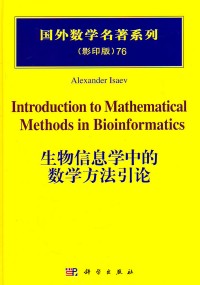
Introduction to mathematical methods in bioinformatics
副标题:无
分类号:
ISBN:9787030313812
微信扫一扫,移动浏览光盘
简介
《生物信息学中的数学方法引论(影印版)》的特色之一就是没有对所有的生物信息学问题进行泛泛的介绍,而是选择了生物信息学中核心问题之一——序列分析作为《生物信息学中的数学方法引论(影印版)》的主要内容。由于缩小了范围,作者可以在有限的篇幅中更详尽的介绍序列分析的各种数学模型和算法。
This book looks at the mathematical foundations of the modelscurrently in use. This is crucial for the correct interpretation of theoutputs of the models. A bioinformatician should be able not onlyto use software packages, but also to know the mathematics behindthese packages. From this point of view, mathematics departmentsthroughout the world have a major role to play in bioinformaticseducation by teaching courses on the mathematical foundations ofthe subject. Based on the courses taught by the author the bookcombines several topics in biological sequence analysis withmathematical and statistical material required for such analysis.
目录
《生物信息学中的数学方法引论(英文影印版)》
part i sequence analysis
1 introduction: biological sequences
2 sequence alignment
2.1 sequence similarity
2.2 dynamic programming: global alignment
2.3 dynamic programming: local alignment
2.4 alignment with affine gap model
2.5 heuristic alignment algorithms
2.5.1 fasta
2.5.2 blast
2.6 significance of scores
2.7 multiple alignment
2.7.1 msa
2.7.2 progressive alignment
exercises
3 markov chains and hidden markov models
3.1 markov chains
3.2 hidden markov models
3.3 the viterbi algorithm
.3.4 the forward algorithm
3.5 the backward algorithm and posterior decoding
3.6 parameter estimation for hmms
3.6.1 estimation when paths are known
3.6.2 estimation when paths are unknown
3.7 hmms with silent states
3.8 profile hmms
3.9 multiple sequence alignment by profile hmms
exercises
protein folding
4.1 levels of protein structure
4.2 prediction by profile hmms
4.3 threading
4.4 molecular modeling
4.5 lattice hp-model
exercises
5 phylogenetic reconstruction
5.1 phylogenetic trees
5.2 parsimony methods
5.3 distance methods
5.4 evolutionary models
5.4.1 the jukes-cantor model
5.4.2 the kimura model
5.4.3 the felsenstein model
5.4.4 the hasegawa-kishino-yano (hky) model
5.5 maximum likelihood method
5.6 model comparison
exercises
part ii mathematical background for sequence analysis
6 elements of probability theory
6.1 sample spaces and events
6.2 probability measure
6.3 conditional probability
6.4 random variables
6.5 integration of random variables
6.6 monotone functions on the real line
6.7 distribution functions
6.8 common types of random variables
6.8.1 the discrete type
6.8.2 the continuous type
6.9 common discrete and continuous distributions
6.9.1 the discrete case
6.9.2 the continuous case
6.10 vector-valued random variables
6.11 sequences of random variables
exercises
7 significance of sequence alignment scores
7.1 the problem
7.2 random walks
7.3 significance of scores
exercises
elements of statistics
8.1 statistical modeling
8.2 parameter estimation
8.3 hypothesis testing
8.4 significance of scores for global alignments
exercises
9 substitution matrices
9.1 the general form of a substitution matrix.
9.2 pam substitution matrices
9.3 blosum substitution matrices
exercises
references
index
part i sequence analysis
1 introduction: biological sequences
2 sequence alignment
2.1 sequence similarity
2.2 dynamic programming: global alignment
2.3 dynamic programming: local alignment
2.4 alignment with affine gap model
2.5 heuristic alignment algorithms
2.5.1 fasta
2.5.2 blast
2.6 significance of scores
2.7 multiple alignment
2.7.1 msa
2.7.2 progressive alignment
exercises
3 markov chains and hidden markov models
3.1 markov chains
3.2 hidden markov models
3.3 the viterbi algorithm
.3.4 the forward algorithm
3.5 the backward algorithm and posterior decoding
3.6 parameter estimation for hmms
3.6.1 estimation when paths are known
3.6.2 estimation when paths are unknown
3.7 hmms with silent states
3.8 profile hmms
3.9 multiple sequence alignment by profile hmms
exercises
protein folding
4.1 levels of protein structure
4.2 prediction by profile hmms
4.3 threading
4.4 molecular modeling
4.5 lattice hp-model
exercises
5 phylogenetic reconstruction
5.1 phylogenetic trees
5.2 parsimony methods
5.3 distance methods
5.4 evolutionary models
5.4.1 the jukes-cantor model
5.4.2 the kimura model
5.4.3 the felsenstein model
5.4.4 the hasegawa-kishino-yano (hky) model
5.5 maximum likelihood method
5.6 model comparison
exercises
part ii mathematical background for sequence analysis
6 elements of probability theory
6.1 sample spaces and events
6.2 probability measure
6.3 conditional probability
6.4 random variables
6.5 integration of random variables
6.6 monotone functions on the real line
6.7 distribution functions
6.8 common types of random variables
6.8.1 the discrete type
6.8.2 the continuous type
6.9 common discrete and continuous distributions
6.9.1 the discrete case
6.9.2 the continuous case
6.10 vector-valued random variables
6.11 sequences of random variables
exercises
7 significance of sequence alignment scores
7.1 the problem
7.2 random walks
7.3 significance of scores
exercises
elements of statistics
8.1 statistical modeling
8.2 parameter estimation
8.3 hypothesis testing
8.4 significance of scores for global alignments
exercises
9 substitution matrices
9.1 the general form of a substitution matrix.
9.2 pam substitution matrices
9.3 blosum substitution matrices
exercises
references
index
Introduction to mathematical methods in bioinformatics
- 名称
- 类型
- 大小
光盘服务联系方式: 020-38250260 客服QQ:4006604884
云图客服:
用户发送的提问,这种方式就需要有位在线客服来回答用户的问题,这种 就属于对话式的,问题是这种提问是否需要用户登录才能提问
Video Player
×
Audio Player
×
pdf Player
×
