

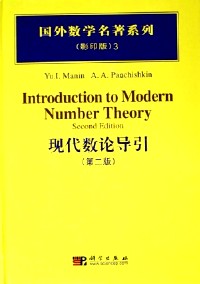
Introduction to modern number theory = 现代数论导引 / 2nd ed.
副标题:无
作 者:Yu.I. Manin, A.A. Panchishkin.
分类号:
ISBN:9787030166876
微信扫一扫,移动浏览光盘
简介
《现代数论导引(第2版)(影印版)》以统一的观点概述数论的现状及其不同分支的发展趋势,由基本问题出发,揭示现代数论的中心思想。主要论题包括类域论的非-Abel-般化、递归计算、丢番图方程、Zeta-函数和L-函数。
《现代数论导引(第2版)(影印版)》新版作了大量修订,内容上也作了扩充,增加了一些新的章节,如怀尔斯对费马大定理的证明,综合不同理论而得到的现代数论的相关技巧。此外,作者还专门增加一章,讲述算术上同调和非交换几何,关于具有多个有理点的簇中点的计数问题的一个报告,质数判定中的多项式时间算法以及其他论题。
目录
partiproblemsandtricks.
elementarynumbertheory
1.1problemsaboutprimes.divisibilityandprimality
1.1.1arithmeticalnotation
1.1.2primesandcompositenumbers
1.1.3thefactorizationtheoremandtheeuclidean
algorithm
1.1.4calculationswithresidueclasses
1.1.5thequadraticreciprocitylawanditsuse
1.1.6thedistributionofprimes
1.2diophantineequationsofdegreeoneandtwo
1.2.1theequationax+by=c
1.2.2lineardiophantinesystems
1.2.3equationsofdegreetwo
1.2.4theminkowski-hasseprincipleforquadraticforms
1.2.5pell'sequation
1.2.6representationofintegersandquadraticformsby
quadraticforms
1.2.7analyticmethods
1.2.8equivalenceofbinaryquadraticforms
.1.3cubicdiophantineequations
1.3.1theproblemoftheexistenceofasolution
1.3.2additionofpointsonacubiccurve
1.3.3thestructureofthegroupofrationalpointsofa
non-singularcubiccurve
1.3.4cubiccongruencesmoduloaprime
1.4approximationsandcontinuedfractions
1.4.1bestapproximationstoirrationalnumbers
1.4.2fareyseries
1.4.3continuedfractions
1.4.4sl2-equivalence
1.4.5periodiccontinuedfractionsandpell'sequation
1.5diophantineapproximationandtheirrationality
1.5.1ideasintheproofthat(3)isirrational
1.5.2themeasureofirrationalityofanumber
1.5.3thethue-siegel-roththeorem,transcendental
numbers,anddiophantineequations
1.5.4proofsoftheidentities(1.5.1)and(1.5.2)
1.5.5therecurrentsequencesanandbn
1.5.6transcendentalnumbersandtheseventhhilbert
problem
1.5.7workofyu.v.nesterenkoon.e.[nes99]
2someapplicationsofelementarynumbertheory
2.1factorizationandpublickeycryptosystems
2.1.1factorizationistime-consuming
2.1.2one-wayfunctionsandpublickeyencryption
2.1.3apublickeycryptosystem
2.1.4statisticsandmassproductionofprimes
2.1.5probabilisticprimalitytests
2.1.6thediscretelogarithmproblemandthe
diffie-hellmankeyexchangeprotocol
2.1.7computingofthediscretelogarithmonelliptic
curvesoverfinitefields(ecdlp)
2.2deterministicprimalitytests
2.2.1adleman-pomerance-rumelyprimalitytest:basicideas
2.2.2gausssumsandtheiruseinprimalitytesting.
2.2.3detaileddescriptionoftheprimalitytest2.2.4primesisinp
2.2.5thealgorithmofm.agrawal,n.kayalandn.saxena
2.2.6practicalandtheoreticalprimalityproving.the
ecpp(ellipticcurveprimalityprovingbyf.morain,see[atmo93b])
2.2.7primesinarithmeticprogression
2.3factorizationoflargeintegers
2.3.1comparativedifficultyofprimalitytestingand
factorization
2.3.2factorizationandquadraticforms
2.3.3theprobabilisticalgorithmclasno
2.3.4thecontinuedfractionsmethod(cfrac)andreal
quadraticfields
2.3.5theuseofellipticcurves
partiiideasandtheories
3inductionandrecursion
3.1elementarynumbertheoryfromthepointofviewoflogic
3.1.1elementarynumbertheory
3.1.2logic
3.2diophantinesets
3.2.1enumerabilityanddiophantinesets
3.2.2diophantinenessofenumerablesets
3.2.3firstpropertiesofdiophantinesets
3.2.4diophantinenessandpell'sequation
3.2.5thegraphoftheexponentisdiophantine
3.2.6diophantinenessandbinomialcoefficients
3.2.7binomialcoefficientsasremainders
3.2.8diophantinenessofthefactorial
3.2.9factorialandeuclideandivision
3.2.10supplementaryresults
3.3partiallyrecursivefunctionsandenumerablesets
3.3.1partialfunctionsandcomputablefunctions
3.3.2thesimplefunctions
3.3.3elementaryoperationsonpartialfunctions
3.3.4partiallyrecursivedescriptionofafunction
3.3.5otherrecursivefunctions
3.3.6furtherpropertiesofrecursivefunctions
3.3.7linkwithlevelsets
3.3.8linkwithprojectionsoflevelsets
3.3.9matiyasevich'stheorem
3.3.10theexistenceofcertainbijections
3.3.11operationsonprimitivelyenumerablesets
3.3.12gsdel'sfunction
3.3.13discussionofthepropertiesofenumerablesets
3.4diophantinenessofasetandalgorithmicundecidability
3.4.1algorithmicundecidabilityandunsolvability
3.4.2sketchproofofthematiyasevichtheorem
arithmeticofalgebraicnumbers
4.1algebraicnumbers:theirrealizationsandgeometry
4.1.1adjoiningrootsofpolynomials
4.1.2galoisextensionsandfrobeniuselements
4.1.3tensorproductsoffieldsandgeometricrealizations
ofalgebraicnumbers
4.1.4units,thelogarithmicmap,andtheregulator
4.1.5latticepointsinaconvexbody
4.1:6deductionofdirichlet'stheoremfromminkowski'slemma
4.2decompositionofprimeideals,dedekinddomains,andvaluations
4.2.1primeidealsandtheuniquefactorizationproperty
4.2.2finitenessoftheclassnumber..
4.2.3decompositionofprimeidealsinextensions
4.2.4decompositionofprimesincyslotomicfields
4.2.5primeideals,valuationsandabsolutevalues
4..3localandglobalmethods
4.3.1p-adicnumbers
4.3.2applicationsofp-adicnumberstosolvingcongruenca
4.3.3thehilbertsymbol
4.3.4algebraicextensionsofqp,andthetatefield
4.3.5normalizedabsolutevalues
4.3.6placesofnumberfieldsandtheproductformula
4.3.7adelesandideles
theringofadeles
theidelegroup
4.3.8thegeometryofadelesandideles
4.4classfieldtheory
4.4.1abelianextensionsofthefieldofrationalnumbers
4.4.2frobeniusautomorphismsofnumberfieldsand
artin'sreciprocitymap
4.4.3thechebotarevdensitytheorem
4.4.4thedecompositionlawand
theartinreciprocitymap
4.4.5thekernelofthereciprocitymap
4.4.6theartinsymbol
4.4.7globalpropertiesoftheartinsymbol
4.4.8alinkbetweentheartinsymbolandlocalsymbols
4.4.9propertiesofthelocalsymbol
4.4.10anexplicitconstructionofabelianextensionsofa
localfield,andacalculationofthelocalsymbol
4.4.11abelianextensionsofnumberfields
4.5galoisgroupinarithetical'problems
4.5.1dividingacircleintonequalparts
4.5.2kummerextensionsandthepowerresiduesymbol
4.5.3galoiscohomology
4.5.4acohomologicaldefinitionofthelocalsymbol
4.5.5thebrauergroup,thereciprocitylawandthe
minkowski-hasseprinciple 5arithmeticofalgebraicvarieties 5.1arithmeticvarietiesandbasicnotionsofalgebraicgeometry
5.1.1equationsandrings
5.1.2thesetofsolutionsofasystem
5.1.3example:thelanguageofcongruences
5.1.4equivalenceofsystemsofequations
5.1.5solutionsask-algebrahomomorphisms
5.1.6thespectrumofaring
5.1.7regularfunctions
5.1.8atopologyonspec(a)
5.1.9schemes
5.1.10ring-valuedpointsofschemes
5.1.11solutionstoequationsandpointsofschemes
5.1.12chevalley'stheorem
5.1.13somegeometricnotions
5.2geometricnotionsinthestudyofdiophantineequations
5.2.1basicquestions
5.2.2geometricclassification
5.2.3existenceofrationalpointsandobstructionstothe
hasseprinciple
5.2.4finiteandinfinitesetsofsolutions
5.2.5numberofpointsofboundedheight
5.2.6heightandarakelovgeometry
5.3ellipticcurves,abelianvarieties,andlineargroups
5.3.1algebraiccurvesandriemannsurfaces
5.3.2ellipticcurves
5.3.3tarecurveanditspointsoffiniteorder
5.3.4themordell-weiltheoremandgaloiscohomology
5.3.5abelianvarietiesandjacobians
5.3.6thejacobianofanalgebraiccurve
5.3.7siegel'sformulaandtamagawa'measure
5.4diophantineequationsandgaloisrepresentations
5.4.1thetaremoduleofanellipticcurve
5.4.2thetheoryofcomplexmultiplication
5.4.3charactersofl-adicrepresentations
5.4.4representationsinpositivecharacteristic
5.4.5thetatemoduleofanumberfield
5.5thetheoremoffairingsandfinitenessproblemsindiophantinegeometry
5.5.1reductionofthemordellconjecturetothefinitenessconjecture
5.5.2thetheoremofshafarevichonfinitenessforellipticcurves
5.5.3passagetoabelianvarieties
5.5.4finitenessproblemsandtatesconjecture
5.5.5reductionoftheconjecturesoftatetothefinitenesspropertiesorisogenies5.5.6thefaltings-arakelovheight
5.5.7heightsunderisogeniesandconjecturetzetafunctionsandmodularforms
6.1zetafunctionsofarithmeticschemes
6.1.1zetafunctionsofarithmeticschemes
6.1.2analyticcontinuationofthezetafunctions
6.1.3schemesoverfinitefieldsanddeligne'stheorem
6.1.4zetafunctionsandexponentialsums
6.2l-functions,thetheoryoftateandexpliciteformulae
6.2.1l-functionsofrationalgaloisrepresentations
6.2.2theformalismofartin
6.2.3example:thededekindzetafunction
6.2.4heckecharactersandthetheoryoftare
6.2.5explicitformulae
6.2.6theweilgroupanditsrepresentations
6.2.7zetafunctions,l-functionsandmotives
6.3modularformsandeulerproducts
6.3.1alinkbetweenalgebraicvarietiesandl-functions
6.3.2classicalmodularforms
6.3.3application:tatecurveandsemistableellipticcurves
6.3.4analyticfamiliesofellipticcurvesandcongruence
subgroups
6.3.5modularformsforcongruencesubgroups
6.3.6hecketheory
6.3.7primitiveforms
6.3.8weil'sinversetheorem
6,4modularformsandgaloisrepresentations
6.4.1ramanujan'scongruenceandgaloisrepresentations
6.4.2alinkwitheichler-shimura'sconstruction
6.4.3theshimura-taniyama-weilconjecture
6.4.4theconjectureofbirchandswinnerton-dyer
6.4.5theartinconjectureandcuspforms
theartinconductor
6.4.6modularrepresentationsoverfinitefields
6.5automorphicformsandthelanglandsprogram
6.5.1arelationbetweenclassicalmodularformsand
representationtheory
6.5.2automorphicl-functions
furtheranalyticpropertiesofautomorphicl-functions
6.5.3thelanglandsfunctorialityprinciple
6.5.4automorphicformsandlanglandsconjectures
fermat'slasttheoremandfamiliesofmodularforms
7.1shimura-taniyama-weilconjectureandreciprocitylaws
7.1.1problemofpierredefermat(1601-1665)
7.1.2g.lam6'smistake
7.1.3ashortoverviewofwiles'marvelousproof
7.1.4thestwconjecture
7.1.5aconnectionwiththequadraticreciprocitylaw
7.1.6acompleteproofofthestwconjecture
7.1.7modularityofsemistableellipticcurves
7.1.8structureoftheproofoftheorem7.13(semistable
stwconjecture)
7.2theoremoflanglands-tunnelland
modularitymodulo3
7.2.1galoisrepresentations:preparation
7.2.2modularitymodulop
7.2.3passagefromcuspformsofweightonetocuspforms
ofweighttwo..
7.2.4preliminaryreviewofthestagesoftheproofoftheorem7.13onmodularity
7.3modularityofgaloisrepresentationsanduniversaldeformationrings
7.3.1galoisrepresentationsoverlocalnoetherianalgebras
7.3.2deformationsofgaloisrepresentations
7.3.3modulargaloisrepresentations
7.3.4admissibledeformationsandmodulardeformations
7.3.5universaldeformationrings
7.4wiles'maintheoremandisomorphismcriteriaforlocalrings
7.4.1strategyoftheproofofthemaintheorem7.33
7.4.2surjectivityof
7.4.3constructionsoftheuniversaldeformationring
7.4.4asketchofaconstructionoftheuniversalmodulardeformationringt2
7.4.5universalityandthechebotarevdensitytheorem
7.4.6isomorphismcriteriaforlocalrings
7.4.7j-structuresandthesecondcriterionofisomorphismoflocalrings
7.5wiles'inductionstep:applicationofthecriteriaandgaloiscohomology
7.5.1wiles'inductionstepintheproofofmaintheorem7.33
7.5.2aformularelatingpreparation
7.5.3theselmergroupand
7.5.4infinitesimaldeformations
7.5.5deformationsoftype
7.6therelativeinvariant,themaininequalityandtheminimalcase
7.6.1therelativeinvariant
7.6.2themaininequality
7.6.3theminimalcase
7.7endofwiles'proofandtheoremonabsoluteirreducibility
7.7.1theoremonabsoluteirreducibility
7.7.2fromp=3top=5
7.7.3familiesofellipticcurveswithfixede
7.7.4theendoftheproofthemostimportantinsightspartiiianalogiesandvisionsiii-0introductorysurveytopartiii:motivationsanddescription
iii.1analogiesanddifferencesbetweennumbersandfunctions:point,archimedeanpropertiesetc
iii.1.1cauchyresidueformulaandtheproductformula
iii.l.2arithmeticvarieties
iii.l.3infinitesimalneighborhoodsoffibers
iii,.2arakelovgeometry,fiberovercycles,greenfunctions
(d'apresgillet-soule)
iii.2.1arithmeticchowgroups
iii.2.2arithmeticintersectiontheoryandarithmetic
riemann-rochtheorem
iii.2.3geometricdescriptionoftheclosedfibersatinfinity
iii.3-functions,localfactorsatserre'sf-factors
iii.3.1archimedeanl-factors
iii.3.2deninger'sformulae
iii.4aguessthatthemissinggeometricobjectsare
noncommutativespaces
iii.4.1typesandexamplesofnoncommutativespaces,and
howtoworkwiththem.noncommutativegeometry
andarithmetic
isomorphismofnoncommutativespacesandmoritaequivalence
thetoolsofnoncommutativegeometry
iii.4.2generalitiesonspectraltriples
iii.4.3contentsofpartiii:descriptionofpartsofthisprogram
8arakelovgeometryandnoncommutativegeometry
8.1schottkyuniformizationandarakelovgeometry
8.1.1motivationsandthecontextoftheworkof
consani-marcolli
8.1.2analyticconstructionofdegeneratingcurvesover
completelocalfields
8.1.3schottkygroupsandnewperspectivesinarakelov
geometry
schottkyuniformizationandschottkygroups
fuchsianandschottkyuniformization
8.1.4hyperbolichandlebodies
geodesicsinr
8.1.5arakelovgeometryandhyperbolicgeometry
arakelovgreenfunction
crossratioandgeodesics
differentialsandschottkyuniformization
greenfunctionandgeodesics
8.2cohomologicalconstructions
8.2.1archimedeancohomology
operators
sl(2,r)representatious
8.2.2localfactorandarchimedeancohomology
8.2.3cohomologicalconstructions
8.2.4zetafunctionofthespecialfiberandreidemeister
torsion
8.3spectraltriples,dynamicsandzetafunctions
8.3.1adynamicaltheoryatinfinity
8.3.2homotopyquotion
8.3.3filtration
8.3.4hilbertspaceandgrading
8.3.5cuntz-kriegeralgebra
spectraltriplesforschottkygroups
8.3.6arithmeticsurfaces:homologyandcohomology
8.3.7archimedeanfactorsfromdynamics
8.3.8adynamicaltheoryformumfordcurves
genustwoexample
8.3.9cohomologyof
8.3.10spectraltriplesandmumfordcurves
8.4reductionmod
8.4.1homotopyquotientsand"reductionmodinfinity"
8.4.2baum-connesmap
references
index...
elementarynumbertheory
1.1problemsaboutprimes.divisibilityandprimality
1.1.1arithmeticalnotation
1.1.2primesandcompositenumbers
1.1.3thefactorizationtheoremandtheeuclidean
algorithm
1.1.4calculationswithresidueclasses
1.1.5thequadraticreciprocitylawanditsuse
1.1.6thedistributionofprimes
1.2diophantineequationsofdegreeoneandtwo
1.2.1theequationax+by=c
1.2.2lineardiophantinesystems
1.2.3equationsofdegreetwo
1.2.4theminkowski-hasseprincipleforquadraticforms
1.2.5pell'sequation
1.2.6representationofintegersandquadraticformsby
quadraticforms
1.2.7analyticmethods
1.2.8equivalenceofbinaryquadraticforms
.1.3cubicdiophantineequations
1.3.1theproblemoftheexistenceofasolution
1.3.2additionofpointsonacubiccurve
1.3.3thestructureofthegroupofrationalpointsofa
non-singularcubiccurve
1.3.4cubiccongruencesmoduloaprime
1.4approximationsandcontinuedfractions
1.4.1bestapproximationstoirrationalnumbers
1.4.2fareyseries
1.4.3continuedfractions
1.4.4sl2-equivalence
1.4.5periodiccontinuedfractionsandpell'sequation
1.5diophantineapproximationandtheirrationality
1.5.1ideasintheproofthat(3)isirrational
1.5.2themeasureofirrationalityofanumber
1.5.3thethue-siegel-roththeorem,transcendental
numbers,anddiophantineequations
1.5.4proofsoftheidentities(1.5.1)and(1.5.2)
1.5.5therecurrentsequencesanandbn
1.5.6transcendentalnumbersandtheseventhhilbert
problem
1.5.7workofyu.v.nesterenkoon.e.[nes99]
2someapplicationsofelementarynumbertheory
2.1factorizationandpublickeycryptosystems
2.1.1factorizationistime-consuming
2.1.2one-wayfunctionsandpublickeyencryption
2.1.3apublickeycryptosystem
2.1.4statisticsandmassproductionofprimes
2.1.5probabilisticprimalitytests
2.1.6thediscretelogarithmproblemandthe
diffie-hellmankeyexchangeprotocol
2.1.7computingofthediscretelogarithmonelliptic
curvesoverfinitefields(ecdlp)
2.2deterministicprimalitytests
2.2.1adleman-pomerance-rumelyprimalitytest:basicideas
2.2.2gausssumsandtheiruseinprimalitytesting.
2.2.3detaileddescriptionoftheprimalitytest2.2.4primesisinp
2.2.5thealgorithmofm.agrawal,n.kayalandn.saxena
2.2.6practicalandtheoreticalprimalityproving.the
ecpp(ellipticcurveprimalityprovingbyf.morain,see[atmo93b])
2.2.7primesinarithmeticprogression
2.3factorizationoflargeintegers
2.3.1comparativedifficultyofprimalitytestingand
factorization
2.3.2factorizationandquadraticforms
2.3.3theprobabilisticalgorithmclasno
2.3.4thecontinuedfractionsmethod(cfrac)andreal
quadraticfields
2.3.5theuseofellipticcurves
partiiideasandtheories
3inductionandrecursion
3.1elementarynumbertheoryfromthepointofviewoflogic
3.1.1elementarynumbertheory
3.1.2logic
3.2diophantinesets
3.2.1enumerabilityanddiophantinesets
3.2.2diophantinenessofenumerablesets
3.2.3firstpropertiesofdiophantinesets
3.2.4diophantinenessandpell'sequation
3.2.5thegraphoftheexponentisdiophantine
3.2.6diophantinenessandbinomialcoefficients
3.2.7binomialcoefficientsasremainders
3.2.8diophantinenessofthefactorial
3.2.9factorialandeuclideandivision
3.2.10supplementaryresults
3.3partiallyrecursivefunctionsandenumerablesets
3.3.1partialfunctionsandcomputablefunctions
3.3.2thesimplefunctions
3.3.3elementaryoperationsonpartialfunctions
3.3.4partiallyrecursivedescriptionofafunction
3.3.5otherrecursivefunctions
3.3.6furtherpropertiesofrecursivefunctions
3.3.7linkwithlevelsets
3.3.8linkwithprojectionsoflevelsets
3.3.9matiyasevich'stheorem
3.3.10theexistenceofcertainbijections
3.3.11operationsonprimitivelyenumerablesets
3.3.12gsdel'sfunction
3.3.13discussionofthepropertiesofenumerablesets
3.4diophantinenessofasetandalgorithmicundecidability
3.4.1algorithmicundecidabilityandunsolvability
3.4.2sketchproofofthematiyasevichtheorem
arithmeticofalgebraicnumbers
4.1algebraicnumbers:theirrealizationsandgeometry
4.1.1adjoiningrootsofpolynomials
4.1.2galoisextensionsandfrobeniuselements
4.1.3tensorproductsoffieldsandgeometricrealizations
ofalgebraicnumbers
4.1.4units,thelogarithmicmap,andtheregulator
4.1.5latticepointsinaconvexbody
4.1:6deductionofdirichlet'stheoremfromminkowski'slemma
4.2decompositionofprimeideals,dedekinddomains,andvaluations
4.2.1primeidealsandtheuniquefactorizationproperty
4.2.2finitenessoftheclassnumber..
4.2.3decompositionofprimeidealsinextensions
4.2.4decompositionofprimesincyslotomicfields
4.2.5primeideals,valuationsandabsolutevalues
4..3localandglobalmethods
4.3.1p-adicnumbers
4.3.2applicationsofp-adicnumberstosolvingcongruenca
4.3.3thehilbertsymbol
4.3.4algebraicextensionsofqp,andthetatefield
4.3.5normalizedabsolutevalues
4.3.6placesofnumberfieldsandtheproductformula
4.3.7adelesandideles
theringofadeles
theidelegroup
4.3.8thegeometryofadelesandideles
4.4classfieldtheory
4.4.1abelianextensionsofthefieldofrationalnumbers
4.4.2frobeniusautomorphismsofnumberfieldsand
artin'sreciprocitymap
4.4.3thechebotarevdensitytheorem
4.4.4thedecompositionlawand
theartinreciprocitymap
4.4.5thekernelofthereciprocitymap
4.4.6theartinsymbol
4.4.7globalpropertiesoftheartinsymbol
4.4.8alinkbetweentheartinsymbolandlocalsymbols
4.4.9propertiesofthelocalsymbol
4.4.10anexplicitconstructionofabelianextensionsofa
localfield,andacalculationofthelocalsymbol
4.4.11abelianextensionsofnumberfields
4.5galoisgroupinarithetical'problems
4.5.1dividingacircleintonequalparts
4.5.2kummerextensionsandthepowerresiduesymbol
4.5.3galoiscohomology
4.5.4acohomologicaldefinitionofthelocalsymbol
4.5.5thebrauergroup,thereciprocitylawandthe
minkowski-hasseprinciple 5arithmeticofalgebraicvarieties 5.1arithmeticvarietiesandbasicnotionsofalgebraicgeometry
5.1.1equationsandrings
5.1.2thesetofsolutionsofasystem
5.1.3example:thelanguageofcongruences
5.1.4equivalenceofsystemsofequations
5.1.5solutionsask-algebrahomomorphisms
5.1.6thespectrumofaring
5.1.7regularfunctions
5.1.8atopologyonspec(a)
5.1.9schemes
5.1.10ring-valuedpointsofschemes
5.1.11solutionstoequationsandpointsofschemes
5.1.12chevalley'stheorem
5.1.13somegeometricnotions
5.2geometricnotionsinthestudyofdiophantineequations
5.2.1basicquestions
5.2.2geometricclassification
5.2.3existenceofrationalpointsandobstructionstothe
hasseprinciple
5.2.4finiteandinfinitesetsofsolutions
5.2.5numberofpointsofboundedheight
5.2.6heightandarakelovgeometry
5.3ellipticcurves,abelianvarieties,andlineargroups
5.3.1algebraiccurvesandriemannsurfaces
5.3.2ellipticcurves
5.3.3tarecurveanditspointsoffiniteorder
5.3.4themordell-weiltheoremandgaloiscohomology
5.3.5abelianvarietiesandjacobians
5.3.6thejacobianofanalgebraiccurve
5.3.7siegel'sformulaandtamagawa'measure
5.4diophantineequationsandgaloisrepresentations
5.4.1thetaremoduleofanellipticcurve
5.4.2thetheoryofcomplexmultiplication
5.4.3charactersofl-adicrepresentations
5.4.4representationsinpositivecharacteristic
5.4.5thetatemoduleofanumberfield
5.5thetheoremoffairingsandfinitenessproblemsindiophantinegeometry
5.5.1reductionofthemordellconjecturetothefinitenessconjecture
5.5.2thetheoremofshafarevichonfinitenessforellipticcurves
5.5.3passagetoabelianvarieties
5.5.4finitenessproblemsandtatesconjecture
5.5.5reductionoftheconjecturesoftatetothefinitenesspropertiesorisogenies5.5.6thefaltings-arakelovheight
5.5.7heightsunderisogeniesandconjecturetzetafunctionsandmodularforms
6.1zetafunctionsofarithmeticschemes
6.1.1zetafunctionsofarithmeticschemes
6.1.2analyticcontinuationofthezetafunctions
6.1.3schemesoverfinitefieldsanddeligne'stheorem
6.1.4zetafunctionsandexponentialsums
6.2l-functions,thetheoryoftateandexpliciteformulae
6.2.1l-functionsofrationalgaloisrepresentations
6.2.2theformalismofartin
6.2.3example:thededekindzetafunction
6.2.4heckecharactersandthetheoryoftare
6.2.5explicitformulae
6.2.6theweilgroupanditsrepresentations
6.2.7zetafunctions,l-functionsandmotives
6.3modularformsandeulerproducts
6.3.1alinkbetweenalgebraicvarietiesandl-functions
6.3.2classicalmodularforms
6.3.3application:tatecurveandsemistableellipticcurves
6.3.4analyticfamiliesofellipticcurvesandcongruence
subgroups
6.3.5modularformsforcongruencesubgroups
6.3.6hecketheory
6.3.7primitiveforms
6.3.8weil'sinversetheorem
6,4modularformsandgaloisrepresentations
6.4.1ramanujan'scongruenceandgaloisrepresentations
6.4.2alinkwitheichler-shimura'sconstruction
6.4.3theshimura-taniyama-weilconjecture
6.4.4theconjectureofbirchandswinnerton-dyer
6.4.5theartinconjectureandcuspforms
theartinconductor
6.4.6modularrepresentationsoverfinitefields
6.5automorphicformsandthelanglandsprogram
6.5.1arelationbetweenclassicalmodularformsand
representationtheory
6.5.2automorphicl-functions
furtheranalyticpropertiesofautomorphicl-functions
6.5.3thelanglandsfunctorialityprinciple
6.5.4automorphicformsandlanglandsconjectures
fermat'slasttheoremandfamiliesofmodularforms
7.1shimura-taniyama-weilconjectureandreciprocitylaws
7.1.1problemofpierredefermat(1601-1665)
7.1.2g.lam6'smistake
7.1.3ashortoverviewofwiles'marvelousproof
7.1.4thestwconjecture
7.1.5aconnectionwiththequadraticreciprocitylaw
7.1.6acompleteproofofthestwconjecture
7.1.7modularityofsemistableellipticcurves
7.1.8structureoftheproofoftheorem7.13(semistable
stwconjecture)
7.2theoremoflanglands-tunnelland
modularitymodulo3
7.2.1galoisrepresentations:preparation
7.2.2modularitymodulop
7.2.3passagefromcuspformsofweightonetocuspforms
ofweighttwo..
7.2.4preliminaryreviewofthestagesoftheproofoftheorem7.13onmodularity
7.3modularityofgaloisrepresentationsanduniversaldeformationrings
7.3.1galoisrepresentationsoverlocalnoetherianalgebras
7.3.2deformationsofgaloisrepresentations
7.3.3modulargaloisrepresentations
7.3.4admissibledeformationsandmodulardeformations
7.3.5universaldeformationrings
7.4wiles'maintheoremandisomorphismcriteriaforlocalrings
7.4.1strategyoftheproofofthemaintheorem7.33
7.4.2surjectivityof
7.4.3constructionsoftheuniversaldeformationring
7.4.4asketchofaconstructionoftheuniversalmodulardeformationringt2
7.4.5universalityandthechebotarevdensitytheorem
7.4.6isomorphismcriteriaforlocalrings
7.4.7j-structuresandthesecondcriterionofisomorphismoflocalrings
7.5wiles'inductionstep:applicationofthecriteriaandgaloiscohomology
7.5.1wiles'inductionstepintheproofofmaintheorem7.33
7.5.2aformularelatingpreparation
7.5.3theselmergroupand
7.5.4infinitesimaldeformations
7.5.5deformationsoftype
7.6therelativeinvariant,themaininequalityandtheminimalcase
7.6.1therelativeinvariant
7.6.2themaininequality
7.6.3theminimalcase
7.7endofwiles'proofandtheoremonabsoluteirreducibility
7.7.1theoremonabsoluteirreducibility
7.7.2fromp=3top=5
7.7.3familiesofellipticcurveswithfixede
7.7.4theendoftheproofthemostimportantinsightspartiiianalogiesandvisionsiii-0introductorysurveytopartiii:motivationsanddescription
iii.1analogiesanddifferencesbetweennumbersandfunctions:point,archimedeanpropertiesetc
iii.1.1cauchyresidueformulaandtheproductformula
iii.l.2arithmeticvarieties
iii.l.3infinitesimalneighborhoodsoffibers
iii,.2arakelovgeometry,fiberovercycles,greenfunctions
(d'apresgillet-soule)
iii.2.1arithmeticchowgroups
iii.2.2arithmeticintersectiontheoryandarithmetic
riemann-rochtheorem
iii.2.3geometricdescriptionoftheclosedfibersatinfinity
iii.3-functions,localfactorsatserre'sf-factors
iii.3.1archimedeanl-factors
iii.3.2deninger'sformulae
iii.4aguessthatthemissinggeometricobjectsare
noncommutativespaces
iii.4.1typesandexamplesofnoncommutativespaces,and
howtoworkwiththem.noncommutativegeometry
andarithmetic
isomorphismofnoncommutativespacesandmoritaequivalence
thetoolsofnoncommutativegeometry
iii.4.2generalitiesonspectraltriples
iii.4.3contentsofpartiii:descriptionofpartsofthisprogram
8arakelovgeometryandnoncommutativegeometry
8.1schottkyuniformizationandarakelovgeometry
8.1.1motivationsandthecontextoftheworkof
consani-marcolli
8.1.2analyticconstructionofdegeneratingcurvesover
completelocalfields
8.1.3schottkygroupsandnewperspectivesinarakelov
geometry
schottkyuniformizationandschottkygroups
fuchsianandschottkyuniformization
8.1.4hyperbolichandlebodies
geodesicsinr
8.1.5arakelovgeometryandhyperbolicgeometry
arakelovgreenfunction
crossratioandgeodesics
differentialsandschottkyuniformization
greenfunctionandgeodesics
8.2cohomologicalconstructions
8.2.1archimedeancohomology
operators
sl(2,r)representatious
8.2.2localfactorandarchimedeancohomology
8.2.3cohomologicalconstructions
8.2.4zetafunctionofthespecialfiberandreidemeister
torsion
8.3spectraltriples,dynamicsandzetafunctions
8.3.1adynamicaltheoryatinfinity
8.3.2homotopyquotion
8.3.3filtration
8.3.4hilbertspaceandgrading
8.3.5cuntz-kriegeralgebra
spectraltriplesforschottkygroups
8.3.6arithmeticsurfaces:homologyandcohomology
8.3.7archimedeanfactorsfromdynamics
8.3.8adynamicaltheoryformumfordcurves
genustwoexample
8.3.9cohomologyof
8.3.10spectraltriplesandmumfordcurves
8.4reductionmod
8.4.1homotopyquotientsand"reductionmodinfinity"
8.4.2baum-connesmap
references
index...
Introduction to modern number theory = 现代数论导引 / 2nd ed.
- 名称
- 类型
- 大小
光盘服务联系方式: 020-38250260 客服QQ:4006604884
云图客服:
用户发送的提问,这种方式就需要有位在线客服来回答用户的问题,这种 就属于对话式的,问题是这种提问是否需要用户登录才能提问
Video Player
×
Audio Player
×
pdf Player
×
