

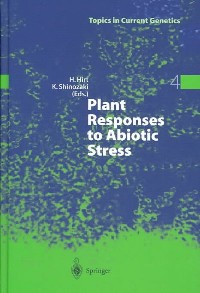
Plant responses to abiotic stress /
副标题:无
作 者:Heribert Hirt, Kazuo Shinozaki, (eds.)
分类号:
ISBN:9783540200376
微信扫一扫,移动浏览光盘
简介
Summary:
Publisher Summary 1
Environmental stresses represent the most limiting factors for agricultural productivity. Apart from biotic stress caused by plant pathogens, there are a number of abiotic stresses such as extremes in temperature, drought, salinity, heavy metals and radiation which all have detrimental effects on plant growth and yield. However, certain plant species and ecotypes have聽developed various mechanisms to adapt to such聽stress conditions. Recent advances in the understanding of these abiotic stress responses provided the impetus for compiling up-to-date reviews discussing all relevant topics in abiotic stress signaling of plants in a single volume. Topical reviews were prepared by selected experts and contain an introduction, discussion of the state of the art and important future tasks of the particular fields.
目录
Table Of Contents:
Introduction 1(270)
Heribert Hirt 1(8)
Water stress 2(1)
Salt stress 2(1)
Low temperature stress 3(1)
ABA as abiotic stress signalling hormone 4(1)
Heat stress 4(1)
Oxidative stress 5(1)
Heavy metal stress 6(1)
Genotoxic stress 6(1)
Stress transcriptome analysis 7(1)
Stress sensors in the model organism Synechocystis 8(1)
1 Molecular responses of higher plants to dehydration 9(30)
Dorothea Bartels and Erik Souer 9(30)
Abstract 9(1)
1.1 Introduction 9(1)
1.2 Plant species and experimental systems used in molecular studies 10(1)
1.3 Abscisic acid (ABA) 11(2)
1.4 The perception of water stress 13(6)
1.4.1 Histidine kinases 13(1)
1.4.2 The role of kinases and phosphatases in the response to water deficit 14(2)
1.4.2 Calcium signalling 16(1)
1.4.3 Heterotrimeric G-proteins 17(1)
1.4.4 Phospholipid signalling 17(2)
1.5 Transcriptional control 19(7)
1.5.1 The ABA responsive element 22(1)
1.5.2 The dehydration-responsive element 22(1)
1.5.3 The SAP domain 23(1)
1.5.4 Myb and helix-loop-helix domains 24(1)
1.5.5 Homeodomain proteins 25(1)
1.5.6 An RNA as a signalling molecule? 25(1)
1.5.7 Positioning of signals in the network 26(1)
1.6 Dehydration-activated proteins 26(2)
1.6.1 The accumulation of compatible solutes 26(1)
1.6.2 Genes that encode proteins with protective functions 27(1)
1.6.3 Reactive oxygen intermediates 28(1)
1.7 Conclusions and outlook 28(2)
Acknowledgements 30(1)
References 30(7)
Abbreviations 37(2)
2 Abscisic acid signalling 39(34)
Alexander Christmann, Erwin Grill and Michael Meinhard 39(34)
Abstract 39(1)
2.1 Introduction 39(1)
2.2 Systems used to study ABA signal transduction 40(1)
2.3 ABA biosynthesis 41(3)
2.3.1 Reactions generating substrates for NCED 43(1)
2.3.2 NCED-catalyzed cleavage reaction 43(1)
2.3.3 Formation of ABA from xanthoxirt 43(1)
2.3.4 Feedback regulation of ABA biosynthesis 44(1)
2.4. signalling components 44(13)
2.4.1 ABA- Receptor 44(1)
2.4.2 Intracellular messengers 45(4)
2.4.3 0-proteins 49(1)
2.4.4 Famesyltransferase ERA1 50(1)
2.4.5 Protein phosphatases 50(3)
2.4.6 Protein kinases 53(1)
2.4.7 Transcriptional regulators 54(3)
2.5 RNA and protein turnover during ABA response 57(1)
2.6 Cross-talk 58(1)
Acknowledgements 58(1)
References 58(15)
3 Plant responses to heat stress 73(30)
Priti Krishna 73(30)
Abstract 73(1)
3.1 Introduction 73(1)
3.2 Major families of heat shock proteins 74(5)
3.2.1 Hsp100 74(1)
3.2.2 Hsp90 75(1)
3.2.3 Hsp70 76(1)
3.2.4 Small hsps 77(1)
3.2.5 The Chaperonins 78(1)
3.3 Transcriptional regulation of hsps 79(8)
3.3.1 Structure of plant Hsfs 80(1)
3.3.2 Regulation of plant Hsfs 80(7)
3.4 Ca2+ and heat shock response 87(1)
3.5 Hormones and heat stress response 88(2)
3.6 Relationship between heat and other stresses 90(1)
3.7 Developmental regulation of shsps by Hsfs 91(1)
3.8 Future directions 92(1)
Acknowledgements 93(1)
References 93(10)
4 Sensors of abiotic stress in systechocystis 103(18)
Koji Mikami, Iwane Suzuki and Norio Murata 103(18)
Abstract 103(1)
4.1 Introduction 103(1)
4.2 Hik33 as a cold sensor 104(2)
4.3 Hik33 as a sensor of hyperosmotic stress 106(1)
4.4 Perception of multiple stresses by Hik33 106(2)
4.5 Hik16, Hik33, and Hik34 as salt sensors 108(1)
4.6 Hik7 and Rre29 as the sensor and signal transducer of a phosphate deficit 108(1)
4.7 Sensors of metal ions 109(3)
4.7.1 Hik27 and Rre16 as the sensor and signal transducer of manganese deficiency 110(2)
4.7.2 Hik30 and Rre33 as the sensor and signal transducer of an excess of Ni2+ ions 112(1)
4.8 Comparative analysis of histidine kinases (Hiks) in cyanobacteria 112(1)
4.9 Future perspectives 113(1)
Acknowledgements 114(1)
References 114(7)
5 Oxidative stress signalling 121(30)
Radhika Desikan, John T. Hancock and Steven J. Neill 121(30)
Abstract 121(1)
5.1 Introduction 121(1)
5.2 Reactive oxygen species (ROS) 122(2)
5.3 Redox balance and the generation and removal of ROS 124(6)
5.3.1 Redox balance 124(1)
5.3.2 ROS generation 124(4)
5.3.3 Removal of ROS 128(2)
5.4 Cellular responses 130(7)
5.4.1 Effects on gene expression 130(4)
5.4.2 Signalling 134(3)
5.5 H2O2 biology 137(4)
5.5.2 H2O2 and stomata 139(1)
5.5.3 H2O2 and roots 140(1)
5.5.4 Anoxia and H2O2 140(1)
5.6 Conclusions 141(1)
References 141(7)
Abbreviations 148(3)
6 Signal transduction in plant cold acclimation 151(36)
Pekka Heino and E. Tapio Palva 151(36)
Abstract 151(1)
6.1 Introduction 151(5)
6.1.1 Low temperature stress 151(1)
6.1.2 Cold acclimation 152(3)
6.1.3 Molecular dissection of cold acclimation 155(1)
6.2 Signal perception and low temperature sensing 156(2)
6.2.1 Perception of cold 156(1)
6.2.2 Membrane rigidification 157(1)
6.3 Role of Cat in cold acclimation 158(4)
6.4 Protein phosphorylation 162(3)
6.4.1 Protein kinases 162(2)
6.4.2 Protein phosphatases 164(1)
6.5 Regulation of gene expression in response to low temperature 165(10)
6.5.1 Gene expression in response to cold 165(1)
6.5.2 CRT/DRE/LTRE regulated gene expression 166(3)
6.5.3 ABRE mediated gene expression 169(1)
6.5.4 Regulation of transcription factors 170(3)
6.5.5 Post-transcriptional regulation of gene expression 173(2)
6.6 Conclusions 175(1)
Acknowledgements 176(1)
References 176(11)
7 Heavy metal signalling in plants: linking cellular and organismic responses 187(30)
Andrea Polle and Andres Sch眉tzendiibel 187(30)
Abstract 187(1)
7.1 Introduction 187(2)
7.2 Chemical properties, toxicity, and stress signalling of heavy metals with contrasting functions in plants 189(4)
7.2.1 Copper 189(1)
7.2.2 Cadmium 190(3)
7.3 Uptake and sensing of heavy metals: regulation of metal homeostasis 193(6)
7.3.1 Extracellular cellular processes and biotrophic interactions 193(2)
7.3.2 Cellular signalling of copper - means to maintain homeostasis 195(3)
7.3.3 Cellular signalling of cadmium 198(1)
7.4 Stress signals triggering plant growth and development at the organismic level 199(5)
7.4.1 Links between cellular heavy metal signalling and inhibition of root growth 199(3)
7.4.2 Long distance signalling and shoot responses to heavy metals 202(2)
7.5 Conclusions and implication for future research 204(1)
Acknowledgements 205(1)
References 205(12)
8 Molecular genetics of genotoxic stress signalling in plants 217(24)
Roman Ulm 217(24)
Abstract 217(1)
8.1 Introduction 217(1)
8.2 What is genotoxic stress? 218(3)
8.3 Genotoxic stress signalling 221(11)
8.3.1 From inside the nucleus 221(4)
8.3.2 From the cell periphery 225(5)
8.3.3 Transcriptional response to genotoxic stress in plants 230(1)
8.3.4 UV-B signalling 231(1)
8.4 Rapid genomic change in plants? 232(1)
8.5 Conclusions 233(1)
Acknowledgements 233(1)
References 233(6)
Abbreviations 239(2)
9 Plant salt tolerance 241(30)
Viswanathan Chinnusamy and Jian-Kang Zhu 241(30)
Abstract 241(1)
9.1 Introduction 241(1)
9.2 Sodium entry into plant cells 242(1)
9.3 Input signals of salt stress 243(9)
9.3.1 Calcium signalling 244(2)
9.3.2 Calcium sensors 246(2)
9.3.3 Hybrid two-component receptor kinases 248(2)
9.3.4 MAPK pathway 250(2)
9.4 ABA-mediated salt stress signaling 252(1)
9.5 The SOS signaling pathway of ion homeostasis 253(2)
9.6 Osmotic stress management 255(2)
9.6.1 Sodium sequestration into the vacuole 256(1)
9.6.2 K+ Uptake 256(1)
9.63 Osmoprotectant biosynthesis 257(1)
9.7 Stress damage control and repair 258(1)
9.7.1 Salt stress induced proteins 258(1)
9.8 Oxidative stress management 259(1)
9.9 Growth regulation 260(1)
9.10 Conclusions and perspectives 261(1)
Acknowledgements 261(1)
References 261(10)
10 Transcriptome analysis in abiotic stress conditions in higher plants 271(26)
Motoaki Seki, Ayako Kamei, Masakazu Satou, Tetsuya Sakurai, Miki Fujita, Youko Oono, Kazuko Yamaguchi-Shinozaki and Kazuo Shinozaki 271(26)
Abstract 271(1)
10.1 Introduction 271(1)
10.2 Cis- and trans-acting factors involved in regulation of gene expression by drought, high-salinity and cold stress 272(1)
10.2.1 Application of cDNA microarray analysis to expression profiling under abiotic stress conditions 273(1)
10.3 Collection and functional annotation of RIKEN Arabidopsis full-length (RAFL) cDNAs 273(4)
10.3.1 Application of RIKEN Arabidopsis full-length (RAFL) cDNA microarray to identify drought-, cold-, or high-salinity-stress regulated genes 274(3)
10.4 Stress-inducible genes and functions of their gene products identified by RAFL cDNA microarray 277(8)
10.4.1 Cold-inducible genes and stress-downregulated genes identified using RAFL cDNA microarray 281(2)
10.4.2 Application of RAFL cDNA microarray to study the expression profiles under abiotic stress conditions 283(2)
10.5 Application of Arabidopsis GeneChip to study the expression profiles under abiotic stress conditions 285(2)
10.6 Abiotic stress-inducible genes identified using microarrays in monocots 287(1)
10.7 Conclusions and perspectives 287(2)
Acknowledgements 289(1)
References 289(5)
Abbreviations 294(3)
Index 297
Introduction 1(270)
Heribert Hirt 1(8)
Water stress 2(1)
Salt stress 2(1)
Low temperature stress 3(1)
ABA as abiotic stress signalling hormone 4(1)
Heat stress 4(1)
Oxidative stress 5(1)
Heavy metal stress 6(1)
Genotoxic stress 6(1)
Stress transcriptome analysis 7(1)
Stress sensors in the model organism Synechocystis 8(1)
1 Molecular responses of higher plants to dehydration 9(30)
Dorothea Bartels and Erik Souer 9(30)
Abstract 9(1)
1.1 Introduction 9(1)
1.2 Plant species and experimental systems used in molecular studies 10(1)
1.3 Abscisic acid (ABA) 11(2)
1.4 The perception of water stress 13(6)
1.4.1 Histidine kinases 13(1)
1.4.2 The role of kinases and phosphatases in the response to water deficit 14(2)
1.4.2 Calcium signalling 16(1)
1.4.3 Heterotrimeric G-proteins 17(1)
1.4.4 Phospholipid signalling 17(2)
1.5 Transcriptional control 19(7)
1.5.1 The ABA responsive element 22(1)
1.5.2 The dehydration-responsive element 22(1)
1.5.3 The SAP domain 23(1)
1.5.4 Myb and helix-loop-helix domains 24(1)
1.5.5 Homeodomain proteins 25(1)
1.5.6 An RNA as a signalling molecule? 25(1)
1.5.7 Positioning of signals in the network 26(1)
1.6 Dehydration-activated proteins 26(2)
1.6.1 The accumulation of compatible solutes 26(1)
1.6.2 Genes that encode proteins with protective functions 27(1)
1.6.3 Reactive oxygen intermediates 28(1)
1.7 Conclusions and outlook 28(2)
Acknowledgements 30(1)
References 30(7)
Abbreviations 37(2)
2 Abscisic acid signalling 39(34)
Alexander Christmann, Erwin Grill and Michael Meinhard 39(34)
Abstract 39(1)
2.1 Introduction 39(1)
2.2 Systems used to study ABA signal transduction 40(1)
2.3 ABA biosynthesis 41(3)
2.3.1 Reactions generating substrates for NCED 43(1)
2.3.2 NCED-catalyzed cleavage reaction 43(1)
2.3.3 Formation of ABA from xanthoxirt 43(1)
2.3.4 Feedback regulation of ABA biosynthesis 44(1)
2.4. signalling components 44(13)
2.4.1 ABA- Receptor 44(1)
2.4.2 Intracellular messengers 45(4)
2.4.3 0-proteins 49(1)
2.4.4 Famesyltransferase ERA1 50(1)
2.4.5 Protein phosphatases 50(3)
2.4.6 Protein kinases 53(1)
2.4.7 Transcriptional regulators 54(3)
2.5 RNA and protein turnover during ABA response 57(1)
2.6 Cross-talk 58(1)
Acknowledgements 58(1)
References 58(15)
3 Plant responses to heat stress 73(30)
Priti Krishna 73(30)
Abstract 73(1)
3.1 Introduction 73(1)
3.2 Major families of heat shock proteins 74(5)
3.2.1 Hsp100 74(1)
3.2.2 Hsp90 75(1)
3.2.3 Hsp70 76(1)
3.2.4 Small hsps 77(1)
3.2.5 The Chaperonins 78(1)
3.3 Transcriptional regulation of hsps 79(8)
3.3.1 Structure of plant Hsfs 80(1)
3.3.2 Regulation of plant Hsfs 80(7)
3.4 Ca2+ and heat shock response 87(1)
3.5 Hormones and heat stress response 88(2)
3.6 Relationship between heat and other stresses 90(1)
3.7 Developmental regulation of shsps by Hsfs 91(1)
3.8 Future directions 92(1)
Acknowledgements 93(1)
References 93(10)
4 Sensors of abiotic stress in systechocystis 103(18)
Koji Mikami, Iwane Suzuki and Norio Murata 103(18)
Abstract 103(1)
4.1 Introduction 103(1)
4.2 Hik33 as a cold sensor 104(2)
4.3 Hik33 as a sensor of hyperosmotic stress 106(1)
4.4 Perception of multiple stresses by Hik33 106(2)
4.5 Hik16, Hik33, and Hik34 as salt sensors 108(1)
4.6 Hik7 and Rre29 as the sensor and signal transducer of a phosphate deficit 108(1)
4.7 Sensors of metal ions 109(3)
4.7.1 Hik27 and Rre16 as the sensor and signal transducer of manganese deficiency 110(2)
4.7.2 Hik30 and Rre33 as the sensor and signal transducer of an excess of Ni2+ ions 112(1)
4.8 Comparative analysis of histidine kinases (Hiks) in cyanobacteria 112(1)
4.9 Future perspectives 113(1)
Acknowledgements 114(1)
References 114(7)
5 Oxidative stress signalling 121(30)
Radhika Desikan, John T. Hancock and Steven J. Neill 121(30)
Abstract 121(1)
5.1 Introduction 121(1)
5.2 Reactive oxygen species (ROS) 122(2)
5.3 Redox balance and the generation and removal of ROS 124(6)
5.3.1 Redox balance 124(1)
5.3.2 ROS generation 124(4)
5.3.3 Removal of ROS 128(2)
5.4 Cellular responses 130(7)
5.4.1 Effects on gene expression 130(4)
5.4.2 Signalling 134(3)
5.5 H2O2 biology 137(4)
5.5.2 H2O2 and stomata 139(1)
5.5.3 H2O2 and roots 140(1)
5.5.4 Anoxia and H2O2 140(1)
5.6 Conclusions 141(1)
References 141(7)
Abbreviations 148(3)
6 Signal transduction in plant cold acclimation 151(36)
Pekka Heino and E. Tapio Palva 151(36)
Abstract 151(1)
6.1 Introduction 151(5)
6.1.1 Low temperature stress 151(1)
6.1.2 Cold acclimation 152(3)
6.1.3 Molecular dissection of cold acclimation 155(1)
6.2 Signal perception and low temperature sensing 156(2)
6.2.1 Perception of cold 156(1)
6.2.2 Membrane rigidification 157(1)
6.3 Role of Cat in cold acclimation 158(4)
6.4 Protein phosphorylation 162(3)
6.4.1 Protein kinases 162(2)
6.4.2 Protein phosphatases 164(1)
6.5 Regulation of gene expression in response to low temperature 165(10)
6.5.1 Gene expression in response to cold 165(1)
6.5.2 CRT/DRE/LTRE regulated gene expression 166(3)
6.5.3 ABRE mediated gene expression 169(1)
6.5.4 Regulation of transcription factors 170(3)
6.5.5 Post-transcriptional regulation of gene expression 173(2)
6.6 Conclusions 175(1)
Acknowledgements 176(1)
References 176(11)
7 Heavy metal signalling in plants: linking cellular and organismic responses 187(30)
Andrea Polle and Andres Sch眉tzendiibel 187(30)
Abstract 187(1)
7.1 Introduction 187(2)
7.2 Chemical properties, toxicity, and stress signalling of heavy metals with contrasting functions in plants 189(4)
7.2.1 Copper 189(1)
7.2.2 Cadmium 190(3)
7.3 Uptake and sensing of heavy metals: regulation of metal homeostasis 193(6)
7.3.1 Extracellular cellular processes and biotrophic interactions 193(2)
7.3.2 Cellular signalling of copper - means to maintain homeostasis 195(3)
7.3.3 Cellular signalling of cadmium 198(1)
7.4 Stress signals triggering plant growth and development at the organismic level 199(5)
7.4.1 Links between cellular heavy metal signalling and inhibition of root growth 199(3)
7.4.2 Long distance signalling and shoot responses to heavy metals 202(2)
7.5 Conclusions and implication for future research 204(1)
Acknowledgements 205(1)
References 205(12)
8 Molecular genetics of genotoxic stress signalling in plants 217(24)
Roman Ulm 217(24)
Abstract 217(1)
8.1 Introduction 217(1)
8.2 What is genotoxic stress? 218(3)
8.3 Genotoxic stress signalling 221(11)
8.3.1 From inside the nucleus 221(4)
8.3.2 From the cell periphery 225(5)
8.3.3 Transcriptional response to genotoxic stress in plants 230(1)
8.3.4 UV-B signalling 231(1)
8.4 Rapid genomic change in plants? 232(1)
8.5 Conclusions 233(1)
Acknowledgements 233(1)
References 233(6)
Abbreviations 239(2)
9 Plant salt tolerance 241(30)
Viswanathan Chinnusamy and Jian-Kang Zhu 241(30)
Abstract 241(1)
9.1 Introduction 241(1)
9.2 Sodium entry into plant cells 242(1)
9.3 Input signals of salt stress 243(9)
9.3.1 Calcium signalling 244(2)
9.3.2 Calcium sensors 246(2)
9.3.3 Hybrid two-component receptor kinases 248(2)
9.3.4 MAPK pathway 250(2)
9.4 ABA-mediated salt stress signaling 252(1)
9.5 The SOS signaling pathway of ion homeostasis 253(2)
9.6 Osmotic stress management 255(2)
9.6.1 Sodium sequestration into the vacuole 256(1)
9.6.2 K+ Uptake 256(1)
9.63 Osmoprotectant biosynthesis 257(1)
9.7 Stress damage control and repair 258(1)
9.7.1 Salt stress induced proteins 258(1)
9.8 Oxidative stress management 259(1)
9.9 Growth regulation 260(1)
9.10 Conclusions and perspectives 261(1)
Acknowledgements 261(1)
References 261(10)
10 Transcriptome analysis in abiotic stress conditions in higher plants 271(26)
Motoaki Seki, Ayako Kamei, Masakazu Satou, Tetsuya Sakurai, Miki Fujita, Youko Oono, Kazuko Yamaguchi-Shinozaki and Kazuo Shinozaki 271(26)
Abstract 271(1)
10.1 Introduction 271(1)
10.2 Cis- and trans-acting factors involved in regulation of gene expression by drought, high-salinity and cold stress 272(1)
10.2.1 Application of cDNA microarray analysis to expression profiling under abiotic stress conditions 273(1)
10.3 Collection and functional annotation of RIKEN Arabidopsis full-length (RAFL) cDNAs 273(4)
10.3.1 Application of RIKEN Arabidopsis full-length (RAFL) cDNA microarray to identify drought-, cold-, or high-salinity-stress regulated genes 274(3)
10.4 Stress-inducible genes and functions of their gene products identified by RAFL cDNA microarray 277(8)
10.4.1 Cold-inducible genes and stress-downregulated genes identified using RAFL cDNA microarray 281(2)
10.4.2 Application of RAFL cDNA microarray to study the expression profiles under abiotic stress conditions 283(2)
10.5 Application of Arabidopsis GeneChip to study the expression profiles under abiotic stress conditions 285(2)
10.6 Abiotic stress-inducible genes identified using microarrays in monocots 287(1)
10.7 Conclusions and perspectives 287(2)
Acknowledgements 289(1)
References 289(5)
Abbreviations 294(3)
Index 297
Plant responses to abiotic stress /
- 名称
- 类型
- 大小
光盘服务联系方式: 020-38250260 客服QQ:4006604884
云图客服:
用户发送的提问,这种方式就需要有位在线客服来回答用户的问题,这种 就属于对话式的,问题是这种提问是否需要用户登录才能提问
Video Player
×
Audio Player
×
pdf Player
×
