

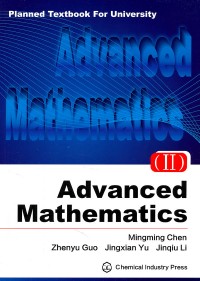
简介
本书为《高等数学(Ⅱ)(英文版)》,由陈明明、郭振宇、于晶贤、李
金秋编著。
《高等数学(Ⅱ)(英文版)》内容如下:
The aim of this book is to meet the requirement of bilingual
teaching of advanced mathematics. The selection of the contents
is in accordance with the fundamental requirements of teaching
issued by the Ministry of Education of China. And base on the
property of our university, we select some examples about
petrochemical industry. These examples may help readers to
understand the application of advanced mathematics in
petrochemical industry.
This book is divided into two volumes.The first volume
contains calculus of functions of a single variable and
differential equation.The second volume contains vector algebra
and analytic geometry in space, multivariable calculus and
infinite series.
This book may be used as a textbook for undergraduate
students in the science and engineering schools whose majors are
not mathematics, and may also be suitable to the readers at the
same level.
目录
Chapter 8 Vector Algebra and Analytic Geometry of Space
8.1 Vectors and their linear operations
8.1.1 The concept of vector
8.1.2 Vector linear operations
8.1.3 Three-dimensional rectangular coordinate system
8.1.4 Component representation of vector linear operations
8.1.5 Length,direction angles and projection of a vector
Exercise 8-1
8.2 Multiplicative operations on vectors
8.2.1 The scalar product(dot product,inner product)of two vectors
8.2.2 The vector product(cross product,outer product)of two vectors
*8.2.3 The mixed product of three vectors
Exercise 8-2
8.3 Surfaces and their equations
8.3.1 Definition of surface equations
8.3.2 Surfaces of revolution
8.3.3 Cylinders
8.3.4 Quadric surfaces
Exercise 8-3
8.4 Space curves and their equations
8.4.1 General form of equations of space curves
8.4.2 Parametric equations of space curves
*8.4.3 Parametric equations of a surface
8.4.4 Projections of space curves on coordinate planes
Exercise 8-4
8.5 Plane and its equation
8.5.1 Point-normal form of the equation of a plane
8.5.2 General form of the equation of a plane
8.5.3 The included angle between two planes
Exercise 8-5
8.6 Straight line in space and its equation
8.6.1 General form of the equations of a straight line
8.6.2 Parametric equations and symmetric form equations of a straight line
8.6.3 The included angel between two lines
8.6.4 The included angle between a line and a plane
8.6.5 Some examples
Exercise 8-6
Exercise 8
Chapter 9 The multivariable differential calculus and its applications44
9.1 Basic concepts of multivariable functions
9.1.1 Planar sets n-dimensional space
9.1.2 The concept of a multivariable function
9.1.3 Limits of multivariable functions
9.1.4 Continuity of multivariable functions
Exercise 9-1
9.2 Partial derivatives
9.2.1 Definition and computation of partial derivatives
9.2.2 Higher-order partial derivatives
Exercise 9-2
9.3 Total differentials
9.3.1 Definition of total differential
9.3.2 Applications of the total differential to approximate computation
Exercise 9-3
9.4 Differentiation of multivariable composite functions
9.4.1 Composition of functions of one variable and multivariable functions
9.4.2 Composition of multivariable functions and multivariable functions
9.4.3 Other case
Exercise 9-4
9.5 Differentiation of implicit functions
9.5.1 Case of one equation
9.5.2 Case of system of equations
Exercise 9-5
9.6 Applications of differential calculus of multivariable functions in geometry
9.6.1 Derivatives and differentials of vector-valued functions of one variable
9.6.2 Tangent line and normal plane to a space curve
9.6.3 Tangent plane and normal line of surfaces
Exercise 9-6
9.7 Directional derivatives and gradient
9.7.1 Directional derivatives
9.7.2 Gradient
Exercise 9-7
9.8 Extreme value problems for multivariable functions
9.8.1 Unrestricted extreme values and global maxima and minima
9.8.2 Extreme values with constraints the method of Lagrange multipliers
Exercise 9-8
9.9 Taylor formula for functions of two variables
9.9.1 Taylor formula for functions of two variables
9.9.2 Proof of the sufficient condition for extreme values of function of two variables
Exercise 9-9
Exercise 9
Chapter 10 Multiple Integrals
10.1 The concept and properties of double integrals
10.1.1 The concept of double integrals
10.1.2 Properties of double Integrals
Exercise 10-1
10.2 Computation of double integrals
10.2.1 Computation of double integrals in rectangular coordinates
10.2.2 Computation of double integrals in polar coordinates
*10.2.3 Integration by substitution for double integrals
Exercise 10-2
10.3 Triple integrals
10.3.1 Concept of triple integrals
10.3.2 Computation of triple integrals
Exercise 10-3
10.4 Application of multiple integrals
10.4.1 Area of a surface
10.4.2 Center of mass
10.4.3 Moment of inertia
10.4.4 Gravitational force
Exercise 10-4
10.5 Integral with parameter
Exercise 10-5
Exercise 10
Chapter 1 1Line and Surface Integrals
11.1 Line integrals with respect to arc lengths
11.1.1 The concept and properties of the line integral with respect to arc lengths
11.1.2 Computation of line integral with respect to arc lengths
Exercise 11-1
11.2 Line integrals with respect to coordinates
11.2.1 The concept and properties of the line integrals with respect to coordinates
11.2.2 Computation of line integrals with respect to coordinates
11.2.3 The relationship between the two types of line integral
Exercise 11-2
11.3 Green’s formula and the application to fields
11.3.1 Green’s formula
11.3.2 The conditions for a planar line integral to have independence of path
11.3.3 Quadrature problem of the total differential
Exercise 11-3
11.4 Surface integrals with respect to acreage
11.4.1 The concept and properties of the surface integral with respect to acreage
11.4.2 Computation of surface integrals with respect to acreage
Exercise 11-4
11.5 Surface integrals with respect to coordinates
11.5.1 The concept and properties of the surface integrals with respect to coordinates
11.5.2 Computation of surface integrals with respect to coordinates
11.5.3 The relationship between the two types of surface integral
Exercise 11-5
11.6 Gauss’ formula
11.6.1 Gauss’ formula
*11.6.2 Flux and divergence
Exercise 11-6
11.7 Stokes formula
11.7.1 Stokes formula
11.7.2 Circulation and rotation
Exercise 11-7
Exercise 11
Chapter 12 Infinite Series
12.1 Concepts and properties of series with constant terms
12.1.1 Concepts of series with constant terms
12.1.2 Properties of convergence with series
*12.1.3 Cauchy’s convergence principle
Exercise 12-1
12.2 Convergence tests for series with constant terms
12.2.1 Convergence tests for series of positive terms
12.2.2 Alternating series and Leibniz’s test
12.2.3 Absolute and conditional convergence
Exercise 12-2
12.3 Power series
12.3.1 Concepts of series of functions
12.3.2 Power series and convergence of power series
12.3.3 Operations on power series
Exercise 12-3
12.4 Expansion of functions in power series
Exercise 12-4
12.5 Application of expansion of functions in power series
12.5.1 Approximations by power series
12.5.2 Power series solutions of differential equation
12.5.3 Euler formula
Exercise 12-5
12.6 Fourier series
12.6.1 Trigonometric series and orthogonality of the system of trigonometric functions
12.6.2 Expand a function into a Fourier series
12.6.3 Expand a function into the sine series and cosine series
Exercise 12-6
12.7 The Fourier series of a function of period 21
Exercise 12-7
Exercise 12
Reference
8.1 Vectors and their linear operations
8.1.1 The concept of vector
8.1.2 Vector linear operations
8.1.3 Three-dimensional rectangular coordinate system
8.1.4 Component representation of vector linear operations
8.1.5 Length,direction angles and projection of a vector
Exercise 8-1
8.2 Multiplicative operations on vectors
8.2.1 The scalar product(dot product,inner product)of two vectors
8.2.2 The vector product(cross product,outer product)of two vectors
*8.2.3 The mixed product of three vectors
Exercise 8-2
8.3 Surfaces and their equations
8.3.1 Definition of surface equations
8.3.2 Surfaces of revolution
8.3.3 Cylinders
8.3.4 Quadric surfaces
Exercise 8-3
8.4 Space curves and their equations
8.4.1 General form of equations of space curves
8.4.2 Parametric equations of space curves
*8.4.3 Parametric equations of a surface
8.4.4 Projections of space curves on coordinate planes
Exercise 8-4
8.5 Plane and its equation
8.5.1 Point-normal form of the equation of a plane
8.5.2 General form of the equation of a plane
8.5.3 The included angle between two planes
Exercise 8-5
8.6 Straight line in space and its equation
8.6.1 General form of the equations of a straight line
8.6.2 Parametric equations and symmetric form equations of a straight line
8.6.3 The included angel between two lines
8.6.4 The included angle between a line and a plane
8.6.5 Some examples
Exercise 8-6
Exercise 8
Chapter 9 The multivariable differential calculus and its applications44
9.1 Basic concepts of multivariable functions
9.1.1 Planar sets n-dimensional space
9.1.2 The concept of a multivariable function
9.1.3 Limits of multivariable functions
9.1.4 Continuity of multivariable functions
Exercise 9-1
9.2 Partial derivatives
9.2.1 Definition and computation of partial derivatives
9.2.2 Higher-order partial derivatives
Exercise 9-2
9.3 Total differentials
9.3.1 Definition of total differential
9.3.2 Applications of the total differential to approximate computation
Exercise 9-3
9.4 Differentiation of multivariable composite functions
9.4.1 Composition of functions of one variable and multivariable functions
9.4.2 Composition of multivariable functions and multivariable functions
9.4.3 Other case
Exercise 9-4
9.5 Differentiation of implicit functions
9.5.1 Case of one equation
9.5.2 Case of system of equations
Exercise 9-5
9.6 Applications of differential calculus of multivariable functions in geometry
9.6.1 Derivatives and differentials of vector-valued functions of one variable
9.6.2 Tangent line and normal plane to a space curve
9.6.3 Tangent plane and normal line of surfaces
Exercise 9-6
9.7 Directional derivatives and gradient
9.7.1 Directional derivatives
9.7.2 Gradient
Exercise 9-7
9.8 Extreme value problems for multivariable functions
9.8.1 Unrestricted extreme values and global maxima and minima
9.8.2 Extreme values with constraints the method of Lagrange multipliers
Exercise 9-8
9.9 Taylor formula for functions of two variables
9.9.1 Taylor formula for functions of two variables
9.9.2 Proof of the sufficient condition for extreme values of function of two variables
Exercise 9-9
Exercise 9
Chapter 10 Multiple Integrals
10.1 The concept and properties of double integrals
10.1.1 The concept of double integrals
10.1.2 Properties of double Integrals
Exercise 10-1
10.2 Computation of double integrals
10.2.1 Computation of double integrals in rectangular coordinates
10.2.2 Computation of double integrals in polar coordinates
*10.2.3 Integration by substitution for double integrals
Exercise 10-2
10.3 Triple integrals
10.3.1 Concept of triple integrals
10.3.2 Computation of triple integrals
Exercise 10-3
10.4 Application of multiple integrals
10.4.1 Area of a surface
10.4.2 Center of mass
10.4.3 Moment of inertia
10.4.4 Gravitational force
Exercise 10-4
10.5 Integral with parameter
Exercise 10-5
Exercise 10
Chapter 1 1Line and Surface Integrals
11.1 Line integrals with respect to arc lengths
11.1.1 The concept and properties of the line integral with respect to arc lengths
11.1.2 Computation of line integral with respect to arc lengths
Exercise 11-1
11.2 Line integrals with respect to coordinates
11.2.1 The concept and properties of the line integrals with respect to coordinates
11.2.2 Computation of line integrals with respect to coordinates
11.2.3 The relationship between the two types of line integral
Exercise 11-2
11.3 Green’s formula and the application to fields
11.3.1 Green’s formula
11.3.2 The conditions for a planar line integral to have independence of path
11.3.3 Quadrature problem of the total differential
Exercise 11-3
11.4 Surface integrals with respect to acreage
11.4.1 The concept and properties of the surface integral with respect to acreage
11.4.2 Computation of surface integrals with respect to acreage
Exercise 11-4
11.5 Surface integrals with respect to coordinates
11.5.1 The concept and properties of the surface integrals with respect to coordinates
11.5.2 Computation of surface integrals with respect to coordinates
11.5.3 The relationship between the two types of surface integral
Exercise 11-5
11.6 Gauss’ formula
11.6.1 Gauss’ formula
*11.6.2 Flux and divergence
Exercise 11-6
11.7 Stokes formula
11.7.1 Stokes formula
11.7.2 Circulation and rotation
Exercise 11-7
Exercise 11
Chapter 12 Infinite Series
12.1 Concepts and properties of series with constant terms
12.1.1 Concepts of series with constant terms
12.1.2 Properties of convergence with series
*12.1.3 Cauchy’s convergence principle
Exercise 12-1
12.2 Convergence tests for series with constant terms
12.2.1 Convergence tests for series of positive terms
12.2.2 Alternating series and Leibniz’s test
12.2.3 Absolute and conditional convergence
Exercise 12-2
12.3 Power series
12.3.1 Concepts of series of functions
12.3.2 Power series and convergence of power series
12.3.3 Operations on power series
Exercise 12-3
12.4 Expansion of functions in power series
Exercise 12-4
12.5 Application of expansion of functions in power series
12.5.1 Approximations by power series
12.5.2 Power series solutions of differential equation
12.5.3 Euler formula
Exercise 12-5
12.6 Fourier series
12.6.1 Trigonometric series and orthogonality of the system of trigonometric functions
12.6.2 Expand a function into a Fourier series
12.6.3 Expand a function into the sine series and cosine series
Exercise 12-6
12.7 The Fourier series of a function of period 21
Exercise 12-7
Exercise 12
Reference
- 名称
- 类型
- 大小
光盘服务联系方式: 020-38250260 客服QQ:4006604884
云图客服:
用户发送的提问,这种方式就需要有位在线客服来回答用户的问题,这种 就属于对话式的,问题是这种提问是否需要用户登录才能提问
Video Player
×
Audio Player
×
pdf Player
×
