

简介
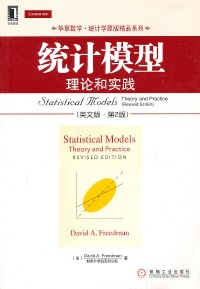
《统计模型:理论和实践(英文版·第2版)》内容简介:Some books are correct. Some are clear. Some are useful. Some are entertaining. Few are even two of these. This book is all four. Statistical Models: Theory and Practice is lucid, candid and insightful, a joy to read. We are fortunate that David Freedman finished this new edition before his death in late 2008. We are deeply saddened by his passing, and we greatly admire the energy and cheer he brought to this volume——and many other projects——-during his final months.
目录
Foreword to the ReVised Edition
Preface
1 Observational Studies and Experiments
1.1 Introduction
1.2 The HIP trial
1.3 Snow on cholera
1.4 Yule on the causes of poverty
Exercise set A
1.5 End notes
2 The Regression Line
2.1 Introduction
2.2 The regression line
2.3 Hooke's law
Exercise set A
2.4 Complexities
2.5 Simple vs multiple regression
Exercise set B
2.6 End notes
3 Matrix Algebra
3.1 Introduction
Exercise set A
3.2 Determinants and inverses
Exercise set B
3.3 Random vectors
Exercise set C
3.4 Positive definite matrices
Exercise set D
3.5 The normal distribution
Exercise set E
3.6 If you want a book on matrix algebra
4 Multiple Regression
4.1 Introduction
Exercise set A
4.2 Standard errors
Things we don't need
Exercise set B
4.3 Explained variance in multiple regression
Association or causation?
Exercise set C
4.4 What happens to OLS if the assumptions break down?
4.5 Discussion questions
4.6 End notes
5 Multiple Regression: Special Topics
5.1 Introduction
5.2 OLSisBLUE
Exercise set A
5.3 Generalized least squares
Exercise set B
5.4 Examples on GLS
Exercise set C
5.5 What happens to GLS if the assumptions break down?
5.6 Normal theory
Statistical significance
Exercise set D
5.7 The F-test
"The" F-test in applied work
Exercise set E
5.8 Data snooping
Exercise set F
5.9 Discussion questions
5.10 End notes
6 Path Models
6.1 Stratification
Exercise set A
6.2 Hooke's law revisited
Exercise set B
6.3 Political repression during the McCarthy era
Exercise set C
6.4 Inferring causation .by regression
Exercise set D
6.5 Response schedules for path diagrams
Selection vs intervention
Structural equations and stable parameter:Ambiguity in notation
Exercise set E
6.6 Dummy variables
Types of variables
6.7 Discussion questions
6.8 End notes
7 Maximum Likelihood
7.1 Introduction
Exercise set A
7.2 Probit models
Why not regression?
The latent-variable formulation
Exercise set B
Identification vs estimation
What if the Ui are N?
Exercise set C
7.3 Logit models
Exercise set D
7.4 The effect of Catholic schools
Latent variables
Response schedules
The second equation
Mechanics: bivariate probit
Why a model rather than a cross-lab?
Interactions
More on table 3 in Evans and Schwab
More on the second equation
Exercise set E
7.5 Discussion questions
7.6 End notes
8 The Bootstrap
8.1 Introduction
Exercise set A
8.2 Bootstrapping a model for energy demand
Exercise set B
8.3 End notes
9 Simultaneous Equations
9.1 Introduction
Exercise set A
9.2 Instrumental variables
Exercise set B
9.3 Estimating the butter model
Exercise set C
9.4 What are the two stages?
Invariance assumptions
9.5 A social-science example: education and fertility
More on Rindfuss et al
9.6 Covariates
9.7 Linear probability models
The assumptions
The questions
Exercise set D
9.8 More on IVLS
Some technical issues
Exercise set E
Simulations to illustrate IVLS
9.9 Discussion questions
9.10 End notes
10 Issues in Statistical Modeling
10.1 Introduction
The bootstrap
The role of asymptotics
Philosophers' stones
The modelers' response
10.2 Critical literature
10.3 Response schedules
10.4 Evaluating the models in chapters 7-9
10.5 Summing up
References
Answers to Exercises
The Computer Labs
Appendix: Sample MATLAB Code
Reprints
Gibson on McCarthy
Evans and Schwab on Catholic Schools
Rindfuss et al on Education and Fertility
Schneider et al on Social Capital
Index
Preface
1 Observational Studies and Experiments
1.1 Introduction
1.2 The HIP trial
1.3 Snow on cholera
1.4 Yule on the causes of poverty
Exercise set A
1.5 End notes
2 The Regression Line
2.1 Introduction
2.2 The regression line
2.3 Hooke's law
Exercise set A
2.4 Complexities
2.5 Simple vs multiple regression
Exercise set B
2.6 End notes
3 Matrix Algebra
3.1 Introduction
Exercise set A
3.2 Determinants and inverses
Exercise set B
3.3 Random vectors
Exercise set C
3.4 Positive definite matrices
Exercise set D
3.5 The normal distribution
Exercise set E
3.6 If you want a book on matrix algebra
4 Multiple Regression
4.1 Introduction
Exercise set A
4.2 Standard errors
Things we don't need
Exercise set B
4.3 Explained variance in multiple regression
Association or causation?
Exercise set C
4.4 What happens to OLS if the assumptions break down?
4.5 Discussion questions
4.6 End notes
5 Multiple Regression: Special Topics
5.1 Introduction
5.2 OLSisBLUE
Exercise set A
5.3 Generalized least squares
Exercise set B
5.4 Examples on GLS
Exercise set C
5.5 What happens to GLS if the assumptions break down?
5.6 Normal theory
Statistical significance
Exercise set D
5.7 The F-test
"The" F-test in applied work
Exercise set E
5.8 Data snooping
Exercise set F
5.9 Discussion questions
5.10 End notes
6 Path Models
6.1 Stratification
Exercise set A
6.2 Hooke's law revisited
Exercise set B
6.3 Political repression during the McCarthy era
Exercise set C
6.4 Inferring causation .by regression
Exercise set D
6.5 Response schedules for path diagrams
Selection vs intervention
Structural equations and stable parameter:Ambiguity in notation
Exercise set E
6.6 Dummy variables
Types of variables
6.7 Discussion questions
6.8 End notes
7 Maximum Likelihood
7.1 Introduction
Exercise set A
7.2 Probit models
Why not regression?
The latent-variable formulation
Exercise set B
Identification vs estimation
What if the Ui are N?
Exercise set C
7.3 Logit models
Exercise set D
7.4 The effect of Catholic schools
Latent variables
Response schedules
The second equation
Mechanics: bivariate probit
Why a model rather than a cross-lab?
Interactions
More on table 3 in Evans and Schwab
More on the second equation
Exercise set E
7.5 Discussion questions
7.6 End notes
8 The Bootstrap
8.1 Introduction
Exercise set A
8.2 Bootstrapping a model for energy demand
Exercise set B
8.3 End notes
9 Simultaneous Equations
9.1 Introduction
Exercise set A
9.2 Instrumental variables
Exercise set B
9.3 Estimating the butter model
Exercise set C
9.4 What are the two stages?
Invariance assumptions
9.5 A social-science example: education and fertility
More on Rindfuss et al
9.6 Covariates
9.7 Linear probability models
The assumptions
The questions
Exercise set D
9.8 More on IVLS
Some technical issues
Exercise set E
Simulations to illustrate IVLS
9.9 Discussion questions
9.10 End notes
10 Issues in Statistical Modeling
10.1 Introduction
The bootstrap
The role of asymptotics
Philosophers' stones
The modelers' response
10.2 Critical literature
10.3 Response schedules
10.4 Evaluating the models in chapters 7-9
10.5 Summing up
References
Answers to Exercises
The Computer Labs
Appendix: Sample MATLAB Code
Reprints
Gibson on McCarthy
Evans and Schwab on Catholic Schools
Rindfuss et al on Education and Fertility
Schneider et al on Social Capital
Index
- 名称
- 类型
- 大小
光盘服务联系方式: 020-38250260 客服QQ:4006604884
云图客服:
用户发送的提问,这种方式就需要有位在线客服来回答用户的问题,这种 就属于对话式的,问题是这种提问是否需要用户登录才能提问
Video Player
×
Audio Player
×
pdf Player
×
