

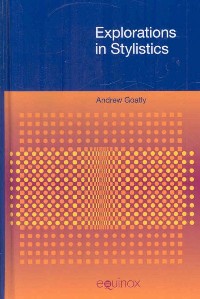
简介
Author Goatly (English, Lingnan U., Hong Kong) identifies some of the development in the field of Stylistics since its pioneer, Roman Jakobson, identified the patterning of the message as the poetic function. His analyses illustrate how Jakobson's primary emphasis on the message surrenders to emphasis on the code (language) or undermining the code, on context, on reader response, and on the relationship of the shared assumptions of the addresser (speaker, writer) and addressee (listener, reader). To illustrate, the author uses a diverse selection of authors, from Golding to Pinter, and from Ishiguro to Rowling. A pivotal chapter examines how the differing stylistic perspectives can be applied to the same text. The essays will interest both undergraduate and graduate students in Stylistics courses. Distributed in North America by The David Brown Book Co. Annotation 漏2009 Book News, Inc., Portland, OR (booknews.com)
目录
Typographical conventions viii
Acknowledgements ix
1 Developments in stylistics 1
2 Lexico-grammar and process in Golding's Pincher Martin 10
2.1 Introduction 10
2.1.1 Halliday's transitivity system 13
2.2 Transitivity, nominalisation and process in two contrasting
passages 14
2.2.1 Introduction: a sample of the passages analysed 14
2.2.2 Transitivity options in Passages A and B 16
2.2.3 Nominalisation, congruence and consonance 24
2.2.4 Conclusion 28
2.3 General patterns of nominalisation 29
2.3.1 Non-congruent and non-consonant uses of
nominalisation 29
2.3.2 Incongruent but consonant uses of nominalisation 34
2.4 Summary and conclusion: Pincher Martin and The Inheritors,
process and Buddhist philosophy 36
3 Corpus linguistics, Systemic Functional Grammar and literary
meaning: a critical analysis of Harry Potter and the
Philosopher's Stone 41
3.1 Introduction 41
3.2 Part 1. Applying SFG to the corpus 42
3.2.1 A deductive approach using external ideologies 42
3.2.2 Overt ideologies and ideological categories of the text 47
3.2.3 Inductive discovery of representation and ideology 51
3.2.4 Summary 55
3.3 Part 2. Questioning the SFG-corpus approach 56
4 Marked Theme and its interpretation in A. E. Housman's
A Shropshire Lad 59
4.1 Introduction 59
4.1.1 Why study Theme in A Shropshire Lad? 59
4.1.2 Technical terms: theme, marked theme and method of
development 60
4.1.3 Degrees of markedness 61
4.1.4 Additional grammatical resources for thematic
management 62
4.1.5 Marked thematic clauses 62
4.2 Method of analysis 62
4.2.1 Procedure 62
4.2.2 Methodological matters arising from analysis 65
4.3 Results and discussion 67
4.3.1 The semantic fields of marked Themes and their relation
to literary theme 67
4.3.2 Thematic patterning in individual poems 73
4.3.3 Multiply-marked themes 83
4.3.4 Patterns of marked Theme in the sequence and degrees
of dialogism 92
4.3.5 Housman as a poet of the vernacular? 94
4.3.6 Relation of findings to earlier work on genre and Theme 95
5 A stylistic analysis of Elizabeth Jennings' 'One Flesh':
poem as product and process 97
5.1 Introduction 97
5.2 Stylistic analysis - text as object/product 100
5.2.1 Inactivity and verbs 100
5.2.2 Inactivity and sound effects 102
5.2.3 Separation and lexis 103
5.2.4 Separation and phonology 104
5.3 Foregrounding the final sentence 105
5.4 Text as process - discourse pragmatics 107
5.4.1 Syntax as process: arrest and release 108
5.4.2 Detecting moves between discourse divisions 110
5.4.3 Reference and deixis 111
5.4.4 Non-factives and presuppositions 113
5.4.5 Negative polarity, opposition and defeated expectations 114
5.4.6 Pragmatic possibilities for the final question 117
5.5 Summary 120
6 The pragmatics of co-operation and politeness in two extracts
from Harold Pinter's The Birthday Party 122
6.1 Introduction 122
6.2 The style of Harold Pinter 122
6.3 The Co-operative Principle 124
6.4 The Politeness Principle 126
6.5 Phatic communion 129
6.6 Analysis of extract 1 133
6.7 Analysis of extract 2 136
6.8 Summary and afterthought 140
7 The limits of politeness: a butler's pragmatic dilemmas in
Kazuo Ishiguro's The Remains of the Day 144
7.1 Introduction 144
7.2 Observing and breaking the Politeness maxims 145
7.2.1 Agreement 145
7.2.2 Sympathy 148
7.2.3 Approbation 149
7.2.4 Modesty 154
7.2.5 Generosity 157
7.3 Quality, Manner and self-deception 159
7.4 Negative face, restraint and dignity 164
7.4.1 Challenges to self-restraint and dignity 167
7.4.2 Stevens' journey of discovery 171
7.5 Summary and conclusion 175
8 Conceptual metaphor, its paradoxes, modifications and
distortions in the poetry of John Donne 177
8.1 Introduction 177
8.2 Metaphor 178
8.2.1 What are we talking about? 178
8.2.2 The interplay of metaphors 178
8.2.3 The theory of conceptual metaphor 180
8.2.4 Identifying conceptual metaphors and metaphor themes:
METALUDE 182
8.2.5 More than Cool Reason and conceptual metaphor as 'code' 184
8.3 Metaphor in Donne's poetry 185
8.3.1 Donne's 'platonic love' and the mind/body relationship 185
8.3.2 Relationship and Proximity/Cohesion 186
8.3.3 RELATIONSHIP IS COHESION/PROXIMITY versus
FREEDOM IS SPACE TO MOVE 189
8.3.4 RELATIONSHIP IS COHESION/PROXIMITY and its
paradoxes in Donne 191
8.3.5 Parting as symbolic through literalisation 194
8.3.6 Overcoming separation through RELATIONSHIP IS
TRANSACTION 197
8.3.7 EXISTENCE IS PROXIMITY and death as separation 203
8.4 CERTAINTY/RELIABILTY IS STABILITY versus love as
change and destruction 207
8.5 Summary and conclusion 217
References 219
Index 227
Index of metaphor themes 233
Explorations in stylistics /
- 名称
- 类型
- 大小
光盘服务联系方式: 020-38250260 客服QQ:4006604884
云图客服:
用户发送的提问,这种方式就需要有位在线客服来回答用户的问题,这种 就属于对话式的,问题是这种提问是否需要用户登录才能提问
Video Player
×
Audio Player
×
pdf Player
×
