

简介
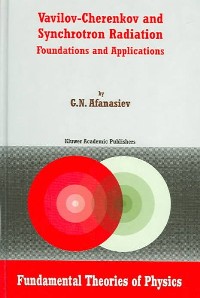
The theory of the Vavilov-Cherenkov radiation observed by Cherenkov in 1934 was created by Tamm, Frank and Ginsburg who associated the observed blue light with the uniform charge motion of a charge at a velocity greater than the velocity of light in the medium. On the other hand, Vavilov, Cherenkov's teacher, attributed the observed blue light to the deceleration of electrons. This has given rise to the appearance of papers in which the radiation of a charge uniformly moving in a finite space interval was related to the Bremsstrahlung arising at the end points of the motion interval.
This monograph is intended for students of the third year and higher, for postgraduates, for professional scientists (both experimentalists and theoreticians) dealing with Vavilov-Cherenkov and synchrotron radiation. An acquaintance with the three volumes of the Landau and Lifshitz course (Quantum Mechanics, Classical Field Theory and Macroscopic Electrodynamics) is sufficient for understanding the text.
目录
1 INTRODUCTION 1
2 THE TAMM PROBLEM IN THE VAVILOV-CHERENKOV
RADIATION THEORY 15
2.1 Vavilov-Cherenkov radiation in a finite region of space . 15
2.1.1 Mathematical preliminaries .............. 15
2.1.2 Particular cases.................... . 16
2.1.3 Original Tamm problem ................ .. 32
2.1.4 Comparison of tle Tamm and exact solutions . . 35
2.1.5 Spatial distribution of shock waves .......... . 38
2.1.6 Time evolution cf the electromagnetic field on the
surface of a sphere . ....... .......... 41
2.1.7 Comparison with the Tamm vector potential . . 46
2.2 Spatial distribution of Fourier components .......... 50
2.2.1 Quasi-classical a proximation . .......... .. 51
2.2.2 Numerical calculations ..... . . . . . ..52
2.3 Quantum analysis of the Tamm formula . . . . . . . . . . . 58
2.4 Back to the original Tamm problem . . . . . . . . . . . . . 63
2.4.1 Exact solution ................... . . 63
2.4.2 Restoring vectorI potential in the spectral represen-
tation ....... .. ... .... ....... .70
2.4.3 The Tamm approximate solution . . . . . . . . . . . 74
2.4.4 Concrete example showing that the CSW is not al-
ways reduced to the interference of BS shock waves 76
2.5 Schwinger's approach to the Tamm problem . . . . . . . . . 78
2.5.1 Instantaneous pdwer frequency spectrum . . . . . 80
2.5.2 Instantaneous angular-frequency distribution of the
power spectrum ..................... 84
2.5.3 Angular-frequency distribution of the radiated en-
ergy for a finite time interval. . . . . . . . . . . . 84
2.5.4 Frequency distribution of the radiated energy . . . . 86
2.6 The Tamm problem in the spherical basis . . . . . ..... 93
2.6.1 Expansion of the Tarhm problem in terms of the Leg-
endre polynomials ................... 93
2.7 Short resume of this chapte . . . . . . . . . . . . . ..... 97
3 NON-UNIFORM CHARGE MOTION IN A DISPERSION-
FREE MEDIUM 99
3.1 Introduction. .............. .. ... ....... . 99
3.2 Statement of the physical prpblem .............. 100
3.2.1 Simplest accelerated and decelerated motions [9] . .101
3.2.2 Completely relativistic accelerated and decelerated
motions [11] .. ............. ...... 107
3.3 Smooth Tamm problem in the time representation . . . . . 115
3.3.1 Moving singularities of electromagnetic field . . . . . 115
3.4 Concluding remarks for this chapter . . . . . . . . . . 124
chapter4 CHERENKOV RADIATION
IN A DISPERSIVE MEDIUM127
4.1 Introduction ................. ....... . . 127
4.2 Mathematical preliminaries. . . . . . . . . . . . . . . . . . 128
4.3 Electromagnetic potentials and field strengths . . . . . . . . 131
4.4 Time-dependent polarization of the medium . . . . . . . . . 141
4.4.1 Another choice of polarization . . . . . . . . . . . . 144
4.5 On the Krinig-Kramers dispersion relations . . . . . . . . . 148
4.6 The energy flux and the number of photons . . . . . . . . . 149
4.7 WKB estimates .... ... . .............. . 155
4.7.1 Charge velocity exceeds the critical velocity . . . .158
4.7.2 Charge velocity is smaller than the critical velocity 160
4.8 Numerical results . ................... . . 162
4.8.1 Estimation of non-radiation terms . . . . . . . . . . 164
4.9 The influence of the imaginary part of . . . . . . . . . . . 167
4.10 Application to concrete substances . . . . . . . . . . . . 175
4.10.1 Dielectric permittivity (4.7) . . . . . . . . . . . . . . 179
4.10.2 Dielectric permittivity (4.45) . . . . . . . . . . . . . 184
4.11 Cherenkov radiation without Use of the spectral representation188
4.11.1 Particular cases .......... . ... ... . 191
4.11.2 Numerical Results...................... 196
4.12 Short resume of this Chapter. . . . . . . . . . ........ 204
5 INFLUENCE OF FINITE OBSERVATIONAL DISTANCES
AND CHARGE DECELERATION 209
5.1 Introduction ................. ......... . 209
5.2 Finite observational distances and small acceleration . . .. 210
5.2.1 The original Tamm approach . . . . . . . . . . . . . 210
5.2.2 Exact electromagnetic field strengths and angular-
frequency distribution of the radiated energy . . . 212
5.2.3 Approximations.. ..... ............. 214
5.2.4 Decelerated charge motion. . . . . . . . . . . . . . 216
5.2.5 Numerical results .................. 219
5.3 Motion in a finite spatial interval with arbitrary acceleration 232
5.3.1 Introduction . .................. . . 233
5.3.2 Main mathematical formulae . . . . . . . . . . . . . 235
5.3.3 Particular cases ...... ....... ... 238
5.3.4 Analytic estimates ..... .............. 257
5.3.5 The absolutely continuous charge motion. . . . . . . 261
5.3.6 Superposition of Uniform and accelerated motions 272
5.3.7 Short discussion of the smoothed Tamm problem 275
5.3.8 Historical remarks on the VC radiation and
bremsstrahlung . ...... .. ..... ... . 276
5.4 Short resume of Chapter 5 ................... 279
6 RADIATION OF ELECTRIC, MAGNETIC AND
TOROIDAL DIPOLES MOVING IN A MEDIUM 283
6.1 Introduction. . .............. . . ....... . 283
6.2 Mathematical preliminaries: equivalent sources of the elec-
tromagnetic field ... . .... ............. 285
6.2.1 A pedagogical example: circular current. . . . . . . 285
6.2.2 The elementary toroidal solenoid . . . . . ..... . . 286
6.3 Electromagnetic field of electric, magnetic, and
toroidal dipoles in time representation. . . . . . . . . . . . . 293
6.3.1 Electromagnetic field of a moving point-like current
loop ............. . ... ........... 293
6.3.2 Electromagnetic field of a moving point-like
toroidal solenoid ................. . .. 300
6.3.3 Electromagnetic field of a moving point-like electric
dipole . . . .. . . . . . .... . . . ... .. . 307
6.3.4 Electromagnetic field of induced dipole moments . 310
6.4 Electromagnetic field of electric, magnetic,
and toroidal dipoles in the spectral representation . . . . . 313
6.4.1 Unbounded motion of magnetic, toroidal,
and electric dipoles in medium . . . . . . . .... . 313
6.4.2 The Tamm problen for electric charge, magnetic,
electric, and toroidal dipoles . . . . . . . . . . . . . . 327
6.5 Electromagnetic field of a precessing magnetic dipole . . . 334
6.6 Discussion and Conclusion . . . . . . . . . . . . ....... 337
7 QUESTIONS CONCERNING OBSERVATION
OF THE VAVILOV-CHERENKOV RADIATION 341
7.1 Introduction ............. ........... . 341
7.2 Cherenkov radiation from a charge of finite dimensions . . 343
7.2.1 Cherenkov radiation as the origin of the charge de-
celeration ....... .. ..... ......... 349
7.3 Cherenkov radiation in dispersive medium ........ . . 350
7.4 Radiation of a charge moving in a cylindrical
dielectric sample ........................ 355
7.4.1 Radial energy flux .................. 356
7.4.2 Energy flux along the motion axis . . . . ..... . . . 357
7.4.3 Optical interpretation . . . . . . . . . . . . .. . 358
7.5 Vavilov-Cherenkov and transition radiations
for a spherical sample .... ........ . .. ..360
7.5.1 Optical interpretation . . . . . . . . . . . . . . . . . 360
7.5.2 Exact solution ................. . . 362
7.5.3 Metallic sphere ................... .. . 376
7.6 Discussion on the transition radiation . . . . . . . . . . . . 382
7.6.1 Comment on the transition radiation . . . . . . . . 382
7.6.2 Comment on the Tanmm problem . . . . . . . . . . . 390
8 SELECTED PROBLEMS OF THE
SYNCHROTRON RADIATION 397
8.1 Introduction. .................. ....... 397
8.2 Synchrotron radiation in vacuum. . . . . . . . . . . . . . . . 398
8.2.1 Introductory remarks . . . . . . . . . . . . . . . . . 399
8.2.2 Energy radiated for the period of motion . . . . . . 404
8.2.3 Instantaneous distribution of synchrotron radiation . 407
8.3 Synchrotron radiation in medium . . . . . . . . . . . . . . . 422
8.3.1 Mathematical preliminaries . . . . . . . . . . . . . . 422
8.3.2 Electromagnetic field strengths . . . . . . . . . . . . 423
8.3.3 Singularities of electromagnetic field . . . . . . . . . 424
8.3.4 Digression on the Cherenkov radiation . . . . . . . . 426
8.3.5 Electromagnetic field in the wave zone . . . . . . . . 428
8.3.6 Numerical results for synchrotron motion in a medium434
8.4 Conclusion .................. ......... 442
9 SOME EXPERIMENTAL TRENDS IN THE VAVILOV-
CHERENKOV RADIATION THEORY 447
9.1 Fine structure of the Vavilov-Cherenkov radiation. .. . . . 447
9.1.1 Simple experiments With 657 MeV protons . . . . . 451
9.1.2 Main computational formulae . . . . . . . . . . . . . 453
9.1.3 Numerical results . . . . . . . . . . . . . . . . . . . 462
9.1.4 Discussion . . . . . . . . . . . . . . . . 462
9.1.5 Concluding remarks to this section . . . . . . . . . . 470
9.2 Observation of anomalous Cherenkov rings. . . . . . . . . . 471
9.3 Two-quantum Cherenkov effect . . . . . . . . . . . . . . . . 471
9.3.1 Pedagogical example: the kinematics of the one-photon
Cherenkov effect ............... 472
9.3.2 The kinematics of the two-photon Cherenkov effect . 474
9.3.3 Back to the general two-photon Cherenkov effect . . 480
9.3.4 Relation to the classical Cherenkov effect . . . . . . 483
9.4 Discussion and Conclusion on the Two-Photon Cherenkov
Effect . . . . . . . . . . , . . . . . . . . . . . . . . . . . . . 483
- 名称
- 类型
- 大小
光盘服务联系方式: 020-38250260 客服QQ:4006604884
云图客服:
用户发送的提问,这种方式就需要有位在线客服来回答用户的问题,这种 就属于对话式的,问题是这种提问是否需要用户登录才能提问
Video Player
×
Audio Player
×
pdf Player
×
