

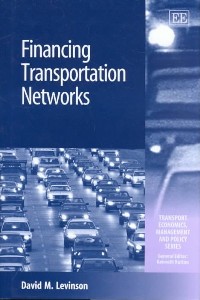
简介
"Pollution, alternative fuels, congestion, intelligent transport systems, and the shift from construction to maintenance all call for a reconsideration of the existing highway revenue mechanisms, in particular the gas tax. David Levinson explores the fundamental theoretical basis of highway finance, in particular the use of tolls, and supports that theory with empirical evidence. The author examines highway finance from the perspective of individual jurisdictions and travellers, and considers their interactions, rather than specifying a single optimal solution. Congestion pricing has long been a goal of transportation economists, who believe it will result in a more efficient use of resources. Levinson argues that if the governance were to become more decentralized, and collection costs continue to drop, tolls could return to prominence as the preferred means of financing roads for both local and intercity travel. An approach that creates the local winners necessary to implement road pricing is required before it can be expected to become widespread." "Economists, civil engineers, planners, students and policymakers will find this detailed examination of transportation networks enlightening and useful."--BOOK JACKET.Title Summary field provided by Blackwell North America, Inc. All Rights Reserved
The book ought to be read by any practitioner or scholar who claims a serious interest in transportation finance. It would be an excellent secondary text for any course in transportation finance or policy, in either an economics department or a public policy program. This is a most welcomed addition to the transportation finance literature. Odd J. Stalebrink, West Virginia University, US Pollution, alternative fuels, congestion, intelligent transportation systems, and the shift from construction to maintenance all call for a reconsideration of the existing highway revenue mechanisms, especially the gas tax. David Levinson explores the fundamental theoretical basis of highway finance, in particular the use of tolls, and supports that theory with empirical evidence. The author examines highway finance from the perspective of individual jurisdictions and travellers, and considers their interactions rather than specifying a single optimal solution. Congestion pricing has long been a goal of transportation economists, who believe it will result in a more efficient use of resources. Levinson argues that if the governance were to become more decentralized, and collection costs continue to drop, tolls could return to prominence as the preferred means of financing roads for both local and intercity travel. An approach that creates the local winners necessary to implement road pricing is required before it can be expected to become widespread. Economists, civil engineers, planners, students and policymakers will find this detailed examination of transportation networks enlightening and useful.
目录
Contents
Acknowledgements
1. Introduction
Rationales for Road Pricing
Financing Infrastructure
Change in Tax Base with Alternative Fuels
Social Costs
Congestion Pricing
Outline of the Book
Notes
2. History
Introduction
Tolls in the Ancient and Medieval World
Roads Before Modern Turnpikes
Turnpikes in Great Britain, 1656–1900
Turnpikes in America: 1785–1900
Turnpikes in America, 1900–Present
Recent International Experience
Conclusions
Notes
3. Costs
Introduction
Vehicles
Infrastructure
Toll Collection
Accidents
Noise
Air Pollution and Global Change
Conclusion
Notes
4. Revenues
Introduction
Data
Hypotheses
Results
Sensitivity Analysis
Summary and Conclusions
Notes
5. Hierarchy
Introduction
Transportation Hierarchy and Network Topology
Economic Properties
Logrolling and Decentralization Economies
Service Areas
Conclusions
Notes
6. Intertemporal Equity
Introduction
Old Versus New
Pay-Go, Bonds, and Impact Fees
Continous Recovery
Bargaining
Examples
Summary and Conclusions
Notes
7. Finance Choice on a Beltway
Introduction
The Spatial Free-Rider Problem
Free Reiders and Jusrisdiction Size
Tax – Toll Game
Optimal Spacing of Tolls
Conclusions
Note
8. Finance Choice on an Interstate
Introduction
Actions and Objectives
Network Geometry
Demand
Consumer\\u0027s Surplus
Profit
Cost
Revenue
Mathematical Solution
Evaluation
Policy Selection
Government Hierarchy
Sensitivity to Model Coefficients
Conclusions
9. Finance Choice at a Frontier
Introduction
Model
Objectives
Toll Setting
Solutions
Non-Cooperative Game Theory
Infinitely Repeated Game
Conclusions
Notes
10. Congestion Pricing
Introduction
Conventional Congestion Pricing Model
Game Theoretic Congestion Model
Conclusions
Notes
11. Compensation
Introduction
Stealing Time
Reimbursing Time: Delayer Pays
Buying Time: Hot Lanes
Borrowed Time
Sharing Time
Conclusions
Notes
12. Deploying Electronic Tolls
Introduction
Deployment Theory
Dynamic Payment Choice Model
Payment Choice
Changing Dispositions toward ETC and Network Externalities
Policy Variables: Capacity and Dsicount
Model System
Results
Conclusions
Notes
13. Summary and Conclusions
Introduction
Summary
General Trends
Speculations on the Deployment of Priced Roads
Bibliography
Index
A
B
C
D
E
F
G
H
I
J
K
L
M
N
O
P
R
S
T
U
V
W
Z
- 名称
- 类型
- 大小
光盘服务联系方式: 020-38250260 客服QQ:4006604884
云图客服:
用户发送的提问,这种方式就需要有位在线客服来回答用户的问题,这种 就属于对话式的,问题是这种提问是否需要用户登录才能提问
Video Player
×
Audio Player
×
pdf Player
×
