

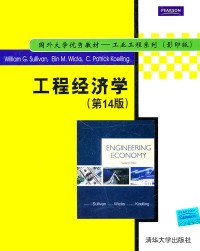
Enginering economy
副标题:无
作 者:William G. Sullivan,Elin M. Wicks,C. Patrick Koelling[著]
分类号:
ISBN:9787302246961
微信扫一扫,移动浏览光盘
简介
Willian G. Sullivan等编著的《工程经济学(第14版)(影印版)》是工
程经济学领域的畅销教材,麻省理工学院等数十所美国大学以及英国、韩
国、新加坡等很多国家的一些知名院校都将本书作为“工程经济学”课程
的最主要教材。
本书系统介绍了工程经济分析的理论、原理、方法和应用案例。全书
共分为3部分。第1部分是工程经济基本原理,主要阐述工程经济分析的基
本原则、重要的成本概念和估计技术、货币时间价值原理等工程经济学的
基本概念和原理;第2部分介绍工程经济基本方法,深入分析了投资方案的
赢利性评价方法和比选方法,折旧、所得税、通货膨胀等对评价方法的影
响,设备更新分析方法,不确定性分析方法;第3部分为工程经济分析方法
特别专题,内容包括公共项目的费用效益分析方法、风险分析技术和融资
及资本预算方法。
《工程经济学(第14版)(影印版)》适合作为经济类、管理类、工业工
程及相关专业本科生或研究生的教材。
目录
Preface
Acknowledgments
PART 1 Fundamentals of Engineering Economy
CHAPTER 1 Introduction to Engineering Economy
1.1 Introduction
1.2 The Principles of Engineering Economy
1.3 Engineering Economy and the Design Process
1.4 Using Spreadsheets in Engineering Economic Analysis
1.5 Summary
CHAPTER 2 Cost Concepts and Design Economics
2.1 Cost Terminology
2.2 The General Economic Environment
2.3 Cost-Driven Design Optimization
2.4 Present Economy Studies
2.5 Case Study――The Economics of Daytime Running Lights
2.6 Summary
Appendix 2-A Accounting Fundamentals
CHAPTER 3 Cost-Estimation Techniques
3.1 Introduction
3.2 An Integrated Approach
3.3 Selected Estimating Techniques (Models)
3.4 Parametric Cost Estimating
3.5 Cost Estimation in the Design Process
3.6 Case Study――Demanufacturing of Computers
3.7 Summary
CHAPTER 4 The Time Value of Money
4.1 Introduction
4.2 Simple Interest
4.3 Compound Interest
4.4 The Concept of Equivalence
4.5 Notation and Cash-Flow Diagrams and Tables
4.6 Relating Present and Future Equivalent Values of Single Cash Flows
4.7 Relating a Uniform Series (Annuity) to Its Present and Future Equivalent Values
4.8 Summary of Interest Formulas and Relationships for Discrete Compounding
4.9 Deferred Annuities (Uniform Series)
4.10 Equivalence Calculations Involving Multiple Interest Formulas
4.11 Uniform (Arithmetic) Gradient of Cash Flows
4.12 Geometric Sequences of Cash Flows
4.13 Interest Rates that Vary with Time
4.14 Nominal and Effective Interest Rates
4.15 Compounding More Often than Once per Year
4.16 Interest Formulas for Continuous Compounding and Discrete Cash Flows
4.17 Case Study――Understanding Economic “Equivalence”
4.18 Summary
Part Ⅱ Engineering Economy in Action
CHAPTER 5 Evaluating a Single Project
5.1 Introduction
5.2 Determining the Minimum Attractive Rate of Return (MARR)
5.3 The Present Worth Method
5.4 The Future Worth Method
5.5 The Annual Worth Method
5.6 The Internal Rate of Return Method
5.7 The External Rate of Return Method
5.8 The Payback (Payout) Period Method
5.9 Case Study――A Proposed Capital Investment to Improve Process Yield
5.10 Summary
Appendix 5-A The Multiple Rate of Return Problem with the IRR Method
CHAPTER 6 Comparison and Selection among Alternatives
6.1 Introduction
6.2 Basic Concepts for Comparing Alternatives
6.3 The Study (Analysis) Period
6.4 Useful Lives Are Equal to the Study P.eriod
6.5 Useful Lives Are Unequal among the Alternatives
6.6 Personal Finances
6.7 Case Study--Ned and Larry's Ice Cream Company
6.8 Postevaluatio.n of Results
6.9 Summary
CHAPTER 7 Depreciation and Income Taxes
7.1 Introduction
7.2 Depreciation Concepts and Terminology
7.3 The Classical (Historical) Depreciation, Methods
7.4 The Modified Accelerated Cost Recovery' System
7.5 A Comprehensive Depreciation Example
7.6 Introduction to ,Income Taxes
7,7 The Effective (Marginal)Corporate Income Tax Rate
7.8 Gain (Loss) on the Disposal of an Asset
7.9 General.Procedure for Making After;Tax Economic Analyses
7.10 Illustration of Computations of ATCFs
7.11 Economic Value Added
7.12 Summary
CHAPTER 8 Price Chancles and Exchancle Rates
8.1 Introduction
8.2 Terminology and Basic Concepts
8.3 Fixed and Responsive Annuities
8.4 Spreadsheet Application
8.5 Foreign Exchange Rates and Purchasing Power Concepts
8.6 Case Study--Selecting Electric Moto.rs to Power an Assembly Line
8.7 Summary
CHAPTER 9 Replacement Analysis
9.1 Introduction
9.2 Reasons for Replacement Anaiysis
9.3 Factors that Must Be Considered in Replacement Studies
9.4 Typisal Replacement Problems
9.5 Determining the Economic Life:of a New Asset (Challenger)
9.6 Determining the Economic Life of a Defender
9.7 Comparisons in which the Defender's Useful Life Differs from that of the Challenger
9.8 Retirement without Replacement (Abandonment)
9.9 AfterTax Replacement Studies
9.10 Case Study--Replacement of a Hospital's Emergency Electrical Supply System
9.11 Summary
PART Ⅲ Additional Topics in Engineering Economy
CHAPTER 10 Evaluating Projects with the Benefit-Cost Ratio Method
10.1 Introduction
10.2 Perspective and Terminology for Analyzing Public Projects
10.3 Self-Liquidating Projects
10.4 Multiple-Purpose Projects
10.5 Difficulties in Evaluating Public-Sector Projects
10.6 What Interest Rate Should Be Used for Public Projects?
10.7 The Benefit-Cost Ratio Method
10.8 Evaluating Independent Projects by B-C Ratios
10.9 Comparison of Mutually Exclusive Projects by B--C Rations
10.10 Criticisms and Shortcomings of the Benefit-Cost Ratio Method
10.11 Case Study--Improving a Railroad Crossing
10.12 Summary
CHAPTER 11 Breakeven and Sensitivity Analysis
11.1 Introduction.
11.2 Breakeven Analysis
11.3 Sensitivity Analysis
11.4 Multiple Factor Sensitivity Analysis
11.5 Case Study--Analysis of a Business Venture
11.6 Summary
CHAPTER 12 Probabilistic Risk Analysis
12.1 Introduction
12.2 Sources of Uncertainty
12.3 The Distribution of Random Variables
12.4 Evaluation of Projects with Discrete Random Variables
12.5 Evaluation of Projects with Continuous Random Variables
12.6 Evaluation of Uncertainty by Monte Carlo Simulation
12.7 Performing Monte Carlo Simulation with a Computer
12.8 Decision Trees
12.9 Real Options Analysis
12.10 Case Study--The Oils Well That Ends Well Company
12.11 Summary
CHAPTER 13 The Capital Budgeting Process
13.1 Introduction
13.2 Debt Capital
13.3 Equity Capital
13.4 The Weighted Average Cost of Capital (WACC)
13.5 Project Selection
13.6 Postmortem Review
13.7 Budgeting of Capital Investments and Management Perspective
13.8 Leasing Decisions
13.9 Capital Allocation
13.10 Case Study--Financing an Automobile
13.11 Summary
CHAPTER 14 Decision Making Considering Multiattributes
14.1 Introduction
14.2 Examples of Multiattribute Decisions
14.3 Choice of Attributes
14.4 Selection of a Measurement Scale
14.5 Dimensionality of the Problem
14.6 Noncompensatory Models
14.7 Compensatory Models
14.8 Summary
PART Ⅳ Appendices
A Using Excel to Solve Engineering Economy Problems
B Abbreviations and Notation
C Interest and Annuity Tables for Discrete Compounding
D Interest and Annuity Tables for Continuous Compounding
E Standard Normal Distribution
F Selected References
G Answers to Selected Problems
Index
Acknowledgments
PART 1 Fundamentals of Engineering Economy
CHAPTER 1 Introduction to Engineering Economy
1.1 Introduction
1.2 The Principles of Engineering Economy
1.3 Engineering Economy and the Design Process
1.4 Using Spreadsheets in Engineering Economic Analysis
1.5 Summary
CHAPTER 2 Cost Concepts and Design Economics
2.1 Cost Terminology
2.2 The General Economic Environment
2.3 Cost-Driven Design Optimization
2.4 Present Economy Studies
2.5 Case Study――The Economics of Daytime Running Lights
2.6 Summary
Appendix 2-A Accounting Fundamentals
CHAPTER 3 Cost-Estimation Techniques
3.1 Introduction
3.2 An Integrated Approach
3.3 Selected Estimating Techniques (Models)
3.4 Parametric Cost Estimating
3.5 Cost Estimation in the Design Process
3.6 Case Study――Demanufacturing of Computers
3.7 Summary
CHAPTER 4 The Time Value of Money
4.1 Introduction
4.2 Simple Interest
4.3 Compound Interest
4.4 The Concept of Equivalence
4.5 Notation and Cash-Flow Diagrams and Tables
4.6 Relating Present and Future Equivalent Values of Single Cash Flows
4.7 Relating a Uniform Series (Annuity) to Its Present and Future Equivalent Values
4.8 Summary of Interest Formulas and Relationships for Discrete Compounding
4.9 Deferred Annuities (Uniform Series)
4.10 Equivalence Calculations Involving Multiple Interest Formulas
4.11 Uniform (Arithmetic) Gradient of Cash Flows
4.12 Geometric Sequences of Cash Flows
4.13 Interest Rates that Vary with Time
4.14 Nominal and Effective Interest Rates
4.15 Compounding More Often than Once per Year
4.16 Interest Formulas for Continuous Compounding and Discrete Cash Flows
4.17 Case Study――Understanding Economic “Equivalence”
4.18 Summary
Part Ⅱ Engineering Economy in Action
CHAPTER 5 Evaluating a Single Project
5.1 Introduction
5.2 Determining the Minimum Attractive Rate of Return (MARR)
5.3 The Present Worth Method
5.4 The Future Worth Method
5.5 The Annual Worth Method
5.6 The Internal Rate of Return Method
5.7 The External Rate of Return Method
5.8 The Payback (Payout) Period Method
5.9 Case Study――A Proposed Capital Investment to Improve Process Yield
5.10 Summary
Appendix 5-A The Multiple Rate of Return Problem with the IRR Method
CHAPTER 6 Comparison and Selection among Alternatives
6.1 Introduction
6.2 Basic Concepts for Comparing Alternatives
6.3 The Study (Analysis) Period
6.4 Useful Lives Are Equal to the Study P.eriod
6.5 Useful Lives Are Unequal among the Alternatives
6.6 Personal Finances
6.7 Case Study--Ned and Larry's Ice Cream Company
6.8 Postevaluatio.n of Results
6.9 Summary
CHAPTER 7 Depreciation and Income Taxes
7.1 Introduction
7.2 Depreciation Concepts and Terminology
7.3 The Classical (Historical) Depreciation, Methods
7.4 The Modified Accelerated Cost Recovery' System
7.5 A Comprehensive Depreciation Example
7.6 Introduction to ,Income Taxes
7,7 The Effective (Marginal)Corporate Income Tax Rate
7.8 Gain (Loss) on the Disposal of an Asset
7.9 General.Procedure for Making After;Tax Economic Analyses
7.10 Illustration of Computations of ATCFs
7.11 Economic Value Added
7.12 Summary
CHAPTER 8 Price Chancles and Exchancle Rates
8.1 Introduction
8.2 Terminology and Basic Concepts
8.3 Fixed and Responsive Annuities
8.4 Spreadsheet Application
8.5 Foreign Exchange Rates and Purchasing Power Concepts
8.6 Case Study--Selecting Electric Moto.rs to Power an Assembly Line
8.7 Summary
CHAPTER 9 Replacement Analysis
9.1 Introduction
9.2 Reasons for Replacement Anaiysis
9.3 Factors that Must Be Considered in Replacement Studies
9.4 Typisal Replacement Problems
9.5 Determining the Economic Life:of a New Asset (Challenger)
9.6 Determining the Economic Life of a Defender
9.7 Comparisons in which the Defender's Useful Life Differs from that of the Challenger
9.8 Retirement without Replacement (Abandonment)
9.9 AfterTax Replacement Studies
9.10 Case Study--Replacement of a Hospital's Emergency Electrical Supply System
9.11 Summary
PART Ⅲ Additional Topics in Engineering Economy
CHAPTER 10 Evaluating Projects with the Benefit-Cost Ratio Method
10.1 Introduction
10.2 Perspective and Terminology for Analyzing Public Projects
10.3 Self-Liquidating Projects
10.4 Multiple-Purpose Projects
10.5 Difficulties in Evaluating Public-Sector Projects
10.6 What Interest Rate Should Be Used for Public Projects?
10.7 The Benefit-Cost Ratio Method
10.8 Evaluating Independent Projects by B-C Ratios
10.9 Comparison of Mutually Exclusive Projects by B--C Rations
10.10 Criticisms and Shortcomings of the Benefit-Cost Ratio Method
10.11 Case Study--Improving a Railroad Crossing
10.12 Summary
CHAPTER 11 Breakeven and Sensitivity Analysis
11.1 Introduction.
11.2 Breakeven Analysis
11.3 Sensitivity Analysis
11.4 Multiple Factor Sensitivity Analysis
11.5 Case Study--Analysis of a Business Venture
11.6 Summary
CHAPTER 12 Probabilistic Risk Analysis
12.1 Introduction
12.2 Sources of Uncertainty
12.3 The Distribution of Random Variables
12.4 Evaluation of Projects with Discrete Random Variables
12.5 Evaluation of Projects with Continuous Random Variables
12.6 Evaluation of Uncertainty by Monte Carlo Simulation
12.7 Performing Monte Carlo Simulation with a Computer
12.8 Decision Trees
12.9 Real Options Analysis
12.10 Case Study--The Oils Well That Ends Well Company
12.11 Summary
CHAPTER 13 The Capital Budgeting Process
13.1 Introduction
13.2 Debt Capital
13.3 Equity Capital
13.4 The Weighted Average Cost of Capital (WACC)
13.5 Project Selection
13.6 Postmortem Review
13.7 Budgeting of Capital Investments and Management Perspective
13.8 Leasing Decisions
13.9 Capital Allocation
13.10 Case Study--Financing an Automobile
13.11 Summary
CHAPTER 14 Decision Making Considering Multiattributes
14.1 Introduction
14.2 Examples of Multiattribute Decisions
14.3 Choice of Attributes
14.4 Selection of a Measurement Scale
14.5 Dimensionality of the Problem
14.6 Noncompensatory Models
14.7 Compensatory Models
14.8 Summary
PART Ⅳ Appendices
A Using Excel to Solve Engineering Economy Problems
B Abbreviations and Notation
C Interest and Annuity Tables for Discrete Compounding
D Interest and Annuity Tables for Continuous Compounding
E Standard Normal Distribution
F Selected References
G Answers to Selected Problems
Index
Enginering economy
- 名称
- 类型
- 大小
光盘服务联系方式: 020-38250260 客服QQ:4006604884
云图客服:
用户发送的提问,这种方式就需要有位在线客服来回答用户的问题,这种 就属于对话式的,问题是这种提问是否需要用户登录才能提问
Video Player
×
Audio Player
×
pdf Player
×
