

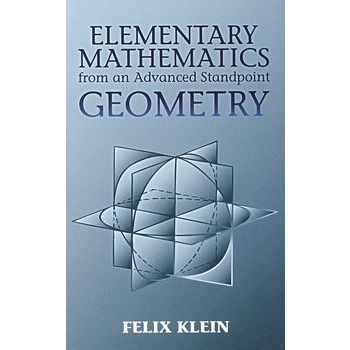
从高观点看初等数学/Elementary mathematics from an advanced standpoint
副标题:无
作 者:Felix Klein 著
分类号:
ISBN:9780486434810
微信扫一扫,移动浏览光盘
简介
This text begins with the simplest geometric manifolds, the Grassmann determinant principle for the plane and the Grassmann principle for space; and more. Also explores affine and projective transformations; higher point transformations; transformations with change of space element; and the theory of the imaginary. Concludes with a systematic discussion of geometry and its foundations. 1939 edition. 141 figures.
目录
Part One: The Simplest Geometric Manifolds
I. Line-Segment, Area, Volume, as Relative Magnitudes
Definition by means of determinants; interpretation of the sign
Simplest applications, especially the cross ratio
Area of rectilinear polygons
Curvilinear areas
Theory of Amsler's polar planimeter
Volume of polyhedrons, the law of edges
One-sided polyhedrons
II. The Grassmann Determinant Principle for the Plane
Line-segment (vectors)
Application in statics of rigid systems
Classification of geometric magnitudes according to their behavior under trans formation of rectangular coordinates
Application of the principle of classification to elementary magnitudes
III. The Grassmann Principle for Space
Line-segment and plane-segment
Application to statics of rigid bodies
Relation to MSbius' null-system
Geometric interpretation of the null-system.
Connection with the theory of screws
IV. Classification of the Elementary Configurations of Space according to their
Behavior under Transformation of Rectangular Coordinates
Generalities concerning transformations of rectangular space coordinates
Transformation formulas for some elementary magnitudes
Couple and free plane magnitude as equivalent manifolds
Free line-segment and free plane magnitude ("polar" and "axial" vector)
Scalars of first and second kind
Outlines of a rational vector algebra
Lack of a uniform nomenclature in vector calculus
V. Derivative Manifolds
Derivatives from points (carves, surfaces, point sets)
Difference between analytic and synthetic geometry
Projective geometry and the principle of duality
Pliicker's analytic method and the extension of the principle of duality (lin coordinates)
Grassmann's Ausdehnungsiehre;n-dimensional geometry
Scalar and vector fields; rational vector analysis
Part Two: Geometric Transformations
Transformations and their analytic representation
I. AtBne Transformations
Analytic definition and fundamental properties
Application to theory of ellipsoid
Parallel projection from one plane upon another
Axonometric mapping of space (affine transformation with vanishing deter- minant)
Fundamental theorem of Poblke
II. Projective Transformations
Analytic definition; introduction of homogeneous coordinates
Geometric definition: Every coUineation is a projective transformation
Behavior of fundamental manifolds under projective transformation
Central projection of space upon a plane (projective transformation with vanishing determinant)
Relief perspective
Application of projection in deriving properties of comcs
III. Higher Point Transformations
1. The Transformation by Reciprocal Radii
Peaucellier's method of drawing a line
Stereographic projection of the sphere
2. Some More General Map Projections.
Mercator's projection
Tissot theorems
3. The Most General Reversibly Unique Continuous Point Transformatins
Genus and connectivity of surfaces
Euler's theorem on polyhedra
IV. Transformations wlth Change of Space Element
1. Dualistic Transformations
2. Contact Transformations
3. Some Examples
Forms of algebraic order and class curves
Application of contact transformations to theory of cog wheels
V. Theory of the Imaginary
Imaginary cirde-points and imaginary sphere-circle
Imaginary transformation
Von Staudt s interpretation of self-conjugate imaginary manifolds by means oJ real polar systems
Von Staudt's complete interpretation of single imaginary elements
Space relations of imaginary points and lines
……
Part Three:Systematic Discussion of Geometry and Its Foundations
II Foundations of Geometry
Index of Names
Index of Contents
I. Line-Segment, Area, Volume, as Relative Magnitudes
Definition by means of determinants; interpretation of the sign
Simplest applications, especially the cross ratio
Area of rectilinear polygons
Curvilinear areas
Theory of Amsler's polar planimeter
Volume of polyhedrons, the law of edges
One-sided polyhedrons
II. The Grassmann Determinant Principle for the Plane
Line-segment (vectors)
Application in statics of rigid systems
Classification of geometric magnitudes according to their behavior under trans formation of rectangular coordinates
Application of the principle of classification to elementary magnitudes
III. The Grassmann Principle for Space
Line-segment and plane-segment
Application to statics of rigid bodies
Relation to MSbius' null-system
Geometric interpretation of the null-system.
Connection with the theory of screws
IV. Classification of the Elementary Configurations of Space according to their
Behavior under Transformation of Rectangular Coordinates
Generalities concerning transformations of rectangular space coordinates
Transformation formulas for some elementary magnitudes
Couple and free plane magnitude as equivalent manifolds
Free line-segment and free plane magnitude ("polar" and "axial" vector)
Scalars of first and second kind
Outlines of a rational vector algebra
Lack of a uniform nomenclature in vector calculus
V. Derivative Manifolds
Derivatives from points (carves, surfaces, point sets)
Difference between analytic and synthetic geometry
Projective geometry and the principle of duality
Pliicker's analytic method and the extension of the principle of duality (lin coordinates)
Grassmann's Ausdehnungsiehre;n-dimensional geometry
Scalar and vector fields; rational vector analysis
Part Two: Geometric Transformations
Transformations and their analytic representation
I. AtBne Transformations
Analytic definition and fundamental properties
Application to theory of ellipsoid
Parallel projection from one plane upon another
Axonometric mapping of space (affine transformation with vanishing deter- minant)
Fundamental theorem of Poblke
II. Projective Transformations
Analytic definition; introduction of homogeneous coordinates
Geometric definition: Every coUineation is a projective transformation
Behavior of fundamental manifolds under projective transformation
Central projection of space upon a plane (projective transformation with vanishing determinant)
Relief perspective
Application of projection in deriving properties of comcs
III. Higher Point Transformations
1. The Transformation by Reciprocal Radii
Peaucellier's method of drawing a line
Stereographic projection of the sphere
2. Some More General Map Projections.
Mercator's projection
Tissot theorems
3. The Most General Reversibly Unique Continuous Point Transformatins
Genus and connectivity of surfaces
Euler's theorem on polyhedra
IV. Transformations wlth Change of Space Element
1. Dualistic Transformations
2. Contact Transformations
3. Some Examples
Forms of algebraic order and class curves
Application of contact transformations to theory of cog wheels
V. Theory of the Imaginary
Imaginary cirde-points and imaginary sphere-circle
Imaginary transformation
Von Staudt s interpretation of self-conjugate imaginary manifolds by means oJ real polar systems
Von Staudt's complete interpretation of single imaginary elements
Space relations of imaginary points and lines
……
Part Three:Systematic Discussion of Geometry and Its Foundations
II Foundations of Geometry
Index of Names
Index of Contents
从高观点看初等数学/Elementary mathematics from an advanced standpoint
- 名称
- 类型
- 大小
光盘服务联系方式: 020-38250260 客服QQ:4006604884
云图客服:
用户发送的提问,这种方式就需要有位在线客服来回答用户的问题,这种 就属于对话式的,问题是这种提问是否需要用户登录才能提问
Video Player
×
Audio Player
×
pdf Player
×
