

简介
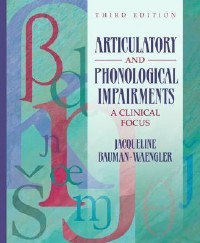
"The third edition of Articulatory and Phonological Impairments provides students with a clinical framework that encompasses basic terms and concepts, phonetic transcription, and several theoretical perspectives that are applied to clinical examples throughout. Jacqueline Bauman-Waengler demonstrates a systematic transition from a knowledge based in clinical practice to the diagnosis and treatment of individuals with articulatory and phonological disorders. The text focuses on phonemic approaches to the diagnosis and treatment of motor-based disorders, replete with a thorough discussion of phonetic principles."--BOOK JACKET.
目录
Contents
Preface 000
Chapter 1 Clinical Framework: Basic Terms and Concepts 000
Articulation and Articulation Disorders 000
Phonetics and Its Relationship to Articulation Disorders 000
Speech Sounds versus Phonemes: Clinical Application 000
Phonology and Phonological Disorders 000
Phonetics versus Phonology: Form and Function 000
Articulation Disorders versus Phonological Disorders 000
Summary 000
Case Study 000
Think Critically 000
Test Yourself 000
Websites 000
Further Readings 000
Chapter 2 Articulatory Phonetics: Speech Sound Form 000
Vowels versus Consonants 000
American English Vowels 000
American English Consonants 000
Sounds in Context: Coarticulation and Assimilation 000
Syllable Structure 000
Syllable Structure: Clinical Implications 000
Summary 000
Case Study 000
Think Critically 000
Test Yourself 000
Websites 000
Further Readings 000
Chapter 3 Phonetic Transcription and Diacritics 000
Phonetic Transcription as a Notational System 000
Why Use Phonetic Transcription? 000
Diacritics 000
Diacritics Used with Consonants 000
Diacritics Used with Vowels 000
Diacritics for Stress, Duration, and Syllable Boundaries 000
Clinical Implications 000
Summary 000
Case Study 000
Think Critically 000
Test Yourself 000
Websites 000
Further Readings 000
Chapter 4 Theoretical Considerations and Practical Application 000
Phonology 000
What Is Phonology? 000
How Does Phonology Work? 000
How Did the Concept of the Phoneme Develop? 000
Speech Sound versus Phoneme: Clinical Application 000
Distinctive Feature Theories 000
What Are Distinctive Features? 000
How Do Distinctive Features Work? 000
How Did Distinctive Feature Theories Develop? 000
Distinctive Feature Theories: Clinical Application 000
Generative Phonology 000
What Is Generative Phonology? 000
How Does Generative Phonology Work? 000
How Did Generative Phonology Develop? 000
Distinctive Feature and Generative Phonology: Clinical Application 000
Natural Phonology 000
What Is Natural Phonology? 000
How Does Natural Phonology Work? 000
Phonological Processes 000
How Did Natural Phonology Develop? 000
Natural Phonology: Clinical Application 000
Linear versus Nonlinear Phonologies 000
What Are Linear and Nonlinear Phonologies? 000
How Do Nonlinear Phonologies Work? 000
How Did Nonlinear Phonology Develop? 000
Nonlinear Phonologies: Clinical Implications 000
Summary 000
Case Study 000
Think Critically 000
Test Yourself 000
Websites 000
Further Readings 000
Chapter 5 Normal Phonological Development 000
Aspects of Structural and Functional Development 000
Aspects of Perceptual Development 000
Prelinguistic Stages: Before the First Words 000
Vocoids 000
Contoids 000
Syllable Shapes 000
Babbling and Its Relationship to Later Language Development 000
Prosodic Feature Development 000
Transition from Babbling to First Words 000
The First Fifty Words 000
Segmental Form Development 000
Prosodic Feature Development 000
The Preschool Child 000
Segmental Form Development: Vowels 000
Segmental Form Development: Consonants 000
Phonological Processes 000
Developmental Issues: Natural Phonology versus Nonlinear Phonology 000
Prosodic Feature Development 000
The School-Age Child 000
Segmental Form Development 000
Phonological Awareness, Emerging Literacy, and Phonological Disorders 000
Prosodic Feature Development 000
Summary 000
Case Study 000
Think Critically 000
Test Yourself 000
Websites 000
Further Readings 000
Chapter 6 Appraisal: Collection of Data 000
Evaluation by the Clinician 000
Initial Impression 000
Articulation Tests 000
Some Advantages and Disadvantages of Articulation Tests 000
Factors to Consider When Selecting a Measure of Articulation 000
Assessment Procedures to Supplement Articulation Tests 000
Organizing Articulation Test Results: Describing the Error 000
Stimulability Testing 000
Spontaneous Speech Sample 000
Organizing the Continuous Speech Sample 000
Evaluation of the Speech Mechanism 000
What to Look for When Evaluating the Speech Mechanism 000
Selection of Additional Assessment Measures 000
Hearing Screening 000
Language Testing 000
Specific Auditory Perceptual Testing 000
Cognitive Appraisal 000
Special Considerations 000
The Child with Emerging Phonology 000
The Unintelligible Child 000
The Dialect Speaker 000
The Speaker of English as a Second Language 000
Summary of the Data 000
Summary 000
Case Study 000
Think Critically 000
Test Yourself 000
Websites 000
Further Readings 000
Chapter 7 Diagnosis: Phonetic Versus Phonemic Emphasis 000
Preliminary Analysis: Inventory and Distribution of Speech Sounds 000
Using a Matrix to Examine the Inventory and Distribution of Speech Sounds 165
Phonemic Contrasts: Differentiating Phonetic from Phonemic Disorders 000
Decision Making: Primarily Phonetic Emphasis 000
Guidelines for Beginning Therapy 000
Decision Making: Primarily Phonemic Emphasis 000
Inventory and Distribution of Speech Sounds 000
Syllable Shapes and Constraints 000
Phonological Contrasts 000
Phonological Error Patterns 000
Measures of Intelligibility and Severity 000
Measures of Intelligibility 000
Measures of Severity 000
Summary 000
Case Study 000
Think Critically 000
Test Yourself 000
Websites 000
Further Readings 000
Chapter 8 Therapy for Phonetic Errors 000
Decision Making: When to Use a Phonetic Approach 000
Phonetic Errors 000
Decision Making: A Phonetic Approach with Phonemic Disorders? 000
Therapy Sequence 000
General Overview of Therapy Progression 000
Individual Sound Errors 000
Misarticulations of [s] and [z] 000
Phonetic Description 000
Linguistic Function 000
Initial Remarks 000
Types of Misarticulation 000
Therapeutic Suggestions 000
Coarticulatory Conditions 000
Misarticulations of [ S ] and [Z] 000
Phonetic Description 000
Linguistic Function 000
Initial Remarks 000
Types of Misarticulation 000
Therapeutic Suggestions 000
Coarticulatory Conditions 000
Misarticulations of [k] and [g] 000
Phonetic Description 000
Linguistic Function 000
Initial Remarks 000
Types of Misarticulation 000
Therapeutic Suggestions 000
Coarticulatory Conditions 000
Misarticulations of [l] 000
Phonetic Description 000
Linguistic Function 000
Initial Remarks 000
Types of Misarticulation 000
Therapeutic Suggestions 000
Coarticulatory Conditions 000
Misarticulations of [r] and the Central Vowels with R-Coloring 000
Phonetic Description 000
Linguistic Function 000
Initial Remarks 000
Types of Misarticulation 000
Therapeutic Suggestions 000
Coarticulatory Conditions 000
Misarticulations of [T] and [D] 000
Phonetic Description 000
Linguistic Function 000
Types of Misarticulation 000
Therapeutic Suggestions 000
Coarticulatory Conditions 000
Misarticulations of [f] and [v] 000
Phonetic Description 000
Types of Misarticulation 000
Therapeutic Suggestions 000
Coarticulatory Conditions 000
Affricate Problems 000
Phonetic Description 000
Types of Misarticulation 000
Therapeutic Suggestions 000
Coarticulatory Conditions 000
Voicing Problems 000
Therapeutic Suggestions 000
Consonant Cluster Problems 000
Therapeutic Suggestions 000
Coarticulatory Conditions 000
Summary 000
Case Study 000
Think Critically 000
Test Yourself 000
Websites 000
Further Readings 000
Chapter 9 Treatment of Phonemic Errors 000
Treatment Principles 000
Minimal Pair Contrast Therapy 000
Minimal Opposition Contrast Therapy 271
Maximal Oppositions Approach 000
Multiple Oppositions Approach 000
Phonological Process Therapy 000
Cycles Training 000
Metaphon Therapy 000
Phonemic Disorders with Concurrent Language Problems: Therapeutic Suggestions
000
Connecting Phonology to Morphosyntax 000
Connecting Phonology to Semantics 000
The Child with an Emerging Phonological System: Therapeutic Suggestions 000
Combining Phonology with Semantics: Developing a Lexicon 000
Treatment of Multiple Vowel Errors 000
The Child with a Very Limited Vowel Inventory: Therapeutic Suggestions 000
The Child with a High Proportion of Vowel Substitutions: Therapeutic Suggestions
000
Summary 000
Case Study 000
Case Study 000
Think Critically 000
Test Yourself 000
Websites 000
Further Readings 000
Chapter 10 Articulatory/Phonological Disorders in Selected Populations 000
Childhood Apraxia of Speech: A Disorder of Speech Motor Control 000
Definition and General Features 000
Articulatory/Phonological Characteristics 000
Clinical Implications: Diagnostics 000
Clinical Implications: Therapeutics 000
Motor Speech Disorders: Cerebral Palsy 000
Definition and General Features 000
Articulatory/Phonological Characteristics 000
Clinical Implications: Diagnostics 000
Clinical Implications: Therapeutics 000
Clefting: Cleft Palate and Cleft Lip 000
Definition and General Features 000
Articulatory/Phonological Characteristics 000
Clinical Implications: Diagnostics 000
Clinical Implications: Therapeutics 000
Mental Disability 000
Definition and General Features 000
Articulatory/Phonological Characteristics 000
Clinical Implications: Diagnostics 000
Clinical Implications: Therapeutics 000
Hearing Impairment 000
Definition and General Features 000
Articulatory/Phonological Characteristics 000
Clinical Implications: Diagnostics 000
Clinical Implications: Therapeutics 000
Motor Speech Disorders: Acquired Apraxia of Speech 000
Definition and General Features 000
Articulatory/Phonological Characteristics 000
Clinical Implications: Diagnostics 000
Clinical Implications: Therapeutics 000
Motor Speech Disorders: The Dysarthrias 000
Definition and General Features 000
Articulatory/Phonological Characteristics 000
Clinical Implications: Diagnostics 000
Clinical Implications: Therapeutics 000
Summary 000
Case Study 000
Think Critically 000
Test Yourself 000
Websites 000
Further Readings 000
Glossary 000
References 000
Author Index 000
Subject Index 000
- 名称
- 类型
- 大小
光盘服务联系方式: 020-38250260 客服QQ:4006604884
云图客服:
用户发送的提问,这种方式就需要有位在线客服来回答用户的问题,这种 就属于对话式的,问题是这种提问是否需要用户登录才能提问
Video Player
×
Audio Player
×
pdf Player
×
