

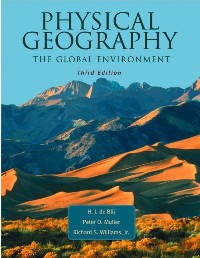
Physical geography : the global environment / 3rd ed.
副标题:无
作 者:H.J. de Blij, Peter O. Muller, Richard S. Williams, Jr.
分类号:
ISBN:9780195160222
微信扫一扫,移动浏览光盘
简介
Fully revised and presented in fifty-two short, easy-to-teach units, the third edition ofPhysical Geography: The Global Environmentcovers complex topics including long-distance weather linkages, biodiversity, and global change in a manner easily accessible to first- and second-year undergraduates. Set against a backdrop of human interaction with the environment, the text offers comprehensive treatments of Earth's five major components: the atmosphere, the hydrosphere, the lithosphere, the cryosphere, and the biosphere. FEATURES OF THE THIRD EDITION 路Unit Approach:Flexible, self-contained units make the material in the text easier for students to understand and instructors to navigate. 路From the Field Notes:This thought-provoking collection of on-the-scene geographical photographs and writings is taken from the travels of Professor de Blij, who was the Geography Editor on ABC'sGood Morning Americafor seven years and subsequently the Geography Analyst forNBC News. This compelling feature includes new photographs with expanded captions and accompanying locator maps that pinpoint each picture's global position. 路Perspectives on the Human Environment:These revised boxed essays in each unit highlight humanity's relationships with the environment. 路New and Improved Art Program:More than 90% of the photographs, 4-color maps, illustrations, and line art that appear throughout the text are new to this edition. 路Systems Approach Part Openers:These stunning, full-page illustrations graphically display and interrelate each Earth system. 路Web Resources:Included at the end of each unit, these links give students an interactive way to find out more about concepts discussed in the unit. NEW-STUDENT ANCILLARIES 路Study Guide-packaged with each copy of the text-includes unit outlines, glossaries, activities for reinforcement, and review tests with answer keys Hazards Website: provides supplemental information about earthquakes, hurricanes, floods, and other geological, meteorological and biological hazards. Access it at Natural Hazards http://www.oup-usa.org/naturalhazards. NEW-INSTRUCTOR ANCILLARIES 路Instructor's Manual with Test Bank:contains unit summaries, lecture guides, lists of additional references, and a test bank with approximately 1500 multiple choice, short answer, and short essay questions 路Instructor's CD-ROM:includes a computerized version of the test bank and PowerPointRB slides of all line art and selected photography from the text 路Overhead Transparencies:200 color acetates of selected line art from the text are available upon request
目录
Preface
A Global Perspective
Geography
Physical Geography
A Century of Physical Geography
Systems and Models in Physical Geography
Geographic Magnitude
Perspectives on the Human Environment: Sliding Scale
The Planet Earth
Spheres of the Earth System
Hemispheres
Continents and Oceans
Perspectives on the Human Environment: Human Population and Natural Processes
Mapping the Earth''s Surface
The Spherical Earth
Map Projections
Map Interpretation
Evolving Cartographic Technology
Perspectives on the Human Environment: Remote Sensing of the Environment
The Earth in the Universe
The Universe
The Solar System
Perspectives on the Human Environment: Collision!
Earth-Sun Relationships
Earth''s Planetary Motions
Seasonality
Insolation and Its Variation
Perspectives on the Human Environment: Measuring Time on Our Rotating Earth
Atmosphere and Hydrosphere
Composition and Structure of the Atmosphere
Contents of the Atmosphere
The Layered Structure of the Atmosphere
Research Frontiers
Perspectives on the Human Environment: Ozone Holes in the Stratosphere
Radiation and the Heat Balance of the Atmosphere
The Radiation Balance
The Heat Balance
Global Distribution of Heat Flows
Perspectives on the Human Environment: The Greenhouse Effect and Global Warming
Atmospheric and Surface Temperature
What is Temperature?
The Vertical Distribution of Temperature
The Horizontal Distribution of Temperature
Perspectives on the Human Environment: Urban Dust Domes and Heating Patterns
Air Pressure and Winds
Atmospheric Pressure
Air Movement in the Atmosphere
Large-and Smaller-Scale Wind Systems
Local Wind Systems
Perspectives on the Human Environment: Air Pressure and Wind in Our Daily Lives
Circulation Patterns of the Atmosphere
A Model of the Surface Circulation
The Actual Surface Circulation Pattern
Secondary Surface Circulation: Monsoonal Windflows
Circulation of the Upper Atmosphere
Perspectives on the Human Environment: The Sailor''s Legacy-Naming the Winds
Hydrosphere: Circulation of the World Ocean
Surface Currents
Generation of Ocean Currents
Flow Behavior of Ocean Currents
Deep-Sea Currents
The Coupled Ocean-Atmosphere System
El Nino-Southern Oscillation
Perspectives on the Human Environment: The North Atlantic Oscillation
Atmospheric Moisture and the Water Balance
Physical Properties of Water
Measuring Water Vapor
The Hydrologic Cycle
Evaporation
Condensation and Clouds
Precipitation
The Surface Water Balance
Perspectives on the Human Environment: Water Usage in the United States
Precipitation, Air Masses, and Fronts
Precipitation-Producing Processes
Convergent-Lifting Precipitation
Convectional Precipitation
Orographic Precipitation
Frontal (Cyclonic) Precipitation
Air Masses in the Atmosphere
Perspectives on the Human Environment: Tornadoes and Their Consequences
Weather Systems
Low-Latitude Weather Systems
Weather Systems of the Middle and Higher Latitudes
Energy and Moisture Within Weather Systems
Perspectives on the Human Environment: Honduras After Hurricane Mitch
Weather Tracking and Forecasting
Weather Data Acquisition
Mapping Weather Data
Weather Forecasting
Perspectives on the Human Environment: Weather Extremes
Climate Classification and Regionalization
Classifying Climates
The Koppen Climate Classification System
The Regional Distribution of Climate Types
Boundaries of Climate Regions
Perspectives on the Human Environment: Climate in Daily Human Terms
Tropical (A) and Arid (B) Climates
The Major Tropical (A) Climates
The Major Arid (B) Climates Perspectives on the Human Environment: Deforestation of the Tropics
Perspectives on the Human
A Global Perspective
Geography
Physical Geography
A Century of Physical Geography
Systems and Models in Physical Geography
Geographic Magnitude
Perspectives on the Human Environment: Sliding Scale
The Planet Earth
Spheres of the Earth System
Hemispheres
Continents and Oceans
Perspectives on the Human Environment: Human Population and Natural Processes
Mapping the Earth''s Surface
The Spherical Earth
Map Projections
Map Interpretation
Evolving Cartographic Technology
Perspectives on the Human Environment: Remote Sensing of the Environment
The Earth in the Universe
The Universe
The Solar System
Perspectives on the Human Environment: Collision!
Earth-Sun Relationships
Earth''s Planetary Motions
Seasonality
Insolation and Its Variation
Perspectives on the Human Environment: Measuring Time on Our Rotating Earth
Atmosphere and Hydrosphere
Composition and Structure of the Atmosphere
Contents of the Atmosphere
The Layered Structure of the Atmosphere
Research Frontiers
Perspectives on the Human Environment: Ozone Holes in the Stratosphere
Radiation and the Heat Balance of the Atmosphere
The Radiation Balance
The Heat Balance
Global Distribution of Heat Flows
Perspectives on the Human Environment: The Greenhouse Effect and Global Warming
Atmospheric and Surface Temperature
What is Temperature?
The Vertical Distribution of Temperature
The Horizontal Distribution of Temperature
Perspectives on the Human Environment: Urban Dust Domes and Heating Patterns
Air Pressure and Winds
Atmospheric Pressure
Air Movement in the Atmosphere
Large-and Smaller-Scale Wind Systems
Local Wind Systems
Perspectives on the Human Environment: Air Pressure and Wind in Our Daily Lives
Circulation Patterns of the Atmosphere
A Model of the Surface Circulation
The Actual Surface Circulation Pattern
Secondary Surface Circulation: Monsoonal Windflows
Circulation of the Upper Atmosphere
Perspectives on the Human Environment: The Sailor''s Legacy-Naming the Winds
Hydrosphere: Circulation of the World Ocean
Surface Currents
Generation of Ocean Currents
Flow Behavior of Ocean Currents
Deep-Sea Currents
The Coupled Ocean-Atmosphere System
El Nino-Southern Oscillation
Perspectives on the Human Environment: The North Atlantic Oscillation
Atmospheric Moisture and the Water Balance
Physical Properties of Water
Measuring Water Vapor
The Hydrologic Cycle
Evaporation
Condensation and Clouds
Precipitation
The Surface Water Balance
Perspectives on the Human Environment: Water Usage in the United States
Precipitation, Air Masses, and Fronts
Precipitation-Producing Processes
Convergent-Lifting Precipitation
Convectional Precipitation
Orographic Precipitation
Frontal (Cyclonic) Precipitation
Air Masses in the Atmosphere
Perspectives on the Human Environment: Tornadoes and Their Consequences
Weather Systems
Low-Latitude Weather Systems
Weather Systems of the Middle and Higher Latitudes
Energy and Moisture Within Weather Systems
Perspectives on the Human Environment: Honduras After Hurricane Mitch
Weather Tracking and Forecasting
Weather Data Acquisition
Mapping Weather Data
Weather Forecasting
Perspectives on the Human Environment: Weather Extremes
Climate Classification and Regionalization
Classifying Climates
The Koppen Climate Classification System
The Regional Distribution of Climate Types
Boundaries of Climate Regions
Perspectives on the Human Environment: Climate in Daily Human Terms
Tropical (A) and Arid (B) Climates
The Major Tropical (A) Climates
The Major Arid (B) Climates Perspectives on the Human Environment: Deforestation of the Tropics
Perspectives on the Human
Physical geography : the global environment / 3rd ed.
- 名称
- 类型
- 大小
光盘服务联系方式: 020-38250260 客服QQ:4006604884
云图客服:
用户发送的提问,这种方式就需要有位在线客服来回答用户的问题,这种 就属于对话式的,问题是这种提问是否需要用户登录才能提问
Video Player
×
Audio Player
×
pdf Player
×
