

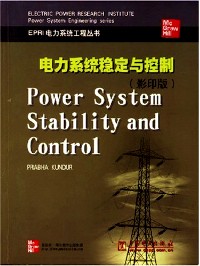
Power System Stability and Control
副标题:无
分类号:
ISBN:9787508308173
微信扫一扫,移动浏览光盘
简介
《EPRI电力系统工程丛书·电力系统稳定与控制(影印版)》是美国电力研究院(EPRI)组织“电力系统工程丛书”中,一部专门阐述电力稳定与控制的专著。随着世界范围内电力系统互联逐步扩大、新技术的不断采用、经济性以及电力工业调整所带来的约束,现代电力系统正日趋复杂。因这部专著的帮助,读者可以有效地解决由于电力工业的巨大变化所带来的稳定与控制方面的问题。《EPRI电力系统工程丛书·电力系统稳定与控制(影印版)》的英版一经出版便成为国外电力界畅销的经典著作。
国际公认的电力系统稳定专家Prabha.kuneurfgf博士、曾执教于伦多大学,担任过安大略水电局(Onatio Hydro)电力系统规划设计工作,现为加拿大不到列颠哥伦比亚省电力技术实验室公司总裁及首席执行。《EPRI电力系统工程丛书·电力系统稳定与控制(影印版)》正是作者多年来亲身实践的总结,书中的真知灼见也正是读者理解、建模、分析并运用最新技术手段处理电力系统稳定与问题时所急需的。读者将从朽上中充分了解到现代电力系统结构,控制的不同形式和水平,以及有日和复一日的工作中所面对的稳定问题的实质。
《EPRI电力系统工程丛书·电力系统稳定与控制(影印版)》对于设备特性和建模方法进行了详尽阐述。具体内容包括发电机、励磁系统,原之机,交流与直流传输线路,系统负荷(有功与无功功率控制),并提出了控制设备的模型。不同类型的电力系统稳定性,可以通过由多种分析方法和控制手段来描述,以减少大范围的稳定问题的发生。
Kundur博士是以务实的态度和力求实用的观点著书立说的,因而书中包含了丰富详尽的来源于实践的第一手资料;在对待数学模型和数学计算上,则做到了严谨精确,一丝不苟。此外,书中还列举了大量的工程实例,使读者可以从中学习工程实践中所应具备的必要的基本理论瓣洞察力。
为适应中国电力工业的快速发展,满足中国广大电力专业在校师生特别是高年级本科生和研究生以及科技人员直接阅读国外科技专著,掌握第一手资料的需要,中国电力出版社与麦当劳-希尔教育出版(亚洲)公司合作,在中华人民共和国境内(不包括香港、澳门特别行政区及台湾)出版发行《EPRI电力系统工程丛书·电力系统稳定与控制(影印版)》的影印版。
目录
目录
PART Ⅰ GENERAL BACKGROUND
1 GENERAL CHARACTERISTICS OF MODERN POWER SYSTEMS
1.1 Evolution of electric power systems
1.2 Structure of the power system
1.3 Power system control
1.4 Design and operating criteria for stability
References
2 INTRODUCTION TO THE POWER SYSTEM STABILITY PROBLEM
2.1 Basic concepts and definitions
2.1.1 Rotor angle stability
2.1.2 Voltage stability and voltage collapse
2.1.3 Mid-term and long-term stability
2.2 Classification of stability
2.3 Historical review of stability problems
References
PART Ⅱ EQUIPMENT CHARACTERISTICS AND MODELLING
3 SYNCHRONOUS MACHINE THEORY AND MODELLING
3.1 Physical description
3.1.1 Armature and field structure
3.1.2 Machines with multiple pole pairs
3.1.3 MMF waveforms
3.1.4 Direct and quadrature axes
3.2 Mathematical description of a synchronous machine
3.2.1 Review of magnetic circuit equations
3.2.2 Basic equations of a synchronous machine
3.3 The dq0 transformation
3.4 Per unit representation
3.4.1 Per unit system for the stator quantities
3.4.2 Per unit stator voltage equations
3.4.3 Per unit rotor voltage equations
3.4.4 Stator flux linkage equations
3.4.5 Rotor flux linkage equations
3.4.6 Per unit system for the rotor
3.4.7 Per unit power and torque
3.4.8 Alternative per unit systems and transformations
3.4.9 Summary of per unit equations
3.5 Equivalent circuits for direct and quadrature axes
3.6 Steady-state analysis
3.6.1 Voltage,current,and flux linkage relationships
3.6.2 Phasor representation
3.6.3 Rotor angle
3.6.4 Steady-state equivalent circuit
3.6.5 Procedure for computing steady-state values
3.7 Electrical transient performance characteristics
3.7.1 Short-circuit current in a simple RL circuit
3.7.2 Three-phase short-circuit at the terminals of a synchronous machine
3.7.3 Elimination of dc offset in short-circuit current
3.8 Magnetic saturation
3.8.1 Open-circuit and short-circuit characteristics
3.8.2 Representation of saturation in stability studies
3.8.3 Improved modelling of saturation
3.9 Equations of motion
3.9.1 Review of mechanics of motion
3.9.2 Swing equation
3.9.3 Mechanical starting time
3.9.4 Calculation of inertia constant
3.9.5 Representation in system studies
References
4 SYNCHRONOUS MACHINE PARAMETERS
4.1 Operational parameters
4.2 Standard parameters
4.3 Frequency-response characteristics
4.4 Determination of synchronous machine parameters
References
5 SYNCHRONOUS MACHINE REPRESENTATION IN STABILITY STUDIES
5.1 Simplifications essential for large-scale studies
5.1.1 Neglect of stator pψ terms
5.1.2 Neglecting the effect of speed variations on stator voltages
5.2 Simplified model with amortisseurs neglected
5.3 Constant flux linkage model
5.3.1 Classical model
5.3.2 Constant flux linkage model including the effects of subtransient circuits
5.3.3 Summary of simple models for different time frames
5.4 Reactive capability limits
5.4.1 Reactive capability curves
5.4.2 V curves and compounding curves
References
6 AC TRANSMISSION
6.1 Transmission lines
6.1.1 Electrical characteristics
6.1.2 Performance equations
6.1.3 Natural or surge impedance loading
6.1.4 Equivalent circuit of a transmission line
6.1.5 Typical parameters
6.1.6 Performance requirements of power transmission lines
6.1.7 Voltage and current profile under no-load
6.1.8 Voltage-power characteristics
6.1.9 Power transfer and stability considerations
6.1.10 Effect of line loss on V-P and Q-P characteristics
6.1.11 Thermal limits
6.1.12 Loadability characteristics
6.2 Transformers
6.2.1 Representation of two-winding transformers
6.2.2 Representation of three-winding transformers
6.2.3 Phase-shifting transformers
6.3 Transfer of power between active sources
6.4 Power-flow analysis
6.4.1 Network equations
6.4.2 Gauss-Seidel method
6.4.3 Newton-Raphson(N-R)method
6.4.4 Fast decoupled load-flow(FDLF)methods
6.4.5 Comparison of the power-flow solution methods
6.4.6 Sparsity-oriented triangular factorization
6.4.7 Network reduction
References
7 POWER SYSTEM LOADS
7.1 Basic load-modelling concepts
7.1.1 Static load models
7.1.2 Dynamic load models
7.2 Modelling of induction motors
7.2.1 Equations of an induction machine
7.2.2 Steady-state characteristics
7.2.3 Alternative rotor constructions
7.2.4 Representation of saturation
7.2.5 Per unit representation
7.2.6 Representation in stability studies
7.3 Synchronous motor model
7.4 Acquisition of load-model parameters
7.4.1 Measurement-based approach
7.4.2 Component-based approach
7.4.3 Sample load characteristics
References
8 EXCITATION SYSTEMS
8.1 Excitation system requirements
8.2 Elements of an excitation system
8.3 Types of excitation systems
8.3.1 DC excitation systems
8.3.2 AC excitation systems
8.3.3 Static excitation systems
8.3.4 Recent developments and future trends
8.4 Dynamic performance measures
8.4.1 Large-signal performance measures
8.4.2 Small-signal performance measures
8.5 Control and protective functions
8.5.1 AC and DC regulators
8.5.2 Excitation system stabilizing circuits
8.5.3 Power system stabilizer(PSS)
8.5.4 Load compensation
8.5.5 Underexcitation limiter
8.5.6 Overexcitation limiter
8.5.7 Volts-per-hertz limiter and protection
8.5.8 Field-shorting circuits
8.6 Modelling of excitation systems
8.6.1 Per unit system
8.6.2 Modelling of excitation system components
8.6.3 Modelling of complete excitation systems
8.6.4 Field testing for model development and verification
References
9 PRIME MOVERS AND ENERGY SUPPLY SYSTEMS
9.1 Hydraulic turbines and governing systems
9.1.1 Hydraulic turbine transfer function
9.1.2 Nonlinear turbine model assuming inelastic water column
9.1.3 Governors for hydraulic turbines
9.1.4 Detailed hydraulic system model
9.1.5 Guidelines for modelling hydraulic turbines
9.2 Steam turbines and governing systems
9.2.1 Modelling of steam turbines
9.2.2 Steam turbine controls
9.2.3 Steam turbine off-frequency capability
9.3 Thermal energy systems
9.3.1 Fossil-fuelled energy systems
9.3.2 Nuclear-based energy systems
9.3.3 Modelling of thermal energy systems
References
10 HIGH-VOLTAGE DIRECT-CURRENT TRANSMISSION
10.1 HVDC system configurations and components
10.1.1 Classification of HVDC links
10.1.2 Components of HVDC transmission system
10.2 Converter theory and performance equations
10.2.1 Valve characteristics
10.2.2 Converter circuits
10.2.3 Converter transformer rating
10.2.4 Multiple-bridge converters
10.3 Abnormal operation
10.3.1 Arc-back(backfire)
10.3.2 Commutation failure
10.4 Control of HVDC systems
10.4.1 Basic principles of control
10.4.2 Control implementation
10.4.3 Converter firing-control systems
10.4.4 Valve blocking and bypassing
10.4.5 Starting,stopping,and power-flow reversal
10.4.6 Controls for enhancement of ac system performance
10.5 Harmonics and filters
10.5.1 AC side harmonics
10.5.2 DC side harmonics
10.6 Influence of ac system strength on ac/dc system interaction
10.6.1 Short-circuit ratio
10.6.2 Reactive power and ac system strength
10.6.3 Problems with low ESCR systems
10.6.4 Solutions to problems associated with weak systems
10.6.5 Effective inertia constant
10.6.6 Forced commutation
10.7 Responses to dc and ac system faults
10.7.1 DC line faults
10.7.2 Converter faults
10.7.3 AC system faults
10.8 Multiterminal HVDC systems
10.8.1 MTDC network configurations
10.8.2 Control of MTDC systems
10.9 Modelling of HVDC systems
10.9.1 Representation for power-flow solution
10.9.2 Per unit system for dc quantities
10.9.3 Representation for stability studies
References
11 CONTROL OF ACTIVE POWER AND REACTIVE POWER
11.1 Active power and frequency control
11.1.1 Fundamentals of speed governing
11.1.2 Control of generating unit power output
11.1.3 Composite regulating characteristic of power systems
11.1.4 Response rates of turbine-governing systems
11.1.5 Fundamentals of automatic generation control
11.1.6 Implementation of AGC
11.1.7 Underfrequency load shedding
11.2 Reactive power and voltage control
11.2.1 Production and absorption of reactive power
11.2.2 Methods of voltage control
11.2.3 Shunt reactors
11.2.4 Shunt capacitors
11.2.5 Series capacitors
11.2.6 Synchronous condensers
11.2.7 Static var systems
11.2.8 Principles of transmission system compensation
11.2.9 Modelling of reactive compensating devices
11.2.10 Application of tap-changing transformers to transmission systems
11.2.11 Distribution system voltage regulation
11.2.12 Modelling of transformer ULTC control systems
11.3 Power-flow analysis procedures
11.3.1 Prefault power flows
11.3.2 Postfault power flows
References
PART Ⅲ SYSTEM STABILITY:physical aspects,analysis,and improvement
12 SMALL-SIGNAL STABILITY
12.1 Fundamental concepts of stability of dynamic systems
12.1.1 State-space representation
12.1.2 Stability of a dynamic system
12.1.3 Linearization
12.1.4 Analysis of stability
12.2 Eigenproperties of the state matrix
12.2.1 Eigenvalues
12.2.2 Eigenvectors
12.2.3 Modal matrices
12.2.4 Free motion of a dynamic system
12.2.5 Mode shape,sensitivity,and participation factor
12.2.6 Controllability and observability
12.2.7 The concept of complex frequency
12.2.8 Relationship between eigenproperties and transfer functions
12.2.9 Computation of eigenvalues
12.3 Small-signal stability of a single-machine infinite bus system
12.3.1 Generator represented by the classical model
12.3.2 Effects of synchronous machine field circuit dynamics
12.4 Effects of excitation system
12.5 Power system stabilizer
12.6 System state matrix with amortisseurs
12.7 Small-signal stability of multimachine systems
12.8 Special techniques for analysis of very large systems
12.9 Characteristics of small-signal stability problems
References
13 TRANSIENT STABILITY
13.1 An elementary view of transient stability
13.2 Numerical integration methods
13.2.1 Euler method
13.2.2 Modified Euler method
13.2.3 Runge-Kutta(R-K)methods
13.2.4 Numerical stability of explicit integration methods
13.2.5 Implicit integration methods
13.3 Simulation of power system dynamic response
13.3.1 Structure of the power system model
13.3.2 Synchronous machine representation
13.3.3 Excitation system representation
13.3.4 Transmission network and load representation
13.3.5 Overall system equations
13.3.6 Solution of overall system equations
13.4 Analysis of unbalanced faults
13.4.1 Introduction to symmetrical components
13.4.2 Sequence impedances of synchronous machines
13.4.3 Sequence impedances of transmission lines
13.4.4 Sequence impedances of transformers
13.4.5 Simulation of different types of faults
13.4.6 Representation of open-conductor conditions
13.5 Performance of protective relaying
13.5.1 Transmission line protection
13.5.2 Fault-clearing times
13.5.3 Relaying quantities during swings
13.5.4 Evaluation of distance relay performance during swings
13.5.5 Prevention of tripping during transient conditions
13.5.6 Automatic line reclosing
13.5.7 Generator out-of-step protection
13.5.8 Loss-of-excitation protection
13.6 Case study of transient stability of a large system
13.7 Direct method of transient stability analysis
13.7.1 Description of the transient energy function approach
13.7.2 Analysis of practical power systems
13.7.3 Limitations of the direct methods
References
14 VOLTAGE STABILITY
14.1 Basic concepts related to voltage stability
14.1.1 Transmission system characteristics
14.1.2 Generator characteristics
14.1.3 Load characteristics
14.1.4 Characteristics of reactive compensating devices
14.2 Voltage collapse
14.2.1 Typical scenario of voltage collapse
14.2.2 General characterization based on actual incidents
14.2.3 Classification of voltage stability
14.3 Voltage stability analysis
14.3.1 Modelling requirements
14.3.2 Dynamic analysis
14.3.3 Static analysis
14.3.4 Determination of shortest distance to instability
14.3.5 The continuation power-flow analysis
14.4 Prevention of voltage collapse
14.4.1 System design measures
14.4.2 System-operating measures
References
15 SUBSYNCHRONOUS OSCILLATIONS
15.1 Turbine-generator torsional characteristics
15.1.1 Shaft system model
15.1.2 Torsional natural frequencies and mode shapes
15.2 Torsional interaction with power system controls
15.2.1 Interaction with generator excitation controls
15.2.2 Interaction with speed governors
15.2.3 Interaction with nearby dc converters
15.3 Subsynchronous resonance
15.3.1 Characteristics of series capacitor-compensated transmission systems
15.3.2 Self-excitation due to induction generator effect
15.3.3 Torsional interaction resulting in SSR
15.3.4 Analytical methods
15.3.5 Countermeasures to SSR problems
15.4 Impact of network-switching disturbances
15.5 Torsional interaction between closely coupled units
15.6 Hydro generator torsional characteristics
References
16 MID-TERM AND LONG-TERM STABILITY
16.1 Nature of system response to severe upsets
16.2 Distinction between mid-term and long-term stability
16.3 Power plant response during severe upsets
16.3.1 Thermal power plants
16.3.2 Hydro power plants
16.4 Simulation of long-term dynamic response
16.4.1 Purpose of long-term dynamic simulations
16.4.2 Modelling requirements
16.4.3 Numerical integration techniques
16.5 Case studies of severe system upsets
16.5.1 Case study involving an overgenerated island
16.5.2 Case study involving an undergenerated island
References
17 METHODS OF IMPROVING STABILITY
17.1 Transient stability enhancement
17.1.1 High-speed fault clearing
17.1.2 Reduction of transmission system reactance
17.1.3 Regulated shunt compensation
17.1.4 Dynamic braking
17.1.5 Reactor switching
17.1.6 Independent-pole operation of circuit breakers
17.1.7 Single-pole switching
17.1.8 Steam turbine fast-valving
17.1.9 Generator tripping
17.1.10 Controlled system separation and load shedding
17.1.11 High-speed excitation systems
17.1.12 Discontinuous excitation control
17.1.13 Control of HVDC transmission links
17.2 Small-signal stability enhancement
17.2.1 Power system stabilizers
17.2.2 Supplementary control of static var compensators
17.2.3 Supplementary control of HVDC transmission links
References
INDEX
PART Ⅰ GENERAL BACKGROUND
1 GENERAL CHARACTERISTICS OF MODERN POWER SYSTEMS
1.1 Evolution of electric power systems
1.2 Structure of the power system
1.3 Power system control
1.4 Design and operating criteria for stability
References
2 INTRODUCTION TO THE POWER SYSTEM STABILITY PROBLEM
2.1 Basic concepts and definitions
2.1.1 Rotor angle stability
2.1.2 Voltage stability and voltage collapse
2.1.3 Mid-term and long-term stability
2.2 Classification of stability
2.3 Historical review of stability problems
References
PART Ⅱ EQUIPMENT CHARACTERISTICS AND MODELLING
3 SYNCHRONOUS MACHINE THEORY AND MODELLING
3.1 Physical description
3.1.1 Armature and field structure
3.1.2 Machines with multiple pole pairs
3.1.3 MMF waveforms
3.1.4 Direct and quadrature axes
3.2 Mathematical description of a synchronous machine
3.2.1 Review of magnetic circuit equations
3.2.2 Basic equations of a synchronous machine
3.3 The dq0 transformation
3.4 Per unit representation
3.4.1 Per unit system for the stator quantities
3.4.2 Per unit stator voltage equations
3.4.3 Per unit rotor voltage equations
3.4.4 Stator flux linkage equations
3.4.5 Rotor flux linkage equations
3.4.6 Per unit system for the rotor
3.4.7 Per unit power and torque
3.4.8 Alternative per unit systems and transformations
3.4.9 Summary of per unit equations
3.5 Equivalent circuits for direct and quadrature axes
3.6 Steady-state analysis
3.6.1 Voltage,current,and flux linkage relationships
3.6.2 Phasor representation
3.6.3 Rotor angle
3.6.4 Steady-state equivalent circuit
3.6.5 Procedure for computing steady-state values
3.7 Electrical transient performance characteristics
3.7.1 Short-circuit current in a simple RL circuit
3.7.2 Three-phase short-circuit at the terminals of a synchronous machine
3.7.3 Elimination of dc offset in short-circuit current
3.8 Magnetic saturation
3.8.1 Open-circuit and short-circuit characteristics
3.8.2 Representation of saturation in stability studies
3.8.3 Improved modelling of saturation
3.9 Equations of motion
3.9.1 Review of mechanics of motion
3.9.2 Swing equation
3.9.3 Mechanical starting time
3.9.4 Calculation of inertia constant
3.9.5 Representation in system studies
References
4 SYNCHRONOUS MACHINE PARAMETERS
4.1 Operational parameters
4.2 Standard parameters
4.3 Frequency-response characteristics
4.4 Determination of synchronous machine parameters
References
5 SYNCHRONOUS MACHINE REPRESENTATION IN STABILITY STUDIES
5.1 Simplifications essential for large-scale studies
5.1.1 Neglect of stator pψ terms
5.1.2 Neglecting the effect of speed variations on stator voltages
5.2 Simplified model with amortisseurs neglected
5.3 Constant flux linkage model
5.3.1 Classical model
5.3.2 Constant flux linkage model including the effects of subtransient circuits
5.3.3 Summary of simple models for different time frames
5.4 Reactive capability limits
5.4.1 Reactive capability curves
5.4.2 V curves and compounding curves
References
6 AC TRANSMISSION
6.1 Transmission lines
6.1.1 Electrical characteristics
6.1.2 Performance equations
6.1.3 Natural or surge impedance loading
6.1.4 Equivalent circuit of a transmission line
6.1.5 Typical parameters
6.1.6 Performance requirements of power transmission lines
6.1.7 Voltage and current profile under no-load
6.1.8 Voltage-power characteristics
6.1.9 Power transfer and stability considerations
6.1.10 Effect of line loss on V-P and Q-P characteristics
6.1.11 Thermal limits
6.1.12 Loadability characteristics
6.2 Transformers
6.2.1 Representation of two-winding transformers
6.2.2 Representation of three-winding transformers
6.2.3 Phase-shifting transformers
6.3 Transfer of power between active sources
6.4 Power-flow analysis
6.4.1 Network equations
6.4.2 Gauss-Seidel method
6.4.3 Newton-Raphson(N-R)method
6.4.4 Fast decoupled load-flow(FDLF)methods
6.4.5 Comparison of the power-flow solution methods
6.4.6 Sparsity-oriented triangular factorization
6.4.7 Network reduction
References
7 POWER SYSTEM LOADS
7.1 Basic load-modelling concepts
7.1.1 Static load models
7.1.2 Dynamic load models
7.2 Modelling of induction motors
7.2.1 Equations of an induction machine
7.2.2 Steady-state characteristics
7.2.3 Alternative rotor constructions
7.2.4 Representation of saturation
7.2.5 Per unit representation
7.2.6 Representation in stability studies
7.3 Synchronous motor model
7.4 Acquisition of load-model parameters
7.4.1 Measurement-based approach
7.4.2 Component-based approach
7.4.3 Sample load characteristics
References
8 EXCITATION SYSTEMS
8.1 Excitation system requirements
8.2 Elements of an excitation system
8.3 Types of excitation systems
8.3.1 DC excitation systems
8.3.2 AC excitation systems
8.3.3 Static excitation systems
8.3.4 Recent developments and future trends
8.4 Dynamic performance measures
8.4.1 Large-signal performance measures
8.4.2 Small-signal performance measures
8.5 Control and protective functions
8.5.1 AC and DC regulators
8.5.2 Excitation system stabilizing circuits
8.5.3 Power system stabilizer(PSS)
8.5.4 Load compensation
8.5.5 Underexcitation limiter
8.5.6 Overexcitation limiter
8.5.7 Volts-per-hertz limiter and protection
8.5.8 Field-shorting circuits
8.6 Modelling of excitation systems
8.6.1 Per unit system
8.6.2 Modelling of excitation system components
8.6.3 Modelling of complete excitation systems
8.6.4 Field testing for model development and verification
References
9 PRIME MOVERS AND ENERGY SUPPLY SYSTEMS
9.1 Hydraulic turbines and governing systems
9.1.1 Hydraulic turbine transfer function
9.1.2 Nonlinear turbine model assuming inelastic water column
9.1.3 Governors for hydraulic turbines
9.1.4 Detailed hydraulic system model
9.1.5 Guidelines for modelling hydraulic turbines
9.2 Steam turbines and governing systems
9.2.1 Modelling of steam turbines
9.2.2 Steam turbine controls
9.2.3 Steam turbine off-frequency capability
9.3 Thermal energy systems
9.3.1 Fossil-fuelled energy systems
9.3.2 Nuclear-based energy systems
9.3.3 Modelling of thermal energy systems
References
10 HIGH-VOLTAGE DIRECT-CURRENT TRANSMISSION
10.1 HVDC system configurations and components
10.1.1 Classification of HVDC links
10.1.2 Components of HVDC transmission system
10.2 Converter theory and performance equations
10.2.1 Valve characteristics
10.2.2 Converter circuits
10.2.3 Converter transformer rating
10.2.4 Multiple-bridge converters
10.3 Abnormal operation
10.3.1 Arc-back(backfire)
10.3.2 Commutation failure
10.4 Control of HVDC systems
10.4.1 Basic principles of control
10.4.2 Control implementation
10.4.3 Converter firing-control systems
10.4.4 Valve blocking and bypassing
10.4.5 Starting,stopping,and power-flow reversal
10.4.6 Controls for enhancement of ac system performance
10.5 Harmonics and filters
10.5.1 AC side harmonics
10.5.2 DC side harmonics
10.6 Influence of ac system strength on ac/dc system interaction
10.6.1 Short-circuit ratio
10.6.2 Reactive power and ac system strength
10.6.3 Problems with low ESCR systems
10.6.4 Solutions to problems associated with weak systems
10.6.5 Effective inertia constant
10.6.6 Forced commutation
10.7 Responses to dc and ac system faults
10.7.1 DC line faults
10.7.2 Converter faults
10.7.3 AC system faults
10.8 Multiterminal HVDC systems
10.8.1 MTDC network configurations
10.8.2 Control of MTDC systems
10.9 Modelling of HVDC systems
10.9.1 Representation for power-flow solution
10.9.2 Per unit system for dc quantities
10.9.3 Representation for stability studies
References
11 CONTROL OF ACTIVE POWER AND REACTIVE POWER
11.1 Active power and frequency control
11.1.1 Fundamentals of speed governing
11.1.2 Control of generating unit power output
11.1.3 Composite regulating characteristic of power systems
11.1.4 Response rates of turbine-governing systems
11.1.5 Fundamentals of automatic generation control
11.1.6 Implementation of AGC
11.1.7 Underfrequency load shedding
11.2 Reactive power and voltage control
11.2.1 Production and absorption of reactive power
11.2.2 Methods of voltage control
11.2.3 Shunt reactors
11.2.4 Shunt capacitors
11.2.5 Series capacitors
11.2.6 Synchronous condensers
11.2.7 Static var systems
11.2.8 Principles of transmission system compensation
11.2.9 Modelling of reactive compensating devices
11.2.10 Application of tap-changing transformers to transmission systems
11.2.11 Distribution system voltage regulation
11.2.12 Modelling of transformer ULTC control systems
11.3 Power-flow analysis procedures
11.3.1 Prefault power flows
11.3.2 Postfault power flows
References
PART Ⅲ SYSTEM STABILITY:physical aspects,analysis,and improvement
12 SMALL-SIGNAL STABILITY
12.1 Fundamental concepts of stability of dynamic systems
12.1.1 State-space representation
12.1.2 Stability of a dynamic system
12.1.3 Linearization
12.1.4 Analysis of stability
12.2 Eigenproperties of the state matrix
12.2.1 Eigenvalues
12.2.2 Eigenvectors
12.2.3 Modal matrices
12.2.4 Free motion of a dynamic system
12.2.5 Mode shape,sensitivity,and participation factor
12.2.6 Controllability and observability
12.2.7 The concept of complex frequency
12.2.8 Relationship between eigenproperties and transfer functions
12.2.9 Computation of eigenvalues
12.3 Small-signal stability of a single-machine infinite bus system
12.3.1 Generator represented by the classical model
12.3.2 Effects of synchronous machine field circuit dynamics
12.4 Effects of excitation system
12.5 Power system stabilizer
12.6 System state matrix with amortisseurs
12.7 Small-signal stability of multimachine systems
12.8 Special techniques for analysis of very large systems
12.9 Characteristics of small-signal stability problems
References
13 TRANSIENT STABILITY
13.1 An elementary view of transient stability
13.2 Numerical integration methods
13.2.1 Euler method
13.2.2 Modified Euler method
13.2.3 Runge-Kutta(R-K)methods
13.2.4 Numerical stability of explicit integration methods
13.2.5 Implicit integration methods
13.3 Simulation of power system dynamic response
13.3.1 Structure of the power system model
13.3.2 Synchronous machine representation
13.3.3 Excitation system representation
13.3.4 Transmission network and load representation
13.3.5 Overall system equations
13.3.6 Solution of overall system equations
13.4 Analysis of unbalanced faults
13.4.1 Introduction to symmetrical components
13.4.2 Sequence impedances of synchronous machines
13.4.3 Sequence impedances of transmission lines
13.4.4 Sequence impedances of transformers
13.4.5 Simulation of different types of faults
13.4.6 Representation of open-conductor conditions
13.5 Performance of protective relaying
13.5.1 Transmission line protection
13.5.2 Fault-clearing times
13.5.3 Relaying quantities during swings
13.5.4 Evaluation of distance relay performance during swings
13.5.5 Prevention of tripping during transient conditions
13.5.6 Automatic line reclosing
13.5.7 Generator out-of-step protection
13.5.8 Loss-of-excitation protection
13.6 Case study of transient stability of a large system
13.7 Direct method of transient stability analysis
13.7.1 Description of the transient energy function approach
13.7.2 Analysis of practical power systems
13.7.3 Limitations of the direct methods
References
14 VOLTAGE STABILITY
14.1 Basic concepts related to voltage stability
14.1.1 Transmission system characteristics
14.1.2 Generator characteristics
14.1.3 Load characteristics
14.1.4 Characteristics of reactive compensating devices
14.2 Voltage collapse
14.2.1 Typical scenario of voltage collapse
14.2.2 General characterization based on actual incidents
14.2.3 Classification of voltage stability
14.3 Voltage stability analysis
14.3.1 Modelling requirements
14.3.2 Dynamic analysis
14.3.3 Static analysis
14.3.4 Determination of shortest distance to instability
14.3.5 The continuation power-flow analysis
14.4 Prevention of voltage collapse
14.4.1 System design measures
14.4.2 System-operating measures
References
15 SUBSYNCHRONOUS OSCILLATIONS
15.1 Turbine-generator torsional characteristics
15.1.1 Shaft system model
15.1.2 Torsional natural frequencies and mode shapes
15.2 Torsional interaction with power system controls
15.2.1 Interaction with generator excitation controls
15.2.2 Interaction with speed governors
15.2.3 Interaction with nearby dc converters
15.3 Subsynchronous resonance
15.3.1 Characteristics of series capacitor-compensated transmission systems
15.3.2 Self-excitation due to induction generator effect
15.3.3 Torsional interaction resulting in SSR
15.3.4 Analytical methods
15.3.5 Countermeasures to SSR problems
15.4 Impact of network-switching disturbances
15.5 Torsional interaction between closely coupled units
15.6 Hydro generator torsional characteristics
References
16 MID-TERM AND LONG-TERM STABILITY
16.1 Nature of system response to severe upsets
16.2 Distinction between mid-term and long-term stability
16.3 Power plant response during severe upsets
16.3.1 Thermal power plants
16.3.2 Hydro power plants
16.4 Simulation of long-term dynamic response
16.4.1 Purpose of long-term dynamic simulations
16.4.2 Modelling requirements
16.4.3 Numerical integration techniques
16.5 Case studies of severe system upsets
16.5.1 Case study involving an overgenerated island
16.5.2 Case study involving an undergenerated island
References
17 METHODS OF IMPROVING STABILITY
17.1 Transient stability enhancement
17.1.1 High-speed fault clearing
17.1.2 Reduction of transmission system reactance
17.1.3 Regulated shunt compensation
17.1.4 Dynamic braking
17.1.5 Reactor switching
17.1.6 Independent-pole operation of circuit breakers
17.1.7 Single-pole switching
17.1.8 Steam turbine fast-valving
17.1.9 Generator tripping
17.1.10 Controlled system separation and load shedding
17.1.11 High-speed excitation systems
17.1.12 Discontinuous excitation control
17.1.13 Control of HVDC transmission links
17.2 Small-signal stability enhancement
17.2.1 Power system stabilizers
17.2.2 Supplementary control of static var compensators
17.2.3 Supplementary control of HVDC transmission links
References
INDEX
Power System Stability and Control
- 名称
- 类型
- 大小
光盘服务联系方式: 020-38250260 客服QQ:4006604884
云图客服:
用户发送的提问,这种方式就需要有位在线客服来回答用户的问题,这种 就属于对话式的,问题是这种提问是否需要用户登录才能提问
Video Player
×
Audio Player
×
pdf Player
×
