

简介
From Publishers Weekly
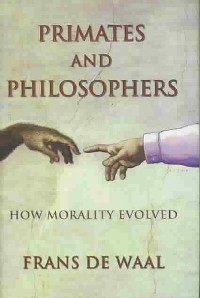
Celebrated primatologist de Waal expands on his earlier work in Good Natured: The Origins of Right and Wrong in Humans and Other Animals to argue that human traits of fairness, reciprocity and altruism develop through natural selection. Based on his 2004 Tanner Lectures at Princeton, this book argues that our morality grows out of the social instincts we share with bonobos, chimpanzees and apes. De Waal criticizes what he calls the "veneer theory," which holds that human ethics is simply an overlay masking our "selfish and brutish nature." De Waal draws on his own work with primates to illustrate the evolution of morality. For example, chimpanzees are more favorably disposed to others who have performed a service for them (such as grooming) and more likely to share their food with these individuals. In three appendixes, de Waal ranges briefly over anthropomorphism, apes and a theory of mind, and animal rights. The volume also includes responses to de Waal by Robert Wright, Christine M. Korsgaard, Philip Kitcher and Peter Singer. Although E.O. Wilson and Robert Wright have long contended that altruism is a product of evolution, de Waal demonstrates through his empirical work with primates the evolutionary basis for ethics. (Oct.)
------------------------------------------
From Scientific American
It was not until a year and a half after his voyage on board the Beagle that Charles Darwin first came face to face with an ape. He was standing by the giraffe house at the London Zoo on a warm day in late March of 1838. The zoo had just acquired an orangutan named Jenny. One of the keepers was teasing her—showing her an apple, refusing to hand it over. Poor Jenny "threw herself on her back, kicked & cried, precisely like a naughty child," Darwin wrote in a letter to his sister. In the secret notebooks that he kept after the voyage, Darwin was speculating about evolution from every angle, including the emotional, and he was fascinated by Jenny’s tantrum. What is it like to be an ape? Does an orangutan’s frustration feel a lot like ours? Might she cherish some sense of right and wrong? Will an ape despair because her keeper is breaking the rules—because he is just not playing fair? Our own species has been talking, volubly and passionately, for at least 50,000 years, and it’s a fair guess that arguments about right and wrong were prominent in our conversation pretty much from the beginning. We started writing things down 5,000 years ago, and some of our first texts were codes of ethics. Our innumerable volumes of scripture and law, our Departments of Justice, High Courts, Low Courts, and Courts of Common Pleas are unique in the living world. But did we human beings invent our feeling for justice, or is it part of the package of primal emotions that we inherited from our ancestors? In other words: Did morality evolve? Dutch-born psychologist, ethologist and primatologist Frans de Waal has spent his career watching the behavior of apes and monkeys, mostly captive troupes in zoos. As a young student, he sat on a wooden stool day after day for six years, observing a colony of chimpanzees at the Arnhem Zoo. Today he watches chimpanzees from an observation post at Emory University’s Yerkes National Primate Research Center in Atlanta and at other zoos and primate centers. His work, along with primatologist Jane Goodall’s, has helped lift Darwin’s conjectures about the evolution of morality to a new level. He has documented tens of thousands of instances of chimpanzee behavior that among ourselves we would call Machiavellian and about as many moments that we would call altruistic, even noble. In his scientific papers and popular books (including Chimpanzee Politics, Our Inner Ape and Good Natured), he argues that Darwin was correct from that first glimpse of Jenny at the zoo. Sympathy, empathy, right and wrong are feelings that we share with other animals; even the best part of human nature, the part that cares about ethics and justice, is also part of nature. De Waal’s latest book, Primates and Philosophers, is based on the Tanner Lectures that he delivered at Princeton University’s Center for Human Values in 2004. In this book he tries—as he has many times before—to refute a popular caricature of Darwinism. Many people assume that to be good, be nice, behave, play well with others, we have to rise above our animal nature. It’s a dog-eat dog world out there—or, as the Romans put it, homo homini lupus, man is wolf to man (a curious proverb for a people whose founding myth was the suckling by a wolf of the infant twins Romulus and Remus). Thomas Henry Huxley, Darwin’s self-appointed bulldog, promoted this dark, cold view of life in a famous lecture, Evolution and Ethics. "The ethical progress of society depends, not on imitating the cosmic process, still less in running away from it, but in combating it," he declared. In Fyodor Dostoyevsky’s The Brothers Karamazov, Ivan puts it another way: if there is no God, then we are lost in a moral chaos. "Everything is permitted." De Waal calls this "Veneer Theory." In this view, human morality is a thin crust on a churning urn of boiling funk. In reality, de Waal reminds us, dogs are social, wolves are social, chimps and macaques are social, and we ourselves are "social to the core." Goodness, generosity and genuine kindness come just as naturally to us as meaner feelings. We didn’t have to invent compassion. When our ancestors began writing down the first codes of conduct, precepts, laws and commandments, they were elaborating on feelings that evolved thousands or even millions of years before they were born. "Instead of empathy being an endpoint," de Waal writes, "it may have been the starting point." Back in the 1950s and 1960s, when animal psychologists talked about "sympathy" and "empathy," they always put those words between quotation marks, de Waal notes. Now he wants to take away the quotation marks. He describes one of his best-known demonstrations that animals care about fairness. In the experiment, he had pairs of capuchin monkeys perform simple tasks in their cages. For successfully completing each task they would get a reward, sometimes a slice of cucumber, sometimes a grape. All the monkeys would work for and eat the cucumber slices, but they preferred grapes. If one monkey kept getting paid in cucumber and it could see that its partner in the next cage was getting grapes, it would get mad, like Darwin’s Jenny. After a while the monkey would refuse to eat or throw the cucumber right out of the cage. Is de Waal right about all this? In the second half of Primates and Philosophers, his arguments are critiqued by a series of commentators, all of whom have written important studies of evolutionary ethics. They cite Freud, Kant, Hume, Nietzsche and Adam Smith. They circle and circle around those pairs of capuchin monkeys: "A capuchin rejects a cucumber when her partner is offered a grape—is she protesting the unfairness, or is she just holding out for a grape?" writes Christine M. Korsgaard, Arthur Kingsley Porter Professor of Philosophy at Harvard University. "Of course, if the lucky capuchin were to throw down the grape until his comrade had a similar reward, that would be very interesting!" writes Philip Kitcher, John Dewey Professor of Philosophy at Columbia University. They disagree, they discuss, they bicker a little, like all primates and philosophers. They illuminate not only ageless questions of ethics but also current concerns such as the Geneva convention and "why universal empathy is such a fragile proposal," as de Waal writes in his response to his critics. By the end of the book it seems clear that we can no longer look at morality as a sort of civilized veneer on a cold and selfish animal, even though that view goes back long before Darwin went to the zoo. Its origin lies in the Western concept of original sin—when Adam and Eve ate their first apple.
目录
Acknowledgments p. vii
Introduction Josiah Ober and Stephen Macedo p. ix
Part I Morally Evolved: Primate Social Instincts, Human Morality, and the Rise and Fall of "Veneer Theory" Frans de Waal p. 1
Appendix A Anthropomorphism and Anthropodenial p. 59
Appendix B Do Apes Have a Theory of Mind? p. 69
Appendix C Animal Rights p. 75
Part II Comments: The Uses of Anthropomorphism by Robert Wright p. 83
Morality and the Distinctiveness of Human Action Christine M. Korsgaard p. 98
Ethics and Evolution: How to Get Here from There Philip Kitcher p. 120
Morality, Reason, and the Rights of Animals Peter Singer p. 140
Part III Response to Commentators: The Tower of Morality Frans de Waal p. 161
References p. 183
Contributors p. 197
Index p. 201
Introduction Josiah Ober and Stephen Macedo p. ix
Part I Morally Evolved: Primate Social Instincts, Human Morality, and the Rise and Fall of "Veneer Theory" Frans de Waal p. 1
Appendix A Anthropomorphism and Anthropodenial p. 59
Appendix B Do Apes Have a Theory of Mind? p. 69
Appendix C Animal Rights p. 75
Part II Comments: The Uses of Anthropomorphism by Robert Wright p. 83
Morality and the Distinctiveness of Human Action Christine M. Korsgaard p. 98
Ethics and Evolution: How to Get Here from There Philip Kitcher p. 120
Morality, Reason, and the Rights of Animals Peter Singer p. 140
Part III Response to Commentators: The Tower of Morality Frans de Waal p. 161
References p. 183
Contributors p. 197
Index p. 201
- 名称
- 类型
- 大小
光盘服务联系方式: 020-38250260 客服QQ:4006604884
云图客服:
用户发送的提问,这种方式就需要有位在线客服来回答用户的问题,这种 就属于对话式的,问题是这种提问是否需要用户登录才能提问
Video Player
×
Audio Player
×
pdf Player
×
