

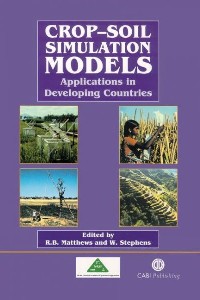
Crop-soil simulation models : applications in developing countries /
副标题:无
作 者:edited by Robin Matthews and William Stephens.
分类号:
ISBN:9780851995632
微信扫一扫,移动浏览光盘
简介
Summary:
Publisher Summary 1
Reviews the various applications of crop simulation models to tropical agriculture that have been published. The 13 contributions identify the successes and limitations of computer models, characterize groups who use the models, and assess where such models might be useful in poverty-oriented research projects in developing countries. Individual chapters summarize work addressing crop genotype improvement, crop management, the impact of climate change, tools to support operational and strategic decision making, and tools for education and training. A condensed version of the first five chapters was published in Advances in agronomy . Distributed by Oxford University Press. Annotation (c) Book News, Inc., Portland, OR (booknews.com)
Publisher Summary 2
The use of crop-soil modelling has so far been mainly confined to the research community. Practical applications have occurred in the areas of decision tools for irrigation studies and pest management. However, there is potential to increase its applied use. This book reviews progress in crop-soil simulation modelling and assesses its application to agriculture in developing countries. It is based on work sponsored by the Natural Resources Systems Programme of the UK Department for International Development.
目录
1 ntroduction 1
Robin Matthews
Part 1: Models as tools in research 7
2 Models as Research Tools 9
Robin Matthews
3 Crop Genotype Improvement 13
Robin Matthews
3.1 Identification and Evaluation of Desirable Plant Characteristics 14
3.2 Environmental Characterization 19
3.3 GxE Interactions 22
4 Crop Management 29
Robin Matthews
4.1 Yield Gap Analysis 29
4.2 Sil Surface Management 33
4.3 Planting 33
4.4 Water Management 37
4.5 Nutrient Management 41
4.6 Pest and Disease Management 47
4.7 Weed Management 49
4.8 Harvesting 53
5 Cropping and Farming Systems 55
Robin Matthews
5.1 New Crops and Cropping Systems 55
5.2 Evaluating Sustainability 58
5.3 Farm Household Models 63
6 Regional and National Planning 69
Robin Matthews
6.1 Linear Programming Approaches 70
6.2 Dynamic Simulation Approaches 74
6.3 Limitations 76
6.4 Impact 77
7 Global Level Processes 79
Robin Matthews and Reiner Wassmann
7.1 Impact of Climate Change on Rice Production 80
7.2 Greenhouse Gas Production 86
7.3 The El Nino-Southern Oscillation 90
Part 2: Models as decision-support tools 93
8 Decision Theory and Decision Support Systems 95
William Stephens
8.1 Decisions, Decisions, Decisions 95
8.2 Characteristics of Decision Making 95
8.3 Definitions of Decision Support Systems 97
8.4 Spatial and Temporal Scale 101
8.5 Application 102
9 Tools to Support Operational Decision Making 105
William Stephens and Tabitha Middleton
9.1 Pest Management 105
9.2 Irrigation Scheduling 109
9.3 Optimizing Fertilizer Application 112
9.4 Multiple Decision Support 113
9.5 Deciding whether to Implement Emergency Relief 114
10 Tools to Support Strategic Decision Making 117
William Stephens and Tabitha Middleton
10.1 Land-use Planning 117
10.2 planning for Climate Change 120
10.3 Crop Forecasting 121
10.4 Irrigation Planning 123
10.5 Assessing the Benefit of Proposed New Technologies . 124
10.6 Planning Optimum Farm Management Strategies in
Collaboration with Extension Services and Farmers 125
11 Why has the Uptake of Decision Support Systems been
so Poor? 129
William Stephens and Tabitha Middleton
11.1 Model Construction Constraints 132
11.2 Marketing and Support Constraints 136
11.3 Technical and Operational Constraints 141
11.4 Jser Constraints 143
11.5 Other Constraints 144
11.6 Criteria for Success of Decision Support Systems 145
11.7 Risks Associated with using Decision Support Systems 146
Part 3: Models as tools in education and training 149
12 Usirg Models as Tools in Education and Training 151
Anil Graves, Tim Hess and Robin Matthews
12.1 introduction 151
12.2 Using Existing Simulation Models 152
12.3 Model Building 163
12.4 Transferring the Systems Approach to Less-developed
Countries 165
12.5 Considerations for Education and Training 173
12.6 -imitations and Constraints of Models in the
=ducational Context 178
Part 4: Have crop models been useful? 183
13 Who are Models Targetted at? 185
Robin Matthews
13.1 Researchers 186
13.2 Consultants 187
13.3 Educators and Trainers 188
13.4 'olicy Makers 189
13.5 Extensionists 190
13.6 -armers 191
14 Impacts of Crop-Soil Models 195
Robin Matthews, William Stephens and Tim Hess
14.1 Limitations to Use 195
14.2 Constraints to the Uptake of Crop Models 196
14.3 Characteristics for Impact 198
14.4 Concluding Remarks 205
Part 5: The way forward 207
15 Where to Now with Crop Modelling? 209
Robin Matthews
15.1 Modelling Rural Livelihoods 211
15.2 Contribution to Crop Improvement Programmes 217
15.3 Making Information Available - Decision Support Systems 219
15.4 Integrating Model Use into Research ahd Extension Projects 221
15.5 Environmental Research 224
15.6 Building Modelling Capacity 226
15.7 Further Crop-Soil Model Development 227
15.8 Summary 229
16 Concluding Remarks 231
Robin Matthews and William Stephens
References 235
Appendix: Personal Communications 267
Index 271
Crop-soil simulation models : applications in developing countries /
- 名称
- 类型
- 大小
光盘服务联系方式: 020-38250260 客服QQ:4006604884
云图客服:
用户发送的提问,这种方式就需要有位在线客服来回答用户的问题,这种 就属于对话式的,问题是这种提问是否需要用户登录才能提问
Video Player
×
Audio Player
×
pdf Player
×
