

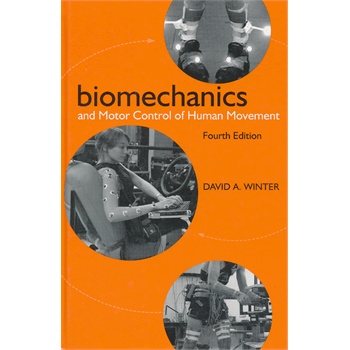
Biomechanics And Motor Control Of Human Movement, Fourth Edition 9780470398180
副标题:无
分类号:
ISBN:9780470398180
微信扫一扫,移动浏览光盘
简介
目录
Preface to the Fourth Edition.
1 Biomechanics as an Interdiscipline.
1.0 Introduction.
1.1 Measurement, Description, Analysis, and Assessment.
1.2 Biomechanics and its Relationship with Physiology andAnatomy.
1.3 Scope of the Textbook.
1.4 References.
2 Signal Processing.
2.0 Introduction.
2.1 Auto- and Cross-Correlation Analyses.
2.2 Frequency Analysis.
2.3 Ensemble Averaging of Repetitive Waveforms.
2.4 References.
3 Kinematics.
3.0 Historical Development and Complexity of Problem.
3.1 Kinematic Conventions.
3.2 Direct Measurement Techniques.
3.3 Imaging Measurement Techniques.
3.4 Processing of Raw Kinematic Data.
3.5 Calculation of Other Kinematic Variables.
3.6 Problems Based on Kinematic Data.
3.7 References.
4 Anthropometry.
4.0 Scope of Anthropometry in Movement Biomechanics.
4.1 Density, Mass, and Inertial Properties.
4.2 Direct Experimental Measures.
4.3 Muscle Anthropometry.
4.4 Problems Based on Anthropometric Data.
4.5 References.
5 Kinetics: Forces and Moments of Force.
5.0 Biomechanical Models.
5.1 Basic Link-Segment Equations—the Free-Body Diagram.
5.2 Force Transducers and Force Plates.
5.3 Bone-on-Bone Forces During Dynamic Conditions.
5.4 Problems Based on Kinetic and Kinematic Data.
5.5 References.
6 Mechanical Work, Energy, and Power.
6.0 Introduction.
6.1 Efficiency.
6.2 Forms of Energy Storage.
6.3 Calculation of Internal and External Work.
6.4 Power Balances at Joints and Within Segments.
6.5 Problems Based on Kinetic and Kinematic Data.
6.6 References.
7 Three-Dimensional Kinematics and Kinetics.
7.0 Introduction.
7.1 Axes Systems.
7.2 Marker and Anatomical Axes Systems.
7.3 Determination of Segment Angular Velocities andAccelerations.
7.4 Kinetic Analysis of Reaction Forces and Moments.
7.5 Suggested Further Reading.
7.6 References.
8 Synthesis of Human Movement—Forward Solutions.
8.0 Introduction.
8.1 Review of Forward Solution Models.
8.2 Mathematical Formulation.
8.3 System Energy.
8.4 External Forces and Torques.
8.5 Designation of Joints.
8.6 Illustrative Example.
8.7 Conclusions.
8.8 References.
9 Muscle Mechanics.
9.0 Introduction.
9.1 Force-Length Characteristics of Muscles.
9.2 Force-Velocity Characteristics.
9.3 Muscle Modeling.
9.4 References.
10 Kinesiological Electromyography.
10.0 Introduction.
10.1 Electrophysiology of Muscle Contraction.
10.2 Recording of the Electromyogram.
10.3 Processing of the Electromyogram,.
10.4 Relationship between Electromyogram and BiomechanicalVariables.
10.5 References.
11 Biomechanical Movement Synergies.
11.0 Introduction.
11.1 The Support Moment Synergy.
11.2 Medial/Lateral and Anterior/Posterior Balance inStanding.
11.3 Dynamic Balance during Walking.
11.4 References.
APPENDICES.
A. Kinematic, Kinetic, and Energy Data.
Figure A.1 Walking Trial—Marker Locations and Mass and FrameRate Information.
Table A.1 Raw Coordinate Data (cm).
Table A.2(a) Filtered Marker Kinematics—Rib Cage andGreater Trochanter (Hip).
Table A.2(b) Filtered Marker Kinematics—Femoral LateralEpicondyle (Knee) and Head of Fibula.
Table A.2(c) Filtered Marker Kinematics—Lateral Malleolus(Ankle) and Heel.
Table A.2(d) Filtered Marker Kinematics—Fifth Metatarsaland Toe.
Table A.3(a) Linear and Angular Kinematics—Foot.
Table A.3(b) Linear and Angular Kinematics—Leg.
Table A.3(c) Linear and Angular Kinematics—Thigh.
Table A.3(d) Linear and Angular Kinematics—1/2 HAT.
Table A.4 Relative Joint Angular Kinematics—Ankle, Knee, andHip.
Table A.5(a) Reaction Forces and Moments of Force—Ankleand Knee.
Table A.5(b) Reaction Forces and Moments ofForce—Hip.
Table A.6 Segment Potential, Kinetic, and Total Energies—Foot,Leg, Thigh, and1/2 HAT.
Table A.7 Power Generation/Absorption and Transfer—Ankle, Knee,and Hip.
B. Units and Definitions Related to Biomechanical andElectromyographical Measurements.
Table B.1 Base SI Units.
Table B.2 Derived SI Units.
Index.
光盘服务联系方式: 020-38250260 客服QQ:4006604884
云图客服:
用户发送的提问,这种方式就需要有位在线客服来回答用户的问题,这种 就属于对话式的,问题是这种提问是否需要用户登录才能提问
