

简介
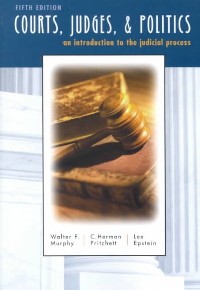
This classic reader has been a best selling component to the Judicial Process/Judicial Politics/American Legal System course for years. Now thoroughly updated while retaining the features that made it attractive for so long: organization, structure, coverage, narrative, choice of excerpts, and flexibility in use, Lee Epstein and Walter Murphy continue the tradition of this book.
目录
Part I "The Nature" of Judging
Chapter 1 Political Jurisprudence
1 Civil and Common Law Systems
1.1 The Civil Law
1.2 The Common Law
2 Conceptualizations of Law: Schools of Jurisprudence
2.1 Natural Law
3.1 Legal Positivism
3.2 The Debate
3 The Expanding and Contracting Declaratory Theory
4 Sociological Jurisprudence and Legal Realism
4.1 Contemporary Outgrowths of Legal Realism
4.2 A Revival of the Jurisprudence of Natural Law
5 Political Jurisprudence
6 What Is to Come
7 Selected References
Readings
1.1 Sir William Blackstone, Commentaries on the Laws of England
1.2 Alexander Hamilton, The Federalist No. 78
1.3 Alexis de Tocqueville, Judicial Power in the United States
1.4 Oliver Wendell Holmes, Jr., The Path of Law
1.5 Benjamin N. Cardozo, The Nature of the Judicial Process
1.6 Judith A. Baer, Our Lives Before the Law: Constructing a Feminist Jurisprudence
Chapter 2 Courts in Constitutional Democracies
1 The Origins of Courts
1.1 Distinctive Characteristics of Judicial Processes
2 The Roles of Courts
2.1 Resolving Disputes
2.2 Making Policy
2.3 Monitoring Governmental Action
2.3.1 Judicial Review in the United States
2.3.2 Judicial Review Abroad
2.3.2.1 The British Alternative
2.3.3 To What Extent Does Judicial Review Present a Paradox?
3 The Expansion of Judicial Power?
4 Selected References
Readings
2.1 Lynn Mather, The Fired Football Coach (Or, How Trial Courts Make Policy)
2.2 Marbury v. Madison (1803)
2.3 Eakin v. Raub (1825)
2.4 Robert A. Dahl, Decision Making in a Democracy: The Supreme Court as a National Policy Maker
2.5 Jonathan D. Casper, The Supreme Court and National Policy
2.6 Jon O. Newman, The Judge Baer Controversy
Part II The American Legal System
Chapter 3. Judicial Organization
1 Establishing the American Legal System
1.1 Article III
1.2 The Judiciary Act of 1789
1.3 Judicial Federalism
2 Today’s System of Federal Courts
2.1 The U.S. Supreme Court
2.2 Reforming the Federal Courts: The Caseload Problem
3 State Court Systems
4 A New Judicial Federalism
4.1 Reviewing the Decisions of State Supreme Courts
4.2 Issuing Injunctions
4.3 Restricting Habeas Corpus
4.4 Limiting Exceptions to the Eleventh Amendment
5 Selected References
Readings
3.1 Judiciary Act of 1789, Section 25
3.2 Owen M. Fiss, The Bureaucratization of the Judiciary
3.3 C. K. Rowland and Robert Carp, Politics and Judgment on the Federal District Courts
3.4 Charles F. Wyzanski, Jr. The Importance of the Trial Judge
3.5 J. Woodford Howard, Jr., Litigation Flow in Three United States Courts of Appeals, and Sue Davis and Donald Songer, The Changing Roles of the United States Courts of Appeals
3.6 U.S. Supreme Court Rule 10, Considerations Governing Review on Writ of Certiorari
3.7 Victor Williams, Solutions to Federal Judicial Gridlock, and Jon O. Newman, 1,000 Judges—The Limit for an Effective Federal Judiciary
3.8 Robert A. Kagan, Bliss Cartwright, Lawrence M. Friedman, and Stanton Wheeler, The Evolution of State Supreme Courts
3.9 William J. Brennan, Guardians of Our Liberties—State Courts No Less than Federal
3.10 Michigan v. Long (1983)
Chapter 4 Judicial Selection and Retention
1 Selection of Federal Judges
1.1 Presidential Considerations
1.1.1 Professional Qualifications
1.2 Confirmation Proceedings
1.3 The Behavior of Judicial Appointees
2 Judicial Selection in the States
2.1 Debates over State Selection Systems
3 Disciplining Judges
3.1 Federal Judges
3.2 State Judges
4 Selected References
Readings
4.1 Sheldon Goldman and Eliot Slotnick, Picking Judges Under Fire
4.2 Sheldon Goldman, Picking Federal Judges
4.3 William H. Rehnquist, 1997 Year-End Report on the Federal Judiciary
4.4 Gregory A. Caldeira and John R. Wright, Lobbying for Justice
4.5 Robert H. Bork, The Tempting of America
4.6 Ronald Stidham, Robert A. Carp, and Donald R. Songer, The Voting Behavior of President Clinton’s Appointees
4.7 Thomas G. Walker and Deborah J. Barrow, The Diversification of the Federal Bench: Policy and Process Ramifications
4.8 Thurgood Marshall, Comments on the Missouri Plan
4.9 Melinda Gann Hall, Competition in Judicial Elections, 1980-1995
4.10 John T. Wold and John H. Culver, The Defeat of the California Justices
4.11 Nixon v. United States (1993)
Chapter 5 The Bar
1 Becoming an Attorney
1.1 Admission to the Bar
2 The Lawyer’s Work
2.1 Development of the Bar
2.2 The Contemporary Practice of Law
3 Challenges Confronting the Legal Profession
4 Selected References
Readings
5.1 Scott Turow, One L: An Inside Account of Life in the First Year at Harvard Law School
5.2 Austin Sarat and William L. F. Felstiner, Law and Strategy in the Divorce Lawyer’s Office
5.3 Abraham S. Blumberg, The Practice of Law as a Confidence Game
5.4 F. Lee Bailey, The Defense Never Rests
5.5 Sandra Day O’Connor, Professionalism
Part III Judicial Power
Chapter 6 Access to Judicial Power
1 Formal Barriers to Entry in the American Legal System
1.1 Jurisdiction
1.2 Case or Controversy
1.2.1 Advisory Opinions
1.2.2 Collusion
1.2.3 Ripeness and Mootness
1.2.4 Political Questions and Justiciability
4.5 Standing
1.3.1 Standing and Organized Interests
4.6 Formal Barriers to Access as Gate-Keeping Devices
2 Informal Barriers to Entry
3 Accessing the Legal System: Who Uses the Courts?
3.1 The Strategies of Interest Groups
3.2 The Influence of Interest Groups
4 Selected References
Readings
6.1 The Washington Administration’s Request for an Advisory Opinion and the Justices’ Response
6.2 Roe v. Wade (1973) versus DeFunis v. Odegaard (1974)
6.3 Baker v. Carr (1962)
6.4 Marc Galanter, Why the "Haves" Come Out Ahead: Speculations on the Limits of Social Change
6.5 Clement E. Vose, Litigation as a Form of Pressure Group Activity
6.6 Gregory A. Caldeira and John R. Wright, Interest Groups and Agenda Setting in the U.S. Supreme Court
Chapter 7 Instruments of Judicial Power
1 Writs of Certiorari
2 Decisions, Opinions, and Orders
3 The Injunction
3.1 Injunctions and Positive Action
4 The Contempt Power
5 The Writ of Habeas Corpus
6 References
Readings
7.1 Texas v. Hopwood (1996)
7.2 Madsen v. Women’s Health Center, Inc. (1994)
7.3 Wyatt v. Stickney (1971) and Wyatt v. Stickney (1972)
7.4 Illinois v. Allen (1970)
Chapter 8 Limitations on Judicial Power
1 Internal Checks
2 Institutional Checks
3 Checks Imposed by the American System of Separated Powers
3.1 Political Checks by Executives
3.2 Legislative Restrictions
4 Checks from the States
5 Checks from the People
6 Selected References
Readings
8.1 Webster v. Reproductive Health Services (1989)
8.2 Lee Epstein and Jack Knight, The Choices Justices Make
8.3 Jeffrey A. Segal, Donald R. Songer, and Charles M. Cameron, Decision Making on the U.S. Courts of Appeals
8.4 Andrew Jackson, Veto of the Bank Bill
8.5 Abraham Lincoln, First Inaugural Address
8.6 Franklin D. Roosevelt, Reorganizing the Federal Judiciary
8.7 Bill Clinton, Statement on the Line-Item Veto
8.8 B.N. Yeltsin, On the Constitutional Court of the Russian Federation
8.9 Ex parte McCardle (1869)
8.10 William N. Eskridge, Jr., Civil Rights Legislation in the 1990s: Reneging on History?
8.11 James H. Kuklinski and John E. Stanga, Political Participation and Government Responsiveness: The Behavior of California Superior Courts
8.12 James L. Gibson, Gregory A. Caldeira, and Vanessa Baird, On the Legitimacy of National High Courts
Part IV Judicial Decision Making
Chapter 9 Fact Finding in the Courts
1 The Adversarial Process
2 Juries
2.1 Jury Trials
2.1.1 Composition of Juries
2.1.2 Number of Jurors
2.1.3 Jury Verdicts
2.2 The Critics and Defenders of Juries
3 Standards for Fact Finding
3.1 Adjudicative Facts
3.2 Legislative Facts and Public Issues
4 Social and Economic Data
4.1 Contemporary Use of Social Science Evidence: The Death Penalty Cases
5 Selected References
Readings
9.1 Marvin E. Frankel, The Adversary Judge: The Experience of the Trial Judge
9.2 Hans Zeisel and Harry Kalven, Jr., The American Experiment
9.3 Geoffrey Norman, Juror Furor
9.4 Clarence Darrow, How to Pick a Jury
9.5 Amitai Etzioni, Science: Threatening the Jury Trial
9.6 Michael Saks, The Limits of Scientific Jury Selection
9.7 Paul Butler, Black Jurors: Right to Acquit? Jury Nullification
9.8 Tracey Gilstrap Weiss, The Great Democratizing Principle: The Effect on South Africa of Planning a Democracy Without a Jury System
9.9 McCleskey v. Kemp (1987)
9.10 David C. Baldus, The Death Penalty Dialogue Between Law and Social Science
9.11 John C. Jeffries, Jr., Justice Lewis F. Powell, Jr.
Chapter 10 Precedents and Legal Reasoning
1 Reasoning by Example
2 Ration Decidendi versus Dicta
2.1 Dicta
3 Treatment of Precedent
3.1 Distinguishing a Precedent
3.2 Limiting a Precedent
3.3 Ignoring a Precedent
3.4 Overruling a Precedent
3.5 Extending a Precedent
4 Precedents and Decision Making
5 Selected References
Readings
10.1 Edward H. Levi, An Introduction to Legal Reasoning
10.2 Lief H. Carter, Reasoning in Law
10.3 MacPherson v. Buick Motor Co. (1916)
10.4 Briefs of the Parties. U.S. Term Limits v. Thornton (1995)
10.5 Ronald Dworkin, Taking Rights Seriously
10.6 Planned Parenthood of Southeastern Pennsylvania v. Casey (1992)
10.7 Jeffrey A. Segal and Harold J. Spaeth, The Influence of Stare Decisis on the Vote of United States Supreme Court Justices, versus Lee Epstein and Jack Knight, The Norm of Stare Decisis
10.8 Lewis F. Powell, Jr., Stare Decisis and Judicial Restraint
10.9 Ronald Kahn, Institutional Norms and Supreme Court Decision-Making: The Rehnquist Court on Privacy and Religion
Chapter 11 Statutory Interpretation
1 Plain Meaning and the Problem of Ambiguity
2 Dealing with Ambiguity: Theories of Statutory Interpretation
2.1 Legislative Intent
2.2 Legislative Purpose
2.3 Public Choice and the New Textualism
2.4 Dynamic Statutory Interpretation
3 Practical Matters in Statutory Interpretation
4 Statutory Law and Judicial Law Making
5 Selected References
Readings
11.1 Felix Frankfurter, Some Reflections on Reading Statutes
11.2 Smith v. United States (1993)
11.3 United Steelworkers of America v. Weber (1979)
11.4 Richard A. Posner, The Federal Courts
11.5 Henry M. Hart, Jr., and Albert M. Sachs, The Legal Process
11.6 Conroy v. Aniskoff (1993)
11.7 Frank Easterbrook, Statutes’ Domains
11.8 Ronald Dworkin. Law as Interpretation
11.9 William N. Eskridge, Jr., Dynamic Statutory Interpretation
Chapter 12 Constitutional Interpretation
1 Constitutional Texts, Constitutions, and Constitutionalism
2 What Is to Be Interpreted?
3 Who Shall Interpret?
4 How Should Judges Interpret the Constitution? American Interpretive Style
5 Modes of Interpretation
5.1 The Text
5.2 Stare Decisis and Doctrinal Analysis
5.3 Original Intent or Understanding
5.4 Structural Analysis
5.5 Purposive Analysis
5.6 Polls of Other Jurisdictions
5.6.1 Polls of Courts Abroad
5.7 Balancing Interests
5.8 Cost-Benefit Analysis
6 Constitutional Interpretation as a Form of Statecraft
7 Selected References
Readings
12.1 United States v. Nixon (1974)
12.2 Antonin Scalia, A Theory of Constitutional Interpretation
12.3 Robert H. Bork, The Tempting of America
12.4 Thurgood Marshall, Reflections on the Bicentennial of the United States Constitution
12.5 The State v. Makwanyane (1995)
12.6 US v. Leon (1984)
12.7 Laurence H. Tribe, Constitutional Calculus: Equal Justice of Economic Efficiency? v. Frank H. Easterbrook, Method, Result, and Authority: A Reply
12.8 William Rehnquist, The Notion of a Living Constitution
12.9 Ronald Dworkin, Taking Rights Seriously
Chapter 13 The Processes of Judicial Decision Making
1 Decisions of Trial Courts
2 Intermediate Appellate Courts
3 State Supreme Courts
4 The U.S. Supreme Court
4.1 Case Selection
4.1.1. Factors Affecting Selection of Cases
4.2 Oral Argument
4.3 The Judicial Conference
4.4 Writing Opinions
4.5 Negotiating and Bargaining
4.6 Voting on the Merits
5 Selected References
Readings
13.1 Charles Nesson, et al. Critical Issues in the Courtroom: Exploring a Hypothetical Case
13.2 James Eisenstein and Herbert Jacob, Felony Justice
13.3 Frank B. Cross and Emerson H. Tiller, Judicial Partisanship and Obedience to Legal Doctrine: Whistleblowing on the Federal Courts of Appeals
13.4 Melinda Gann Hall, Constituent Influence in State Supreme Courts
13.5 Court Acts and Rules
13.6 Certiorari Memoranda
13.7 H. W. Perry, Deciding to Decide
13.8 David J. Danelski, The Influence of the Chief Justice in the Decisional Process
13.9 Paul J. Wahlbeck, James F. Spriggs, and Forest Maltzman, Marshalling the Court: Bargaining and Accommodation on the United States Supreme Court
Chapter 14 The Impact of Judicial Decisions
1 Compliance and Impact
2 Anticipated Consequences
3 Actual Consequences
4 Explaining and Assessing Effects
5 Selected References
Readings
14.1 Bradley C. Canon, and Charles Johnson, Judicial Policies: Implementation and Impact
14.2 Elliot E. Slotnick and Jennifer A. Segal, Television News and the Supreme Court
14.3 Baker v. Carr (1962)
14.4 Louis Fisher, Legislative Vetoes, Phoenix Style
14.5 Gerald N. Rosenberg, The Hollow Hope: Can Courts Generate Social Change
14.6 Michael McCann, Reform Litigation on Trial: Review of "The Hollow Hope"
14.7 Valerie J. Hoekstra and Jeffrey A. Segal, The Shepherding of Local Public Opinion: The Supreme Court and Lamb's Chapel
- 名称
- 类型
- 大小
光盘服务联系方式: 020-38250260 客服QQ:4006604884
云图客服:
用户发送的提问,这种方式就需要有位在线客服来回答用户的问题,这种 就属于对话式的,问题是这种提问是否需要用户登录才能提问
Video Player
×
Audio Player
×
pdf Player
×
