

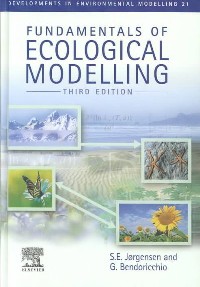
简介
The Third Edition features: • A detailed discussion and step-by-step outline of the modelling procedure. • An account of different model types including overview tables, examples and illustrations. • A comprehensive presentation of the submodels and unit processes used in modelling. • In-depth descriptions of the latest modelling techniques. • Structured exercises at the end of each chapter. • Three mathematical appendices and a subject index.
This practical and proven book very effectively combinesthe theory, methodology and applications of ecological modelling. The new edition is an essential, up-to-date guide to a rapidly growing field.
目录
Acknowledgements
1 Introduction
Physical and mathematical models
Models as a management tool
Models as a scientific tool
Models and holism
The ecosystem as an object for research
Outline of the book
The development of ecological and environmental models
State of the art in the application of models
2 Concepts of Modelling
Introduction
Modelling elements
The modelling procedure
Types of model
Selection of the model type
Selection of model complexity and structure
Verification
Sensitivity analysis
Parameter estimation
Validation
Ecological modelling and quantum theory
Modelling constraints
Problems
3 Ecological Processes
Space and time resolution
Mass transport
Mass balance
Energetic factors
Settling and resuspension
Chemical reactions
Chemical equilibrium
Hydrolysis
Redox
Acid-Base
Adsorption and ion exchange
Volatilization
Biogeochemical cycles in aquatic environments
Photosynthesis
Algal growth
Zooplankton growth
Fish growth
Single population growth
Ecotoxicological processes
Problems
4 Conceptual Models
Introduction
Application of conceptual diagrams
Types of conceptual diagrams
The conceptual diagram as modelling tool
Problems
5 Static Models
Introduction
Network models
Network analysis
ECOPATH software
Response models
6 Modelling Population Dynamics
Introduction
Basic concepts
Growth models in population dynamics
Interaction between populations
Matrix models
Problems
7 Dynamic Biogeochemical Models
Introduction
Application of dynamic models
Eutrophication models I: Overview and two simple eutrophication models
Eutrophication models II: A complex eutrophication model
A wetland model
Problems
8 Ecotoxicological Models
Classification and application of ecotoxicological models
Environmental risk assessment
Characteristics and structure of ecotoxicological models
An overview: The application of models in ecotoxicology
Estimation of ecotoxicological parameters
Ecotoxicological case study I: Modelling the distribution of chromium in a Danish fjord
Ecotoxicological case study II: Contamination of agricultural products by cadmium and lead
Ecotoxicological case study III: A mercury model for Mex Bay, Alexandria
Fugacity fate models
Problems
9 Recent Developments in Ecological and Environmental Modelling
Introduction
Ecosystem characteristics
Structurally dynamic models
Four illustrative structurally dynamic case studies
Application of chaos theory in modelling
Application of catastrophe theory in ecological modelling
New approaches in modelling techniques
Problems
Appendix 1 Mathematical Tools
Vectors
Matrices
Square matrices, eigenvalues and eigenvectors
Differential equations
Systems of differential equations
Numerical methods
Appendix 2 Definition of Expressions, Concepts and Indices
Appendix 3 Parameters for Fugacity Models
References
Subject Index
- 名称
- 类型
- 大小
光盘服务联系方式: 020-38250260 客服QQ:4006604884
云图客服:
用户发送的提问,这种方式就需要有位在线客服来回答用户的问题,这种 就属于对话式的,问题是这种提问是否需要用户登录才能提问
