

简介
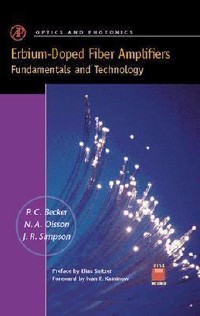
Erbium Fiber Amplifiers is a comprehensive introduction tothe increasingly important topic of optical amplification.Written by three Bell Labs pioneers, the book stresses theimportance of the interrelation of materials properties, optical properties, and systems aspects of optical fiber amplifiers. The floppy disk included with the book contains a PC based educational version of the sophisticated commercial amplifier simulation package OASIX (sold by the Specialty Fiber Group of Lucent Technologies). This powerful numerical simulation softwareallows one to simulate the performance of a real erbium fiber amplifier, and obtain its properties such as signal gain and noise generated. Several parameter sets are included, each of which represents a commercially available type of erbium doped fiber usedin different kinds of amplifiers (e.g. preamplifiers and power amplifiers). The user can vary, via Windows based input screens, various amplifier characteristics such as fiber length, pump power, signal power, and additional signals. The output is savedin a file which can be read by any spreadsheet or plotting package for graphical representation of the results. The software allows the reader to explore on his or her own the concepts of amplifier performance discussed in the book, and gain a more intuitive and interactive educational experience leading to a richer understanding of erbium-doped fiber amplifiers and their applications. Key Features * Includesa software disk with a PC-based amplifier simulation tool derived from a sophisticated commercial package (OASIX), which allows the reader to gain an interactive educationalexperience using parameters for commercially available erbium-doped fibers * Explains the theory of noise in optically amplified systems in an intuitive way * The bookcontains a discussion of components used in amplifier fabrication and of the attendant technologies used in realsystems * The book provides basic tools for amplifier design as well as systems engineering, including the latest developments in WDM and soliton systems * The book discusses the fundamentals of rare earth ions for the reader desiring more depth in the topic * The book is for either the novice of experienced reader * The chapter havelinks between them to allow the reader to understand the relationship between the amplifier characteristics, noise,and systems applications * The book contains extensive references.
目录
CONTENTS
Foreword
Preface
Acknowledgements
1 INTRODUCTION
1.1 Long Haul Fiber Networks
1.2 Historical Development of Erbium-Doped Fiber Amplifiers
1.3 From Glass to Systems – Outline
2 OPTICAL FIBER FABRICATION
2.1 Introduction
2.2 Conventional Communication Fiber
2.3 Rare Earth Doped Fibers
2.3.1 Rare Earth Vapor Phase Delivery Methods
2.3.2 Rare Earth Solution-Doping Methods
2.3.3 Rod and Tube Methods
2.4 Pump-Signal Interaction Methods
2.4.1 Evanescent Field
2.4.2 Double Clad Fiber Design
2.5 Compositions
2.6 Physical Properties
2.6.1 Fiber Refractive Index and Composition Profile
2.6.2 Strength and Reliability
2.6.3 Alternate Glass Host Fabrication
3 COMPONENTS AND INTEGRATION
3.1 Introduction
3.2 Fiber Connectors
3.3 Fusion Splicing
3.4 Pump and Signal Combiners
3.5 Isolators
3.6 Circulators
3.7 Filters
3.8 Fiber Gratings
3.8.1 Introduction
3.8.2 Applications of Bragg Gratings
3.8.3 Long Period Gratings
3.9 Signal Multiplexers and Demultiplexers
3.10 Signal Add/Drop Components
3.11 Dispersion Compensation Components
3.12 Integrated Components
3.13 Pump Lasers
4 RARE EARTH IONS – INTRODUCTORY SURVEY
4.1 Introduction
4.2 Atomic Physics of the Rare Earths
4.2.1 Introduction – The 4f Electron Shell
4.2.2 The "Puzzle" of 4f Electron Optical Spectra
4.2.3 Semiempirical Atomic and Crystal Field Hamiltonians
4.2.4 Energy Level Fitting
4.3 Optical Spectra of Rare Earth Ions
4.3.1 The Character of 4f[sup(N)] – 4f[sup(N)] Optical Transitions
4.3.2 Intensities of One-Photon Transitions – Judd-Ofelt Theory
4.4 Fundamental Properties
4.4.1 Transition Cross Sections
4.4.2 Lifetimes
4.4.3 Linewidths and Broadening
4.5 Spectroscopy of the Er[sup(3+)] Ion
4.5.1 Lifetimes
4.5.2 Er[sup(3+)] Spectra, Cross Sections, and Linewidths
4.6 Er[sup(3+)] -Er[sup(3+)] Interaction Effects
5 ERBIUM-DOPED FIBER AMPLIFIERS – AMPLIFIER BASICS
5.1 Introduction
5.2 Amplification in Three-Level Systems–Basics
5.2.1 Three-Level Rate Equations
5.2.2 The Overlap Factor
5.3 Reduction of the Three-Level System to the Two-Level System
5.3.1 Validity of the Two-Level Approach
5.3.2 Generalized Rate Equations
5.4 Amplified Spontaneous Emission
5.5 Analytical Solutions to the Two-Level System
6 ERBIUM-DOPED FIBER AMPLIFIERS – MODELING AND COMPLEX EFFECTS
6.1 Introduction
6.2 Absorption and Emission Cross Sections
6.3 Gain and ASE Modeling
6.3.1 Model Equations – Homogeneous Broadening
6.3.2 Average Inversion Relationship
6.3.3 Inhomogeneous Broadening
6.4 Amplifier Simulations
6.4.1 Signal Gain, ASE Generation, and Population Inversion
6.4.2 Gain as a Function of Fiber Length
6.4.3 Spectral Profile of the ASE
6.4.4 Small Signal Spectral Gain and Noise Modeling
6.4.5 Saturation Modeling – Signal Gain and Noise Figure
6.4.6 Power Amplifier Modeling
6.4.7 Effective Parameter Modeling
6.5 Transverse Mode Models – Erbium Confinement Effect
6.6 Excited–State Absorption Effects
6.6.1 Model Equations
6.6.2 Modeling Results in the Presence of ESA
6.6.3 800 nm Band Pumping
6.7 Er[sup(3+)] -Er[sup(3+)] Interaction Effects
6.7.1 Upconversion Effects on Amplifier Performance
6.7.2 Pair Induced Quenching
7 OPTICAL AMPLIFIERS IN FIBER OPTIC COMMUNICATION SYSTEMS – THEORY
7.1 Introduction
7.2 Optical Noise: Device Aspects
7.2.1 Classical Derivation of Optical Amplifier Noise
7.2.2 Noise at the Output of an Optical Amplifier
7.2.3 Comparison of Optical Amplifier Devices
7.3 Optical Noise: System Aspects
7.3.1 Receivers
7.3.2 Bit Error Rate Calculations - Direct Detection
7.3.3 Optical Preamplifiers – Noise Figure and Sensitivity
7.3.4 Optical Inline Amplifiers - Amplifier Chains
7.3.5 Noise in Optical Power Amplifiers
7.3.6 Nonlinearity Issues
7.3.7 Analog Applications
8 AMPLIFIER CHARACTERIZATION AND DESIGN ISSUES
8.1 Introduction
8.2 Basic Amplifier Measurement Techniques
8.2.1 Gain Measurements
8.2.2 Power Conversion Efficiency
8.2.3 Noise Figure Measurements
8.3 Amplifier Design Issues
8.3.1 Copropagating and Counterpropagating Pumping Issues
8.3.2 Choice of Fiber Lengths and Geometries for Various Applications
8.3.3 Multistage Amplifiers
8.3.4 Bidirectional Amplifiers
8.3.5 Power Amplifiers
8.3.6 WDM Amplifier Design Issues
8.3.7 Distributed Amplifiers
8.3.8 Waveguide Amplifiers
9 SYSTEM IMPLEMENTATIONS OF AMPLIFIERS
9.1 Introduction
9.2 System Demonstrations and Issues
9.2.1 Preamplifiers
9.2.2 Inline Amplifiers - Single Channel Transmission
9.2.3 Mine Amplifiers - WDM Transmission
9.2.4 Repeaterless Systems
9.2.5 Remote Pumping
9.2.6 Analog Applications
9.2.7 Gain Peaking and Self-Filtering
9.2.8 Polarization Issues
9.2.9 Transient Effects
9.3 Soliton Systems
9.3.1 Principles
9.3.2 System Results and Milestones
10 FOUR LEVEL FIBER AMPLIFIERS FOR 1.3 μM AMPLIFICATION
10.1 Introduction
10.1.1 Gain in a Four-Level System
10.2 Pr[sup(3+)] -doped Fiber Amplifiers
10.2.1 Introduction
10.2.2 Spectroscopic Properties
10.2.3 Gain Results for Pr[sup(3+)] -doped Fiber Amplifiers
10.2.4 Modeling of the Pr[sup(3+)] -doped Fiber Amplifier Gain
10.2.5 System Results
10.3 Nd[sup(3+)] -Doped Fiber Amplifiers
10.3.1 Introduction
10.3.2 Gain Results for Nd[sup(3+)] -Doped Fiber Amplifiers
10.3.3 Modeling of the Nd[sup(3+)] -Doped Fiber Amplifier Gain
Appendix A
A.1 OASIX? Amplifier Simulation Software
A.2 Introduction
A.2.1 System Requirements
A.2.2 Installing OASIX?
A.2.3 Starting OASIX?
A.2.4 What to do next
A.3 A Quick Overview and Tour
A.3.1 Fibers and Modeling Parameters
A.3.2 Saving a Simulation Configuration
A.3.3 Device Types Simulated
A.3.4 Data Entry and Device Conventions
A.3.5 Screens and Menus
A.3.6 Simulation Looping and Output Modes
A.4 Screen Contents and Simulation Methodology
A.4.1 Main/Entry Screen
A.4.2 Single-Stage Setup Screen
A.4.3 Additional Signals Screen
A.4.4 Output Setup Screen
A.4.5 Simulation Status Box
A.5 Simulation Looping Structure
A.5.1 Specifying Loop Parameters
A.5.2 Choosing Loop Order
A.5.3 Linear or Logarithmic Looping
A.5.4 Multiple Parameters Varied in a Loop
A.5.5 Influence on Output Format
A.5.6 Output Modes
A.6 Sample Simulations
A.6.1 Single-Run, Single-Stage EDFA
A.6.2 Multiple-Run, Single-Stage EDFA
A.6.3 Other simulations to try
A.7 Computation of Signal Related Quantities
A.8 Computation of ASE Related Quantities
A.9 Basic Operating Principles
A.9.1 Simulation Speed and the Number of Waves
A.9.2 Causes and Remedies for Convergence Failure
A.10 Comment on the treatment of losses
INDEX
A
B
C
D
E
F
G
H
I
J
K
L
M
N
O
P
Q
R
S
T
U
V
W
Y
Z
- 名称
- 类型
- 大小
光盘服务联系方式: 020-38250260 客服QQ:4006604884
云图客服:
用户发送的提问,这种方式就需要有位在线客服来回答用户的问题,这种 就属于对话式的,问题是这种提问是否需要用户登录才能提问
Video Player
×
Audio Player
×
pdf Player
×
