

简介
Summary:
Publisher Summary 1
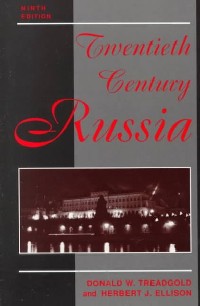
Donald Treadgoldwas one of the most distinguished Russian historians of his generation. His Twentieth Century Russia, a standard text in colleges and universities for several decades,has been regularly revised and expanded to reflect new events and scholarship. The present revision, by Professor Herbert Ellison, contains a major chapter on the Yeltsin era, and brings the Russian story to the final year of the century.Twice in the twentieth century the collapse of the Russian state and empire has been followed by an effort to build a democracy on the Western model. The first effort succumbed within a few months to Lenin’s communist revolution, whose ideas and institutions dominated the history of Russia, and eventually much of the world, during the succeeding seventy-four years. In August 1991, an attempt by Soviet leaders to suppress democratic and nationalist movements unleashed by the Gorbachev reforms, and already victorious in Eastern Europe, precipitated instead an anti-communist revolution under the leadership of Boris Yeltsin.The revolution, and the sweeping transformation that followed, are treated in the new edition, which assesses the aims and scope of the first decade of Russia’s second revolution. The transformation included a new constitutional structure, two fully democratic parliamentary elections and a presidential election (with another of each soon to come), a vigorous revival of political parties and political debate, and major questions about Russia’s political future. Against the broad background of the Russian experience over a turbulent century, it raises the major questions: What are the prospects for Russian democracy? Why are the communists, following an anti-communist revolution, the most powerful parliamentary party in Russia’s new parliament, and what is their impact? Why has the conversion to a market economy proved so difficult and painful, and what are its prospects? How has Russia related to the new states that were once fellow republics of the USSR? Why has the foreign policy of the new Russian democracy moved from a vision of partnership with the US to a reality of conflict and confrontation?Twentieth Century Russia poses these questions, and many more, for the student and the general reader alike, against the fascinating background of Russia’s experience before, during and since the era of communist rule, exploring the roots of current developments in the communist and pre-communist past.
Publisher Summary 2
This classic work by the late Donald Treadgold, one of the most distinguished Russian historians of his generation, stands as the fullest, most comprehensive text available on twentieth century Russian history. Providing a comprehensive overview of the political, economic and cultural institutions of Imperial Russia, it traces the wrenching transformations of Russian society in the opening decades of this century, the emergence of Leninism within Russian Marxism and the broader Russian revolutionary movement, and Lenin’s seizure of power in the aftermath of the February Revolution of 1917. It then follows the course of the consolidation of communist power in Russia, the creation of the Soviet Union, and the record of communist rule from the 20’s to the collapse of communist power in 1991. The work is especially notable for its comprehensive coverage of political, social, economic and cultural changes, and of foreign and revolutionary policy. The ninth edition of Twentieth Century Russia adds to the extensive revisions of previous editions a major chapter on the sweeping changes in Russia in the Yeltsin era by Herbert Ellison.
目录
Table Of Contents:
List of Maps xiii
Preface to the Ninth Edition xv
PART I NEW CURRENTS IN OLD RUSSIA
Introduction: Into Totalitarianism and Out of It 3(1)
The Peoples and the Land 3(4)
The Character of Russian Absolutism 7(2)
The Rise and Fall of Totalitarianism 9(3)
The Russian People 12(13)
Moscow and St. Petersburg 12(5)
The Expansion of Russian Settlement 17(3)
Peasants and Other Russians 20(5)
Marxism Comes to Russia 25(19)
The Revolutionary Movement 25(1)
The Development of Marx's Thought 26(2)
Marx and Russia 28(1)
Marx's Later Years 29(1)
The Teachings of Marxism 30(2)
The Politics of Marxism 32(2)
Marx, Russia, and the ``Asiatic Mode of Production'' 34(2)
Bolsheviks and Mensheviks 36(4)
Lenin and Leninism 40(4)
The Last Tsar: Reaction and the Revolution of 1905 44(12)
The Regime of Nicholas II 44(2)
Reaction and Oppression 46(2)
Imperialism in the Far East 48(1)
The War with Japan 49(1)
The Revolution of 1905 50(2)
The October Manifesto 52(2)
The First Duma 54(2)
The ``Silver Age'' of the Arts 56(11)
Censorship from Left and Right 56(2)
New Currents in Literature 58(2)
Music and Painting 60(3)
The Cultural Scene 63(1)
Art Appreciation and Education 64(3)
Growth of the Russian Economy 67(10)
Prerevolutionary Agriculture 67(2)
Russia's Industrial Revolution 69(2)
The Prosperity of the 1890's 71(3)
Bust and Boom 74(3)
The Last Years of Tsarism 77(18)
Stolypin and the Political Parties 77(2)
The Third and Fourth Dumas 79(2)
The Ascendancy of Rasputin 81(1)
The Coming of the War 82(2)
The War on the Eastern Front 84(3)
The Crisis of 1915 87(2)
The Fall of the Monarchy 89(6)
PART 2 THE COMMUNISTS TAKE POWER
The February Revolution 95(17)
Prospects for Democracy 95(2)
First Crisis of the Provisional Government 97(1)
Lenin's ``April Theses'' 98(2)
The First Coalition 100(1)
The Second Coalition 101(2)
The Kornilov Affair 103(1)
Revolution from Below 104(3)
Revolution in the Borderlands 107(5)
The October Revolution 112(14)
Bolshevik Gains Before the Coup 112(1)
The Uprising 113(2)
The II Congress of Soviets 115(2)
Peace 117(1)
The Significance of Brest-Litovsk 118(2)
Destroying the Old State 120(1)
The Constituent Assembly 121(2)
Building the New State 123(3)
The Civil War (1917--1921) 126(15)
``War Communism'' 126(3)
The White Challenge 129(5)
The Red Victory 134(2)
The Civil War in the Western Borderlands 136(2)
The Muslim Borderlands of the East 138(3)
Lenin and the New Economic Policy 141(17)
``The Peasant Brest'' 141(3)
Limited Freedom in the Economy 144(2)
The End of Organized Opposition 146(3)
The Emergence of Stalin 149(2)
The Constitution of the USSR 151(4)
The Triumvirate 155(3)
Stalin, Trotsky, and Bukharin 158(11)
Dzhugashvili and Bronstein 158(3)
Trotsky Against the Triumvirate 161(2)
Stalin Allied with the Right 163(2)
Trotsky Defeated 165(1)
Bukharin Defeated 166(3)
Finding a Soviet Foreign Policy (1917--1927) 169(11)
Foreign Policy and World Revolution 169(1)
Attempts at Communist Revolution in Germany 170(2)
Diplomatic Relations with the ``Capitalist'' World 172(1)
Anti-Versailles Diplomacy 173(2)
The Ruhr Crisis 175(1)
The ``United Front'' in Britain and China 176(4)
The Revolution, the Arts, and the Church (1917--1927) 180(13)
The Revolution and the Arts 180(1)
The Civil War Period: The Proletkult 181(2)
The NEP: The Fellow Travelers 183(2)
The Revolution and the Church 185(8)
PART 3 STALIN'S RULE THROUGH WORLD WAR II
Stalin and the First Five-Year Plan (1928--1932) 193(16)
The End of the Breathing Space 193(2)
The Secret Police 195(2)
The Unions and the Army 197(1)
Aims of the First Five-Year Plan 198(2)
The Plan in Industry 200(2)
The Plan in Agriculture 202(4)
Other Aspects of the Plan 206(3)
The Consolidation of Totalitarianism (1933--1941) 209(18)
The Dilemma of the Old Bolsheviks 209(1)
``Cadres Decide Everything!'' 210(1)
The Great Purges 211(5)
The ``Stalin Constitution'' of 1936 216(3)
The Position of the Communist Party 219(1)
Economic Growth in the Thirties 220(2)
Industrial Labor 222(1)
The Peasantry 223(1)
The Intelligentsia 224(3)
Lenin, Stalin, and the Non-Russians 227(9)
The Minority Nationalities 227(1)
Ukraine and Belorussia 228(2)
The Caucasus 230(1)
The Muslims 231(2)
The Jews and Other Minorities 233(3)
Stalin's Diplomacy and World Communism (1927--1935) 236(11)
Stalin and the Rise of Hitler 236(3)
Litvinov and Soviet Diplomacy 239(2)
East Asian Weakness 241(2)
The Policy Shift in France 243(2)
The VII Congress of the Comintern 245(2)
Stalin's Diplomacy and World Communism (1936--1941) 247(17)
The Popular Front Government in France 247(1)
Popular Front and Civil War in Spain 248(3)
Popular Front in China and War with Japan 251(2)
Nationalists and Communists 253(1)
Popular Fronts in South Asia 254(1)
Soviet Diplomacy and Collective Security 255(3)
Soviet Negotiations with Both Sides 258(2)
The Nazi-Soviet Pact and the Outbreak of World War II 260(1)
Nazi-Soviet Tensions 261(3)
Stalin's Cultural Policy (1927--1945) 264(11)
The Arts and the First Five-Year Plan 264(2)
The Party Takes Over: ``Socialist Realism'' 266(2)
The Breathing Space of World War II 268(2)
Soviet Educational Policy 270(2)
Stalin's Policy Toward Religion: Frontal Attack and Compromise 272(3)
The USSR in World War II: The Military Crisis (1941--1943) 275(21)
A Diplomatic Revolution 275(1)
The Campaign of 1941 276(3)
Hitler and the Soviet Peoples 279(4)
Stalin's Response 283(3)
The Campaign of 1942 286(3)
Stalin's Propaganda Offensive 289(2)
The Campaign of 1943 291(2)
The Diplomacy of the ``Second Front'' 293(3)
The USSR in World War II: Political Successes (1943--1945) 296(23)
The Teheran Conference 296(1)
Soviet Armies Advance Beyond Soviet Borders 297(3)
Vlasov and the Nazis 300(3)
The Defeat of Nazi Germany 303(2)
The Beginning of Peacemaking 305(2)
The Yalta Conference 307(3)
Post-Yalta Tensions 310(2)
The Potsdam Conference 312(1)
The Defeat of Japan 313(6)
PART 4 THE POSTWAR PERIOD
Communist Expansion in Europe (1945--1953) 319(15)
Communist Partisans in Eastern Europe 319(2)
Communists in the Axis Satellites 321(1)
Communists in Poland and Czechoslovakia 322(1)
Communists in France and Italy 323(1)
Peace with the Defeated Nations 324(2)
The Coming of the Cold War in Europe 326(1)
The Sovietization of Eastern Europe 327(2)
Eastern Europe's ``Second Revolution'' 329(1)
Stalin and Titoism 330(2)
Purges in Eastern Europe 332(2)
Communist Expansion in Asia (1945--1956) 334(12)
Communist Resistance Movements 334(1)
The Aftermath of Japanese Surrender 335(2)
The Chinese Civil War 337(2)
The Communist Offensive of 1948 339(3)
First Steps of the Chinese Communist Regime 342(2)
``Second Revolution'' in China 344(2)
Stalin's Retrenchment (1945--1953) 346(15)
Forced Repatriation 346(3)
The Zhdanovshchina 349(2)
Stalin's Pseudo-Nationalism 351(2)
Changes in the Party and the Government 353(2)
Economic Reconstruction 355(1)
Farm Policy 356(2)
The XIX Party Congress 358(1)
Stalin's Last Months 359(2)
The Rise and Ascendancy of Khrushchev (1953--1964) 361(24)
The Era of Malenkov 361(2)
The Rise of Khrushchev 363(1)
Foreign Policy and Cultural Affairs, 1953-1955 364(2)
The Khrushchev-Bulganin Regime 366(1)
The ``Spirit of Geneva'' 367(1)
The XX Party Congress 368(1)
Revolutionary Stirrings Within the Soviet Orbit 369(2)
The Hungarian Uprising 371(2)
The Defeat of the ``Anti-Party Group'' 373(1)
The Sino-Soviet Dispute 374(2)
The XXI Party Congress 376(2)
Cultural Policy, 1956-1964 378(2)
The XXII Party Congress 380(2)
Khrushchev's Last Days in Power 382(3)
The Brezhnev Regime (1964--1982) 385(23)
First Steps of the New Government 385(2)
The Vietnam War and Relations with China 387(2)
The Six-Day War and the Invasion of Czechoslovakia 389(1)
Dissent, Repressed and Unrepressed 390(5)
Detente 395(1)
Domestic Developments 396(1)
The XXV Party Congress 397(2)
Growing Soviet Influence in Asia and Africa 399(3)
Dissent and Detente Become Entangled 402(2)
The End of the Brezhnev Era 404(4)
The Venture of Gorbachev 408(23)
Andropov, the Abortive Reformer 408(3)
Chernenko, the Living Corpse 411(2)
Gorbachev's Attempted Revolution from Above 413(4)
Foreign Relations: Gains and Losses 417(1)
An Uphill Battle for Reform 418(3)
The Restless Non-Russians 421(2)
More Political and Economic Changes 423(1)
A ``Cultural Revolution'' 424(3)
The Fall of Gorbachev 427(4)
The Revolution of 1991 and the New Russia 431(40)
The Failed Coup 431(1)
Yeltsin Before the Coup 431(3)
Yeltsin in Power 434(4)
Reforming Regional Government 438(3)
Building a Market Economy 441(6)
The New Russia and the World 447(4)
The 1996 Presidential Elections 451(2)
The Communist Platform 453(2)
Reform Aborted (1996-1998) 455(2)
Russia and the East Asian Economic Crisis 457(2)
A New Prime Minister 459(2)
A Final Effort 461(2)
After the Collapse 463(3)
Politics and Economic Policy 466(2)
The Yeltsin Years 468(3)
Appendixes 471(10)
A Selection of Materials for Further Reading 481(24)
About the Book and Author 505(2)
Index 507
List of Maps xiii
Preface to the Ninth Edition xv
PART I NEW CURRENTS IN OLD RUSSIA
Introduction: Into Totalitarianism and Out of It 3(1)
The Peoples and the Land 3(4)
The Character of Russian Absolutism 7(2)
The Rise and Fall of Totalitarianism 9(3)
The Russian People 12(13)
Moscow and St. Petersburg 12(5)
The Expansion of Russian Settlement 17(3)
Peasants and Other Russians 20(5)
Marxism Comes to Russia 25(19)
The Revolutionary Movement 25(1)
The Development of Marx's Thought 26(2)
Marx and Russia 28(1)
Marx's Later Years 29(1)
The Teachings of Marxism 30(2)
The Politics of Marxism 32(2)
Marx, Russia, and the ``Asiatic Mode of Production'' 34(2)
Bolsheviks and Mensheviks 36(4)
Lenin and Leninism 40(4)
The Last Tsar: Reaction and the Revolution of 1905 44(12)
The Regime of Nicholas II 44(2)
Reaction and Oppression 46(2)
Imperialism in the Far East 48(1)
The War with Japan 49(1)
The Revolution of 1905 50(2)
The October Manifesto 52(2)
The First Duma 54(2)
The ``Silver Age'' of the Arts 56(11)
Censorship from Left and Right 56(2)
New Currents in Literature 58(2)
Music and Painting 60(3)
The Cultural Scene 63(1)
Art Appreciation and Education 64(3)
Growth of the Russian Economy 67(10)
Prerevolutionary Agriculture 67(2)
Russia's Industrial Revolution 69(2)
The Prosperity of the 1890's 71(3)
Bust and Boom 74(3)
The Last Years of Tsarism 77(18)
Stolypin and the Political Parties 77(2)
The Third and Fourth Dumas 79(2)
The Ascendancy of Rasputin 81(1)
The Coming of the War 82(2)
The War on the Eastern Front 84(3)
The Crisis of 1915 87(2)
The Fall of the Monarchy 89(6)
PART 2 THE COMMUNISTS TAKE POWER
The February Revolution 95(17)
Prospects for Democracy 95(2)
First Crisis of the Provisional Government 97(1)
Lenin's ``April Theses'' 98(2)
The First Coalition 100(1)
The Second Coalition 101(2)
The Kornilov Affair 103(1)
Revolution from Below 104(3)
Revolution in the Borderlands 107(5)
The October Revolution 112(14)
Bolshevik Gains Before the Coup 112(1)
The Uprising 113(2)
The II Congress of Soviets 115(2)
Peace 117(1)
The Significance of Brest-Litovsk 118(2)
Destroying the Old State 120(1)
The Constituent Assembly 121(2)
Building the New State 123(3)
The Civil War (1917--1921) 126(15)
``War Communism'' 126(3)
The White Challenge 129(5)
The Red Victory 134(2)
The Civil War in the Western Borderlands 136(2)
The Muslim Borderlands of the East 138(3)
Lenin and the New Economic Policy 141(17)
``The Peasant Brest'' 141(3)
Limited Freedom in the Economy 144(2)
The End of Organized Opposition 146(3)
The Emergence of Stalin 149(2)
The Constitution of the USSR 151(4)
The Triumvirate 155(3)
Stalin, Trotsky, and Bukharin 158(11)
Dzhugashvili and Bronstein 158(3)
Trotsky Against the Triumvirate 161(2)
Stalin Allied with the Right 163(2)
Trotsky Defeated 165(1)
Bukharin Defeated 166(3)
Finding a Soviet Foreign Policy (1917--1927) 169(11)
Foreign Policy and World Revolution 169(1)
Attempts at Communist Revolution in Germany 170(2)
Diplomatic Relations with the ``Capitalist'' World 172(1)
Anti-Versailles Diplomacy 173(2)
The Ruhr Crisis 175(1)
The ``United Front'' in Britain and China 176(4)
The Revolution, the Arts, and the Church (1917--1927) 180(13)
The Revolution and the Arts 180(1)
The Civil War Period: The Proletkult 181(2)
The NEP: The Fellow Travelers 183(2)
The Revolution and the Church 185(8)
PART 3 STALIN'S RULE THROUGH WORLD WAR II
Stalin and the First Five-Year Plan (1928--1932) 193(16)
The End of the Breathing Space 193(2)
The Secret Police 195(2)
The Unions and the Army 197(1)
Aims of the First Five-Year Plan 198(2)
The Plan in Industry 200(2)
The Plan in Agriculture 202(4)
Other Aspects of the Plan 206(3)
The Consolidation of Totalitarianism (1933--1941) 209(18)
The Dilemma of the Old Bolsheviks 209(1)
``Cadres Decide Everything!'' 210(1)
The Great Purges 211(5)
The ``Stalin Constitution'' of 1936 216(3)
The Position of the Communist Party 219(1)
Economic Growth in the Thirties 220(2)
Industrial Labor 222(1)
The Peasantry 223(1)
The Intelligentsia 224(3)
Lenin, Stalin, and the Non-Russians 227(9)
The Minority Nationalities 227(1)
Ukraine and Belorussia 228(2)
The Caucasus 230(1)
The Muslims 231(2)
The Jews and Other Minorities 233(3)
Stalin's Diplomacy and World Communism (1927--1935) 236(11)
Stalin and the Rise of Hitler 236(3)
Litvinov and Soviet Diplomacy 239(2)
East Asian Weakness 241(2)
The Policy Shift in France 243(2)
The VII Congress of the Comintern 245(2)
Stalin's Diplomacy and World Communism (1936--1941) 247(17)
The Popular Front Government in France 247(1)
Popular Front and Civil War in Spain 248(3)
Popular Front in China and War with Japan 251(2)
Nationalists and Communists 253(1)
Popular Fronts in South Asia 254(1)
Soviet Diplomacy and Collective Security 255(3)
Soviet Negotiations with Both Sides 258(2)
The Nazi-Soviet Pact and the Outbreak of World War II 260(1)
Nazi-Soviet Tensions 261(3)
Stalin's Cultural Policy (1927--1945) 264(11)
The Arts and the First Five-Year Plan 264(2)
The Party Takes Over: ``Socialist Realism'' 266(2)
The Breathing Space of World War II 268(2)
Soviet Educational Policy 270(2)
Stalin's Policy Toward Religion: Frontal Attack and Compromise 272(3)
The USSR in World War II: The Military Crisis (1941--1943) 275(21)
A Diplomatic Revolution 275(1)
The Campaign of 1941 276(3)
Hitler and the Soviet Peoples 279(4)
Stalin's Response 283(3)
The Campaign of 1942 286(3)
Stalin's Propaganda Offensive 289(2)
The Campaign of 1943 291(2)
The Diplomacy of the ``Second Front'' 293(3)
The USSR in World War II: Political Successes (1943--1945) 296(23)
The Teheran Conference 296(1)
Soviet Armies Advance Beyond Soviet Borders 297(3)
Vlasov and the Nazis 300(3)
The Defeat of Nazi Germany 303(2)
The Beginning of Peacemaking 305(2)
The Yalta Conference 307(3)
Post-Yalta Tensions 310(2)
The Potsdam Conference 312(1)
The Defeat of Japan 313(6)
PART 4 THE POSTWAR PERIOD
Communist Expansion in Europe (1945--1953) 319(15)
Communist Partisans in Eastern Europe 319(2)
Communists in the Axis Satellites 321(1)
Communists in Poland and Czechoslovakia 322(1)
Communists in France and Italy 323(1)
Peace with the Defeated Nations 324(2)
The Coming of the Cold War in Europe 326(1)
The Sovietization of Eastern Europe 327(2)
Eastern Europe's ``Second Revolution'' 329(1)
Stalin and Titoism 330(2)
Purges in Eastern Europe 332(2)
Communist Expansion in Asia (1945--1956) 334(12)
Communist Resistance Movements 334(1)
The Aftermath of Japanese Surrender 335(2)
The Chinese Civil War 337(2)
The Communist Offensive of 1948 339(3)
First Steps of the Chinese Communist Regime 342(2)
``Second Revolution'' in China 344(2)
Stalin's Retrenchment (1945--1953) 346(15)
Forced Repatriation 346(3)
The Zhdanovshchina 349(2)
Stalin's Pseudo-Nationalism 351(2)
Changes in the Party and the Government 353(2)
Economic Reconstruction 355(1)
Farm Policy 356(2)
The XIX Party Congress 358(1)
Stalin's Last Months 359(2)
The Rise and Ascendancy of Khrushchev (1953--1964) 361(24)
The Era of Malenkov 361(2)
The Rise of Khrushchev 363(1)
Foreign Policy and Cultural Affairs, 1953-1955 364(2)
The Khrushchev-Bulganin Regime 366(1)
The ``Spirit of Geneva'' 367(1)
The XX Party Congress 368(1)
Revolutionary Stirrings Within the Soviet Orbit 369(2)
The Hungarian Uprising 371(2)
The Defeat of the ``Anti-Party Group'' 373(1)
The Sino-Soviet Dispute 374(2)
The XXI Party Congress 376(2)
Cultural Policy, 1956-1964 378(2)
The XXII Party Congress 380(2)
Khrushchev's Last Days in Power 382(3)
The Brezhnev Regime (1964--1982) 385(23)
First Steps of the New Government 385(2)
The Vietnam War and Relations with China 387(2)
The Six-Day War and the Invasion of Czechoslovakia 389(1)
Dissent, Repressed and Unrepressed 390(5)
Detente 395(1)
Domestic Developments 396(1)
The XXV Party Congress 397(2)
Growing Soviet Influence in Asia and Africa 399(3)
Dissent and Detente Become Entangled 402(2)
The End of the Brezhnev Era 404(4)
The Venture of Gorbachev 408(23)
Andropov, the Abortive Reformer 408(3)
Chernenko, the Living Corpse 411(2)
Gorbachev's Attempted Revolution from Above 413(4)
Foreign Relations: Gains and Losses 417(1)
An Uphill Battle for Reform 418(3)
The Restless Non-Russians 421(2)
More Political and Economic Changes 423(1)
A ``Cultural Revolution'' 424(3)
The Fall of Gorbachev 427(4)
The Revolution of 1991 and the New Russia 431(40)
The Failed Coup 431(1)
Yeltsin Before the Coup 431(3)
Yeltsin in Power 434(4)
Reforming Regional Government 438(3)
Building a Market Economy 441(6)
The New Russia and the World 447(4)
The 1996 Presidential Elections 451(2)
The Communist Platform 453(2)
Reform Aborted (1996-1998) 455(2)
Russia and the East Asian Economic Crisis 457(2)
A New Prime Minister 459(2)
A Final Effort 461(2)
After the Collapse 463(3)
Politics and Economic Policy 466(2)
The Yeltsin Years 468(3)
Appendixes 471(10)
A Selection of Materials for Further Reading 481(24)
About the Book and Author 505(2)
Index 507
- 名称
- 类型
- 大小
光盘服务联系方式: 020-38250260 客服QQ:4006604884
云图客服:
用户发送的提问,这种方式就需要有位在线客服来回答用户的问题,这种 就属于对话式的,问题是这种提问是否需要用户登录才能提问
Video Player
×
Audio Player
×
pdf Player
×
