

简介
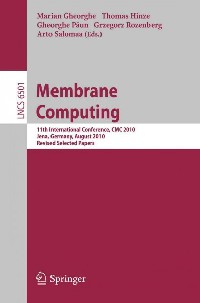
This book constitutes the thoroughly聽refereed post-conference proceedings of the 11th International Conference on Membrane Computing, CMC11, held in Jena, Germany, in August 2010 - continuing the fruitful tradition of 10 previous editions of the International Workshop on Membrane Computing (WMC). The 23 revised full papers presented together with 4 invited papers and the abstracts of 2 keynote lectures were carefully reviewed and selected from numerous submissions. The papers address in this volume cover all the main directions of research in membrane computing, ranging from theoretical topics in the mathematics and computer science to application issues. A special attention was paid to the interaction of membrane computing with biology and computer science, focusing both on the biological roots of membrane computing, on applications of membrane computing in biology and medicine, and on possible electronically based and bioinspired implementations.
目录
Title 1
Preface 4
Table of Contents 6
Keynote Presentations 6
Membrane Computing at Twelve Years 9
References 10
Testing Based on P Systems \u2013 An Overview 11
Introduction 11
Grammar Based Methods 12
Finite State Machine Based Methods 12
Generating Test Sets Using Model Checking 13
Conclusions 13
References 14
Invited Presentations 6
Mobility in Computer Science and in Membrane Systems 15
Mobility in Process Calculi 15
Mobility in Membrane Computing 21
Conclusion 24
References 25
Organization Oriented Chemical Computing 26
Cellular Automata and the Quest for Nontrivial Artificial Self-Reproduction 27
Introduction 27
Cellular Automata 30
Von Neumann's Universal Constructor 32
The Notion of Nontrivial Self-Reproduction 32
Von Neumann's Cellular Automaton 34
Trivial versus Nontrivial Self-Reproduction 37
Self-Reproducing Loop Cellular Automata 40
Reproduction of Arbitrary Configurations 42
Concluding Remarks 43
References 44
An Algorithmic Approach to Tilings of Hyperbolic Spaces: 10 Years Later 45
Poincar茅's Disc 46
The Pentagrid 47
Generalizations 48
The Heptagrid and the Tilings {p,4} and {p+2,3}, p5 48
The Splitting Method and the Tilings {p,q} 49
The Dodecagrid and the 120-Grid 49
The Tiling Problem 50
Cellular Automata in Hyperbolic Spaces 51
General Results 53
Complexity Results 53
Universality Results 54
Possible Applications 55
What Was Already Performed 55
What Could Be Done 56
References 58
Regular Presentations 6
Flattening the Transition P Systems with Dissolution 61
Introduction 61
P Systems and Multisets 62
A Simple Semantics of P Systems 62
Flattening Membrane Systems with Dissolution 65
Conclusion 71
References 72
The Family of Languages Generated by Non-cooperative Membrane Systems 73
Introduction 73
Definitions 75
Formal Language Preliminaries 75
Transitional P Systems 75
Context-Free Grammars and Time-Yield 77
The Membrane Family via the Derivation Trees of Context-Free Grammars 78
Comparison with Known Families 81
Closure Properties 84
A Difficult Language 85
Conclusions 86
References 87
Polymorphic P Systems 89
Introduction 89
What Is Implicitly Required in Most ``Practical\ 90
Program is Data. Cell Nucleus 91
Definitions 91
Results 95
Discussion 101
References 102
A Small Universal Splicing P System 103
Introduction 103
Definitions 104
Splicing Operations 104
Splicing (Tissue) P Systems 105
Universal Restricted Splicing Tissue P System of Small Size 106
Conclusions 109
References 110
Membrane Systems Working in Generating and Accepting Modes: Expressiveness and Encodings 111
Introduction 111
Membrane Systems with Promoters 112
Definition 112
Membrane Systems and Multiset Languages 115
Results on Expressive Power and Encodings 116
Conclusions 125
References 126
BioSimWare: A Software for the Modeling, Simulation and Analysis of Biological Systems 127
Introduction 127
Modeling Biological Systems with BioSimWare 129
Compartmentalization 129
Species and Reactions 129
Stochastic Simulations Algorithms for Single and Multi-volume Systems 130
Single Volume Stochastic Simulation Algorithms 130
Multi-volume Stochastic Simulation Algorithms 132
Tools for the Analysis of Stochastic Simulations 133
Parameter Estimation 134
Other Analysis Tools 136
Applications 137
The Schl枚gl System 137
The Brussellator 138
Stiff Systems 140
Bacterial Chemotaxis 141
Simulation of Fredkin Circuits by Chemical Reaction Systems 144
Conclusion 147
References 148
Modeling Population Growth of Pyrenean Chamois (Rupicapra p. pyrenaica) by Using P-Systems 152
Introduction 152
Pyrenean Chamois 154
A P System Based Modeling Framework 155
Model 157
A Software Tool for Simulation 164
Results 165
Conclusions 166
References 167
On Generalized Communicating P Systems with One Symbol 168
Introduction 168
Preliminaries 169
Main Results 172
Conclusions 181
References 182
A Faster P Solution for the Byzantine Agreement Problem 183
Introduction 183
Preliminaries 184
The EIG-Based Byzantine Agreement Algorithm 186
P Modules 187
Revised Byzantine Agreement Solution 193
Rules and Correctness 194
Rule Sequence for $\\Psi_h$'s Cell $\\psi_h$ 196
Rule Sequences for $\\Gamma_hf$ 198
Rule Sequence for $\\Gamma_hf$'s Cell $\\gamma_'hf$ 199
Rule Sequence for $\\Gamma_hf$'s Cell '$\\gamma_'hf$ 201
Rule Sequence for $\\Gamma_hf$'s Cell $\\gamma_hf$ 201
Module $\\Pi_h$ 202
Complexity 202
Conclusions and Open Problems 203
References 204
Computationally Complete Spiking Neural P Systems without Delay: Two Types of Neurons Are Enough 206
Introduction 206
Definitions 207
Spiking Neural P Systems 208
Results 209
Conclusions 215
References 215
P Systems and Unique-Sum Sets 216
Introduction 216
Basic Definitions 217
P Systems 218
Register Machines 221
Unique-Sum Sets 222
P Systems with Symport/Antiport 223
Purely Multi-catalytic P Systems 228
Final Remarks 232
References 232
An Integrated Approach to P Systems Formal Verification 234
Introduction 234
Basic Definitions and Preliminary Relationships 235
P Systems 235
Kripke Structures 236
Linear Temporal Logic (LTL) 236
Transformation-Communication P Systems and Kripke Structure 237
Transforming P Systems to NuSMV Specifications 238
Transformation-Communication P Systems to NuSMV Specifications 238
Asynchronous Transformation-Communication P Systems Mapped to NuSMV Specifications 239
P Systems with Electrical Charges Mapped to NuSMV Specifications 240
Formal Verification Using NuSMV 241
Conclusions 243
References 243
Using the SRSim Software for Spatial and Rule-Based Modeling of Combinatorially Complex Biochemical Reaction Systems 248
Rule-Based Modeling in Space 248
Spatial Aspects 249
Installing SRSim 251
Required Software 252
Compiling SRSim 252
Using the Software 253
An Exemplary System 253
Definition of the Rule System 253
Molecule and Template Geometry Files 256
The LAMMPS Input Script 258
The Tool ``createGeo'' 260
Concluding Remarks 260
References 262
Depth-First Search with P Systems 265
Introduction 265
The N-Queens Problem 266
Searching Strategies 267
Depth-First Search with P Systems 268
Example 268
A New Solution for the N-Queens Problem 269
A Brief Overview of the Computation 270
Examples 271
Conclusions and Future Work 271
References 272
Towards Modelling of Reactive, Goal-Oriented and Hybrid Intelligent Agents Using P Systems 273
Introduction 273
A MAS Scenario Including Goal-Oriented Agents 274
Formal Modelling of MAS 276
Agents as Cells 276
Data Structures and Objects 276
Behaviours and Rewrite/Communication Rules 277
Priorities of Behaviours 277
Communication Links and Bond Making 278
Dynamic Structure and Cell Differentiation/Division/Death 278
Main Proposal 278
Conclusions and Open Issues 279
References 279
Goldbeter\u2019s Mitotic Oscillator Entirely Modeled by MP Systems 281
Introduction 281
MP Systems 283
The Log-Gain Principle of MP Systems 284
Statistical Distribution of Mitotic MP Models 287
Model Classification According to Descriptional Parameters 288
Analytical Forms of Mitotic MP Grammars 291
Conclusions 291
References 292
Modelling Spatial Heterogeneity and Macromolecular Crowding with Membrane Systems 293
Introduction 293
Spatial Heterogeneity and Macromolecular Crowding in Living Cells 295
Reaction-Diffusion Systems 295
Macromolecular Crowding 296
Classic Computational Approaches 297
Multi-volume Stochastic Simulation Algorithms Based on P Systems 298
Validation of the Diffusion Implemented with -DPP 304
A Popular Diffusion Equation: The Heat Equation 304
Comparison between -DPP and the Heat Equation 305
Macromolecular Crowding with S-DPP 307
Conclusions 309
References 310
Randomized Gandy-Paun-Rozenberg Machines 313
Introduction 313
Gandy-$Paun-Rozenberg Machines; Examples 314
Randomized Gandy-Paun-Rozenberg Machines and NP Complete Problems 320
Concluding Remarks 326
References 326
Feasibility of Organizations \u2013 A Refinement of Chemical Organization Theory with Application to P Systems 333
Introduction 333
Chemical Organization Theory 334
Preliminaries 334
Chemical Organizations 335
Feasibility 335
Definitions 336
Theorem 336
Feasibility in P Systems 338
Examples 338
Conclusions 344
References 344
P Systems with Elementary Active Membranes: Beyond NP and coNP 346
Introduction 346
Definitions 347
Solving a PP-Complete Problem 350
Encoding of Formulae 351
Solution to Sqrt-3SAT 351
Conclusions 354
References 355
Polynomial Complexity Classes in Spiking Neural P Systems 356
Introduction 356
Prerequisites 357
Spiking Neural P Systems 357
Unary versus Binary Input/Output 359
Recognizer SN P Systems 359
Descriptional Complexity and Size of SN P Systems 361
Families of Recognizer SN P Systems 361
Efficiency of Basic Classes of SN P Systems 365
Conclusion 367
References 367
Spiking Neural P Systems with Neuron Division 369
Introduction 369
SN P Systems with Neuron Division 370
Solving SAT 372
Conclusions and Remarks 383
References 384
Matrix Representation of Spiking Neural P Systems 385
Introduction 385
Spiking Neural P Systems 387
Matrix Representation of SN P Systems 388
Matrix Representation for WSN P Systems 393
Conclusions and Remarks 398
References 399
Author Index 400
Preface 4
Table of Contents 6
Keynote Presentations 6
Membrane Computing at Twelve Years 9
References 10
Testing Based on P Systems \u2013 An Overview 11
Introduction 11
Grammar Based Methods 12
Finite State Machine Based Methods 12
Generating Test Sets Using Model Checking 13
Conclusions 13
References 14
Invited Presentations 6
Mobility in Computer Science and in Membrane Systems 15
Mobility in Process Calculi 15
Mobility in Membrane Computing 21
Conclusion 24
References 25
Organization Oriented Chemical Computing 26
Cellular Automata and the Quest for Nontrivial Artificial Self-Reproduction 27
Introduction 27
Cellular Automata 30
Von Neumann's Universal Constructor 32
The Notion of Nontrivial Self-Reproduction 32
Von Neumann's Cellular Automaton 34
Trivial versus Nontrivial Self-Reproduction 37
Self-Reproducing Loop Cellular Automata 40
Reproduction of Arbitrary Configurations 42
Concluding Remarks 43
References 44
An Algorithmic Approach to Tilings of Hyperbolic Spaces: 10 Years Later 45
Poincar茅's Disc 46
The Pentagrid 47
Generalizations 48
The Heptagrid and the Tilings {p,4} and {p+2,3}, p5 48
The Splitting Method and the Tilings {p,q} 49
The Dodecagrid and the 120-Grid 49
The Tiling Problem 50
Cellular Automata in Hyperbolic Spaces 51
General Results 53
Complexity Results 53
Universality Results 54
Possible Applications 55
What Was Already Performed 55
What Could Be Done 56
References 58
Regular Presentations 6
Flattening the Transition P Systems with Dissolution 61
Introduction 61
P Systems and Multisets 62
A Simple Semantics of P Systems 62
Flattening Membrane Systems with Dissolution 65
Conclusion 71
References 72
The Family of Languages Generated by Non-cooperative Membrane Systems 73
Introduction 73
Definitions 75
Formal Language Preliminaries 75
Transitional P Systems 75
Context-Free Grammars and Time-Yield 77
The Membrane Family via the Derivation Trees of Context-Free Grammars 78
Comparison with Known Families 81
Closure Properties 84
A Difficult Language 85
Conclusions 86
References 87
Polymorphic P Systems 89
Introduction 89
What Is Implicitly Required in Most ``Practical\ 90
Program is Data. Cell Nucleus 91
Definitions 91
Results 95
Discussion 101
References 102
A Small Universal Splicing P System 103
Introduction 103
Definitions 104
Splicing Operations 104
Splicing (Tissue) P Systems 105
Universal Restricted Splicing Tissue P System of Small Size 106
Conclusions 109
References 110
Membrane Systems Working in Generating and Accepting Modes: Expressiveness and Encodings 111
Introduction 111
Membrane Systems with Promoters 112
Definition 112
Membrane Systems and Multiset Languages 115
Results on Expressive Power and Encodings 116
Conclusions 125
References 126
BioSimWare: A Software for the Modeling, Simulation and Analysis of Biological Systems 127
Introduction 127
Modeling Biological Systems with BioSimWare 129
Compartmentalization 129
Species and Reactions 129
Stochastic Simulations Algorithms for Single and Multi-volume Systems 130
Single Volume Stochastic Simulation Algorithms 130
Multi-volume Stochastic Simulation Algorithms 132
Tools for the Analysis of Stochastic Simulations 133
Parameter Estimation 134
Other Analysis Tools 136
Applications 137
The Schl枚gl System 137
The Brussellator 138
Stiff Systems 140
Bacterial Chemotaxis 141
Simulation of Fredkin Circuits by Chemical Reaction Systems 144
Conclusion 147
References 148
Modeling Population Growth of Pyrenean Chamois (Rupicapra p. pyrenaica) by Using P-Systems 152
Introduction 152
Pyrenean Chamois 154
A P System Based Modeling Framework 155
Model 157
A Software Tool for Simulation 164
Results 165
Conclusions 166
References 167
On Generalized Communicating P Systems with One Symbol 168
Introduction 168
Preliminaries 169
Main Results 172
Conclusions 181
References 182
A Faster P Solution for the Byzantine Agreement Problem 183
Introduction 183
Preliminaries 184
The EIG-Based Byzantine Agreement Algorithm 186
P Modules 187
Revised Byzantine Agreement Solution 193
Rules and Correctness 194
Rule Sequence for $\\Psi_h$'s Cell $\\psi_h$ 196
Rule Sequences for $\\Gamma_hf$ 198
Rule Sequence for $\\Gamma_hf$'s Cell $\\gamma_'hf$ 199
Rule Sequence for $\\Gamma_hf$'s Cell '$\\gamma_'hf$ 201
Rule Sequence for $\\Gamma_hf$'s Cell $\\gamma_hf$ 201
Module $\\Pi_h$ 202
Complexity 202
Conclusions and Open Problems 203
References 204
Computationally Complete Spiking Neural P Systems without Delay: Two Types of Neurons Are Enough 206
Introduction 206
Definitions 207
Spiking Neural P Systems 208
Results 209
Conclusions 215
References 215
P Systems and Unique-Sum Sets 216
Introduction 216
Basic Definitions 217
P Systems 218
Register Machines 221
Unique-Sum Sets 222
P Systems with Symport/Antiport 223
Purely Multi-catalytic P Systems 228
Final Remarks 232
References 232
An Integrated Approach to P Systems Formal Verification 234
Introduction 234
Basic Definitions and Preliminary Relationships 235
P Systems 235
Kripke Structures 236
Linear Temporal Logic (LTL) 236
Transformation-Communication P Systems and Kripke Structure 237
Transforming P Systems to NuSMV Specifications 238
Transformation-Communication P Systems to NuSMV Specifications 238
Asynchronous Transformation-Communication P Systems Mapped to NuSMV Specifications 239
P Systems with Electrical Charges Mapped to NuSMV Specifications 240
Formal Verification Using NuSMV 241
Conclusions 243
References 243
Using the SRSim Software for Spatial and Rule-Based Modeling of Combinatorially Complex Biochemical Reaction Systems 248
Rule-Based Modeling in Space 248
Spatial Aspects 249
Installing SRSim 251
Required Software 252
Compiling SRSim 252
Using the Software 253
An Exemplary System 253
Definition of the Rule System 253
Molecule and Template Geometry Files 256
The LAMMPS Input Script 258
The Tool ``createGeo'' 260
Concluding Remarks 260
References 262
Depth-First Search with P Systems 265
Introduction 265
The N-Queens Problem 266
Searching Strategies 267
Depth-First Search with P Systems 268
Example 268
A New Solution for the N-Queens Problem 269
A Brief Overview of the Computation 270
Examples 271
Conclusions and Future Work 271
References 272
Towards Modelling of Reactive, Goal-Oriented and Hybrid Intelligent Agents Using P Systems 273
Introduction 273
A MAS Scenario Including Goal-Oriented Agents 274
Formal Modelling of MAS 276
Agents as Cells 276
Data Structures and Objects 276
Behaviours and Rewrite/Communication Rules 277
Priorities of Behaviours 277
Communication Links and Bond Making 278
Dynamic Structure and Cell Differentiation/Division/Death 278
Main Proposal 278
Conclusions and Open Issues 279
References 279
Goldbeter\u2019s Mitotic Oscillator Entirely Modeled by MP Systems 281
Introduction 281
MP Systems 283
The Log-Gain Principle of MP Systems 284
Statistical Distribution of Mitotic MP Models 287
Model Classification According to Descriptional Parameters 288
Analytical Forms of Mitotic MP Grammars 291
Conclusions 291
References 292
Modelling Spatial Heterogeneity and Macromolecular Crowding with Membrane Systems 293
Introduction 293
Spatial Heterogeneity and Macromolecular Crowding in Living Cells 295
Reaction-Diffusion Systems 295
Macromolecular Crowding 296
Classic Computational Approaches 297
Multi-volume Stochastic Simulation Algorithms Based on P Systems 298
Validation of the Diffusion Implemented with -DPP 304
A Popular Diffusion Equation: The Heat Equation 304
Comparison between -DPP and the Heat Equation 305
Macromolecular Crowding with S-DPP 307
Conclusions 309
References 310
Randomized Gandy-Paun-Rozenberg Machines 313
Introduction 313
Gandy-$Paun-Rozenberg Machines; Examples 314
Randomized Gandy-Paun-Rozenberg Machines and NP Complete Problems 320
Concluding Remarks 326
References 326
Feasibility of Organizations \u2013 A Refinement of Chemical Organization Theory with Application to P Systems 333
Introduction 333
Chemical Organization Theory 334
Preliminaries 334
Chemical Organizations 335
Feasibility 335
Definitions 336
Theorem 336
Feasibility in P Systems 338
Examples 338
Conclusions 344
References 344
P Systems with Elementary Active Membranes: Beyond NP and coNP 346
Introduction 346
Definitions 347
Solving a PP-Complete Problem 350
Encoding of Formulae 351
Solution to Sqrt-3SAT 351
Conclusions 354
References 355
Polynomial Complexity Classes in Spiking Neural P Systems 356
Introduction 356
Prerequisites 357
Spiking Neural P Systems 357
Unary versus Binary Input/Output 359
Recognizer SN P Systems 359
Descriptional Complexity and Size of SN P Systems 361
Families of Recognizer SN P Systems 361
Efficiency of Basic Classes of SN P Systems 365
Conclusion 367
References 367
Spiking Neural P Systems with Neuron Division 369
Introduction 369
SN P Systems with Neuron Division 370
Solving SAT 372
Conclusions and Remarks 383
References 384
Matrix Representation of Spiking Neural P Systems 385
Introduction 385
Spiking Neural P Systems 387
Matrix Representation of SN P Systems 388
Matrix Representation for WSN P Systems 393
Conclusions and Remarks 398
References 399
Author Index 400
- 名称
- 类型
- 大小
光盘服务联系方式: 020-38250260 客服QQ:4006604884
云图客服:
用户发送的提问,这种方式就需要有位在线客服来回答用户的问题,这种 就属于对话式的,问题是这种提问是否需要用户登录才能提问
Video Player
×
Audio Player
×
pdf Player
×
