

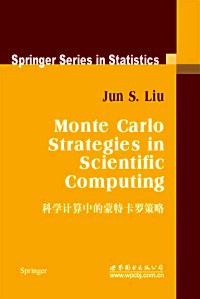
简介
An early experiment that conceives the basic idea of Monte Carlo compu-tatios is known as "Buffon'needle",first stated by Georges Louis Leclerc Comte de Buffon in 1777.In this well-known experiment,on throws a needle of length l onto a flat surface with a grid of parallel lines with spacing.It is easy to compute that,under ideal conditions,the chance that the needle will intersect one of the lines in .Thus,if we lep pN be the Proportion of "intersects"in N throws,we can have an estimate of π as wjocj will"converge"to π as N increases to infinity.
此书为英文版!
目录
preface
1 introduction and examples
1.1 the need of monte carlo techniques
1.2 scope and outline of the book
1.3 computations in statistical physics
1.4 molecular structure simulation
1.5 bioinformatics: finding weak repetitive patterns
1.6 nonlinear dynamic system: target tracking
1.7 hypothesis testing for astronomical observations
1.8 bayesian inference of multilevel models
1.9 monte carlo and missing data problems
basic principles: rejection, weighting, and others
2.1 generating simple random variables
2.2 the rejection method
2.3 variance reduction methods
2.4 exact methods for chain-structured models
2.4.1 dynamic programming
2.4.2 exact simulation
2.5 importance sampling and weighted sample
2.5.1 an example
.2.5.2 the basic idea
2.5.3 the "rule of thumb" for importance sampling
2.5.4 concept of the weighted sample
2.5.5 marginalization in importance sampling
2.5.6 example: solving a linear system
2.5.7 example: a bayesian missing data problem
2.6 advanced importance sampling techniques
2.6.1 adaptive importance sampling
2.6.2 rejection and weighting
2.6.3 sequential importance sampling
2.6.4 rejection control in sequential importance sampling
2.7 application of sis in population genetics
2.8 problems
theory of sequential monte carlo
3.1 early developments: growing a polymer
3.1.1 a simple model of polymer: self-avoid walk
3.1.2 growing a polymer on the square lattice
3.1.3 limitations of the growth method
3.2 sequential imputation for statistical missing data problems
3.2.1 likelihood computation
3.2.2 bayesian computation
3.3 nonlinear filtering
3.4 a general framework
3.4.1 the choice of the sampling distribution
3.4.2 normalizing constant
3.4.3 pruning, enrichment, and resampling
3.4.4 more about resampling
3.4.5 partial rejection control
3.4.6 marginalization, look-ahead, and delayed estimate
3.5 problems
sequential monte carlo in action
4.1 some biological problems
4.1.1 molecular simulation
4.1.2 inference in population genetics
4.1.3 finding motif patterns in dna sequences
4.2 approximating permanents
4.3 counting 0-1 tables with fixed margins
4.4 bayesian missing data problems
4.4.1 murray's data
4.4.2 nonparametric bayes analysis of binomial data
4.5 problems in signal processing
4.5.1 target tracking in clutter and mixture kalman filter
4.5.2 digital signal extraction in fading channels
4.6 problems
metropolis algorithm and beyond
5.1 the metropolis algorithm
5.2 mathematical formulation and hastings's generalization
5.3 why does the metropolis algorithm work?
5.4 some special algorithms
5.4.1 random-walk metropolis
5.4.2 metropolized independence sampler
5.4.3 configurational bias monte carlo
5.5 multipoint metropolis methods
5.5.1 multiple independent proposals
5.5.2 correlated multipoint proposals
5.6 reversible jumping rule
5.7 dynamic weighting
5.8 output analysis and algorithm efficiency
5.9 problems
the gibbs sampler
6.1 gibbs sampling algorithms
6.2 illustrative examples
6.3 some special samplers
6.3.1 slice sampler
6.3.2 metropolized gibbs sampler
6.3.3 hit-and-run algorithm
6.4 data augmentation algorithm
6.4.1 bayesian missing data problem
6.4.2 the original da algorithm
6.4.3 connection with the gibbs sampler
6.4.4 an example: hierarchical bayes model
6.5 finding repetitive motifs in biological sequences
6.5.1 a gibbs sampler for detecting subtle motifs
6.5.2 alignment and classification
6.6 covariance structures of the gibbs sampler
6.6.1 data augmentation
6.6.2 autocovariances for the random-scan gibbs sampler
6.6.3 more efficient use of monte carlo samples
6.7 collapsing and grouping in a gibbs sampler
6.8 problems
7 cluster algorithms for the ising model
7.1 ising and potts model revisit
7.2 the swendsen-wang algorithm as data augmentation
7.3 convergence analysis and generalization
7.4 the modification by wolff
7.5 further generalization
7.6 discussion
7.7 problems
general conditional sampling
8.1 partial resampling
8.2 case studies for partial resampling
8.2.1 gaussian random field model
8.2.2 texture synthesis
8.2.3 inference with multivariate t-distribution
8.3 transformation grsup and generalized gibbs
8.4 application: parameter expansion for data augmentation
8.5 some examples in bayesian inference
8.5.1 probit regression
8.5.2 monte carlo bridging for stochastic differential equa-tion
8.6 problems
9 molecular dynamics and hybrid monte carlo
9.1 basics of newtonian mechanics
9.2 molecular dynamics simulation
9.3 hybrid monte carlo
9.4 algorithms related to hmc
9.4.1 langevin-euler moves
9.4.2 generalized hybrid monte carlo
9.4.3 surrogate transition method
9.5 multipoint strategies for hybrid monte carlo
9.5.1 neal's window method
9.5.2 multipoint method
9.6 application of hmc in statistics
9.6.1 indirect observation model
9.6.2 estimation in the stochastic volatility model
10 multilevel sampling and optimization methods
10.1 umbrella sampling
10.2 simulated annealing
10.3 simulated tempering
10.4 parallel tempering
10.5 generalized ensemble simulation
10.5.1 multicanonical sampling
10.5.2 the 1/k-ensemble method
10.5.3 comparison of algorithms
10.6 tempering with dynamic weighting
10.6.1 ising model simulation at sub-critical temperature
10.6.2 neural network training
11 population-based monte carlo methods
11.1 adaptive direction sampling: snooker algorithm
11.2 conjugate gradient monte carlo
11.3 evolutionary monte carlo
11.3.1 evolutionary movements in binary-coded space
11.3.2 evolutionary movements in continuous space
11.4 some further thoughts
11.5 numerical examples
11.5.1 simulating from a bimodal distribution
11.5.2 comparing algorithms for a multimodal example
11.5.3 variable selection with binary-coded emc
11.5.4 bayesian neural network training
11.6 problems
12 markov chains and their convergence
12.1 basic properties of a markov chain
12.1.1 chapman-kolmogorov equation
12.1.2 convergence to stationarity
12.2 coupling method for card shuffling
12.2.1 random-to-top shuffling
12.2.2 riffle shuffling
12.3 convergence theorem for finite-state markov chains
12.4 coupling method for general markov chain
12.5 geometric inequalities
12.5.1 basic setup
12.5.2 poincare inequality
12.5.3 example: simple random walk on a graph
12.5.4 cheeger's inequality
12.6 functional analysis for markov chains
12.6.1 forward and backward operators
12.6.2 convergence rate of markov chains
12.6.3 maximal correlation
12.7 behavior of the averages
13 selected theoretical topics
13.1 mcmc convergence and convergence diagnostics
13.2 iterative conditional sampling
13.2.1 data augmentation
13.2.2 random-scan gibbs sampler
13.3 comparison of metropolis-type algorithms
13.3.1 peskun's ordering
13.3.2 comparing schemes using peskun's ordering
13.4 eigenvalue analysis for the independence sampler
13.5 perfect simulation
13.6 a theory for dynamic weighting
13.6.1 definitions
13.6.2 weight behavior under different scenarios
13.6.3 estimation with weighted samples
13.6.4 a simulation study
a basics in probability and statistics
a.1 basic probability theory
a.1.1 experiments, events, and probability
a.1.2 univariate random variables and their properties
a.1.3 multivariate random variable
a.1.4 convergence of random variables
a.2 statistical modeling and inference
a.2.1 parametric statistical modeling
a.2.2 frequentist approach to statistical inference
a.2.3 bayesian methodology
a.3 bayes procedure and missing data formalism
a.3.1 the joint and posterior distributions
a.3.2 the missing data problem
a.4 the expectation-maximization algorithm
references
author index
subject index111
1 introduction and examples
1.1 the need of monte carlo techniques
1.2 scope and outline of the book
1.3 computations in statistical physics
1.4 molecular structure simulation
1.5 bioinformatics: finding weak repetitive patterns
1.6 nonlinear dynamic system: target tracking
1.7 hypothesis testing for astronomical observations
1.8 bayesian inference of multilevel models
1.9 monte carlo and missing data problems
basic principles: rejection, weighting, and others
2.1 generating simple random variables
2.2 the rejection method
2.3 variance reduction methods
2.4 exact methods for chain-structured models
2.4.1 dynamic programming
2.4.2 exact simulation
2.5 importance sampling and weighted sample
2.5.1 an example
.2.5.2 the basic idea
2.5.3 the "rule of thumb" for importance sampling
2.5.4 concept of the weighted sample
2.5.5 marginalization in importance sampling
2.5.6 example: solving a linear system
2.5.7 example: a bayesian missing data problem
2.6 advanced importance sampling techniques
2.6.1 adaptive importance sampling
2.6.2 rejection and weighting
2.6.3 sequential importance sampling
2.6.4 rejection control in sequential importance sampling
2.7 application of sis in population genetics
2.8 problems
theory of sequential monte carlo
3.1 early developments: growing a polymer
3.1.1 a simple model of polymer: self-avoid walk
3.1.2 growing a polymer on the square lattice
3.1.3 limitations of the growth method
3.2 sequential imputation for statistical missing data problems
3.2.1 likelihood computation
3.2.2 bayesian computation
3.3 nonlinear filtering
3.4 a general framework
3.4.1 the choice of the sampling distribution
3.4.2 normalizing constant
3.4.3 pruning, enrichment, and resampling
3.4.4 more about resampling
3.4.5 partial rejection control
3.4.6 marginalization, look-ahead, and delayed estimate
3.5 problems
sequential monte carlo in action
4.1 some biological problems
4.1.1 molecular simulation
4.1.2 inference in population genetics
4.1.3 finding motif patterns in dna sequences
4.2 approximating permanents
4.3 counting 0-1 tables with fixed margins
4.4 bayesian missing data problems
4.4.1 murray's data
4.4.2 nonparametric bayes analysis of binomial data
4.5 problems in signal processing
4.5.1 target tracking in clutter and mixture kalman filter
4.5.2 digital signal extraction in fading channels
4.6 problems
metropolis algorithm and beyond
5.1 the metropolis algorithm
5.2 mathematical formulation and hastings's generalization
5.3 why does the metropolis algorithm work?
5.4 some special algorithms
5.4.1 random-walk metropolis
5.4.2 metropolized independence sampler
5.4.3 configurational bias monte carlo
5.5 multipoint metropolis methods
5.5.1 multiple independent proposals
5.5.2 correlated multipoint proposals
5.6 reversible jumping rule
5.7 dynamic weighting
5.8 output analysis and algorithm efficiency
5.9 problems
the gibbs sampler
6.1 gibbs sampling algorithms
6.2 illustrative examples
6.3 some special samplers
6.3.1 slice sampler
6.3.2 metropolized gibbs sampler
6.3.3 hit-and-run algorithm
6.4 data augmentation algorithm
6.4.1 bayesian missing data problem
6.4.2 the original da algorithm
6.4.3 connection with the gibbs sampler
6.4.4 an example: hierarchical bayes model
6.5 finding repetitive motifs in biological sequences
6.5.1 a gibbs sampler for detecting subtle motifs
6.5.2 alignment and classification
6.6 covariance structures of the gibbs sampler
6.6.1 data augmentation
6.6.2 autocovariances for the random-scan gibbs sampler
6.6.3 more efficient use of monte carlo samples
6.7 collapsing and grouping in a gibbs sampler
6.8 problems
7 cluster algorithms for the ising model
7.1 ising and potts model revisit
7.2 the swendsen-wang algorithm as data augmentation
7.3 convergence analysis and generalization
7.4 the modification by wolff
7.5 further generalization
7.6 discussion
7.7 problems
general conditional sampling
8.1 partial resampling
8.2 case studies for partial resampling
8.2.1 gaussian random field model
8.2.2 texture synthesis
8.2.3 inference with multivariate t-distribution
8.3 transformation grsup and generalized gibbs
8.4 application: parameter expansion for data augmentation
8.5 some examples in bayesian inference
8.5.1 probit regression
8.5.2 monte carlo bridging for stochastic differential equa-tion
8.6 problems
9 molecular dynamics and hybrid monte carlo
9.1 basics of newtonian mechanics
9.2 molecular dynamics simulation
9.3 hybrid monte carlo
9.4 algorithms related to hmc
9.4.1 langevin-euler moves
9.4.2 generalized hybrid monte carlo
9.4.3 surrogate transition method
9.5 multipoint strategies for hybrid monte carlo
9.5.1 neal's window method
9.5.2 multipoint method
9.6 application of hmc in statistics
9.6.1 indirect observation model
9.6.2 estimation in the stochastic volatility model
10 multilevel sampling and optimization methods
10.1 umbrella sampling
10.2 simulated annealing
10.3 simulated tempering
10.4 parallel tempering
10.5 generalized ensemble simulation
10.5.1 multicanonical sampling
10.5.2 the 1/k-ensemble method
10.5.3 comparison of algorithms
10.6 tempering with dynamic weighting
10.6.1 ising model simulation at sub-critical temperature
10.6.2 neural network training
11 population-based monte carlo methods
11.1 adaptive direction sampling: snooker algorithm
11.2 conjugate gradient monte carlo
11.3 evolutionary monte carlo
11.3.1 evolutionary movements in binary-coded space
11.3.2 evolutionary movements in continuous space
11.4 some further thoughts
11.5 numerical examples
11.5.1 simulating from a bimodal distribution
11.5.2 comparing algorithms for a multimodal example
11.5.3 variable selection with binary-coded emc
11.5.4 bayesian neural network training
11.6 problems
12 markov chains and their convergence
12.1 basic properties of a markov chain
12.1.1 chapman-kolmogorov equation
12.1.2 convergence to stationarity
12.2 coupling method for card shuffling
12.2.1 random-to-top shuffling
12.2.2 riffle shuffling
12.3 convergence theorem for finite-state markov chains
12.4 coupling method for general markov chain
12.5 geometric inequalities
12.5.1 basic setup
12.5.2 poincare inequality
12.5.3 example: simple random walk on a graph
12.5.4 cheeger's inequality
12.6 functional analysis for markov chains
12.6.1 forward and backward operators
12.6.2 convergence rate of markov chains
12.6.3 maximal correlation
12.7 behavior of the averages
13 selected theoretical topics
13.1 mcmc convergence and convergence diagnostics
13.2 iterative conditional sampling
13.2.1 data augmentation
13.2.2 random-scan gibbs sampler
13.3 comparison of metropolis-type algorithms
13.3.1 peskun's ordering
13.3.2 comparing schemes using peskun's ordering
13.4 eigenvalue analysis for the independence sampler
13.5 perfect simulation
13.6 a theory for dynamic weighting
13.6.1 definitions
13.6.2 weight behavior under different scenarios
13.6.3 estimation with weighted samples
13.6.4 a simulation study
a basics in probability and statistics
a.1 basic probability theory
a.1.1 experiments, events, and probability
a.1.2 univariate random variables and their properties
a.1.3 multivariate random variable
a.1.4 convergence of random variables
a.2 statistical modeling and inference
a.2.1 parametric statistical modeling
a.2.2 frequentist approach to statistical inference
a.2.3 bayesian methodology
a.3 bayes procedure and missing data formalism
a.3.1 the joint and posterior distributions
a.3.2 the missing data problem
a.4 the expectation-maximization algorithm
references
author index
subject index111
- 名称
- 类型
- 大小
光盘服务联系方式: 020-38250260 客服QQ:4006604884
云图客服:
用户发送的提问,这种方式就需要有位在线客服来回答用户的问题,这种 就属于对话式的,问题是这种提问是否需要用户登录才能提问
Video Player
×
Audio Player
×
pdf Player
×
