

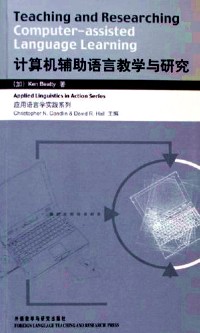
Teaching and researching computer-assisted language learning = 计算机辅助语言教学与研究 /
副标题:无
作 者:Ken Beatty著.
分类号:
ISBN:9787560052472
微信扫一扫,移动浏览光盘
简介
计算机辅助语言学习是应用语言学的一个新兴的、正在迅速发展的分支。《计算机辅助语言教学与研究》对计算机辅助语言学习进行了全面概述,对与其相关的一些科研项目进行了步骤指导,以软件、网站等形式为读者提供了该领域内丰富的资源,并附有术语表。
本书的主要内容及结构如下:
计算机辅助语言学习概述(包括发展历史、主要技术及应用)
计算机辅助语言学习在科研及教学中的地位
计算机辅助语言学习的相关研究
可供借鉴和参考的信息资源及术语
本书旨在通过上述内容向研究者介绍这一领域的研究课题及现状,为教师进行计算机辅助语
目录
General Editors' Preface
Acknowledgements
Introduction
Section I Key concepts
The emergence of CALL
The emergence of CALL
Technology driving CALL
The changing focus of research in CALL
Summary
A brief history of CALL
CALL in the 1950s and 1960s
Simulations
CALL in the 1970s and 1980s
CALL in the 1990s
Summary
Hypertext, hypermedia and multimedia
Hypertext
Hypermedia
Multimedia
Antecedents of multimedia
Science fiction and CALL
The printed book and CALL
Applications to general learning
Applications of multimedia to language learning
Summary
Eight CALL applications
Word processing
Games
Literature
Corpus linguistics
Computer-mediated communication resources
Adapting other materials for CALL
Personal Digital Assistants (PDA)
Summary
Section II The place of CALL in research and teaching
Second-language Acquisition and models of instruction
Concepts in SLA, behaviourism and constructivism
Comprehensible input and output
Criticism of comprehensible input and output theory
Behaviourist and constructivist models of instruction
Behaviourism
Constructivism
The role of collaboration and negotiation of meaning
in the two models
Summary
Collaboration and negotiation of meaning
The place of collaboration in CALL
Structuring collaboration
Differences between collaboration and other terms
The range of collaboration and CALL
Collaboration at the computer
Benefits of collaborative learning at the computer
Collaboration, CALL and SLA
Collaboration at the computer as evidenced by discourse
Challenges to collaboration
Challenges to collaboration in a CALL context
Discourse that evidences challenges to collaboration
Summary
Defining a model of CALL
Defining model
The need for a CALL model
A model of current non-CALL language learning
Dunkin and Biddle's model in a CALL context
Various views of CALL
Teacher and pupil classroom behaviour: activities used
in CALL
A virtual classroom
Aspects of a CALL model
Summary
Theoretical and pedagogical concerns
Concerns for software development
Pedagogical concerns for classroom practice
Evaluating software
Learning and working styles
Evolving technology
Commercial software
Making better use of existing materials
Copyright and plagiarism
Viruses
Safety online
Technological have-nots
Summary
Section III Researching CALL
Current research interests
A new field: reporting CALL research
Approaches to research in CALL
The computer as a tool of research
The role of commercial publishers
Reviewing current studies: a survey
Conducting research
Action research
Summary
Research
Research context 1: The literature review
Research context 2: A pilot study
Research context 3: Corpus linguistics
Research context 4: Error analysis
Research context 5: The experiment
Research context 6: A case study
Research context 7: The survey
Research context 8: The ethnographic approach
Conclusion
Section IV Resources
Glossary of key terms
References
Index
Acknowledgements
Introduction
Section I Key concepts
The emergence of CALL
The emergence of CALL
Technology driving CALL
The changing focus of research in CALL
Summary
A brief history of CALL
CALL in the 1950s and 1960s
Simulations
CALL in the 1970s and 1980s
CALL in the 1990s
Summary
Hypertext, hypermedia and multimedia
Hypertext
Hypermedia
Multimedia
Antecedents of multimedia
Science fiction and CALL
The printed book and CALL
Applications to general learning
Applications of multimedia to language learning
Summary
Eight CALL applications
Word processing
Games
Literature
Corpus linguistics
Computer-mediated communication resources
Adapting other materials for CALL
Personal Digital Assistants (PDA)
Summary
Section II The place of CALL in research and teaching
Second-language Acquisition and models of instruction
Concepts in SLA, behaviourism and constructivism
Comprehensible input and output
Criticism of comprehensible input and output theory
Behaviourist and constructivist models of instruction
Behaviourism
Constructivism
The role of collaboration and negotiation of meaning
in the two models
Summary
Collaboration and negotiation of meaning
The place of collaboration in CALL
Structuring collaboration
Differences between collaboration and other terms
The range of collaboration and CALL
Collaboration at the computer
Benefits of collaborative learning at the computer
Collaboration, CALL and SLA
Collaboration at the computer as evidenced by discourse
Challenges to collaboration
Challenges to collaboration in a CALL context
Discourse that evidences challenges to collaboration
Summary
Defining a model of CALL
Defining model
The need for a CALL model
A model of current non-CALL language learning
Dunkin and Biddle's model in a CALL context
Various views of CALL
Teacher and pupil classroom behaviour: activities used
in CALL
A virtual classroom
Aspects of a CALL model
Summary
Theoretical and pedagogical concerns
Concerns for software development
Pedagogical concerns for classroom practice
Evaluating software
Learning and working styles
Evolving technology
Commercial software
Making better use of existing materials
Copyright and plagiarism
Viruses
Safety online
Technological have-nots
Summary
Section III Researching CALL
Current research interests
A new field: reporting CALL research
Approaches to research in CALL
The computer as a tool of research
The role of commercial publishers
Reviewing current studies: a survey
Conducting research
Action research
Summary
Research
Research context 1: The literature review
Research context 2: A pilot study
Research context 3: Corpus linguistics
Research context 4: Error analysis
Research context 5: The experiment
Research context 6: A case study
Research context 7: The survey
Research context 8: The ethnographic approach
Conclusion
Section IV Resources
Glossary of key terms
References
Index
Teaching and researching computer-assisted language learning = 计算机辅助语言教学与研究 /
- 名称
- 类型
- 大小
光盘服务联系方式: 020-38250260 客服QQ:4006604884
云图客服:
用户发送的提问,这种方式就需要有位在线客服来回答用户的问题,这种 就属于对话式的,问题是这种提问是否需要用户登录才能提问
Video Player
×
Audio Player
×
pdf Player
×
