

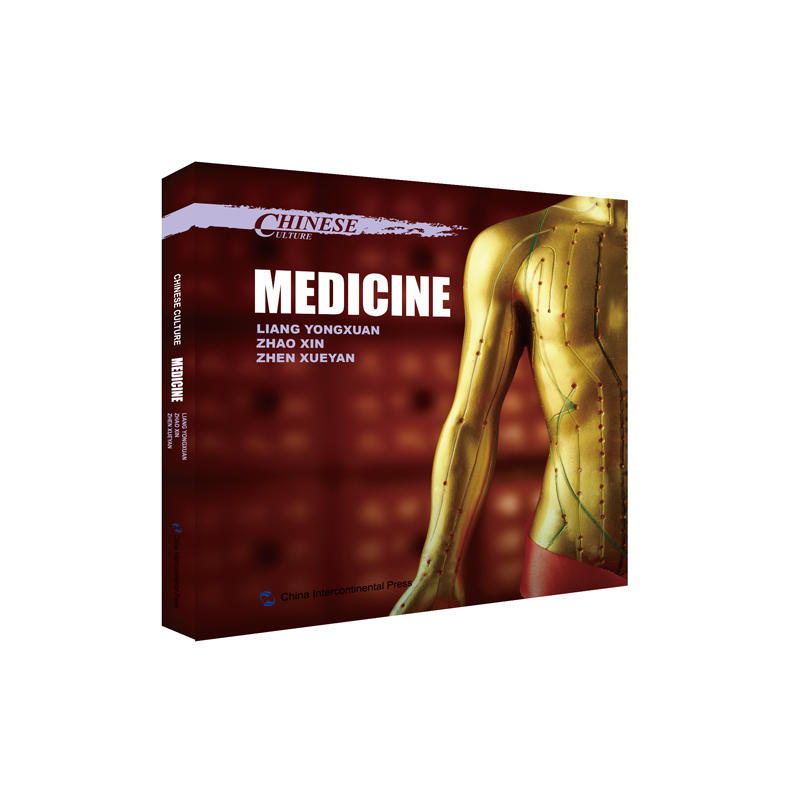
简介
中医药学在中华民族在长期生活和生产实践中形成的宝贵财富。它以解除人类的疾病痛苦为目的,以人与自然的和谐相处为基本思路,在吸收中国古代哲学理念的基础上,构建了自己的理论框架,形成了独特的诊疗方式。
【目录】
Contents
Foreword
The Evolution of Ancient TCM
A Brief Introduction to TCM and Chinese Traditional Culture
The Spread of Ancient Medical Knowledge
The Skills and Virtues of Ancient Doctors
Aspects of Ancient TCM
Basic TCM Theories
The Foundation Works of TCM – The Yellow Emperor’s Classic of Internal Medicine
Sun, Moon and Yin, Yang – the Yin-yang Theory of TCM
Starting with Five-colored Soil – the Five-elements of TCM
Man Is an Integral Part of Nature – the Holistic View of TCM
The Essence, Qi and Shen of the Chinese People
Blood and Body Fluids
TCM on the Five Internal Organs (Viscera)
Why Do We Get Sick?
The Diagnostic Methods of TCM
Syndrome Differentiation
Treating Disease by Preventing Illness before It Begins
About Traditional Chinese Medicine
The Origins of Traditional Chinese Medicine
The Rich Variety of Traditional Chinese Medicine
Processing Traditional Chinese Medicine
The Natures and Flavors of Traditional Chinese Medicine
The Forms of Traditional Chinese Drugs
The Combination of Medicine
The Modern Development of TCM
Acupuncture, Moxibustion and Other External treatments
Channels, Network Vessels and Acupoints
Acupuncture and Moxa-moxibustion
External Treatments to Treat Internal Illness
TCM Theories about the Cultivation of Health
Balance and Health
Emotions and Diseases
The Homology of Medicine and Food
Nourishing the Body with the Five Grains
Health Maintenance in the Four Seasons
Moderate Movement and Rest
The Development of TCM in Modern Times
The Competition between TCM and Western Medicine
The Integration of Traditional
Chinese and Western Medicine
The Combination of Traditional
Chinese and Western Medicine
Modern TCM Education
Modern TCM Diagnoses and Treatments
The Medicine of China’s Ethnic Groups
【免费在线读】
TCM on the Five Internal Organs (Viscera)
The Monarch Organ – the Heart
The Yellow Emperor’s Classic of Internal Medicine compares the human body to a country where the king and ministers each performs their own duties. If each performs their duties properly and works in harmony with each other, the country will be able to resist aggression and evil and people will be able to live healthy and long lives.
Of the five major internal organs, the heart enjoys the most important position. In TCM theory, the heart dominates all the vital activities of the human body and is the body’s supreme commander. As The Yellow Emperor’s Classic of Internal Medicine states: “The heart is the monarch of the organs”. The monarch is the highest ruler of a country and master of all its citizens. The fact that the classic text refers to the heart as the monarch confirms the importance of the heart amongst the viscera.
One of the major functions of the heart is to govern the blood and the vessels. The Yellow Emperor’s Classic of Internal Medicine says that the “heart governs the blood of the human body”, it also describes the relationship between the organs and the blood and states plainly that the blood is dominated by the heart. The book also points out that the blood “never stops running and circulates in the body”, meaning that blood circulates around the body from the internal organs to the muscles in a continuous flow. This, of course, has been proved by modern anatomy to be true.
The Yellow Emperor’s Classic of Internal Medicine also explains several major aspects of the blood circulatory system. It shows knowledge of the different functions of arteries and veins and differentiates between “blood ejects” (arterial blood) and “blood bleed, black and turbid” (venous blood). It is interesting to compare this with developments in Western medicine: the Romans only recognized that the blood was like a tide in the 2nd Century and did not know that blood circulated at all. In the 13th Century, the Arabs started to recognize that blood circulated. However it was only in 1628 that the British doctor William Harvey put forward his more complex views on blood circulation.
According to TCM, another function of the heart is to “govern mental activities”, This means that the heart controls the spirit, thinking and conscious activities (and the intelligence and wisdom reflected in such activities). If the heart is functioning normally in this respect, then a person is spiritually healthy and has “sound sense”. Conversely, if a person’s state of mind is abnormal, then they may suffer from palpitations, forgetfulness, insomnia, mania or functional disorder of the internal organs.
The philosophers and thinkers of ancient China all believed that the heart controlled thinking, wisdom and the spiritual activities of the human body. This led to sayings such as Xin (heart), Xiang Shi Cheng (all wishes come to true) and Xin Ling Shou Qiao (quick-witted and nimble-fingered). The novel Dream of the Red Mansion praises how clever Lin Daiyu is by using an interesting remark, “her heart has one more hole than Bigan”. Where does this literary quotation mean?
Bigan was a talented minister of the Shang Dynasty who first assisted his brother Emperor Yi and then Emperor Yi’s son Emperor Zhou. It was said Bigan’s heart had seven holes. In ancient times it was believed that if a person’s heart had more holes than normal, then he or she must be clever. So the sages, who were known to be very clever and sophisticated, were thought to have more holes in their hearts than the common people. It was also thought that if a person’s heart holes were confused, that person would be clouded in the mind and silly. Such thinking became absorbed by traditional Chinese medicine.
As said above, the concept that “the heart governs mental activities” is an important basic TCM theory. It runs through the whole theoretical system of traditional Chinese medicine, and is an idea that has been followed by most doctors for generations. How do TCM practitioners understand mental activities? One way to explain this is through the following metaphor: “A person’s body is like a car with well-equipped fully functional parts. But if there is no driver, the car cannot run no matter how excellent it is. Mental activities work like the driver.”
The idea that “the heart governs mental activities” also reflects the TCM belief that the heart is the “ruler of life’s activities” and the captain of all internal organs, coordinating them as they undertake all the body’s complicated physiological activities. If the heart gets sick, TCM practitioners believe that the other internal organs will suffer from various disorders and diseases. Therefore, it is not an overstatement to compare the heart to the monarch, to reflect its important role and position amongst the internal organs.
Although TCM places the heart as the organ that governs mental activity, TCM theory does not neglect the functions of the brain. The Yellow Emperor’s Classic of Internal Medicine reads: “The brain is the sea of marrow…the head is the home of sharp intelligence”.
Zhang Zhongjing also said in the Treatise on Febrile and Miscellaneous Diseases that the “head is the ruler of the body and where the spirit light concentrates”. The medical works of later generations of physicians also confirm the important relationship between the brain, the spirit and consciousness.
目录
Contents
Foreword
The Evolution of Ancient TCM
A Brief Introduction to TCM and Chinese Traditional Culture
The Spread of Ancient Medical Knowledge
The Skills and Virtues of Ancient Doctors
Aspects of Ancient TCM
Basic TCM Theories
The Foundation Works of TCM – The Yellow Emperor’s Classic of Internal Medicine
Sun, Moon and Yin, Yang – the Yin-yang Theory of TCM
Starting with Five-colored Soil – the Five-elements of TCM
Man Is an Integral Part of Nature – the Holistic View of TCM
The Essence, Qi and Shen of the Chinese People
Blood and Body Fluids
TCM on the Five Internal Organs (Viscera)
Why Do We Get Sick?
The Diagnostic Methods of TCM
Syndrome Differentiation
Treating Disease by Preventing Illness before It Begins
About Traditional Chinese Medicine
The Origins of Traditional Chinese Medicine
The Rich Variety of Traditional Chinese Medicine
Processing Traditional Chinese Medicine
The Natures and Flavors of Traditional Chinese Medicine
The Forms of Traditional Chinese Drugs
The Combination of Medicine
The Modern Development of TCM
Acupuncture, Moxibustion and Other External treatments
Channels, Network Vessels and Acupoints
Acupuncture and Moxa-moxibustion
External Treatments to Treat Internal Illness
TCM Theories about the Cultivation of Health
Balance and Health
Emotions and Diseases
The Homology of Medicine and Food
Nourishing the Body with the Five Grains
Health Maintenance in the Four Seasons
Moderate Movement and Rest
The Development of TCM in Modern Times
The Competition between TCM and Western Medicine
The Integration of Traditional
Chinese and Western Medicine
The Combination of Traditional
Chinese and Western Medicine
Modern TCM Education
Modern TCM Diagnoses and Treatments
The Medicine of China’s Ethnic Groups
【免费在线读】
TCM on the Five Internal Organs (Viscera)
The Monarch Organ – the Heart
The Yellow Emperor’s Classic of Internal Medicine compares the human body to a country where the king and ministers each performs their own duties. If each performs their duties properly and works in harmony with each other, the country will be able to resist aggression and evil and people will be able to live healthy and long lives.
Of the five major internal organs, the heart enjoys the most important position. In TCM theory, the heart dominates all the vital activities of the human body and is the body’s supreme commander. As The Yellow Emperor’s Classic of Internal Medicine states: “The heart is the monarch of the organs”. The monarch is the highest ruler of a country and master of all its citizens. The fact that the classic text refers to the heart as the monarch confirms the importance of the heart amongst the viscera.
One of the major functions of the heart is to govern the blood and the vessels. The Yellow Emperor’s Classic of Internal Medicine says that the “heart governs the blood of the human body”, it also describes the relationship between the organs and the blood and states plainly that the blood is dominated by the heart. The book also points out that the blood “never stops running and circulates in the body”, meaning that blood circulates around the body from the internal organs to the muscles in a continuous flow. This, of course, has been proved by modern anatomy to be true.
The Yellow Emperor’s Classic of Internal Medicine also explains several major aspects of the blood circulatory system. It shows knowledge of the different functions of arteries and veins and differentiates between “blood ejects” (arterial blood) and “blood bleed, black and turbid” (venous blood). It is interesting to compare this with developments in Western medicine: the Romans only recognized that the blood was like a tide in the 2nd Century and did not know that blood circulated at all. In the 13th Century, the Arabs started to recognize that blood circulated. However it was only in 1628 that the British doctor William Harvey put forward his more complex views on blood circulation.
According to TCM, another function of the heart is to “govern mental activities”, This means that the heart controls the spirit, thinking and conscious activities (and the intelligence and wisdom reflected in such activities). If the heart is functioning normally in this respect, then a person is spiritually healthy and has “sound sense”. Conversely, if a person’s state of mind is abnormal, then they may suffer from palpitations, forgetfulness, insomnia, mania or functional disorder of the internal organs.
The philosophers and thinkers of ancient China all believed that the heart controlled thinking, wisdom and the spiritual activities of the human body. This led to sayings such as Xin (heart), Xiang Shi Cheng (all wishes come to true) and Xin Ling Shou Qiao (quick-witted and nimble-fingered). The novel Dream of the Red Mansion praises how clever Lin Daiyu is by using an interesting remark, “her heart has one more hole than Bigan”. Where does this literary quotation mean?
Bigan was a talented minister of the Shang Dynasty who first assisted his brother Emperor Yi and then Emperor Yi’s son Emperor Zhou. It was said Bigan’s heart had seven holes. In ancient times it was believed that if a person’s heart had more holes than normal, then he or she must be clever. So the sages, who were known to be very clever and sophisticated, were thought to have more holes in their hearts than the common people. It was also thought that if a person’s heart holes were confused, that person would be clouded in the mind and silly. Such thinking became absorbed by traditional Chinese medicine.
As said above, the concept that “the heart governs mental activities” is an important basic TCM theory. It runs through the whole theoretical system of traditional Chinese medicine, and is an idea that has been followed by most doctors for generations. How do TCM practitioners understand mental activities? One way to explain this is through the following metaphor: “A person’s body is like a car with well-equipped fully functional parts. But if there is no driver, the car cannot run no matter how excellent it is. Mental activities work like the driver.”
The idea that “the heart governs mental activities” also reflects the TCM belief that the heart is the “ruler of life’s activities” and the captain of all internal organs, coordinating them as they undertake all the body’s complicated physiological activities. If the heart gets sick, TCM practitioners believe that the other internal organs will suffer from various disorders and diseases. Therefore, it is not an overstatement to compare the heart to the monarch, to reflect its important role and position amongst the internal organs.
Although TCM places the heart as the organ that governs mental activity, TCM theory does not neglect the functions of the brain. The Yellow Emperor’s Classic of Internal Medicine reads: “The brain is the sea of marrow…the head is the home of sharp intelligence”.
Zhang Zhongjing also said in the Treatise on Febrile and Miscellaneous Diseases that the “head is the ruler of the body and where the spirit light concentrates”. The medical works of later generations of physicians also confirm the important relationship between the brain, the spirit and consciousness.
【作者简介】
梁永宣,北京中医药大学教授、博导,中华医学会医史学分会主任委员。
赵歆,北京中医药大学副教授,北京中医药大学首届青年教师讲课比赛一等奖获得者,中国大学视频公开课主讲教师。
甄雪燕,北京中医药大学副教授,中华医学会医史学分会青年委员会副主任委员。
三人自2008年起共同创作多部作品,如《青少年中医药文化知识普及读本》、《中医启蒙三字经》、《中医健康养生谣》等 ,还在北京市部分中小学开展了中医药知识进校园授课活动,有较为丰富的中医科普写作经验。
中国文化系列丛书:中国文化·医药
- 名称
- 类型
- 大小
光盘服务联系方式: 020-38250260 客服QQ:4006604884
云图客服:
用户发送的提问,这种方式就需要有位在线客服来回答用户的问题,这种 就属于对话式的,问题是这种提问是否需要用户登录才能提问
Video Player
×
Audio Player
×
pdf Player
×
