

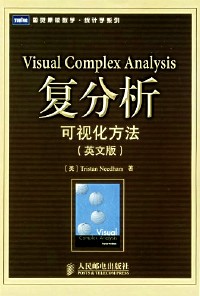
Visual complex analysis = 复分析 : 可视化方法 /
副标题:无
分类号:
ISBN:9787115155160
微信扫一扫,移动浏览光盘
简介
本书是复分析领域近年来较有影响的一本著作。作者用丰富的图例展示各种概念、定理和证明思路,十分便于读者理解,充分揭示了复分析的数学之美。书中讲述的内容有几何、复变函数变换、默比乌斯变换、微分、非欧几何、复积分、柯西公式、向量场、复积分、调和函数等。.
本书可作为大学本科、研究生的复分析课程教材或参考书。.
“……总的说来,本书确实体现了近几十年数学教材的一个发展趋势。把最新的成就,用浅显的方法教给低年级学生。……” ——齐民友(著名数学家,原武汉大学校长).
“《复分析:可视化方法》对我来说首先是一个欣喜,随后便成为深得我心的一本书。tristan needham 运用创新、独特的几何观点,揭示复分析之美中许多令人吃惊的、未被人们认识到的方面。”——roger penrose(英国大物理学家).
“如果你一年之内只能买一本数学书的话,那就买这一本吧。”——mathematical gazette(数学公报).
本书是复分析领域的一部名著,开创了数学领域的可视化潮流,自首次出版以来,已重印了十多次,深受世界读者好评。作者用真正不同寻常和独具创造性的视角来阐述复分析这一经典学科,通过大量的图示使原本比较抽象的数学概念,变得直观易懂,读者在透彻理解理论的同时,还能充分领略数学之美。.
tristan needham 旧金山大学数学系教授,理学院副院长。 牛津大学博士,导师为roger penrose(与霍金齐名的英国物理学家)。 因本书被美国数学会授予carl b. allendoerfer奖。他的研究领域包括几何、复分析、数学史、广义相对论。...
目录
1 geometry and complex arithmetic 1.
i introduction 1
1 historical sketch 1
2 bombelli's “wild thought” 3
3 some terminology and notation 6
4 practice 7
5 symbolic and geometric arithmetic 8
ii euler's formula 10
1 introduction 10
2 moving particle argument 10
3 power series argument 12
4 sine and cosine in terms of euler's formula 14
iii some applications 14
1 introduction 14
2 trigonometry 14
3 geometry 16
4 calculus 20
5 algebra 22
6 vectorial operations 27
iv transformations and euclidean geometry* 30
.1 geometry through the eyes of felix klein 30
2 classifying motions 34
3 three reflections theorem 37
4 similarities and complex arithmetic 39
5 spatial complex numbers? 43
v exercises 45
2 complex functions as transformations 55
i introduction 55
ii polynomials 57
1 positive integer powers 57
2 cubics revisited* 59
3 cassinian curves* 60
iii power series 64
1 the mystery of real power series 64
2 the disc of convergence 67
3 approximating a power series with a polynomial 70
4 uniqueness 71
5 manipulating power series 72
6 finding the radius of convergence 74
7 fourier series* 77
iv the exponential function 79
1 power series approach 79
2 the geometry of the mapping 80
3 another approach 81
v cosine and sine 84
1 definitions and identities 84
2 relation to hyperbolic functions 86
3 the geometry of the mapping 88
vi multifunctions 90
1 example: fractional powers 90
2 single-valued branches of a multifunction 92
3 relevance to power series 95
4 an example with two branch points 96
vii the logarithm function 98
1 inverse of the exponential function 98
2 the logarithmic power series 100
3 general powers 101
viii averaging over circles* 102
1 the centroid 102
2 averaging over regular polygons 105
3 averaging over circles 108
ix exercises 111
3 mobius transformations and inversion 122
i introduction 122
1 definition of m6bius transformations122
2 connection with einstein's theory of relativity* 122
3 decomposition into simple transformations 123
ii inversion 124
1 preliminary definitions and facts 124
2 preservation of circles 126
3 construction using orthogonal circles 128
4 preservation of angles 130
5 preservation of symmetry 133
6 inversion in a sphere 133
iii three illustrative applications of inversion 136
1 a problem on touching circles 136
2 quadrilaterals with orthogonal diagonals 137
3 ptolemy's theorem 138
iv the riemann sphere 139
1 the point at infinity 139
2 stereographic projection 140
3 transferring complex functions to the sphere 143
4 behaviour of functions at infinity 144
5 stereographic formulae* 146
v mobius transformations: basic results 148
1 preservation of circles, angles, and symmetry 148
2 non-uniqueness of the coefficients 149
3 the group property 150
4 fixed points 151
5 fixed points at infinity 152
6 the cross-ratio 154
vi mobius transformations as matrices* 156
1 evidence of a link with linear algebra 156
2 the explanation: homogeneous coordinates 157
3 eigenvectors and eigenvalues* 158
4 rotations of the sphere* 161
vii visualization and classification* 162
1 the main idea 162
2 elliptic, hyperbolic, and loxodromic types 164
3 local geometric interpretation of the multiplier 166
4 parabolic transformations 168
5 computing the multiplier* 169
6 eigenvalue interpretation of the multiplier* 170
viii decomposition into 2 or 4 reflections* 172
1 introduction 172
2 elliptic case 172
3 hyperbolic case 173
4 parabolic case 174
5 summary 175
ix automorphisms of the unit disc* 176
1 counting degrees of freedom 176
2 finding the formula via the symmetry principle 177
3 interpreting the formula geometrically* 178
4 introduction to riemann's mapping theorem 180
x exercises 181
4 differentiation: the amplitwist concept 189
i introduction 189
ii a puzzling phenomenon 189
iii local description of mappings in the plane 191
1 introduction 1 91
2 the jacobian matrix 192
3 the amplitwist concept 193
iv the complex derivative as amplitwist 194
1 the real derivative re-examined 194
2 the complex derivative 195
3 analytic functions 197
4 a brief summary 198
v some simple examples 199
vi conformal = analytic 200
1 introduction 200
2 conformality throughout a region 201
3 conformality and the riemann sphere 203
vii critical points 204
1 degrees of crushing 204
2 breakdown of conformality 205
3 branch points 206
vlll the cauchy-riemann equations 207
1 introduction 207
2 the geometry of linear transformations 208
3 the cauchy-riemann equations 209
ix exercises 211
5 further geometry of differentiation 216
i cauchy-riemann revealed 216
1 introduction 215
2 the cartesian form 216
3 the polar form 217
ii an intimation of rigidity 219
iii visual differentiation of log(z) 222
iv rules of differentiation 223
1 composition 223
2 inverse functions 224
3 addition and multiplication 225
v polynomials, power series, and rational func-tions 226
1 polynomials 226
2 power series 227
3 rational functions 228
vi visual differentiation of the power function 229
vii visual differentiation of exp(z) 231
vlll geometric solution of e'= e232
ix an application of higher derivatives: curva-ture* 234
1 introduction 234
2 analytic transformation of curvature 235
3 complex curvature 238
x celestial mechanics* 241
1 central force fields 241
2 two kinds of elliptical orbit 241
3 changing the first into the second 243
4 the geometry of force 244
5 an explanation 245
6 the kasner-arnol'd theorem 246
xl analytic continuation* 247
1 introduction 247
2 rigidity 249
3 uniqueness 250
4 preservation of identities 251
5 analytic continuation via reflections 252
xll exercises 258
6 non-euclidean geometry* 267..
i introduction 267
1 the parallel axiom 267
2 some facts from non-euclidean geometry 269
3 geometry on a curved surface 270
4 intrinsic versus extrinsic geometry 273
5 gaussian curvature 273
6 surfaces of constant curvature 275
7 the connection with m6bius transformations 277
ii spherical geometry 278
1 the angular excess of a spherical triangle 278
2 motions of the sphere 279
3 a conformal map of the sphere 283
4 spatial rotations as m6bius transformations 286
5 spatial rotations and quaternions 290
iii hyperbolic geometry 293
1 the tractrix and the pseudosphere 293
2 the constant curvature of the pseudosphere* 295
3 a conformal map of the pseudosphere 296
4 beltrami's hyperbolic plane 298
5 hyperbolic lines and reflections 301
6 the bolyai-lobachevsky formula* 305
7 the three types of direct motion 306
8 decomposition into two reflections 311
9 the angular excess of a hyperbolic triangle 313
10 the poincaré disc 315
11 motions of the poincaré disc 319
12 the hemisphere model and hyperbolic space 322
iv exercises 328
7 winding numbers and topology 338
i winding number 338
1 the definition 338
2 what does “inside” mean? 339
3 finding winding numbers quickly 340
ii hopf's degree theorem 341
1 the result 341
2 loops as mappings of the circle* 342
3 the explanation* 343
iii polynomials and the argument principle 344
iv a topological argument principle* 346
1 counting preimages algebraically 346
2 counting preimages geometrically 347
3 topological characteristics of analyticity 349
4 a topological argument principle 350
5 two examples 352
v rouche's theorem 353
1 the result 353
2 the fundamental theorem of algebra 354
3 brouwer's fixed point theorem* 354
vi maxima and minima 355
1 maximum-modulus theorem 355
2 related results 357
vii the schwarz-pick lemma* 357
1 schwarz's lemma 357
2 liouville's theorem 359
3 pick's result 360
vlll the generalized argument principle 363
1 rational functions 363
2 poles and essential singularities 365
3 the explanation* 367
ix exercises 369
8 complex integration: cauchy's theorem 377
i introduction 377
ii the real integral 378
1 the riemann sum 378
2 the trapezoidal rule 379
3 geometric estimation of errors 380
iii the complex integral 383
1 complex riemann sums 383
2 a visual technique 386
3 a useful inequality 386
4 rules of integration 387
iv complex inversion 388
1 a circular arc 388
2 general loops 390
3 winding number 391
v conjugation 392
1 introduction 392
2 area interpretation 393
3 general loops 395
vi power functions 395
1 integration along a circular arc 395
2 complex inversion as a limiting case* 397
3 general contours and the deformation theorem 397
4 a further extension of the theorem 399
5 residues 400
vii the exponential mapping 401
vlll the fundamental theorem 402
1 introduction 402
2 an example 403
3 the fundamental theorem 404
4 the integral as antiderivative 406
5 logarithm as integral 408
ix parametric evaluation 409
x cauchy's theorem 410
1 some preliminaries 410
2 the explanation 412
xl the general cauchy theorem 414
1 the result 414
2 the explanation 415
3 a simpler explanation 417
xll the general formula of contour integration 418
xlii exercises 420
9 cauchy's formula and its applications 427
i cauchy's formula 427
1 introduction 427
2 first explanation 427
3 gauss' mean value theorem 429
4 general cauchy formula 429
ii infinite differentiability and taylor series 431
1 infinite differentiability 431
2 taylor series 432
iii calculus of residues 434
1 laurent series centred at a pole 434
2 a formula for calculating residues 435
3 application to real integrals 436
4 calculating residues using taylor series 438
5 application to summation of series 439
iv annular laurent series 442
1 an example 442
2 laurent's theorem 442
v exercises 446
10 vector fields: physics and topology 450
i vector fields 450
1 complex functions as vector fields 450
2 physical vector fields 451
3 flows and force fields 453
4 sources and sinks 454
ii winding numbers and vector fields* 456
1 the index of a singular point 456
2 the index according to poincaré 459
3 the index theorem 460
iii flows on closed surfaces* 462
1 formulation of the poincaré-hopf theorem 462
2 defining the index on a surface 464
3 an explanation of the poincaré-hopf theorem 465
iv exercises 468
11 vector fields and complex integration 472
i flux and work 472
1 flux 472
2 work 474
3 local flux and local work 476
4 divergence and curl in geometric form* 478
5 divergence-free and curl-free vector fields 479
ii complex integration in terms of vector fields 481
1 the p61ya vector field 481
2 cauchy's theorem 483
3 example: area as flux 484
4 example: winding number as flux 485
5 local behaviour of vector fields* 486
6 cauchy's formula 488
7 positive powers 489
8 negative powers and multipoles 490
9 multipoles at infinity 492
10 laurent's series as a multipole expansion 493
iii the complex potential 494
1 introduction 494
2 the stream function 494
3 the gradient field 497
4 the potential function 498
5 the complex potential 500
6 examples 503
iv exercises 505
12 flows and harmonic functions 508
i harmonic duals 508
1 dual flows 508
2 harmonic duals 511
ii conformal i nvariance 513
1 conformal invariance of harmonicity 513
2 conformal invariance of the laplacian 515
3 the meaning of the laplacian 516
iii a powerful computational tool 517
iv the complex curvature revisited* 520
1 some geometry of harmonic equipotentials 520
2 the curvature of harmonic equipotentials 520
3 further complex curvature calculations 523
4 further geometry of the complex curvature 525
v flow around an obstacle 527
1 introduction 527
2 an example 527
3 the method of images 532
4 mapping one flow onto another 538
vi the physics of riemann's mapping theorem 540
1 introduction 540
2 exterior mappings and flows round obstacles 541
3 interior mappings and dipoles 544
4 interior mappings, vortices, and sources 546
5 an example: automorphisms of the disc 549
6 green's function 550
vii dirichlet's problem 554
1 introduction 554
2 schwarz's interpretation 556
3 dirichlet's problem for the disc 558
4 the interpretations of neumann and bscher 560
5 green's general formula 565
vlll exercises 570
references 573
index 579...
i introduction 1
1 historical sketch 1
2 bombelli's “wild thought” 3
3 some terminology and notation 6
4 practice 7
5 symbolic and geometric arithmetic 8
ii euler's formula 10
1 introduction 10
2 moving particle argument 10
3 power series argument 12
4 sine and cosine in terms of euler's formula 14
iii some applications 14
1 introduction 14
2 trigonometry 14
3 geometry 16
4 calculus 20
5 algebra 22
6 vectorial operations 27
iv transformations and euclidean geometry* 30
.1 geometry through the eyes of felix klein 30
2 classifying motions 34
3 three reflections theorem 37
4 similarities and complex arithmetic 39
5 spatial complex numbers? 43
v exercises 45
2 complex functions as transformations 55
i introduction 55
ii polynomials 57
1 positive integer powers 57
2 cubics revisited* 59
3 cassinian curves* 60
iii power series 64
1 the mystery of real power series 64
2 the disc of convergence 67
3 approximating a power series with a polynomial 70
4 uniqueness 71
5 manipulating power series 72
6 finding the radius of convergence 74
7 fourier series* 77
iv the exponential function 79
1 power series approach 79
2 the geometry of the mapping 80
3 another approach 81
v cosine and sine 84
1 definitions and identities 84
2 relation to hyperbolic functions 86
3 the geometry of the mapping 88
vi multifunctions 90
1 example: fractional powers 90
2 single-valued branches of a multifunction 92
3 relevance to power series 95
4 an example with two branch points 96
vii the logarithm function 98
1 inverse of the exponential function 98
2 the logarithmic power series 100
3 general powers 101
viii averaging over circles* 102
1 the centroid 102
2 averaging over regular polygons 105
3 averaging over circles 108
ix exercises 111
3 mobius transformations and inversion 122
i introduction 122
1 definition of m6bius transformations122
2 connection with einstein's theory of relativity* 122
3 decomposition into simple transformations 123
ii inversion 124
1 preliminary definitions and facts 124
2 preservation of circles 126
3 construction using orthogonal circles 128
4 preservation of angles 130
5 preservation of symmetry 133
6 inversion in a sphere 133
iii three illustrative applications of inversion 136
1 a problem on touching circles 136
2 quadrilaterals with orthogonal diagonals 137
3 ptolemy's theorem 138
iv the riemann sphere 139
1 the point at infinity 139
2 stereographic projection 140
3 transferring complex functions to the sphere 143
4 behaviour of functions at infinity 144
5 stereographic formulae* 146
v mobius transformations: basic results 148
1 preservation of circles, angles, and symmetry 148
2 non-uniqueness of the coefficients 149
3 the group property 150
4 fixed points 151
5 fixed points at infinity 152
6 the cross-ratio 154
vi mobius transformations as matrices* 156
1 evidence of a link with linear algebra 156
2 the explanation: homogeneous coordinates 157
3 eigenvectors and eigenvalues* 158
4 rotations of the sphere* 161
vii visualization and classification* 162
1 the main idea 162
2 elliptic, hyperbolic, and loxodromic types 164
3 local geometric interpretation of the multiplier 166
4 parabolic transformations 168
5 computing the multiplier* 169
6 eigenvalue interpretation of the multiplier* 170
viii decomposition into 2 or 4 reflections* 172
1 introduction 172
2 elliptic case 172
3 hyperbolic case 173
4 parabolic case 174
5 summary 175
ix automorphisms of the unit disc* 176
1 counting degrees of freedom 176
2 finding the formula via the symmetry principle 177
3 interpreting the formula geometrically* 178
4 introduction to riemann's mapping theorem 180
x exercises 181
4 differentiation: the amplitwist concept 189
i introduction 189
ii a puzzling phenomenon 189
iii local description of mappings in the plane 191
1 introduction 1 91
2 the jacobian matrix 192
3 the amplitwist concept 193
iv the complex derivative as amplitwist 194
1 the real derivative re-examined 194
2 the complex derivative 195
3 analytic functions 197
4 a brief summary 198
v some simple examples 199
vi conformal = analytic 200
1 introduction 200
2 conformality throughout a region 201
3 conformality and the riemann sphere 203
vii critical points 204
1 degrees of crushing 204
2 breakdown of conformality 205
3 branch points 206
vlll the cauchy-riemann equations 207
1 introduction 207
2 the geometry of linear transformations 208
3 the cauchy-riemann equations 209
ix exercises 211
5 further geometry of differentiation 216
i cauchy-riemann revealed 216
1 introduction 215
2 the cartesian form 216
3 the polar form 217
ii an intimation of rigidity 219
iii visual differentiation of log(z) 222
iv rules of differentiation 223
1 composition 223
2 inverse functions 224
3 addition and multiplication 225
v polynomials, power series, and rational func-tions 226
1 polynomials 226
2 power series 227
3 rational functions 228
vi visual differentiation of the power function 229
vii visual differentiation of exp(z) 231
vlll geometric solution of e'= e232
ix an application of higher derivatives: curva-ture* 234
1 introduction 234
2 analytic transformation of curvature 235
3 complex curvature 238
x celestial mechanics* 241
1 central force fields 241
2 two kinds of elliptical orbit 241
3 changing the first into the second 243
4 the geometry of force 244
5 an explanation 245
6 the kasner-arnol'd theorem 246
xl analytic continuation* 247
1 introduction 247
2 rigidity 249
3 uniqueness 250
4 preservation of identities 251
5 analytic continuation via reflections 252
xll exercises 258
6 non-euclidean geometry* 267..
i introduction 267
1 the parallel axiom 267
2 some facts from non-euclidean geometry 269
3 geometry on a curved surface 270
4 intrinsic versus extrinsic geometry 273
5 gaussian curvature 273
6 surfaces of constant curvature 275
7 the connection with m6bius transformations 277
ii spherical geometry 278
1 the angular excess of a spherical triangle 278
2 motions of the sphere 279
3 a conformal map of the sphere 283
4 spatial rotations as m6bius transformations 286
5 spatial rotations and quaternions 290
iii hyperbolic geometry 293
1 the tractrix and the pseudosphere 293
2 the constant curvature of the pseudosphere* 295
3 a conformal map of the pseudosphere 296
4 beltrami's hyperbolic plane 298
5 hyperbolic lines and reflections 301
6 the bolyai-lobachevsky formula* 305
7 the three types of direct motion 306
8 decomposition into two reflections 311
9 the angular excess of a hyperbolic triangle 313
10 the poincaré disc 315
11 motions of the poincaré disc 319
12 the hemisphere model and hyperbolic space 322
iv exercises 328
7 winding numbers and topology 338
i winding number 338
1 the definition 338
2 what does “inside” mean? 339
3 finding winding numbers quickly 340
ii hopf's degree theorem 341
1 the result 341
2 loops as mappings of the circle* 342
3 the explanation* 343
iii polynomials and the argument principle 344
iv a topological argument principle* 346
1 counting preimages algebraically 346
2 counting preimages geometrically 347
3 topological characteristics of analyticity 349
4 a topological argument principle 350
5 two examples 352
v rouche's theorem 353
1 the result 353
2 the fundamental theorem of algebra 354
3 brouwer's fixed point theorem* 354
vi maxima and minima 355
1 maximum-modulus theorem 355
2 related results 357
vii the schwarz-pick lemma* 357
1 schwarz's lemma 357
2 liouville's theorem 359
3 pick's result 360
vlll the generalized argument principle 363
1 rational functions 363
2 poles and essential singularities 365
3 the explanation* 367
ix exercises 369
8 complex integration: cauchy's theorem 377
i introduction 377
ii the real integral 378
1 the riemann sum 378
2 the trapezoidal rule 379
3 geometric estimation of errors 380
iii the complex integral 383
1 complex riemann sums 383
2 a visual technique 386
3 a useful inequality 386
4 rules of integration 387
iv complex inversion 388
1 a circular arc 388
2 general loops 390
3 winding number 391
v conjugation 392
1 introduction 392
2 area interpretation 393
3 general loops 395
vi power functions 395
1 integration along a circular arc 395
2 complex inversion as a limiting case* 397
3 general contours and the deformation theorem 397
4 a further extension of the theorem 399
5 residues 400
vii the exponential mapping 401
vlll the fundamental theorem 402
1 introduction 402
2 an example 403
3 the fundamental theorem 404
4 the integral as antiderivative 406
5 logarithm as integral 408
ix parametric evaluation 409
x cauchy's theorem 410
1 some preliminaries 410
2 the explanation 412
xl the general cauchy theorem 414
1 the result 414
2 the explanation 415
3 a simpler explanation 417
xll the general formula of contour integration 418
xlii exercises 420
9 cauchy's formula and its applications 427
i cauchy's formula 427
1 introduction 427
2 first explanation 427
3 gauss' mean value theorem 429
4 general cauchy formula 429
ii infinite differentiability and taylor series 431
1 infinite differentiability 431
2 taylor series 432
iii calculus of residues 434
1 laurent series centred at a pole 434
2 a formula for calculating residues 435
3 application to real integrals 436
4 calculating residues using taylor series 438
5 application to summation of series 439
iv annular laurent series 442
1 an example 442
2 laurent's theorem 442
v exercises 446
10 vector fields: physics and topology 450
i vector fields 450
1 complex functions as vector fields 450
2 physical vector fields 451
3 flows and force fields 453
4 sources and sinks 454
ii winding numbers and vector fields* 456
1 the index of a singular point 456
2 the index according to poincaré 459
3 the index theorem 460
iii flows on closed surfaces* 462
1 formulation of the poincaré-hopf theorem 462
2 defining the index on a surface 464
3 an explanation of the poincaré-hopf theorem 465
iv exercises 468
11 vector fields and complex integration 472
i flux and work 472
1 flux 472
2 work 474
3 local flux and local work 476
4 divergence and curl in geometric form* 478
5 divergence-free and curl-free vector fields 479
ii complex integration in terms of vector fields 481
1 the p61ya vector field 481
2 cauchy's theorem 483
3 example: area as flux 484
4 example: winding number as flux 485
5 local behaviour of vector fields* 486
6 cauchy's formula 488
7 positive powers 489
8 negative powers and multipoles 490
9 multipoles at infinity 492
10 laurent's series as a multipole expansion 493
iii the complex potential 494
1 introduction 494
2 the stream function 494
3 the gradient field 497
4 the potential function 498
5 the complex potential 500
6 examples 503
iv exercises 505
12 flows and harmonic functions 508
i harmonic duals 508
1 dual flows 508
2 harmonic duals 511
ii conformal i nvariance 513
1 conformal invariance of harmonicity 513
2 conformal invariance of the laplacian 515
3 the meaning of the laplacian 516
iii a powerful computational tool 517
iv the complex curvature revisited* 520
1 some geometry of harmonic equipotentials 520
2 the curvature of harmonic equipotentials 520
3 further complex curvature calculations 523
4 further geometry of the complex curvature 525
v flow around an obstacle 527
1 introduction 527
2 an example 527
3 the method of images 532
4 mapping one flow onto another 538
vi the physics of riemann's mapping theorem 540
1 introduction 540
2 exterior mappings and flows round obstacles 541
3 interior mappings and dipoles 544
4 interior mappings, vortices, and sources 546
5 an example: automorphisms of the disc 549
6 green's function 550
vii dirichlet's problem 554
1 introduction 554
2 schwarz's interpretation 556
3 dirichlet's problem for the disc 558
4 the interpretations of neumann and bscher 560
5 green's general formula 565
vlll exercises 570
references 573
index 579...
Visual complex analysis = 复分析 : 可视化方法 /
- 名称
- 类型
- 大小
光盘服务联系方式: 020-38250260 客服QQ:4006604884
云图客服:
用户发送的提问,这种方式就需要有位在线客服来回答用户的问题,这种 就属于对话式的,问题是这种提问是否需要用户登录才能提问
Video Player
×
Audio Player
×
pdf Player
×
