

简介
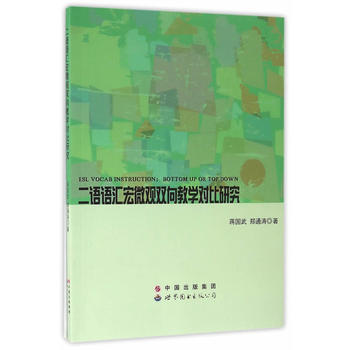
蒋国武、郑通涛所*的《二语语汇宏微观双向教学对比研究》通过实地教学采集研究数据,以“实验性交叉组实验前后测试”的设计模式,新创两套高校学术语汇课程方案:微观正向进程模式与宏观逆向进程模式。本研究基于上述两套课程方案进行实际教学,取得数据并进行分析。结果表明,总体上两种教学法在中国大学生英语语汇习得上都取得了良好的效果,尽管微观逆向教学法略胜于宏观正向教学法。本书尝试用诸多因素解释上述研究发现,其中包括二语习得的特性,习得者的英语水平以及文化因素等。
目录
IntroductionChapter 1: Background1.1 Introduction1.2 Statement of the Problem1.3 Research Objectives1.4 Significance of the Study1.5 Vocabulary Teaching in China1.5.1 English as a Second Language in China1.5.2 The Role of Vocabulary Knowledge1.5.3 The Current Situation of Vocabulary Teaching in ChinaChapter 2: Literature Review2.1 Introduction2.2 Approaches and Methods in Language Teaching2.3 Approaches to Vocabulary Teaching2.3.1 Incidental Approach2.3.2 Intentional Approach2.3.3 Word Association Approach and the Contextualised Approach2.4 Vocabulary Knowledge and Development2.4.1 Vocabulary Size2.4.2 What is Involved in Knowing a Word?2.4.3 Receptive Knowledge versus Productive Knowledge2.4.4 The Development of Vocabulary Knowledge2.4.5 Vocabulary Teaching and Learning Burden2.5 Language Processing and the Conceptualisation of Bottom - up and Top - down2.6 The Components of a Vocabulary Course2.6.1 The Goals of Vocabulary Teaching2.6.2 Needs Analysis of a Vocabulary Course2.6.3 Environment Analysis2.6.4 Teaching Principles2.6.5 Teaching Content and Sequence2.6.6 Format and Presentation2.6.7 Monitoring and Assessment2.6.8 Course Evaluation2.7 Previous Research2.7.1 Research on Bottom - up and Top - down Approaches2.7.2 Research on Vocabulary Teaching2.8 Chinese Culture and the Role of Culture in EFL Teaching2.8.1 The Fundamental Features of Chinese Culture2.8.2 The Role of Culture in EFL Teaching2.9 Summary and ImplicationsChapter 3: Methodology and Design3.1 Introduction3.2 Overview of the Research Project3.3 Research Design3.4 Participants3.4.1 Research Sample3.4.2 Recruitment3.4.3 Allocation of Participants3.5 Instruments3.5.1 Background Information Questionnaire3.5.2 Vocabulary Knowledge Tests3.5.3 Course Evaluation Questionnaire3.6 Research Procedure3.7 Instruction3.7.1 Teaching Procedure3.7.2 Teaching Materials and Resources3.7.3 Teaching Activities3.8 Data Analysis3.9 SummaryChapter 4: Data Analysis4.1 Overview4.2 Preliminary (Descriptive) Analysis4.3 Main Analysis4.3.1 The Results of Academic Vocabulary Size Tests (AVST)4.3.2 The Results of Controlled Productive Knowledge Tests (CPKT)4.4 ConclusionChapter 5: Discussion5.1 Overview5.2 The Different Effect between Bottom - up and Top - down Approaches5.2.1 Nature of L2 Lexical Acquisition and its Alignment with Bottom - up Processing5.2.2 Learner's Low Proficiency Level Favours Bottom- up Proeessing5.2.3 Socio- cultural and Traditional Factors in the Chinese Context5.3 About the Vocabulary Course5.3.1 Composition of the Course ( in terms of Nation' s four strands)5.3.2 The Role of Explicit/Direct Vocabulary Instruction5.3.3 Input Processing Management5.3.4 The Instruction Targeted both Receptive and Productive Skills5.3.5 Combination of both the Key Words Approach and the Contextualised Approach5.3.6 Use of Online Resources5.4 ConclusionChapter 6: Conclusion6.1 Project Summary6.2 Contribution of the Study6.2.1 Contributions to Scholarship in the Field of L2 Research6.2.2 Contributions to Second Language Pedagogy6.3 Limitations of the Current Study and Recommendation for Future Research6.4 Recommendations for Second Language Pedagogy6.4.1 A Plausible.Heuristic and Eclectic Approach in ELT6.4.2 Eclectic Dynamic Language Acquisition Model Integrating Bottom -up and Top -down Dimensions6.5 Final CommentsReferencesAppendix A: Teaching SyllabusAppendix B: Lesson PlanAppendix C: Teaching Materials1.Academic Words Lists (AWL) (Coxhead,2000)2.Sub - lists of the AWL ( Coxhead ,2000)3.IELTS Preparing Book ( IELTS 7,2008.p.78)4.The List of Target Teaching Words$.Academic Vocabulary ExercisesAppendix D: Teaching Resources1.Word Formation: http://wordinfo.info/2.Bilinguial online dictionary: http://www.iciba.corn/3.WordNet Search 3.0: http://wordnetweb.princeton.edu/perl/webwn4.Visuahhesaurus: http://www.visualthesaurus.com/trialover!$.Oxford Collocation Dictionary Online: http://www.ozdic.corn6.Long Dictionary of Contemporary English: http://www.ldoceonline.comAppendix E: Research Instruments1.Background Information Collection Form2.Vocabulary Pre and Post Tests3.Course Evaluation Questionnaire
- 名称
- 类型
- 大小
光盘服务联系方式: 020-38250260 客服QQ:4006604884
云图客服:
用户发送的提问,这种方式就需要有位在线客服来回答用户的问题,这种 就属于对话式的,问题是这种提问是否需要用户登录才能提问
