

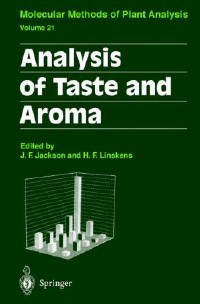
Analysis of taste and aroma/
副标题:无
作 者:edited by J.E. Jackson and H.E. Linskens.
分类号:
ISBN:9783540417538
微信扫一扫,移动浏览光盘
简介
The series Molecular Methods of Plant Analysis launches the former 'Modern Methods' into the 'molecular' era with this volume on "Taste and Aroma". Analysis of the plant components interacting with these two senses, so important for the very survival of human beings and, in more recent times, the key to their enjoyment of life as well, is presented with examples of the use of molecular approaches. These include DNA microarrays, antisense technology and RNA gel blot analysis.Some recent advances in plant analysis technology embrace amongst others the use of electroantennography in the detection of physiologically important flower volatiles. An introductory chapter explains what we know about the molecular biology of human taste and aroma receptors, as this has implications for the analysis of plant components interacting with these receptors. As the first volume in the molecular series, this book lays the foundation for others to come.
目录
1 Molecular Biology of Taste and Aroma Receptors: Implications for Taste and Aroma of Plant Products J.F. Jackson p. 1
1.1 Introduction p. 1
1.2 Taste Buds and Receptor Cells p. 1
1.3 Taste Receptors p. 2
1.4 Taste Receptor Expression Patterns p. 2
1.5 Conclusions for Taste Modality p. 3
1.6 Aroma Detection in Mammals p. 3
1.7 Model for the Olfactory System p. 4
1.8 Conclusions for Aroma Perception in Humans p. 4
References p. 5
2 Use of DNA Microarrays in the Identification of Genes Involved in Strawberry Flavor Formation A. Aharoni and A.P. O'Connell p. 7
2.1 Introduction p. 7
2.2 The Microarray Method p. 9
2.2.1 Principle p. 9
2.2.2 Microarray Procedure p. 9
2.2.2.1 Array Fabrication p. 9
2.2.2.2 Preparation of Targets and Hybridization p. 10
2.2.2.3 Image Analysis and Data Extraction and Mining p. 12
2.2.3 Key Microarray Applications p. 12
2.2.3.1 Monitoring Gene Expression (mRNA Abundance) p. 12
2.2.3.2 DNA Variation p. 13
2.2.3.3 Arrays Containing Other Types of Bio-molecules p. 14
2.3 Strawberry and Flavor Formation p. 14
2.3.1 Strawberry Fruit p. 14
2.3.2 Main Flavor and Aroma Components in Strawberry and Their Biosynthesis p. 15
2.3.3 Acohol Acyltransferases and Ester Formation p. 18
2.4 From Expression to Function: Identification of Strawberry AAT (SAAT) p. 18
2.4.1 Gene Expression During Development and Ripening p. 18
2.4.2 Identification of the SAAT Gene p. 19
2.4.3 SAATEncodes the Ester-Forming Enzyme from Strawberry Fruit p. 20
2.4.4 Other Candidate Genes Associated with Flavor Formation in Strawberry p. 23
2.5 Conclusion and Future Prospects p. 23
References p. 25
3 Testing for Taste and Flavour of Beer T. Yonezawa and T. Fushiki p. 29
3.1 Introduction p. 29
3.2 Characteristics of Taste and Flavour Compounds in Beer p. 30
3.2.1 Taste and Flavour Substances in Beer p. 30
3.2.2 Threshold p. 31
3.2.3 Flavour Units p. 31
3.2.4 Bitterness from Hops p. 32
3.2.5 Hop Aroma p. 33
3.2.6 Acohols p. 33
3.2.7 Acids p. 34
3.2.8 Esters p. 34
3.2.9 Ketones and Aldehydes p. 34
3.2.10 Sulfur Compounds p. 36
3.2.11 Some Notes on Thresholds p. 37
3.2.12 Effects of Carbonation p. 38
3.3 Sensory Testing for Taste and Flavour of Beer p. 38
3.3.1 Descriptive Terminology p. 38
3.3.2 Standard Terminology for Beer Flavour p. 39
3.3.3 Descriptive Test p. 39
3.3.4 Difference Tests p. 41
3.3.5 Bias in Sensory Verdicts p. 41
3.3.6 Application of Taste Sensor p. 41
3.3.7 Preference Test p. 42
3.3.8 Drinkability Test p. 42
3.4 Conclusions p. 43
References p. 44
4 Taste Evaluation for Peptides in Protein Hydrolysates from Soybean and Other Plants K. Maehashi and S. Arai p. 47
4.1 Introduction p. 47
4.2 Bitterness of Peptides from Soybean Protein p. 48
4.2.1 Theory for the Bitterness of Protein Hydrolysate p. 48
4.2.2 Tastes of Soybean Protein Hydrolysate p. 48
4.2.3 Debittering of Peptides p. 50
4.3 Protein Hydrolysates from Soybean and Other Plant Foods p. 51
4.3.1 Fermented Foods p. 51
4.3.2 Other Plant Protein Hydrolysates p. 52
4.4 Acidic Oligopeptides p. 53
4.4.1 Taste of a-L-Glutamyl Oligopeptides p. 53
4.4.2 Taste Properties of Food Protein Hydrolysates p. 54
4.5 Isolation of Peptides from Protein Hydrolysate p. 57
4.5.1 Enzymatic Digestion p. 57
4.5.2 Gel Filtration p. 57
4.5.3 Ion-Exchange Chromatography p. 59
4.5.3.1 Group Fractionation p. 59
4.5.3.2 Ion-Exchange Chromatography by a Gradient Elution p. 60
4.5.4 Thin Layer Chromatography p. 60
4.5.5 Reverse-Phase HPLC p. 61
4.6 Sensory Evaluation p. 61
4.6.1 Detection of Tasty Peptides in Purification Steps p. 61
4.6.2 Determination of Recognition Threshold p. 63
4.6.3 Synergism Among Savory Peptides p. 63
4.6.4 Effect on Five BasicTastes p. 64
4.6.5 Taste Duration-Intensity Curve p. 64
4.6.6 Buffer Capacity of Peptide p. 64
4.7 Conclusions and Vista p. 65
References p. 65
5 Hop Aroma Extraction and Analysis G. Lermusieau and S. Collin p. 69
5.1 Introduction p. 69
5.2 Hop Aroma p. 72
5.2.1 Terpenic Compounds p. 72
5.2.2 Oxidation and Hydrolysis Products from Sesquiterpenes p. 77
5.2.3 Acohols, Carbonyles, Acids and Esters p. 77
5.2.4 Hop Aroma Glycosides p. 82
5.3 Varietal Discrimination of Hop Cultivars According to Their Oil Content p. 83
References p. 86
6 Olfactometry and Aroma Extract Dilution Analysis of Wines V. Ferreira and R. L贸pez and M. Aznar p. 89
6.1 Introduction p. 89
6.2 A Review of Wine Olfactometry p. 89
6.3 Wine Olfactometry: An Overview p. 95
6.4 Methodological Aspects p. 109
6.4.1 Headspace or Total Extraction? p. 109
6.4.2 Obtaining an Extract p. 110
6.4.3 Evaluation of the Representativity of the Extract p. 111
6.4.4 Concentration of the Extracts p. 112
6.4.5 The Chromatographic System for Olfactometry p. 113
6.5 Techniques for Processing the Olfactometric Signal p. 114
6.6 Final Remarks p. 116
References p. 117
7 Analysis of Volatile Components of Citrus Fruit Essential Oils G. Ruberto p. 123
7.1 Introduction p. 123
7.2 Chemical Composition of Citrus Peel Essential Oils p. 125
7.3 Analysis of Citrus Peel Essential Oils p. 134
7.3.1 High Resolution Gas Chromatography (HRGC) p. 134
7.3.2 High Resolution Gas Chromatography-Mass Spectrometry (HRGC-MS) p. 135
7.3.3 High Resolution Gas Chromatography-Fourier Transform IR Spectroscopy (HRGC-FTIR) p. 138
7.3.4 Liquid Chromatography-High Resolution Gas Chromatography-Mass Spectrometry (LC-HRGC-MS) p. 141
7.3.5 Multidimensional Gas Chromatography (MDGC) p. 143
7.4 Deterpenation of Citrus Essential Oils p. 147
7.5 Novel Citrus Fruits p. 150
References p. 153
8 Aroma Volatiles in Fruits in Which Ethylene Production Is Depressed by Antisense Technology A.D.auchot and D.S. Mottram and P. John p. 159
8.1 Why Use Antisense Technology to Study Fruit Aroma? p. 159
8.1.1 Successful Inhibition of Ethylene Biosynthesis in Fruit p. 160
8.1.2 Studying Fruit Aroma in Ethylene-Depleted Fruit p. 160
8.1.3 Fruit Volatile Compound Analyses p. 161
8.2 Methods p. 162
8.2.1 Inhibition of Ethylene Biosynthesis: Fruit Transformation p. 162
8.2.1.1 Tissue Regeneration p. 163
8.2.1.2 Agrobacterium Transformation p. 163
8.2.1.3 Generation of Transformed Plants p. 164
8.2.1.4 Production of Hybrids p. 164
8.2.2 Volatile Analyses p. 165
8.2.2.1 Solvent Extraction p. 165
8.2.2.2 Headspace Sampling p. 165
8.2.2.3 Gas Chromatography-Mass Spectrometry p. 167
8.3 Illustration: Our Results p. 168
8.4 Conclusions p. 170
References p. 171
9 Detection of Physiologically Active Flower Volatiles Using Gas Chromatography Coupled with Electroantennography F.P. Schiestl and F. Marion-Poll p. 173
9.1 Introduction p. 173
9.2 Collection of Floral Scent p. 174
9.2.1 Location of Floral Scent Emission p. 175
9.2.2 Variation of Scent Emission p. 175
9.2.3 Choice of Type and Amount of Adsorbent Material p. 176
9.3 Gas Chromatography p. 177
9.3.1 Fractionation of Samples
9.3.2 Injector Types p. 178
9.3.3 Columns p. 178
9.3.4 Coupling the GC with the Electroantennographic Detector (EAD) p. 179
9.3.4.1 Split p. 179
9.3.4.2 Heating of the Transfer Line p. 180
9.3.4.3 Air Flow Over the Antenna p. 180
9.4 Electrophysiology p. 181
9.4.1 Olfactory System p. 181
9.4.2 EAG p. 182
9.4.2.1 EAG Preparations p. 182
9.4.2.2 Recording an EAG p. 183
9.4.3 GC-SSR (GC-SCR) p. 184
9.4.3.1 Technique p. 184
9.4.3.2 Signal Measurement p. 184
9.4.4 Overcoming Problems ofLow Sensitivity p. 185
9.4.5 Comparison of EAG, GC-EAD, and GC-SSR p. 186
9.5 Behavioural Tests p. 187
9.5.1 Attraction Tests p. 187
9.5.2 Proboscis Extension p. 188
9.6 Compilation of Results p. 188
9.7 Concluding Remarks p. 188
References p. 194
10 Analysis of Rhythmic Emission of Volatile Compounds of Rose Flowers J.P.F.G. Helsper and J.A. Davies and F.W.A. Verstappen p. 199
10.1 Introduction: Rhythmicity in Emission of Volatile Compounds, How and Why p. 199
10.2 Rhythmicity in Emitted Volatiles p. 201
10.2.1 Methods p. 201
10.2.1.1 Plant Containment p. 201
10.2.1.2 Environmental Conditions p. 201
10.2.1.3 Volatile Adsorption p. 202
10.2.1.4 Volatile Desorption p. 202
10.2.1.5 GC and GCMS Analysis p. 203
10.2.1.6 Calibration Curves p. 204
10.2.1.7 Quantification of Compounds for Which No Authentic Standard Is Available p. 205
10.2.1.8 Recovery of Volatiles in the Experimental Setup from Plant to GCMS p. 205
10.2.2 Circadian Rhythmicity in Emission of Volatile Compounds by Rose Flowers: Experimental Results and Discussion p. 205
10.3 Rhythmicity in Precursors of Emitted Volatiles in Rose Petal Tissue p. 211
10.3.1 Introduction p. 211
10.3.2 Methods p. 213
10.3.2.1 Plant Material p. 213
10.3.2.2 Assay of Non-glucosylated Fragrance Compounds in Petal Tissue p. 213
10.3.2.3 Assay of Glucosylated Fragrance Compounds in Petal Tissue p. 214
10.3.3 Rhythmicity in Petal Concentrations of Precursors of Volatile Compounds: Experimental Results and Discussion p. 215
10.4 General Conclusion p. 218
References p. 220
11 Odour Intensity Evaluation in GC-Olfactometry by Finger Span Method P.X. Eti茅vant p. 223
11.1 Introduction p. 223
11.2 Description of the Finger Span Cross-Modality Matching Principle p. 224
11.3 Selection and Training p. 226
11.4 Performance of the Method p. 229
11.5 Applications p. 232
11.5.1 Sample Discrimination Based on Odour Intensity of Constituents p. 232
11.5.2 Determination of Stevens' Coefficients p. 234
11.6 Conclusion p. 236
References p. 236
12 Solid Phase Microextraction Application in GC/Olfactometry Dilution Analysis K.D. Deibler and E.H. Lavin and T.E. Acree p. 239
12.1 Introduction p. 239
12.1.1 Aroma Chemistry p. 239
12.1.2 Mouth Simulators p. 240
12.1.3 Solid Phase Microextraction p. 241
12.2 Description of Methods p. 242
12.2.1 SPME Initialization p. 242
12.2.2 SPME CharmAnalysis p. 243
12.2.3 Quantification of SPME p. 243
12.3 Example of SPME Dilution Analysis p. 245
12.3.1 Methods p. 245
12.3.1.1 SPME Extraction p. 245
12.3.1.2 GC Parameters p. 245
12.3.1.3 Optimization of Exposure Time p. 245
12.3.1.4 Dilution Analysis p. 246
12.3.1.5 CharmAnalysis of Coffee p. 246
12.3.2 Results of Example p. 246
12.4 Conclusions p. 247
References p. 248
13 RNA Gel Blot Analysis to Determine Gene Expression of Floral Scents J. Boatright and N. Dudareva p. 249
13.1 Introduction p. 249
13.2 RNA Gel Blot Analysis p. 251
13.2.1 RNA Isolation p. 252
13.2.2 RNA Fractionation by Agarose-6 M Urea Gel Electrophoresis p. 253
13.2.2.1 Preparation of Vertical Agarose-6 M Urea Gel p. 255
13.2.2.2 Gel Electrophoresis p. 255
13.2.3 Transfer RNA from Gel to Membrane
13.2.4 Hybridization p. 257
References p. 259
Subject Index p. 263
1.1 Introduction p. 1
1.2 Taste Buds and Receptor Cells p. 1
1.3 Taste Receptors p. 2
1.4 Taste Receptor Expression Patterns p. 2
1.5 Conclusions for Taste Modality p. 3
1.6 Aroma Detection in Mammals p. 3
1.7 Model for the Olfactory System p. 4
1.8 Conclusions for Aroma Perception in Humans p. 4
References p. 5
2 Use of DNA Microarrays in the Identification of Genes Involved in Strawberry Flavor Formation A. Aharoni and A.P. O'Connell p. 7
2.1 Introduction p. 7
2.2 The Microarray Method p. 9
2.2.1 Principle p. 9
2.2.2 Microarray Procedure p. 9
2.2.2.1 Array Fabrication p. 9
2.2.2.2 Preparation of Targets and Hybridization p. 10
2.2.2.3 Image Analysis and Data Extraction and Mining p. 12
2.2.3 Key Microarray Applications p. 12
2.2.3.1 Monitoring Gene Expression (mRNA Abundance) p. 12
2.2.3.2 DNA Variation p. 13
2.2.3.3 Arrays Containing Other Types of Bio-molecules p. 14
2.3 Strawberry and Flavor Formation p. 14
2.3.1 Strawberry Fruit p. 14
2.3.2 Main Flavor and Aroma Components in Strawberry and Their Biosynthesis p. 15
2.3.3 Acohol Acyltransferases and Ester Formation p. 18
2.4 From Expression to Function: Identification of Strawberry AAT (SAAT) p. 18
2.4.1 Gene Expression During Development and Ripening p. 18
2.4.2 Identification of the SAAT Gene p. 19
2.4.3 SAATEncodes the Ester-Forming Enzyme from Strawberry Fruit p. 20
2.4.4 Other Candidate Genes Associated with Flavor Formation in Strawberry p. 23
2.5 Conclusion and Future Prospects p. 23
References p. 25
3 Testing for Taste and Flavour of Beer T. Yonezawa and T. Fushiki p. 29
3.1 Introduction p. 29
3.2 Characteristics of Taste and Flavour Compounds in Beer p. 30
3.2.1 Taste and Flavour Substances in Beer p. 30
3.2.2 Threshold p. 31
3.2.3 Flavour Units p. 31
3.2.4 Bitterness from Hops p. 32
3.2.5 Hop Aroma p. 33
3.2.6 Acohols p. 33
3.2.7 Acids p. 34
3.2.8 Esters p. 34
3.2.9 Ketones and Aldehydes p. 34
3.2.10 Sulfur Compounds p. 36
3.2.11 Some Notes on Thresholds p. 37
3.2.12 Effects of Carbonation p. 38
3.3 Sensory Testing for Taste and Flavour of Beer p. 38
3.3.1 Descriptive Terminology p. 38
3.3.2 Standard Terminology for Beer Flavour p. 39
3.3.3 Descriptive Test p. 39
3.3.4 Difference Tests p. 41
3.3.5 Bias in Sensory Verdicts p. 41
3.3.6 Application of Taste Sensor p. 41
3.3.7 Preference Test p. 42
3.3.8 Drinkability Test p. 42
3.4 Conclusions p. 43
References p. 44
4 Taste Evaluation for Peptides in Protein Hydrolysates from Soybean and Other Plants K. Maehashi and S. Arai p. 47
4.1 Introduction p. 47
4.2 Bitterness of Peptides from Soybean Protein p. 48
4.2.1 Theory for the Bitterness of Protein Hydrolysate p. 48
4.2.2 Tastes of Soybean Protein Hydrolysate p. 48
4.2.3 Debittering of Peptides p. 50
4.3 Protein Hydrolysates from Soybean and Other Plant Foods p. 51
4.3.1 Fermented Foods p. 51
4.3.2 Other Plant Protein Hydrolysates p. 52
4.4 Acidic Oligopeptides p. 53
4.4.1 Taste of a-L-Glutamyl Oligopeptides p. 53
4.4.2 Taste Properties of Food Protein Hydrolysates p. 54
4.5 Isolation of Peptides from Protein Hydrolysate p. 57
4.5.1 Enzymatic Digestion p. 57
4.5.2 Gel Filtration p. 57
4.5.3 Ion-Exchange Chromatography p. 59
4.5.3.1 Group Fractionation p. 59
4.5.3.2 Ion-Exchange Chromatography by a Gradient Elution p. 60
4.5.4 Thin Layer Chromatography p. 60
4.5.5 Reverse-Phase HPLC p. 61
4.6 Sensory Evaluation p. 61
4.6.1 Detection of Tasty Peptides in Purification Steps p. 61
4.6.2 Determination of Recognition Threshold p. 63
4.6.3 Synergism Among Savory Peptides p. 63
4.6.4 Effect on Five BasicTastes p. 64
4.6.5 Taste Duration-Intensity Curve p. 64
4.6.6 Buffer Capacity of Peptide p. 64
4.7 Conclusions and Vista p. 65
References p. 65
5 Hop Aroma Extraction and Analysis G. Lermusieau and S. Collin p. 69
5.1 Introduction p. 69
5.2 Hop Aroma p. 72
5.2.1 Terpenic Compounds p. 72
5.2.2 Oxidation and Hydrolysis Products from Sesquiterpenes p. 77
5.2.3 Acohols, Carbonyles, Acids and Esters p. 77
5.2.4 Hop Aroma Glycosides p. 82
5.3 Varietal Discrimination of Hop Cultivars According to Their Oil Content p. 83
References p. 86
6 Olfactometry and Aroma Extract Dilution Analysis of Wines V. Ferreira and R. L贸pez and M. Aznar p. 89
6.1 Introduction p. 89
6.2 A Review of Wine Olfactometry p. 89
6.3 Wine Olfactometry: An Overview p. 95
6.4 Methodological Aspects p. 109
6.4.1 Headspace or Total Extraction? p. 109
6.4.2 Obtaining an Extract p. 110
6.4.3 Evaluation of the Representativity of the Extract p. 111
6.4.4 Concentration of the Extracts p. 112
6.4.5 The Chromatographic System for Olfactometry p. 113
6.5 Techniques for Processing the Olfactometric Signal p. 114
6.6 Final Remarks p. 116
References p. 117
7 Analysis of Volatile Components of Citrus Fruit Essential Oils G. Ruberto p. 123
7.1 Introduction p. 123
7.2 Chemical Composition of Citrus Peel Essential Oils p. 125
7.3 Analysis of Citrus Peel Essential Oils p. 134
7.3.1 High Resolution Gas Chromatography (HRGC) p. 134
7.3.2 High Resolution Gas Chromatography-Mass Spectrometry (HRGC-MS) p. 135
7.3.3 High Resolution Gas Chromatography-Fourier Transform IR Spectroscopy (HRGC-FTIR) p. 138
7.3.4 Liquid Chromatography-High Resolution Gas Chromatography-Mass Spectrometry (LC-HRGC-MS) p. 141
7.3.5 Multidimensional Gas Chromatography (MDGC) p. 143
7.4 Deterpenation of Citrus Essential Oils p. 147
7.5 Novel Citrus Fruits p. 150
References p. 153
8 Aroma Volatiles in Fruits in Which Ethylene Production Is Depressed by Antisense Technology A.D.auchot and D.S. Mottram and P. John p. 159
8.1 Why Use Antisense Technology to Study Fruit Aroma? p. 159
8.1.1 Successful Inhibition of Ethylene Biosynthesis in Fruit p. 160
8.1.2 Studying Fruit Aroma in Ethylene-Depleted Fruit p. 160
8.1.3 Fruit Volatile Compound Analyses p. 161
8.2 Methods p. 162
8.2.1 Inhibition of Ethylene Biosynthesis: Fruit Transformation p. 162
8.2.1.1 Tissue Regeneration p. 163
8.2.1.2 Agrobacterium Transformation p. 163
8.2.1.3 Generation of Transformed Plants p. 164
8.2.1.4 Production of Hybrids p. 164
8.2.2 Volatile Analyses p. 165
8.2.2.1 Solvent Extraction p. 165
8.2.2.2 Headspace Sampling p. 165
8.2.2.3 Gas Chromatography-Mass Spectrometry p. 167
8.3 Illustration: Our Results p. 168
8.4 Conclusions p. 170
References p. 171
9 Detection of Physiologically Active Flower Volatiles Using Gas Chromatography Coupled with Electroantennography F.P. Schiestl and F. Marion-Poll p. 173
9.1 Introduction p. 173
9.2 Collection of Floral Scent p. 174
9.2.1 Location of Floral Scent Emission p. 175
9.2.2 Variation of Scent Emission p. 175
9.2.3 Choice of Type and Amount of Adsorbent Material p. 176
9.3 Gas Chromatography p. 177
9.3.1 Fractionation of Samples
9.3.2 Injector Types p. 178
9.3.3 Columns p. 178
9.3.4 Coupling the GC with the Electroantennographic Detector (EAD) p. 179
9.3.4.1 Split p. 179
9.3.4.2 Heating of the Transfer Line p. 180
9.3.4.3 Air Flow Over the Antenna p. 180
9.4 Electrophysiology p. 181
9.4.1 Olfactory System p. 181
9.4.2 EAG p. 182
9.4.2.1 EAG Preparations p. 182
9.4.2.2 Recording an EAG p. 183
9.4.3 GC-SSR (GC-SCR) p. 184
9.4.3.1 Technique p. 184
9.4.3.2 Signal Measurement p. 184
9.4.4 Overcoming Problems ofLow Sensitivity p. 185
9.4.5 Comparison of EAG, GC-EAD, and GC-SSR p. 186
9.5 Behavioural Tests p. 187
9.5.1 Attraction Tests p. 187
9.5.2 Proboscis Extension p. 188
9.6 Compilation of Results p. 188
9.7 Concluding Remarks p. 188
References p. 194
10 Analysis of Rhythmic Emission of Volatile Compounds of Rose Flowers J.P.F.G. Helsper and J.A. Davies and F.W.A. Verstappen p. 199
10.1 Introduction: Rhythmicity in Emission of Volatile Compounds, How and Why p. 199
10.2 Rhythmicity in Emitted Volatiles p. 201
10.2.1 Methods p. 201
10.2.1.1 Plant Containment p. 201
10.2.1.2 Environmental Conditions p. 201
10.2.1.3 Volatile Adsorption p. 202
10.2.1.4 Volatile Desorption p. 202
10.2.1.5 GC and GCMS Analysis p. 203
10.2.1.6 Calibration Curves p. 204
10.2.1.7 Quantification of Compounds for Which No Authentic Standard Is Available p. 205
10.2.1.8 Recovery of Volatiles in the Experimental Setup from Plant to GCMS p. 205
10.2.2 Circadian Rhythmicity in Emission of Volatile Compounds by Rose Flowers: Experimental Results and Discussion p. 205
10.3 Rhythmicity in Precursors of Emitted Volatiles in Rose Petal Tissue p. 211
10.3.1 Introduction p. 211
10.3.2 Methods p. 213
10.3.2.1 Plant Material p. 213
10.3.2.2 Assay of Non-glucosylated Fragrance Compounds in Petal Tissue p. 213
10.3.2.3 Assay of Glucosylated Fragrance Compounds in Petal Tissue p. 214
10.3.3 Rhythmicity in Petal Concentrations of Precursors of Volatile Compounds: Experimental Results and Discussion p. 215
10.4 General Conclusion p. 218
References p. 220
11 Odour Intensity Evaluation in GC-Olfactometry by Finger Span Method P.X. Eti茅vant p. 223
11.1 Introduction p. 223
11.2 Description of the Finger Span Cross-Modality Matching Principle p. 224
11.3 Selection and Training p. 226
11.4 Performance of the Method p. 229
11.5 Applications p. 232
11.5.1 Sample Discrimination Based on Odour Intensity of Constituents p. 232
11.5.2 Determination of Stevens' Coefficients p. 234
11.6 Conclusion p. 236
References p. 236
12 Solid Phase Microextraction Application in GC/Olfactometry Dilution Analysis K.D. Deibler and E.H. Lavin and T.E. Acree p. 239
12.1 Introduction p. 239
12.1.1 Aroma Chemistry p. 239
12.1.2 Mouth Simulators p. 240
12.1.3 Solid Phase Microextraction p. 241
12.2 Description of Methods p. 242
12.2.1 SPME Initialization p. 242
12.2.2 SPME CharmAnalysis p. 243
12.2.3 Quantification of SPME p. 243
12.3 Example of SPME Dilution Analysis p. 245
12.3.1 Methods p. 245
12.3.1.1 SPME Extraction p. 245
12.3.1.2 GC Parameters p. 245
12.3.1.3 Optimization of Exposure Time p. 245
12.3.1.4 Dilution Analysis p. 246
12.3.1.5 CharmAnalysis of Coffee p. 246
12.3.2 Results of Example p. 246
12.4 Conclusions p. 247
References p. 248
13 RNA Gel Blot Analysis to Determine Gene Expression of Floral Scents J. Boatright and N. Dudareva p. 249
13.1 Introduction p. 249
13.2 RNA Gel Blot Analysis p. 251
13.2.1 RNA Isolation p. 252
13.2.2 RNA Fractionation by Agarose-6 M Urea Gel Electrophoresis p. 253
13.2.2.1 Preparation of Vertical Agarose-6 M Urea Gel p. 255
13.2.2.2 Gel Electrophoresis p. 255
13.2.3 Transfer RNA from Gel to Membrane
13.2.4 Hybridization p. 257
References p. 259
Subject Index p. 263
Analysis of taste and aroma/
- 名称
- 类型
- 大小
光盘服务联系方式: 020-38250260 客服QQ:4006604884
云图客服:
用户发送的提问,这种方式就需要有位在线客服来回答用户的问题,这种 就属于对话式的,问题是这种提问是否需要用户登录才能提问
Video Player
×
Audio Player
×
pdf Player
×
