

简介
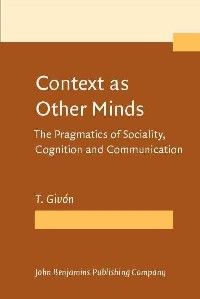
"Givon's new book re-casts pragmatics, and most conspicuously the pragmatics of sociality and communication, in neuro-cognitive, bio-adaptive, evolutionary terms. The fact that context, the core notionof pragmatics, is a framing operation undertaken on the fly through judgements of relevance, has been well known since Aristotle, Kant and Peirce. But the context that is relevant to the pragmatics of sociality and communication is a highly specific mental operation - the mental modeling of the interlocutor's current, rapidly shifting belief-and-intention states. The construed context of social interaction and communications is thus a mental representation of other minds."--BOOK JACKET
目录
Table Of Contents:
Preface xiii
CHAPTER 1: PERSPECTIVE 1(38)
1.1. The conundrum of context 1(1)
1.2. Russell's paradox 2(1)
1.3. Objectivism 3(3)
1.4. Relativism 6(1)
1.5. Other minds 6(2)
1.6. Recurrent themes 8(7)
1.6.1. Relevance and importance 8(1)
1.6.2. Similarity, analogy and metaphor 8(1)
1.6.3. Kind vs. degree: Categories and classification 9(2)
1.6.4. Abductive inference and analogical reasoning 11(1)
1.6.5. Explanation and understanding 11(1)
1.6.6. Teleology, purpose and function 11(1)
1.6.7. Figure/ground: Saliency, frequency and markedness 11(1)
1.6.8. Gradation, continuum and non-discreteness 12(1)
1.6.9. The semiotic relation 12(3)
1.7. Early roots 15(14)
1.7.1. The mystics 15(2)
1.7.2. Plato/Socrates 17(1)
1.7.3. Aristotle 17(5)
1.7.4. Immanuel Kant 22(4)
1.7.5. Charles Sanders Peirce 26(2)
1.7.6. Ludwig Wittgenstein 28(1)
1.8. Modern strands 29(6)
1.8.1. Cultural relativism 29(2)
1.8.2. Early functionalism 31(1)
1.8.3. Speech-acts 32(1)
1.8.4. Logical presupposition 32(1)
1.8.5. Modal logic and possible worlds 33(1)
1.8.6. Ethnography of Speech 34(1)
1.8.7. Developmental pragmatics 34(1)
1.8.8. Pragmatics and the machine 34(1)
1.8.9. Cognitive Psychology 35(1)
1.8.10. Evolutionary biology 35(1)
1.9. Toward an integrated pragmatics of life, mind and language 35(1)
Notes 36(3)
CHAPTER 2: CATEGORIES AS PROTOTYPES: THE ADAPTIVE MIDDLE 39(26)
2.1. Preamble 39(2)
2.2. Philosophical roots 41(2)
2.2.1. Platonic ('logical') categories 41(1)
2.2.2. Wittgensteinean ('flat') categories 42(1)
2.3. Linguistic roots 43(3)
2.3.1. Generativity 43(1)
2.3.2. Emergence 44(1)
2.3.3. Psychological roots 45(1)
2.4. Prototypes: The adaptive middle 46(1)
2.5. The adaptive underpinnings of prototype-like categories 47(4)
2.6. Some social consequences of natural categorization 51(5)
2.6.1. Essentialism and stereotyping 51(1)
2.6.2. Reasoning by feature association 52(1)
2.6.3. Over-generalization as an adaptive strategy 53(1)
2.6.4. Logically-faulty but adaptively-sound conditional reasoning 53(1)
2.6.5. Perspective effects on construed adaptive context 54(1)
2.6.6. Are social categories not natural kinds? 55(1)
2.7. The cultural context of social decision-making 56
2.7.1. The society of intimates 56
2.7.2. Is the society of intimates still relevant? 6o
Notes 36(29)
CHAPTER 3: SEMANTIC NETWORKS AND METAPHORIC LANGUAGE 65(26)
3.1. Culturally shared generic mental maps 65(1)
3.2. General design of the human communication system 65(4)
3.2.1. The cognitive representation system 65(4)
3.2.2. The sensory-motor codes 69(1)
3.2.3. The grammar code 69(1)
3.3. The generic lexicon as a network of nodes and connections 69(3)
3.4. Metaphoric or non-literal meaning 72(12)
3.4.1. The Aristotelian tradition 72(3)
3.4.2. Lakoff et al.'s "conceptual metaphors" 75(4)
3.4.3. The cognitive evidence 79(5)
3.4.4. The diachronic evidence 8i
3.5. Figurative language and semantic networks 84(2)
3.6. Adaptive motivation and frequency distribution of figurative language 86(2)
3.7. Final reflections 88(1)
Notes 89(2)
CHAPTER 4: GRAMMAR AND OTHER MINDS: AN EVOLUTIONARY PERSPECTIVE 91(34)
4.1. Sociality, communication and other minds 91(1)
4.2. Mental models 92(3)
4.2.1. Semantic ('procedural') memory 92(1)
4.2.2. Episodic ('declarative') memory 93(1)
4.2.3. Working memory and/or attention 93(1)
4.2.4. Interaction between memory systems 94(1)
4.3. Grammar 95(5)
4.3.1. Developmental-evolutionary perspective 95(1)
4.3.2. Grammar as structure 95(1)
4.3.3. Grammar as adaptive function 96(1)
4.3.4. Communication without grammar 97(3)
4.4. Grammar and other minds 100(6)
4.4.1. The mental representation of context 100(1)
4.4.2. Access to definite referents 101(3)
4.4.3. Access to the interlocutor's epistemic and deontic states 104(2)
4.5. The selectivity of mental models 106(2)
4.6. Other minds in an evolutionary perspective 108(15)
4.6.1. Overview 108(3)
4.6.2. 'Reasoning' by feature association: The wrong metaphor? 111(1)
4.6.3. Neurological incrementation: From old-brain to limbus to neo-cortex 112(1)
4.6.4. Transformations of the referent 113(3)
4.6.5. The puzzle of consciousness 116(4)
4.6.6. The adaptive context of representing other minds 120(3)
Notes 123(2)
CHAPTER 5: REFERENTIAL COHERENCE 125(24)
5.1. Coherence as mental operations 125(1)
5.2. Coherence as grounding 126(13)
5.2.1. Grounding in episodic representation 126(1)
5.2.2. Cataphoric grounding 126(8)
5.2.3 Anaphoric grounding 134(5)
5.3. Use frequency, markedness and cognitive status 139(2)
5.4. Cognitive model 141(4)
5.4.1. Preamble 143(1)
5.4.2. Cognitive operations 143(2)
5.5. Discussion 145(2)
Notes 147(2)
CHAPTER 6: PROPOSITIONAL MODALITIES 149(30)
6.1. Propositions vs. speakers 149(1)
6.2. Epistemic modalities 150(3)
6.2.1. Recapitulation 150(1)
6.2.2. Presupposition vs. assertion 151(2)
6.3. Tense 153(3)
6.4. Aspect 156(5)
6.4.1. Perfectivity 156(2)
6.4.2. Preterit, perfect and deferred relevance 158(1)
6.4.3. Immediacy and affect: Remote vs. vivid 159(2)
6.4.4. Correlation between modality, tense and aspect 161(1)
6.5. Deontic sub-modes of irrealis 161(5)
6.5.1. Preamble 161(1)
6.5.2. The subjunctive mood 162(4)
6.6. The pragmatics of KEG-assertions 166(2)
6.7. Evidentiality 168(3)
6.8. Knowledge and power: The interaction between epistemics and deontics 171(6)
6.8.1. Epistemic vs. deontic speech-acts 171(2)
6.8.2. The social deontics of knowledge 173(4)
6.9. Summary: Propositional modalities and other minds 177(1)
Notes 177(2)
CHAPTER 7: DISCOURSE COHERENCE 179(16)
7.1. Reorientation 179(1)
7.2. Clause chaining 180(2)
7.2.1. Clauses, chains, and paragraphs 180(1)
7.2.2. Major clause-types in the chain 180(2)
7.3. Chain-initial clauses ('coherence bridges') 182(4)
7.3.1. Pre-posed adverbial clauses 182(2)
7.3.2. Pre-posed adverbial phrases 184(1)
7.3.3. Left-dislocation clauses 185(1)
7.4. Chain-initial vs. chain-medial clauses 186(2)
7.5. Clause-level vs. chain-level conjunction 188(3)
7.6. Chain-medial cataphoric switch-reference (DS) devices 191(2)
7.7. Recapitulation: clause chaining and other minds 193(1)
Notes 194(1)
CHAPTER 8: COMMUNITY AS OTHER MINDS: THE PRAGMATICS OF ORGANIZED SCIENCE 195(26)
8.1. The scientist vs. the organism 195(1)
8.2. Reductionist extremes in the philosophy of science 196(7)
8.2.1. Preamble 196(1)
8.2.2. Deductivist accounts 196(4)
8.2.3. Inductivist accounts 200(3)
8.3. The pragmatics of empirical science 203(11)
8.3.1. Preamble 203(1)
8.3.2. Theory-laden facts 203(2)
8.3.3. Abductive inference 205(3)
8.3.4. Explanation 208(6)
8.4. Multiple loci of pragmatic inference in the empirical cycle 214(2)
8.5. The social pragmatics of science: Community as other minds 216(3)
Notes 219(2)
CHAPTER 9: THE ADAPTIVE PRAGMATICS OF 'SELF' 221(18)
9.1. Preamble 221(1)
9.2. The essentialist self 222(2)
9.3. The multiple self 224(4)
9.3.1. Henrik Ibsen and Erving Goffman 224(3)
9.3.2. Faust, Freud and the multiple self 227(1)
9.4. The impaired self 228(6)
9.4.1. Schizophrenia: The unconstrained multiple 229(2)
9.4.2. Autism: The unyielding essence 231(3)
9.5. The complex self as an adaptive strategy 234(3)
9.5.1. Evolutionary incrementation in framing complexity 234(1)
9.5.2. Between intimates and strangers 235(1)
9.5.3. Other minds and the ontology of 'self' 236(1)
9.5.4. Internalized other minds as a social-restraint mechanism 236(1)
Notes 237(2)
CHAPTER 10: THE PRAGMATICS OF THE MARTIAL ARTS 239(16)
10.1. Preamble 239(1)
10.2. Adaptive realism: There shall be weeping and wailing and gnashing of teeth 239(2)
10.3. The paradox of Karma 241(1)
10.4. Tao and Wu-Wei 242(1)
10.5. Wu-Wei as paradox 243(1)
10.6. Wu-Wei as strategy 243(2)
10.7. The paradox of the invisible leader 245(1)
10.8. The yoga of form 246(1)
10.9. The ritualization of form 247(1)
10.10. Complexity: Seven paradoxes 248(6)
10.10.1. The paradox of Yin and Yang 249(1)
10.10.2. The paradox of discreteness and continuity 250(1)
10.10.3. The paradox or rootedness and lightness 250(1)
10.10.4. The paradox of speed and consciousness 251(1)
10.10.5. The paradox of attention and automaticity 251(2)
10.10.6. The paradox of diffuse attention 253(1)
10.10.7. The paradox of out-of-context practice 253(1)
10.11. Closure 254(1)
References 255(20)
Index 275
Preface xiii
CHAPTER 1: PERSPECTIVE 1(38)
1.1. The conundrum of context 1(1)
1.2. Russell's paradox 2(1)
1.3. Objectivism 3(3)
1.4. Relativism 6(1)
1.5. Other minds 6(2)
1.6. Recurrent themes 8(7)
1.6.1. Relevance and importance 8(1)
1.6.2. Similarity, analogy and metaphor 8(1)
1.6.3. Kind vs. degree: Categories and classification 9(2)
1.6.4. Abductive inference and analogical reasoning 11(1)
1.6.5. Explanation and understanding 11(1)
1.6.6. Teleology, purpose and function 11(1)
1.6.7. Figure/ground: Saliency, frequency and markedness 11(1)
1.6.8. Gradation, continuum and non-discreteness 12(1)
1.6.9. The semiotic relation 12(3)
1.7. Early roots 15(14)
1.7.1. The mystics 15(2)
1.7.2. Plato/Socrates 17(1)
1.7.3. Aristotle 17(5)
1.7.4. Immanuel Kant 22(4)
1.7.5. Charles Sanders Peirce 26(2)
1.7.6. Ludwig Wittgenstein 28(1)
1.8. Modern strands 29(6)
1.8.1. Cultural relativism 29(2)
1.8.2. Early functionalism 31(1)
1.8.3. Speech-acts 32(1)
1.8.4. Logical presupposition 32(1)
1.8.5. Modal logic and possible worlds 33(1)
1.8.6. Ethnography of Speech 34(1)
1.8.7. Developmental pragmatics 34(1)
1.8.8. Pragmatics and the machine 34(1)
1.8.9. Cognitive Psychology 35(1)
1.8.10. Evolutionary biology 35(1)
1.9. Toward an integrated pragmatics of life, mind and language 35(1)
Notes 36(3)
CHAPTER 2: CATEGORIES AS PROTOTYPES: THE ADAPTIVE MIDDLE 39(26)
2.1. Preamble 39(2)
2.2. Philosophical roots 41(2)
2.2.1. Platonic ('logical') categories 41(1)
2.2.2. Wittgensteinean ('flat') categories 42(1)
2.3. Linguistic roots 43(3)
2.3.1. Generativity 43(1)
2.3.2. Emergence 44(1)
2.3.3. Psychological roots 45(1)
2.4. Prototypes: The adaptive middle 46(1)
2.5. The adaptive underpinnings of prototype-like categories 47(4)
2.6. Some social consequences of natural categorization 51(5)
2.6.1. Essentialism and stereotyping 51(1)
2.6.2. Reasoning by feature association 52(1)
2.6.3. Over-generalization as an adaptive strategy 53(1)
2.6.4. Logically-faulty but adaptively-sound conditional reasoning 53(1)
2.6.5. Perspective effects on construed adaptive context 54(1)
2.6.6. Are social categories not natural kinds? 55(1)
2.7. The cultural context of social decision-making 56
2.7.1. The society of intimates 56
2.7.2. Is the society of intimates still relevant? 6o
Notes 36(29)
CHAPTER 3: SEMANTIC NETWORKS AND METAPHORIC LANGUAGE 65(26)
3.1. Culturally shared generic mental maps 65(1)
3.2. General design of the human communication system 65(4)
3.2.1. The cognitive representation system 65(4)
3.2.2. The sensory-motor codes 69(1)
3.2.3. The grammar code 69(1)
3.3. The generic lexicon as a network of nodes and connections 69(3)
3.4. Metaphoric or non-literal meaning 72(12)
3.4.1. The Aristotelian tradition 72(3)
3.4.2. Lakoff et al.'s "conceptual metaphors" 75(4)
3.4.3. The cognitive evidence 79(5)
3.4.4. The diachronic evidence 8i
3.5. Figurative language and semantic networks 84(2)
3.6. Adaptive motivation and frequency distribution of figurative language 86(2)
3.7. Final reflections 88(1)
Notes 89(2)
CHAPTER 4: GRAMMAR AND OTHER MINDS: AN EVOLUTIONARY PERSPECTIVE 91(34)
4.1. Sociality, communication and other minds 91(1)
4.2. Mental models 92(3)
4.2.1. Semantic ('procedural') memory 92(1)
4.2.2. Episodic ('declarative') memory 93(1)
4.2.3. Working memory and/or attention 93(1)
4.2.4. Interaction between memory systems 94(1)
4.3. Grammar 95(5)
4.3.1. Developmental-evolutionary perspective 95(1)
4.3.2. Grammar as structure 95(1)
4.3.3. Grammar as adaptive function 96(1)
4.3.4. Communication without grammar 97(3)
4.4. Grammar and other minds 100(6)
4.4.1. The mental representation of context 100(1)
4.4.2. Access to definite referents 101(3)
4.4.3. Access to the interlocutor's epistemic and deontic states 104(2)
4.5. The selectivity of mental models 106(2)
4.6. Other minds in an evolutionary perspective 108(15)
4.6.1. Overview 108(3)
4.6.2. 'Reasoning' by feature association: The wrong metaphor? 111(1)
4.6.3. Neurological incrementation: From old-brain to limbus to neo-cortex 112(1)
4.6.4. Transformations of the referent 113(3)
4.6.5. The puzzle of consciousness 116(4)
4.6.6. The adaptive context of representing other minds 120(3)
Notes 123(2)
CHAPTER 5: REFERENTIAL COHERENCE 125(24)
5.1. Coherence as mental operations 125(1)
5.2. Coherence as grounding 126(13)
5.2.1. Grounding in episodic representation 126(1)
5.2.2. Cataphoric grounding 126(8)
5.2.3 Anaphoric grounding 134(5)
5.3. Use frequency, markedness and cognitive status 139(2)
5.4. Cognitive model 141(4)
5.4.1. Preamble 143(1)
5.4.2. Cognitive operations 143(2)
5.5. Discussion 145(2)
Notes 147(2)
CHAPTER 6: PROPOSITIONAL MODALITIES 149(30)
6.1. Propositions vs. speakers 149(1)
6.2. Epistemic modalities 150(3)
6.2.1. Recapitulation 150(1)
6.2.2. Presupposition vs. assertion 151(2)
6.3. Tense 153(3)
6.4. Aspect 156(5)
6.4.1. Perfectivity 156(2)
6.4.2. Preterit, perfect and deferred relevance 158(1)
6.4.3. Immediacy and affect: Remote vs. vivid 159(2)
6.4.4. Correlation between modality, tense and aspect 161(1)
6.5. Deontic sub-modes of irrealis 161(5)
6.5.1. Preamble 161(1)
6.5.2. The subjunctive mood 162(4)
6.6. The pragmatics of KEG-assertions 166(2)
6.7. Evidentiality 168(3)
6.8. Knowledge and power: The interaction between epistemics and deontics 171(6)
6.8.1. Epistemic vs. deontic speech-acts 171(2)
6.8.2. The social deontics of knowledge 173(4)
6.9. Summary: Propositional modalities and other minds 177(1)
Notes 177(2)
CHAPTER 7: DISCOURSE COHERENCE 179(16)
7.1. Reorientation 179(1)
7.2. Clause chaining 180(2)
7.2.1. Clauses, chains, and paragraphs 180(1)
7.2.2. Major clause-types in the chain 180(2)
7.3. Chain-initial clauses ('coherence bridges') 182(4)
7.3.1. Pre-posed adverbial clauses 182(2)
7.3.2. Pre-posed adverbial phrases 184(1)
7.3.3. Left-dislocation clauses 185(1)
7.4. Chain-initial vs. chain-medial clauses 186(2)
7.5. Clause-level vs. chain-level conjunction 188(3)
7.6. Chain-medial cataphoric switch-reference (DS) devices 191(2)
7.7. Recapitulation: clause chaining and other minds 193(1)
Notes 194(1)
CHAPTER 8: COMMUNITY AS OTHER MINDS: THE PRAGMATICS OF ORGANIZED SCIENCE 195(26)
8.1. The scientist vs. the organism 195(1)
8.2. Reductionist extremes in the philosophy of science 196(7)
8.2.1. Preamble 196(1)
8.2.2. Deductivist accounts 196(4)
8.2.3. Inductivist accounts 200(3)
8.3. The pragmatics of empirical science 203(11)
8.3.1. Preamble 203(1)
8.3.2. Theory-laden facts 203(2)
8.3.3. Abductive inference 205(3)
8.3.4. Explanation 208(6)
8.4. Multiple loci of pragmatic inference in the empirical cycle 214(2)
8.5. The social pragmatics of science: Community as other minds 216(3)
Notes 219(2)
CHAPTER 9: THE ADAPTIVE PRAGMATICS OF 'SELF' 221(18)
9.1. Preamble 221(1)
9.2. The essentialist self 222(2)
9.3. The multiple self 224(4)
9.3.1. Henrik Ibsen and Erving Goffman 224(3)
9.3.2. Faust, Freud and the multiple self 227(1)
9.4. The impaired self 228(6)
9.4.1. Schizophrenia: The unconstrained multiple 229(2)
9.4.2. Autism: The unyielding essence 231(3)
9.5. The complex self as an adaptive strategy 234(3)
9.5.1. Evolutionary incrementation in framing complexity 234(1)
9.5.2. Between intimates and strangers 235(1)
9.5.3. Other minds and the ontology of 'self' 236(1)
9.5.4. Internalized other minds as a social-restraint mechanism 236(1)
Notes 237(2)
CHAPTER 10: THE PRAGMATICS OF THE MARTIAL ARTS 239(16)
10.1. Preamble 239(1)
10.2. Adaptive realism: There shall be weeping and wailing and gnashing of teeth 239(2)
10.3. The paradox of Karma 241(1)
10.4. Tao and Wu-Wei 242(1)
10.5. Wu-Wei as paradox 243(1)
10.6. Wu-Wei as strategy 243(2)
10.7. The paradox of the invisible leader 245(1)
10.8. The yoga of form 246(1)
10.9. The ritualization of form 247(1)
10.10. Complexity: Seven paradoxes 248(6)
10.10.1. The paradox of Yin and Yang 249(1)
10.10.2. The paradox of discreteness and continuity 250(1)
10.10.3. The paradox or rootedness and lightness 250(1)
10.10.4. The paradox of speed and consciousness 251(1)
10.10.5. The paradox of attention and automaticity 251(2)
10.10.6. The paradox of diffuse attention 253(1)
10.10.7. The paradox of out-of-context practice 253(1)
10.11. Closure 254(1)
References 255(20)
Index 275
- 名称
- 类型
- 大小
光盘服务联系方式: 020-38250260 客服QQ:4006604884
云图客服:
用户发送的提问,这种方式就需要有位在线客服来回答用户的问题,这种 就属于对话式的,问题是这种提问是否需要用户登录才能提问
Video Player
×
Audio Player
×
pdf Player
×
