

简介
Summary:
Publisher Summary 1
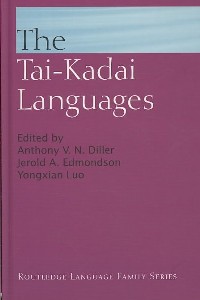
Diller, Edmondson, and Luo present 23 chapters describing recent research on Tai-Kadai, one of the world's major language families. Coverage includes an introduction to the current state of research, debate and speculation about Tai-Kadai's ultimate linkages; overviews and resources relating to the Tai languages; discussion of some special Tai features often overlooked in standard treatments but of linguistic interest; chapters dealing with aspects of diachronic change and grammaticalization, of particular relevance as linguistic theory confronts languages of the Tai-Kadai type; and information on the little-described Kam-Sui languages. For undergraduate and postgraduate students of linguistics and language, and scholars and professionals in historical linguistics, linguistics anthropology and language development. Coeditors and authors Diller, Edmondson, and Luo are with the Australian National U., the U. of Texas Arlington, and the U. of Texas, respectively; credentials for the other 18 contributing authors are not stated. Annotation 漏2008 Book News, Inc., Portland, OR (booknews.com)
目录
CONTENTS
PART 1 1
CHAPTER ONE 3
INTRODUCTION 3
1.1. TAI-KADAI: PROGRESS AND PROSPECTS 3
1.2. ACKNOWLEDGMENTS 3
1.3. ORGANIZATION 4
1.4. TERMINOLOGY AND ITS INTERPRETATIVE NUANCES 5
CHAPTER TWO 9
SINO-TAI AND TAI-KADAI: ANOTHER LOOK 9
2.1. Introduction 9
2.2. The Sino-Tai hypothesis: A review of different theories 10
2.2.1. Shared typological features between Chinese and Tai 10
2.2.2. The traditional view on the Sino-Tai link and competing theories 10
2.2.3. Benedict¿s Austro-Tai theory and his method of tele-reconstruction 13
2.2.4. Sino-Tibetan-Austronesian and Kadai-Austronesian 14
2.3. The role of Tai in Old Chinese reconstruction 16
2.3.1. Initial clusters in OC as retained in Tai 16
2.3.2. Retention of bilabial initials which have developed into labial-dentals in Modern Chinese 16
2.3.3. The reconstruction of final -g for OC: Some supporting evidence 17
2.3.4. Unique correspondences: the case of ¿five¿, ¿goose¿, ¿gill¿, ¿six¿ 18
2.3.5. Shared innovation: finals *-l and *-r 18
2.4. PROGRESS AND NEW FINDINGS 20
2.4.1. The sibilant complex 20
2.4.2. The issue of basic vocabulary 20
2.4.3. Morphological and orthographical evidence 21
2.5. SUMMARY 23
PART 2 28
CHAPTER THREE 30
RESOURCES FOR THAI LANGUAGE RESEARCH 30
3.1. INTRODUCTION 30
3.1.1. Scope 30
3.1.2. Bibliographies and anthologies 30
3.1.3. Grammars and overviews 31
3.2. PHONETICS, PHONOLOGY AND ORTHOGRAPHY 31
3.2.1. Distinctive units 31
3.2.2. Phonological approaches and overviews 32
3.2.3. Consonants, vowels and tones 33
3.2.4. Psycholinguistics and phonology; phonesthesia 33
3.2.5. Orthography and Romanization 34
3.3. SYNTAX AND SEMANTICS 34
3.3.1. Syntactic typology 34
3.3.2. History of Thai syntactic research 35
3.3.3. Theoretical perspectives in syntax 36
3.3.4. Compounding, nominalization and morphological processes 37
3.3.5. Nominal substitutes and classifiers 38
3.3.6. Verbs, transitivity, predicate constructions and grammaticalization 39
3.3.7. Other parts of speech and constructions 42
3.3.8. Discourse, conversation and sociolinguistically-based studies 43
3.3.9. Semantics and lexical fields 44
3.4. SOCIOLINGUISTIC, COMPARATIVE AND HISTORICAL STUDIES 45
3.4.1. Sociolinguistic perspectives on Thailand 45
3.4.2. Registers, polite speech and special styles 46
3.4.3. Loans, contact and bilingualism 47
3.4.4. Comparative studies 49
3.4.5. Historical and philological studies 50
3.4.6. Tonogenesis and its quandaries 52
CHAPTER FOUR 82
VERBS AND MULTI-VERB CONSTRUCTIONS IN LAO 82
4.1. Introduction 82
4.2. Verbs, verb classes, aspect-modality marking 84
4.3. Argument structure in single-verb clauses 85
4.3.1. Ellipsis 85
4.3.2. Transitivity and valency 87
4.3.3. Formal mechanisms for valency-changing 95
4.3.4. Constituent structure and information structure: subject, topic, focus 95
4.3.5. Summary 102
4.4. Multi-verb constructions 103
4.4.1. Headship, ¿main verb properties¿, and constituency tests 103
4.4.2. Deverbal aspect/modality marking 114
4.4.3. ¿Despatch¿ expressions for hosting three arguments in a single clause 123
4.4.4. Disposal constructions 127
4.4.5. Complex motion expressions 128
4.4.6. Secondary predication constructions 131
4.4.7. Oblique phrases/adjunction 154
4.4.8. Causative constructions 158
4.4.9. Complementation 161
4.4.10. Coordinating constructions 172
4.5. Conclusion 174
4.5.1. Ambiguity and complexity 174
4.5.2. Summary 176
CHAPTER FIVE 182
SHAN AND OTHER NORTHERN TIER SOUTHEAST TAI LANGUAGES OF MYANMAR AND CHINA: THEMES AND VARIATIONS 182
5.1. BACKGROUND 182
5.2. LOCATIONS STUDIED 186
5.3. A GLIMPSE AT SHAN SETTLEMENT HISTORY 188
5.3.1. Tai Khamti 189
5.3.2. Tai Mao 189
5.3.3. Tai Long 189
5.3.4. Tai N?a/L?a 190
5.3.5. Tai Man 190
5.3.6. Tai Laing 190
5.3.7. Tai Ting 190
5.3.8. Tai Ta? 190
5.3.9. The Tai Kh?n and Tai Nui 191
5.3.10. Tai Phake 191
5.3.11. Tai Sa? 191
5.3.12. Tai Loi 191
5.3.13. Tai Dam and Don 191
5.3.14. Tai Kha,, Tai Xa, and Tai Ya. 192
5.4. COMPARATIVE RESULTS 192
5.4.1. Shan phonological basics 192
5.4.2. COnsonant changes in Shan 194
5.4.3. Deplosivization 196
5.4.4. Lenition of /kh/ to /x/ 198
5.4.5. Fortition of f to ph. 198
5.4.6. Variation of fortition (f to ph) by location 199
5.4.7. Loss of secondary articulation 199
5.4.8. Vowel changes 199
5.4.9. PALATALIZATION 200
5.5. CONCLUSION 200
CHAPTER SIX 205
THE TAI LANGUAGES OF ASSAM 205
6.1. THE TAI PEOPLE IN ASSAM 205
6.1.1. Tai Ahom 205
6.1.2. Other Tai groups in Assam 206
6.2. NOTES ON THE PHONOLOGY OF THE TAI LANGUAGES OF ASSAM 210
6.2.1. Consonants 210
6.2.2. Vowels 212
6.2.3. Tones 214
6.3. NOTES ON THE MORPHOSYNTAX OF THE TAI LANGUAGES OF ASSAM 217
6.3.1. Morphology 217
6.3.2. Syntactic structure 217
6.4. THE DEVELOPMENT OF BOUND TAM MAKERS IN TAI AITON 220
6.4.1. Areal influence on the Tai languages of Assam 220
6.4.2. Position of TAM markers in Tai languages 221
6.4.3. TAM markers in Tai Aiton 223
6.4.4. Development of bound TAM morphemes in Aiton narrative texts 223
6.4.5. Is kaa1 a past tense marker? 230
6.4.6. Coda 231
6.5. CHANGED TONE IN PHAKE 232
6.5.1. The Tai Phake questioning tone 232
6.5.2. The Tai Phake negative tone 234
6.5.3. The Tai Phake imperative tone 237
6.6. BI-DIALECTALISM IN THE TAI KHAMYANG SPEECH COMMUNITY 238
CHAPTER SEVEN 252
THE LUE LANGUANGE 252
7.1. LUE AND NEIGHBOURING DIALECTS 252
7.2. PHONOLOGY 261
7.3. VARIATION 286
CHAPTER EIGHT 295
THE TAI DIALECTS OF NGH? AN, VIETNAM (TAY DAENG, TAY YO, TAY MUONG) 295
8.1. INTRODUCTION 295
8.2. LES THAI ET LES DIALECTES THAI DU NGH? AN 296
8.3. GÉNÉRALITÉS PHONÉTIQUES 297
8.4. TAY DAENG (OU TAY THANH) 298
8.4.1. Système Consonantique 298
8.4.2. Système Vocalique 298
8.4.3. Système Tonal 299
8.4.4. Notes Grammaticales 299
8.5. TAY YO 301
8.5.1. Système Consonantique 301
8.5.2. Système Vocalique 302
8.5.3. Système Tonal 302
8.5.4. Notes Grammaticales 304
8.5.5. Situation Linguistique du tay yo: 305
8.6. TAY MUONG 306
8.6.1. Système Consonantique 307
8.6.2. Système Vocalique 307
8.6.3. Système Tonal 308
8.6.4. Texte 308
8.6.5. Texte 309
8.7. LE PROTO THAI ET LES DIALECTES 311
CHAPTER NINE 314
ZHUANG 314
9.1. INTRODUCTION 314
9.1.1. Geographic setting 314
9.1.2. Language and their speakers 314
9.1.3. Change and variations 315
9.1.4. Autonyms and ethonyms 316
9.1.5. Early history 316
9.1.6. Language contact, convergence and divergence, Chinese influence 317
9.1.7. Zhuang Writing 317
9.2. PHONOLOGY 318
9.2.1. Fengshan Zhuang phonology 320
9.3. WORD CLASSES AND BASIC SYNTACTIC PATTERNS 321
9.3.1. Word classes 321
9.3.2. Word structure 321
9.3.3. Basic word order 323
9.3.4. Demonstrative adjectives 324
9.3.5. Pronouns and other pronominal items 324
9.3.6. Classifiers and quantifiers 326
9.3.7. Closed functional classes 331
9.3.8. Elaborate expressions 337
9.3.9. Colour terms 338
9.3.10. Emotional concepts 338
9.4. GRAMMATICAL PROCESSES 339
9.4.1. Grammar and grammatical processes 339
9.4.2. Reduplication 342
9.4.3. exical nominalisation 343
9.5. SIMPLE MAIN CLAUSES 344
9.5.1. Types of predicate arguments 344
9.5.2. Modality: irrealis and epistemic 350
9.5.3. Interrogative sentences 353
9.5.4. Comparative sentences 355
9.5.5. Existential sentences and copula sentences 357
9.5.6. Passive and pseudo-passive 359
9.5.7. Tense and aspect 360
9.6. COMPLEX CONSTRUCTIONS 363
9.6.1. Subordinate constructions 363
9.6.2. Coordinate clauses 366
9.6.3. Anaphora and binding 370
9.7. ACKNOWLEDGEMENTS 372
CHAPTER TEN 375
BOUYEI PHONOLOGY 375
10.1. Introduction 375
10.2. Phonology of Wangmo Bouyei 375
10.2.1. Initial consonants 376
10.2.2. Final consonants 376
10.2.3. Vowels 376
10.2.4. Tones 376
10.3. Comparison with other dialects 378
10.3.1. Aspiration 378
10.3.2. al and Alveolar Fricatives 379
10.3.3. Palatalization and Labialization 379
10.3.4. Vowels 380
10.3.5. Tones 381
10.3.6. Finals 383
10.3.7. Summary 384
CHAPTER ELEVEN 386
SAEK REVISITED 386
PART 3 391
CHAPTER TWELVE 393
FOUR-WORD ELABORATE EXPRESSIONS IN YUNNAN TAI LUE ¿A PAN-TAI CULTURAL TRAIT? 393
12.1. Introduction 393
12.2. Examples of four-word expressions in Tai Lue 395
12.3. The structure of the four-word expressions in Tai Lue 398
12.3.1. Components: A four-word expression is composed of four monosyllabic words 398
12.3.2. Reduplication: A four-word expression may have reduplication 398
12.3.3. Rhyme: In most four-word expressions, the second and third words rhyme or alliterate 399
12.3.4. Semantic parallelism: The four words can be split into two parallel sets of semantic units (AB
CD) 399
12.3.5. Idiomatic meaning: The meaning of a four -word expression must be learned as a whole 399
12.4. The grammatical status of four-word expressions 399
12.5. Conclusion 400
CHAPTER THIRTEEN 402
TAI AESTHETICS 402
13.1. Linguistic techniques for the creation of phay1r??4 402
13.2. Phay1r??4 And Poetic Constraints 405
13.3. conclusion 409
CHAPTER FOURTEEN 413
THE OLD ZHUANG SCRIPT 413
14.1. METHODOLOGY 416
14.2. A SAMPLE TEXT 416
14.3. RELATIVE FREQUENCY OF CHARACTER TYPES AND READINGS 420
14.4. PHONETIC READINGS 421
14.5. REGIONAL VARIATION 423
14.6. ZHUANG CHARACTERS 423
14.7. CONCLUSION 424
PART 4 427
CHAPTER FIFTEEN 429
AN ETYMOLOGICAL SPECULATION ON THE SEQUENTIAL INDICATOR ???? IN THAI NARRATIVE 429
15.1. Introduction 429
15.2. Sequentiality as a significant feature of narrative discourse 429
15.2.1. Austroasiatic Language Family 430
15.2.2. Tai-Kadai Language Family 431
15.2.3. Sino-Tibetan language family 431
15.3. Comparison of the sequential indicators in Southeast Asian languages 432
15.3.1. Austroasiatic Language Family 432
15.3.2. Tai-Kadai language family 433
15.3.3. Sino-Tibetan Language Family 434
15.3.4. Austronesian language family 434
15.3.5. Hmong-Mien Language Family 434
15.4. The sequential indicator ???? as an areal feature 435
15.5. Historical implications 436
15.6. Conclusion 440
CHAPTER SIXTEEN 443
A HISTORICAL STUDY OF /thîi/ IN THAI 443
16.1. The aim of the study 443
16.2. Sources of data 443
16.3. /thîi/ in modern Thai 443
16.3.1. /thîi/ as a simple noun 443
16.3.2. /thîi/ as a class noun 444
16.3.3. The /thîi/ compound 444
16.3.4. /thîi/ as a classifier 445
16.3.5. /thîi/ as an ordinal numeral marker 445
16.3.6. /thîi/ as a preposition 445
16.3.7. /thîi/ as a relative clause marker 446
16.3.8. /thîi/ as a complementizer 446
16.3.9. /thîi/ as a nominalizer 448
16.4. A Historical Development of /thîi/ 449
16.4.1. /thîi/ in the Sukhothai period 449
16.4.2. /thîi/ in the Ayutthaya period 452
16.4.3. /thîi/ in the Mid-Ratanakosin period 454
16.4.4. Summary of the functions of /thîi/ 458
16.5. A comparison of a grammaticalization pathway of /thîi/ and a historical development of /thîi/ 459
16.5.1. Bisang¿s grammaticalization pathway of /thîi/ 459
16.5.2. Historical Development of /thîi/ 460
16.5.3. /thîi/ as an ordinal numeral marker 461
16.5.4. A comparison of a grammaticalization pathway and a historical study of /thîi/ 462
16.6. The Equivalents of /thîi/ in Other Tai Languages 462
16.6.1. /thîi/ in Mueang Hiam dialect 462
16.6.2. /thîi/ in Shangsi Zhuang 463
16.7. Conclusion 464
CHAPTER SEVENTEEN 466
BIPOLAR DISTRIBUTION OF A WORD AND GRAMMATICALIZATION IN THAI: A DISCOURSE PERSPECTIVE 466
17.1. Introduction 466
17.2. ¿Bipolar distribution of a word¿ and the theoretical framework 466
17.3. Data 468
17.4. The case of hây 469
17.5. The case of ????? 476
17.6. Conclusion 480
CHAPTER EIGHTEEN 482
DIRECTIONAL VERBS AS SUCCESS MARKERS IN THAI: ANOTHER GRAMMATICALIZATION PATH 482
18.1. Introduction 482
18.2. Motivation for using the six directional verbs as success markers 484
18.2.1. Inherent meanings of the six directional verbs 484
18.2.2. Semantic properties of the co-occurring verb phrases 485
18.2.3. Pragmatic constraint on the occurrence of success markers 489
18.2.4. Summary 490
18.3. Grammaticalization of directional verbs into success markers 490
18.3.1. Previous analyses of corresponding verbs in other languages 491
18.3.2. Grammaticalization of directional verbs into success markers 493
18.4. Conclusion 502
PART 5 505
CHAPTER NINETEEN 507
KAM 507
19.1. Introduction 507
19.2. Phonology 509
19.2.1. Consonants and syllable initial phonemes 509
19.2.2. Explanations about Kam vowels and syllable 511
19.2.3. Tones 512
19.2.4. Syllable structure and correlations among the units 513
19.3. Syntax 514
19.3.1. Noun phrases 514
19.3.2. Verb phrases 529
19.3.3. Word order and variations 547
19.3.4. Passive structures 551
19.4. Discourse Patterns as Revealed in Narrative 555
19.4.1. Story-telling activity in Kam communities 555
19.4.2. The structural characteristics of Kam narrative discourse 555
19.4.3. Sentence-final particles (SFP) in narrative discourse 560
19.4.4. Communicational aspects of narrating 570
19.4.5. Summary 576
19.5. Speech communities and sociolinguistic issues 576
19.5.1. Dialects 577
19.5.2. Language use 577
19.5.3. Literacy effort 578
19.5.4. New trends in migration, media exposure, and family orientation 579
CHAPTER TWENTY 583
SUI 583
20.1. INTRODUCTON 583
20.2. RHYMES 585
20.3. TONES 585
20.4. RIMES 587
20.5. Language variation 589
20.6. WORD CATEGORIES 590
20.7. SYNTAX 591
20.8. VARIATION IN WORD FORMS 591
20.9. RECORDING SYSTEM 592
20.10. CONCLUSION 592
CHAPTER TWENTY-ONE 594
CHADONG, A NEWLY-DISCOVERED KAM-SUI LANGUAGE IN NORTHERN GUANGXI 594
21.1. The Sounds of Chadong 596
21.1.1. Initials 596
21.1.2. Finals 596
21.1.3. Tones 597
21.2. Lexicon 598
21.2.1. Word formation 598
21.3. Grammar 601
21.3.1. Word classes 601
21.4. Word Order 609
21.4.1. Modification of nouns and classifiers 609
21.4.2. Double object constructions 610
21.4.3. Comparative Constructions 610
PART 6 619
CHAPTER TWENTY-TWO 621
THE HLAI LANGUAGE 621
22.1. Introduction 621
22.2. Hlai phonology and lexicons 622
22.2.1. Hlai word structure 622
22.2.2. Hlai lexicons: Kra-Dai traits versus Hlai traits 627
22.3. Hlai Varieties 629
22.3.1. Southern Hlai (SH) 630
22.3.2. Northern Hlai (NH) 631
22.3.3. Central Hlai (CH) 634
22.3.4. Jiamao 637
22.3.5. Other varieties 639
22.4. Other linguistics features 643
22.4.1. Syntax 643
22.4.2. Orthography 645
CHAPTER TWENTY-THREE 651
KRA OR KADAI LANGUAGES 651
23.1. INTRODUCTION 651
23.2. KRA OR KADAI AND THE KAM-SUI BRANCH 652
23.3. GELAO 654
23.3.1. Phonology and subdivisions 655
23.4. LACHI 656
23.5. BUYANG AND EN 658
23.6. QABIAO 660
23.7. LAHA 661
23.8. COMPARISION OF THE SYnTACTIC FEATURES 663
23.8.1. Word order 664
ILLUSTRATIONS
FIGURES
Figure 4 1: Constituents of the Lao clause, in order 96
Figure 4 2: Elements of the Lao verb phrase, in order 114
Figure 4 3: Slots in the ¿manner-path-direction construction¿ 129
Figure 5 1: GEDNEY DIAGRAM OF TAI TONES 185
Figure 5 2: SPEAKERS AND LOCATIONS STUDIED 187
Figure 5 3: Northern Shan tone values as a function of Proto-Tai tone categories and initial consonants 192
Figure 5 4: Khamti tone values as a function of Proto-Tai tone categories and initial consonants 192
Figure 5 5: Southern Shan tone values as a function of Proto-tai Tone categories and initial consonants 193
Figure 5 6: Phake tone values as a function of Proto-Tai tone categories and initial consonants 194
Figure 5 7: Taunggyi Shan s?aa1 ¿basket¿ vs saa1 ¿angry¿. 195
Figure 5 8: A comparison of sound change in Shan locations 196
Figure 5 9: Deplosivization of /?d/ ? /l/, /?b/ ? /m/, /?bl/ ? /l/, and variably /n/ ? /l/ 197
Figure 5 10: CHANGE OF /kh/ TO /x/ IN SHAN BY REGION 198
Figure 5 11: FORTITION OF /f/ TO /ph/ 199
Figure 5 12: LOSS OF SECONDARY ARTICULATION 199
Figure 5 13: VOWEL DIPHONGIZATION CHANGES 200
Figure 5 14: Pattern of Palatalizations 200
Figure 8 1: La branche des langues Thai-Yaay (Tai) de la famille Tai-Kadai 296
Figure 8 2: Tons du Tay Thanh (Con Cuông, Ngh? An) 299
Figure 8 3: Tons du Tay Daeng (Mai Chau Thu?ng, Hòa Bình) 299
Figure 8 4: Tons du Tay Daeng (Mai Châu H?, Hòa Bình) 299
Figure 8 5: Tons du Tay Yo (Qu? Châu, Ngh? An) 302
Figure 8 6: Tons du Tay Muong (Tuong Duong, Ngh? An) 308
Figure 17 1: Functions of hây 469
Figure 17 2: Overview of Grammaticalization Path for ?????? 477
Figure 18 1: Grammaticalization path of directional verbs in Thai 500
Figure 19 1: Grouping of Kam SFPs 567
Figure 19 2: Illustration of Syntactic Positions of SFPs 568
Figure 19 3: SFPs in COMP position 570
Figure 23 1: Lala Noong Lay waveform and pitch track tu33ma41? ¿CLF-horse¿ 653
MAPS
Map 5 1: AREAS STUDIED, SHOWING THE APPROXIMATE LOCATION OF THE DATA SITES 184
Map 7 1: Showing areas of greatest Lue concentration 259
Map 7 2: Showing the localities in which the Tai languages of British India are spoken 260
Map 7 3: Showing three major Lue speech areas previously studied by Gedney (1964) and Li (1964) 261
Map 7 4: Three major dialect areas within Sipsongpanna 287
Map 9 1: Zhuang Speaking Area 315
Map 15 1: Geographical distribution of the sequential indicator in the Southeast Asian area 436
TABLES
Table 2 1: Chinese ¿ Tai Tonal Correspondences 11
Table 4 1: Some V1-V2 sequences with different underlying structures 83
Table 4 2: Five Lao verb categories based on logical/aspectual distinctions 84
Table 4 3: Grammatical distinctions between three one-place constructions 88
Table 4 4: Grammatical distinctions between five two-place constructions 90
Table 4 5: Three types of V1-V2 combination, by yes-answer behaviour. 108
Table 4 6: Three types of resultative construction, according to semantic structure of V1 139
Table 4 7: Grammatical properties distinguishing a range of Lao V1-V2 structures 176
Table 6 1: Consonant phonemes in phake, khamti and khamyang 210
Table 6 2: Realigned Aiton phoneme chart 211
Table 6 3: Possible consonant phonemes in Ahom 211
Table 6 4: Vowel phonemes in Phake 212
Table 6 5: Vowel phonemes in Aiton 213
Table 6 6: Examples of proto */i/ and */e/ recorded by Banchob (MS) and (1987) and compared with the proto forms after Li (1977) 213
Table 6 7: Possible vowel phonemes in Ahom 214
Table 6 8: Tones in Phake 214
Table 6 9: Tones in Khamyang 215
Table 6 10: Tones produced by bidya thoumoung for Aiton 216
Table 6 11: Aiton tone box 216
Table 6 12: General rules of syntax for Khamti (Needham 1894:81) 218
Table 6 13: Tam markers in Aiton texts 223
Table 6 14: Analysis of sentences in Nang Wimala¿S historical story 226
Table 6 15: Analysis of sentences in Ong Cham¿S story of the Crow and the Fox 228
Table 6 16: Comparison of questioning tone and high falling tone in Phake 233
Table 6 17: The questioning tone in Phake 234
Table 6 18: Imperative markers in Phake and Aiton 238
Table 6 19: Comparison of Khamyang initial/b/, /l/ and /m/ 240
Table 6 20: Vowel reduction/centralisation in Khamyang 241
Table 6 21: Comparison of Khamyang tones 241
Table 9 1: Northern Zhuang /r/ and their Southern Zhuang counterparts 318
Table 9 2: Some variations in rhymes between Northern and Southern Zhuang 319
Table 9 3: Comparison of some Wenshan Zhuang and Wuming Zhuang finals 319
Table 9 4: Tone contrast in six Zhuang dialects 319
Table 9 5: Fengshan Zhuang consonants 320
Table 9 6: Fengshan Zhuang vowels 320
Table 9 7: Tones in Fengshan 321
Table 9 8: Personal pronouns in Fengshan Zhuang 324
Table 9 9: Interrogative and indefinite pronouns 325
Table 9 10: Reflexives 325
Table 9 11: Cardinals 326
Table 9 12: ¿Eleven¿ to ¿nineteen¿ 326
Table 9 13: ¿Twenty¿ to ¿ninety¿ 327
Table 9 14: Names of the month 328
Table 9 15: Locative words 333
Table 11 1: COMPARISON OF SAEK PHONEMES AS SPOKEN BY ONE SPEAKER IN 1976 AND ANOTHER IN 2006 387
Table 14 1: Zhuang Readings of ? er2 (Source: Gu Zhuangzi zidian) 414
Table 14 2: Typology of Graphs and Mode of Reading in Zhuang Manuscripts 420
Table 16 1: Occurrences of nine functions of /thîi/ in the four periods 459
Table 19 1: Kam Initial Phonemes 510
Table 19 2: Examples of Kam syllable initial phonemes 510
Table 19 3: Kam tones 512
Table 19 4: The Six-part Anatomy of the Kam Narratives 557
Table 19 5: Indexing of the Kam SFPs 562
Table 19 6: SFP clusters without the PERF Marker 564
Table 22 1: Baoding and Tongshi Tonal Split System 623
Table 22 2: Tonal correspondences between Baoding and Tongshi 623
Table 22 3: Hlai lexical traits of Kra-Dai origin 628
Table 22 4: Lexical traits of Hlai languages 628
Table 22 5: Hlai varieties 629
Table 22 6: HLAI Tone C comparisons 634
Table 22 7: Eastern Hlai dialect tone split 635
Table 22 8: Cun tones in historical perspectives 639
Table 22 9: Orthography of Hlai tones 646
- 名称
- 类型
- 大小
光盘服务联系方式: 020-38250260 客服QQ:4006604884
云图客服:
用户发送的提问,这种方式就需要有位在线客服来回答用户的问题,这种 就属于对话式的,问题是这种提问是否需要用户登录才能提问
Video Player
×
Audio Player
×
pdf Player
×
