

简介
Summary:
Publisher Summary 1
"In this book, Andy Baxevanis and Francis Ouellette . . . have undertaken the difficult task of organizing the knowledge in this field in a logical progression and presenting it in a digestible form. And they have done an excellent job. This fine text will make a major impact on biological research and, in turn, on progress in biomedicine. We are all in their debt."-Eric Lander from the Foreword
Reviews from the First Edition
"...provides a broad overview of the basic tools for sequence analysis ... For biologists approaching this subject for the first time, it will be a very useful handbook to keep on the shelf after the first reading, close to the computer."-Nature Structural Biology
"...should be in the personal library of any biologist who uses the Internet for the analysis of DNA and protein sequence data." -Science
"...a wonderful primer designed to navigate the novice through the intricacies of in scripto analysis ... The accomplished gene searcher will also find this book a useful addition to their library ... an excellent reference to the principles of bioinformatics."-Trends in Biochemical Sciences
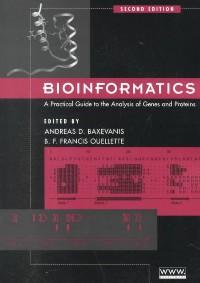
This new edition of the highly successful Bioinformatics: A Practical Guide to the Analysis of Genes and Proteins provides a sound foundation of basic concepts, with practical discussions and comparisons of both computational tools and databases relevant to biological research.
Equipping biologists with the modern tools necessary to solve practical problems in sequence data analysis, the Second Edition covers the broad spectrum of topics in bioinformatics, ranging from Internet concepts to predictive algorithms used on sequence, structure, and expression data. With chapters written by experts in the field, this up-to-date reference thoroughly covers vital concepts and is appropriate for both the novice and the experienced practitioner. Written in clear, simple language, the book is accessible to users without an advanced mathematical or computer science background. This new edition includes:
* All new end-of-chapter Web resources, bibliographies, and problem sets
* Accompanying Web site containing the answers to the problems, as well as links to relevant Web resources
* New coverage of comparative genomics, large-scale genome analysis, sequence assembly, and expressed sequence tags
* A glossary of commonly used terms in bioinformatics and genomics
Bioinformatics: A Practical Guide to the Analysis of Genes and Proteins, Second Edition is essential reading for researchers, instructors, and students of all levels in molecular biology and bioinformatics, as well as for investigators involved in genomics, positional cloning, clinical research, and computational biology.
目录
Table Of Contents:
Foreword xiii
Preface xv
Contributors xvii
Bioinformatics and the Internet 1(18)
Andreas D. Baxevanis
Internet Basics 2(2)
Connecting to the Internet 4(3)
Electronic Mail 7(3)
File Transfer Protocol 10(3)
The World Wide Web 13(3)
Internet Resources for Topics Presented in Chapter 1 16(1)
References 17(2)
The NCBI Data Model 19(26)
James M. Ostell
Sarah J. Wheelan
Jonathan A. Kans
Introduction 19(5)
PUBs: Publications or Perish 24(4)
SEQ-Ids: What's in a Name? 28(3)
BIOSEQs: Sequences 31(3)
BIOSEQ-SETs: Collections of Sequences 34(1)
SEQ-ANNOT: Annotating the Sequence 35(5)
SEQ-DESCR: Describing the Sequence 40(1)
Using the Model 41(2)
Conclusions 43(1)
References 43(2)
The Genbank Sequence Database 45(20)
Ilene Karsch-Mizrachi
B. F. Francis Ouellette
Introduction 45(2)
Primary and Secondary Databases 47(1)
Format vs. Content: Computers vs. Humans 47(2)
The Database 49(1)
The GenBank Flatfile: A Dissection 49(9)
Concluding Remarks 58(1)
Internet Resources for Topics Presented in Chapter 3 58(1)
References 59(1)
Appendices 59(6)
Appendix 3.1 Example of GenBank Flatfile Format 59(2)
Appendix 3.2 Example of EMBL Flatfile Format 61(2)
Appendix 3.3 Example of a Record in CON Division 63(2)
Submitting DNA Sequences to the Databases 65(18)
Jonathan A. Kans
B. F. Francis Ouellette
Introduction 65(1)
Why, Where, and What to Submit? 66(1)
DNA/RNA 67(2)
Population, Phylogenetic, and Mutation Studies 69(1)
Protein-Only Submissions 69(1)
How to Submit on the World Wide Web 70(1)
How to Submit with Sequin 70(7)
Updates 77(1)
Consequences of the Data Model 77(2)
EST/STS/GSS/HTG/SNP and Genome Centers 79(1)
Concluding Remarks 79(1)
Contact Points for Submission of Sequence Data to DDBJ/EMBL/GenBank 80(1)
Internet Resources for Topics Presented in Chapter 4 80(1)
References 81(2)
Structure Databases 83(28)
Christopher W. V. Hogue
Introduction to Structures 83(4)
PDB: Protein Data Bank at the Research Collaboratory for Structural Bioinformatics (RCSB) 87(4)
MMDB: Molecular Modeling Database at NCBI 91(3)
Stucture File Formats 94(1)
Visualizing Structural Information 95(5)
Database Structure Viewers 100(3)
Advanced Structure Modeling 103(1)
Structure Similarity Searching 103(3)
Internet Resources for Topics Presented in Chapter 5 106(1)
Problem Set 107(1)
References 107(4)
Genomic Mapping And Mapping Databases 111(44)
Peter S. White
Tara C. Matise
Interplay of Mapping and Sequencing 112(1)
Genomic Map Elements 113(2)
Types of Maps 115(5)
Complexities and Pitfalls of Mapping 120(2)
Data Repositories 122(5)
Mapping Projects and Associated Resources 127(15)
Practical Uses of Mapping Resources 142(4)
Internet Resources for Topics Presented in Chapter 6 146(2)
Problem Set 148(1)
References 149(6)
Information Retrieval From Biological Databases 155(32)
Andreas D. Baxevanis
Integrated Information Retrieval: The Entrez System 156(16)
LocusLink 172(6)
Sequence Databases Beyond NCBI 178(3)
Medical Databases 181(2)
Internet Resources for Topics Presented in Chapter 7 183(1)
Problem Set 184(1)
References 185(2)
Sequence Alignment and Database Searching 187(28)
Gregory D. Schuler
Introduction 187(1)
The Evolutionary Basis of Sequence Alignment 188(2)
The Modular Nature of Proteins 190(3)
Optimal Alignment Methods 193(2)
Substitution Scores and Gap Penalties 195(3)
Statistical Significance of Alignments 198(1)
Database Similarity Searching 198(2)
FASTA 200(2)
BLAST 202(2)
Database Searching Artifacts 204(4)
Position-Specific Scoring Matrices 208(1)
Spliced Alignments 209(1)
Conclusions 210(2)
Internet Resources for Topics Presented in Chapter 8 212(1)
References 212(3)
Creation and Analysis of Protein Multiple Sequence Alignments 215(18)
Geoffrey J. Barton
Introduction 215(1)
What is a Multiple Alignment, and Why Do It? 216(1)
Structural Alignment or Evolutionary Alignment? 216(1)
How to Multiply Align Sequences 217(5)
Tools to Assist the Analysis of Multiple Alignments 222(5)
Collections of Multiple Alignments 227(1)
Internet Resources for Topics Presented in Chapter 9 228(1)
Problem Set 229(1)
References 230(3)
Predictive Methods Using DNA Sequences 233(20)
Andreas D. Baxevanis
GRAIL 235(1)
Fgeneh/Fgenes 236(2)
MZEF 238(2)
GENSCAN 240(1)
POCRUSTES 241(5)
How Well Do the Methods Work? 246(2)
Strategies and Considerations 248(2)
Internet Resources for Topics Presented in Chapter 10 250(1)
Problem Set 251(1)
References 251(2)
Predictive Methods Using Protein Sequences 253(30)
Sharmila Banerjee-Basu
Andreas D. Baxevanis
Protein Identity Based on Composition 254(3)
Physical Properties Based on Sequence 257(2)
Motifs and Patterns 259(4)
Secondary Structure and Folding Classes 263(6)
Specialized Structures or Features 269(5)
Tertiary Structure 274(3)
Internet Resources for Topics Presented in Chapter 11 277(1)
Problem Set 278(1)
References 279(4)
Expressed Sequence Tags (ESTs) 283(20)
Tyra G. Wolfsberg
David Landsman
What is an EST? 284(4)
EST Clustering 288(5)
TIGR Gene Indices 293(1)
STACK 293(1)
ESTs and Gene Discovery 294(1)
The Human Gene Map 294(1)
Gene Prediction in Genomic DNA 295(1)
ESTs and Sequence Polymorphisms 296(1)
Assessing Levels of Gene Expression Using ESTs 296(2)
Internet Resources for Topics Presented in Chapter 12 298(1)
Problem Set 298(1)
References 299(4)
Sequence Assembly and Finishing Methods 303(20)
Rodger Staden
David P. Judge
James K. Bonfield
The Use of Base Cell Accuracy Estimates or Confidence Values 305(1)
The Requirements for Assembly Software 306(1)
Global Assembly 306(1)
File Formats 307(1)
Preparing Readings for Assembly 308(3)
Introduction to Gap4 311(1)
The Contig Selector 311(1)
The Contig Comparator 312(1)
The Template Display 313(3)
The Consistency Display 316(1)
The Contig Editor 316(3)
The Contig Joining Editor 319(1)
Disassembling Readings 319(1)
Experiment Suggestion and Automation 319(2)
Concluding Remarks 321(1)
Internet Resources for Topics Presented in Chapter 13 321(1)
Problem Set 322(1)
References 322(1)
Phylogenetic Analysis 323(36)
Fiona S. L. Brinkman
Detlef D. Leipe
Fundamental Elements of Phylogenetic Models 325(2)
Tree Interpretation---The Importance of Identifying Paralogs and Orthologs 327(1)
Phylogenetic Data Analysis: The Four Steps 327(2)
Alignment: Building the Data Model 329(4)
Alignment: Extraction of a Phylogenetic Data Set 333(2)
Determining the Substitution Model 335(5)
Tree-Building Methods 340(5)
Distance, Parsimony, and Maximum Likelihood: What's the Difference? 345(1)
Tree Evaluation 346(2)
Phylogenetics Software 348(6)
Internet-Accessible Phylogenetic Analysis Software 354(2)
Some Simple Practical Considerations 356(1)
Internet Resources for Topics Presented in Chapter 14 356(1)
References 357(2)
Comparative Genome Analysis 359(34)
Michael Y. Galperin
Eugene V. Koonin
Progress in Genome Sequencing 360(6)
Genome Analysis and Annotation 366(16)
Application of Comparative Genomics---Reconstruction of Metabolic Pathways 382(3)
Avoiding Common Problems in Genome Annotation 385(2)
Conclusions 387(1)
Internet Resources for Topics Presented in Chapter 15 387(2)
Problems for Additional Study 389(1)
References 390(3)
Large-Scale Genome Analysis 393(20)
Paul S. Meltzer
Introduction 393(1)
Technologies for Large-Scale Gene Expression 394(5)
Computational Tools for Expression Analysis 399(8)
Hierarchical Clustering 407(2)
Prospects for the Future 409(1)
Internet Resources for Topics Presented in Chapter 16 410(1)
References 410(3)
Using Perl to Facilitate Biological Analysis 413(38)
Lincoln D. Stein
Getting Started 414(2)
How Scripts Work 416(1)
Strings, Numbers, and Variables 417(1)
Arithmetic 418(1)
Variable Interpolation 419(1)
Basic Input and Output 420(2)
Filehandles 422(2)
Making Decisions 424(3)
Conditional Blocks 427(3)
What is Truth? 430(1)
Loops 430(2)
Combining Loops with Input 432(1)
Standard Input and Output 433(2)
Finding the Length of a Sequence File 435(1)
Pattern Matching 436(4)
Extracting Patterns 440(1)
Arrays 441(3)
Arrays and Lists 444(1)
Split and Join 444(1)
Hashes 445(1)
A Real-World Example 446(3)
Where to Go From Here 449(1)
Internet Resources for Topics Presented in Chapter 17 449(1)
Suggested Reading 449(2)
Glossary 451(6)
Index 457
Foreword xiii
Preface xv
Contributors xvii
Bioinformatics and the Internet 1(18)
Andreas D. Baxevanis
Internet Basics 2(2)
Connecting to the Internet 4(3)
Electronic Mail 7(3)
File Transfer Protocol 10(3)
The World Wide Web 13(3)
Internet Resources for Topics Presented in Chapter 1 16(1)
References 17(2)
The NCBI Data Model 19(26)
James M. Ostell
Sarah J. Wheelan
Jonathan A. Kans
Introduction 19(5)
PUBs: Publications or Perish 24(4)
SEQ-Ids: What's in a Name? 28(3)
BIOSEQs: Sequences 31(3)
BIOSEQ-SETs: Collections of Sequences 34(1)
SEQ-ANNOT: Annotating the Sequence 35(5)
SEQ-DESCR: Describing the Sequence 40(1)
Using the Model 41(2)
Conclusions 43(1)
References 43(2)
The Genbank Sequence Database 45(20)
Ilene Karsch-Mizrachi
B. F. Francis Ouellette
Introduction 45(2)
Primary and Secondary Databases 47(1)
Format vs. Content: Computers vs. Humans 47(2)
The Database 49(1)
The GenBank Flatfile: A Dissection 49(9)
Concluding Remarks 58(1)
Internet Resources for Topics Presented in Chapter 3 58(1)
References 59(1)
Appendices 59(6)
Appendix 3.1 Example of GenBank Flatfile Format 59(2)
Appendix 3.2 Example of EMBL Flatfile Format 61(2)
Appendix 3.3 Example of a Record in CON Division 63(2)
Submitting DNA Sequences to the Databases 65(18)
Jonathan A. Kans
B. F. Francis Ouellette
Introduction 65(1)
Why, Where, and What to Submit? 66(1)
DNA/RNA 67(2)
Population, Phylogenetic, and Mutation Studies 69(1)
Protein-Only Submissions 69(1)
How to Submit on the World Wide Web 70(1)
How to Submit with Sequin 70(7)
Updates 77(1)
Consequences of the Data Model 77(2)
EST/STS/GSS/HTG/SNP and Genome Centers 79(1)
Concluding Remarks 79(1)
Contact Points for Submission of Sequence Data to DDBJ/EMBL/GenBank 80(1)
Internet Resources for Topics Presented in Chapter 4 80(1)
References 81(2)
Structure Databases 83(28)
Christopher W. V. Hogue
Introduction to Structures 83(4)
PDB: Protein Data Bank at the Research Collaboratory for Structural Bioinformatics (RCSB) 87(4)
MMDB: Molecular Modeling Database at NCBI 91(3)
Stucture File Formats 94(1)
Visualizing Structural Information 95(5)
Database Structure Viewers 100(3)
Advanced Structure Modeling 103(1)
Structure Similarity Searching 103(3)
Internet Resources for Topics Presented in Chapter 5 106(1)
Problem Set 107(1)
References 107(4)
Genomic Mapping And Mapping Databases 111(44)
Peter S. White
Tara C. Matise
Interplay of Mapping and Sequencing 112(1)
Genomic Map Elements 113(2)
Types of Maps 115(5)
Complexities and Pitfalls of Mapping 120(2)
Data Repositories 122(5)
Mapping Projects and Associated Resources 127(15)
Practical Uses of Mapping Resources 142(4)
Internet Resources for Topics Presented in Chapter 6 146(2)
Problem Set 148(1)
References 149(6)
Information Retrieval From Biological Databases 155(32)
Andreas D. Baxevanis
Integrated Information Retrieval: The Entrez System 156(16)
LocusLink 172(6)
Sequence Databases Beyond NCBI 178(3)
Medical Databases 181(2)
Internet Resources for Topics Presented in Chapter 7 183(1)
Problem Set 184(1)
References 185(2)
Sequence Alignment and Database Searching 187(28)
Gregory D. Schuler
Introduction 187(1)
The Evolutionary Basis of Sequence Alignment 188(2)
The Modular Nature of Proteins 190(3)
Optimal Alignment Methods 193(2)
Substitution Scores and Gap Penalties 195(3)
Statistical Significance of Alignments 198(1)
Database Similarity Searching 198(2)
FASTA 200(2)
BLAST 202(2)
Database Searching Artifacts 204(4)
Position-Specific Scoring Matrices 208(1)
Spliced Alignments 209(1)
Conclusions 210(2)
Internet Resources for Topics Presented in Chapter 8 212(1)
References 212(3)
Creation and Analysis of Protein Multiple Sequence Alignments 215(18)
Geoffrey J. Barton
Introduction 215(1)
What is a Multiple Alignment, and Why Do It? 216(1)
Structural Alignment or Evolutionary Alignment? 216(1)
How to Multiply Align Sequences 217(5)
Tools to Assist the Analysis of Multiple Alignments 222(5)
Collections of Multiple Alignments 227(1)
Internet Resources for Topics Presented in Chapter 9 228(1)
Problem Set 229(1)
References 230(3)
Predictive Methods Using DNA Sequences 233(20)
Andreas D. Baxevanis
GRAIL 235(1)
Fgeneh/Fgenes 236(2)
MZEF 238(2)
GENSCAN 240(1)
POCRUSTES 241(5)
How Well Do the Methods Work? 246(2)
Strategies and Considerations 248(2)
Internet Resources for Topics Presented in Chapter 10 250(1)
Problem Set 251(1)
References 251(2)
Predictive Methods Using Protein Sequences 253(30)
Sharmila Banerjee-Basu
Andreas D. Baxevanis
Protein Identity Based on Composition 254(3)
Physical Properties Based on Sequence 257(2)
Motifs and Patterns 259(4)
Secondary Structure and Folding Classes 263(6)
Specialized Structures or Features 269(5)
Tertiary Structure 274(3)
Internet Resources for Topics Presented in Chapter 11 277(1)
Problem Set 278(1)
References 279(4)
Expressed Sequence Tags (ESTs) 283(20)
Tyra G. Wolfsberg
David Landsman
What is an EST? 284(4)
EST Clustering 288(5)
TIGR Gene Indices 293(1)
STACK 293(1)
ESTs and Gene Discovery 294(1)
The Human Gene Map 294(1)
Gene Prediction in Genomic DNA 295(1)
ESTs and Sequence Polymorphisms 296(1)
Assessing Levels of Gene Expression Using ESTs 296(2)
Internet Resources for Topics Presented in Chapter 12 298(1)
Problem Set 298(1)
References 299(4)
Sequence Assembly and Finishing Methods 303(20)
Rodger Staden
David P. Judge
James K. Bonfield
The Use of Base Cell Accuracy Estimates or Confidence Values 305(1)
The Requirements for Assembly Software 306(1)
Global Assembly 306(1)
File Formats 307(1)
Preparing Readings for Assembly 308(3)
Introduction to Gap4 311(1)
The Contig Selector 311(1)
The Contig Comparator 312(1)
The Template Display 313(3)
The Consistency Display 316(1)
The Contig Editor 316(3)
The Contig Joining Editor 319(1)
Disassembling Readings 319(1)
Experiment Suggestion and Automation 319(2)
Concluding Remarks 321(1)
Internet Resources for Topics Presented in Chapter 13 321(1)
Problem Set 322(1)
References 322(1)
Phylogenetic Analysis 323(36)
Fiona S. L. Brinkman
Detlef D. Leipe
Fundamental Elements of Phylogenetic Models 325(2)
Tree Interpretation---The Importance of Identifying Paralogs and Orthologs 327(1)
Phylogenetic Data Analysis: The Four Steps 327(2)
Alignment: Building the Data Model 329(4)
Alignment: Extraction of a Phylogenetic Data Set 333(2)
Determining the Substitution Model 335(5)
Tree-Building Methods 340(5)
Distance, Parsimony, and Maximum Likelihood: What's the Difference? 345(1)
Tree Evaluation 346(2)
Phylogenetics Software 348(6)
Internet-Accessible Phylogenetic Analysis Software 354(2)
Some Simple Practical Considerations 356(1)
Internet Resources for Topics Presented in Chapter 14 356(1)
References 357(2)
Comparative Genome Analysis 359(34)
Michael Y. Galperin
Eugene V. Koonin
Progress in Genome Sequencing 360(6)
Genome Analysis and Annotation 366(16)
Application of Comparative Genomics---Reconstruction of Metabolic Pathways 382(3)
Avoiding Common Problems in Genome Annotation 385(2)
Conclusions 387(1)
Internet Resources for Topics Presented in Chapter 15 387(2)
Problems for Additional Study 389(1)
References 390(3)
Large-Scale Genome Analysis 393(20)
Paul S. Meltzer
Introduction 393(1)
Technologies for Large-Scale Gene Expression 394(5)
Computational Tools for Expression Analysis 399(8)
Hierarchical Clustering 407(2)
Prospects for the Future 409(1)
Internet Resources for Topics Presented in Chapter 16 410(1)
References 410(3)
Using Perl to Facilitate Biological Analysis 413(38)
Lincoln D. Stein
Getting Started 414(2)
How Scripts Work 416(1)
Strings, Numbers, and Variables 417(1)
Arithmetic 418(1)
Variable Interpolation 419(1)
Basic Input and Output 420(2)
Filehandles 422(2)
Making Decisions 424(3)
Conditional Blocks 427(3)
What is Truth? 430(1)
Loops 430(2)
Combining Loops with Input 432(1)
Standard Input and Output 433(2)
Finding the Length of a Sequence File 435(1)
Pattern Matching 436(4)
Extracting Patterns 440(1)
Arrays 441(3)
Arrays and Lists 444(1)
Split and Join 444(1)
Hashes 445(1)
A Real-World Example 446(3)
Where to Go From Here 449(1)
Internet Resources for Topics Presented in Chapter 17 449(1)
Suggested Reading 449(2)
Glossary 451(6)
Index 457
- 名称
- 类型
- 大小
光盘服务联系方式: 020-38250260 客服QQ:4006604884
云图客服:
用户发送的提问,这种方式就需要有位在线客服来回答用户的问题,这种 就属于对话式的,问题是这种提问是否需要用户登录才能提问
Video Player
×
Audio Player
×
pdf Player
×
