

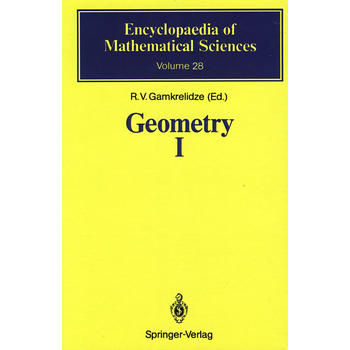
Geometry I : basic ideas and concepts of differential geometry几何I
副标题:无
作 者:D.V
分类号:
ISBN:9783540519997
微信扫一扫,移动浏览光盘
简介
Since the early work of Gauss and Riemann, differential geometry has grown into a vast network of ideas and approaches, encompassing local considerations such as differential invariants and jets as well as global ideas, such as Morse theory and characteristic classes. In this volume of the Encyclopaedia, the authors give a tour of the principal areas and methods of modern differential geomerty. The book is structured so that the reader may choose parts of the text to read and still take away a completed picture of some area of differential geometry. Beginning at the introductory level with curves in Euclidian space, the sections become more challenging, arriving finally at the advanced topics which form the greatest part of the book: transformation groups, the geometry of differential equations, geometric structures, the equivalence problem, the geometry of elliptic operators. Several of the topics are approaches which are now enjoying a resurgence, e.g. G-structures and contact geometry. As an overview of the major current methods of differential geometry, EMS 28 is a map of these different ideas which explains the interesting points at every stop. The authors' intention is that the reader should gain a new understanding of geometry from the process of reading this survey.
目录
Preface
Chapter 1. Introduction: A Metamathematical View of Differential Geometry
1. Algebra and Geometry - the Duality of the Intellect
2. Two Examples: Algebraic Geometry, Propositional Logic and Set Theory
3. On the History of Geometry
4. Differential Calculus and Commutative Algebra
5. What is Differential Geometry?
Chapter 2. The Geometry of Surfaces
1. Curves in Euclidean Space
1.1. Curves
1.2. The Natural Parametrization and the Intrinsic Geometry of Curves
1.3. Curvature. The Frenet Frame
1.4. Affine and Unimodular Properties of Curves
2. Surfaces in E3
2.1. Surfaces. Charts
2.2. The First Quadratic Form. The Intrinsic Geometry of a Surface
2.3. The Second Quadratic Form. The Extrinsic Geometry of a Surface
2.4. Derivation Formulae. The First and Second Quadratic Forms
2.5. The Geodesic Curvature of Curves. Geodesics
2.6. Parallel Transport of Tangent Vectors on a Surface. Covariant Differentiation. Connection
2.7. Deficiencies of Loops, the "Theorema Egregium" of Gauss and the Gauss-Bonnet Formula
2.8. The Link Between the First and Second Quadratic Forms. The Gauss Equation and the Peterson-Mainardi-Codazzi Equations
2.9. The Moving Frame Method in the Theory of Surfaces
2.10. A Complete System of Invariants of a Surface
3. Multidimensional Surfaces
3.1. n-Dimensional Surfaces in En+p
3.2. Covariant Differentiation and the Second Quadratic Form
3.3. Normal Connection on a Surface. The Derivation Formulae
3.4. The Multidimensional Version of the Gauss-Peterson-Mainardi-Codazzi Equations. Ricci's Theorem
3.5. The Geometrical Meaning and Algebraic Properties of the Curvature Tensor
3.6. Hypersurfaces. Mean Curvatures. The Formulae of Steiner and Weyl
3.7. Rigidity of Multidimensional Surfaces
Chapter 3. The Field Approach of Riemann
1. From the Intrinsic Geometry of Gauss to Riemannian Geometry
1.1. The Essence of Riemann's Approach
1.2. Intrinsic Description of Surfaces
1.3. The Field Point of View on Geometry
1.4. Two Examples
2. Manifolds and Bundles (the Basic Concepts)
2.1. Why Do We Need Manifolds?
2.2. Definition of a Manifold
2.3. The Category of Smooth Manifolds
2.4. Smooth Bundles
3. Tensor Fields and Differential Forms
3.1. Tangent Vectors
3.2. The Tangent Bundle and Vector Fields
3.3. Covectors, the Cotangent Bundle and Differential Forms of the First Degree
3.4. Tensors and Tensor Fields
3.5. The Behaviour of Tensor Fields Under Maps. The Lie Derivative
3.6. The Exterior Differential. The de Rham Complex
4. Riemannian Manifolds and Manifolds with a Linear Connection
4.1. Riemannian Metric
4.2. Construction of Riemannian Metrics
4.3. Linear Connections
4.4. Normal Coordinates
Chapter 4. The Group Approach of Lie and Klein. The Geometry of Transformation Groups
Chapter 5. The Geometry of Differential Equations
Chapter 6. Geometric Structures
Chapter 7. The Equivalence Problem, Differential Invariants and Pseudogroups
Chapter 8. Global Aspects of Differential Geometry
Geometry I : basic ideas and concepts of differential geometry几何I
- 名称
- 类型
- 大小
光盘服务联系方式: 020-38250260 客服QQ:4006604884
云图客服:
用户发送的提问,这种方式就需要有位在线客服来回答用户的问题,这种 就属于对话式的,问题是这种提问是否需要用户登录才能提问
Video Player
×
Audio Player
×
pdf Player
×
