

简介
Summary:
Publisher Summary 1
Research papers abound on the ethics and design and operation of health screening programs. Through a case study at a British maternity hospital of a genetic screening and testing program for such chromosomal abnormalities as Down's syndrome, the authors explore the little-researched area of the complexity of population-based screening systems. Figures and tables summarize risk factors, and the responses of some 1,600 near-term pregnant women and hospital staff interviewed regarding appropriate parental age and genetic testing participation. The clearly stated study conclusions have implications for practice. Heyman is a health research professor at St. Bartholomew's School of Nursing and Midwifery at City U. in London. Henriksen is a registered midwife and student at the U. of Northumbria. Annotation c. Book News, Inc., Portland, OR (booknews.com)
Publisher Summary 2
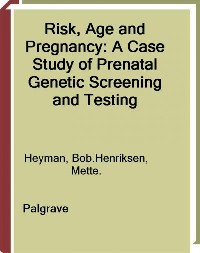
Risk, Age and Pregnancyprovides an in-depth case study of the operation of a prenatal genetic screening and testing system. The authors integrate observational, qualitative interview and survey data, exploring the perspectives of pregnant women, hospital doctors and midwives, and the communication between women and the hospital doctors who advise them. The book offers insights relevant to those concerned with the rapidly growing field of genetic risk management.
目录
Cover
Risk, Age and Pregnancy
Contents
List of Figures
List of Tables
Acknowledgements
Introduction
Scope of the book
Aim
From case to population-based human services
The Geneticisation of Pregnancy
Scope of the Introduction
Terminological politics
Down\\u0027s syndrome and genetic screening/testing
Pregnancy risk management
Down\\u0027s syndrome
The incidence of Down\\u0027s syndrome births
Predicting Down\\u0027s syndrome
The meaning of Down\\u0027s syndrome
The prenatal genetic screening/testing system
Serum screening
Probabilistic inference from serum markers
Complications
Technical advances
Amniocentesis
The genetic screening/testing risk escalator
Risk management systems for Down\\u0027s syndrome
Variation in prenatal genetic screening/testing policy
Maternal genetic screening/testing at the hospital research site
Risk knowledge
Research methodology
Methods
The research samples
Structure of the book
1 The Constitution of Down\\u0027s Syndrome as a Risk Entity
Introduction
The classification of Down\\u0027s syndrome as an event
Women\\u0027s views of Down\\u0027s syndrome as an event
Medical views of Down\\u0027s syndrome as an event
Selective attention to Down\\u0027s syndrome
The preventability of Down\\u0027s syndrome
The routinisation of screening scans
The non-risk of stillbirths
2 Age and Pregnancy
Introduction
Social clock theory
The timing of parenthood
Age boundaries for parenthood
Risk consciousness and attitudes to the timing of parenthood
Dimensions of parental age
Birth age
Parenthood age
Vital age
Age in relation to the life span
The timing of the parental project
Apparent ageing
Historical ageing
Age and non-parental roles
Genetic age
Medical age
Reasons for parental age judgements
3 The Offer of Genetic Screening/Testing
Introduction
Joining the maze
Socio-economic status and requesting genetic tests
The offer of genetic screening
When is an offer really an offer?
Hospital genetic tests offers
Who was offered genetic screening/testing?
Qualitative evidence
Genetic screening/testing options
4 Women\\u0027s Decisions about Genetic Tests I: Values and Probabilities
Introduction
The take-up of genetic screening/testing
Factors associated with decisions about genetic tests
Why weren\\u0027t older women more likely to accept serum screening?
Value judgements and decision-making
Acceptance of Down\\u0027s syndrome
Coping with Down\\u0027s syndrome
Rejection of Down\\u0027s syndrome
Probability estimation and decision-making
The probability heuristic
Limited predictive power
Multiple probabilities of the same event
Changing the probability of the same event
Personal probability assessment
Acceptance of maternal age as an indicator of high risk
Rejection of maternal age as an indicator of high risk
Maternal age as a binary risk marker
5 Women\\u0027s Decisions about Genetic Tests II: Time Management and Outcomes
Introduction
Time management
Shorter-term considerations
Body violation
Late termination
Waiting for test results
Miscarriage risk from amniocentesis
Gambling for peace of mind
Longer-term considerations
Predicting future intentions
Screening/testing outcomes
Serum screening outcomes
Amniocentesis
6 The Hospital Consultation I: The Pre-test Risk of Genetic Abnormalities
Introduction
The sample of hospital consultations
The consultations
Scope of Chapters 6 and 7
Opening gambits
The opening gambit for younger women
The opening gambit for older women
The woman\\u0027s agenda
The pre-test risk picture
The meaning of Down\\u0027s syndrome
The probability of Down\\u0027s syndrome
Second-order uncertainty about probability estimates
The calibration of maternal age
Quantitative versus qualitative representations of probabilities
Down\\u0027s syndrome versus genetic abnormalities
Changes in probabilities during the course of the pregnancy
The framing of probabilities
Positive versus negative representations of pre-test probabilities
7 The Hospital Consultation II: Risk and Genetic Screening/Testing
Introduction
Communication about the genetic decision tree
Representation of the genetic screening/testing decision tree
Negotiation of choice
Family decision-making
Communicating the risk picture after serum screening
The effect of serum screening on probability
False negatives and positives
Communicating the risk picture after amniocentesis
The risk of amniocentesis inducing a miscarriage
Balancing the risks of miscarriage and Down\\u0027s syndrome
Amniocentesis errors
Waiting for amniocentesis results
Pregnancy termination
Conclusions
1. Risks are constituted by screening systems (Chapter 1)
2. Risk management is shaped by wider cultural attitudes (Chapters 1 and 2)
3. The incorporation of service user choice into system design gives rise to social inequalities (Chapter 3)
4. The behaviour of screening systems does not match their design specification (Chapter 3)
5. The operation of screening systems is determined by the interaction of population and case-based considerations (Chapter 3)
6. The specification of screening systems is influenced by resource constraints (Chapter 3)
7. Divisions between higher and lower risk groups become reified (Chapter 4)
8. Risk managers face the dilemma that offering the higher risk group only more intense interventions reduces their take-up rate (Chapter 4)
9. Risk communicators must balance the need to avoid distress about unlikely contingencies against the obligation to enable service users to make informed choices (Chapter 5)
10. Bayesian complexities make the full, neutral communication of probabilistic information problematic (Chapter 6)
11. Service users are unlikely to be informed about the full decision tree which they are required to navigate (Chapter 7)
12. The operation of risk management systems is predicated on assumptions about the locus of decision-making responsibility (Chapter 7)
References
Name Index
Subject Index
- 名称
- 类型
- 大小
光盘服务联系方式: 020-38250260 客服QQ:4006604884
云图客服:
用户发送的提问,这种方式就需要有位在线客服来回答用户的问题,这种 就属于对话式的,问题是这种提问是否需要用户登录才能提问
Video Player
×
Audio Player
×
pdf Player
×
