

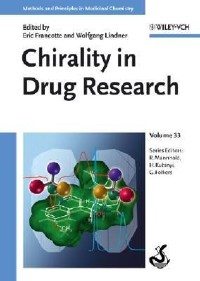
Chirality in drug research /
副标题:无
作 者:edited by Eric Francotte and Wolfgang Lindner.
分类号:
ISBN:9783527310760
微信扫一扫,移动浏览光盘
简介
A growing number of pharmaceutical drugs are chiral (referring to a molecules that are non-superimposable upon their mirror-images) because of their unique pharmacological properties. Following a history of chirality in drugs, Francotte (director and head of separations, Novartis Institutes for BioMedical Research, Switzerland) and Lindner (analytical chemistry, U. of Vienna, Austria) present three chapters discussing synthesis of chiral drugs. An industrial perspective is given on the stereoselective synthesis of drugs, aspects of chirality in natural products drug discovery are examined, and biotransformation methods for preparing chiral drugs and drug intermediates are presented. The next five chapters discuss separations, offering treatments of resolution of chiral drugs and drug intermediates by crystallization, isolation and production of optically pure drugs by enantioselective (able to select one of a chiral pair) chromatography, stereoselective chromatographic methods for drug analysis, capillary electrophoresis coupled to mass spectrometry for chiral drugs analysis, and chiral molecular tools for preparation of enantiopure alcohols and simultaneous determination of their absolute configurations by x-ray crystallography or anisotrophy methods. The final chapter reviews software and literature research on chirality in modeling, chirality in docking, and chiral ligand-receptor interaction and symmetry. Annotation 漏2007 Book News, Inc., Portland, OR (booknews.com)
目录
Preface p. XIII
List of Contributors p. XV
Introduction
1 Chiral Drugs from a Historical Point of View Joseph Gal p. 3
1.1 Introduction p. 3
1.2 A Word About Words p. 3
1.3 Old Chiral Drugs: Natural Remedies 3000BC-1900 p. 4
1.4 Recognition of Chirality in Drugs p. 13
1.5 Enantioselectivity in Drug Action and Drug Metabolism: The Beginnings p. 16
1.6 Drug Chirality in the 20th Century p. 18
References p. 24
Synthesis
2 Stereoselective Synthesis of Drugs - An Industrial Perspective Hons-Jurgen Federsel p. 29
2.1 Introduction: Historical Overview p. 29
2.2 Asymmetry from an Industrial Scale Perspective p. 32
2.3 Stereoselective Processes in Drug Manufacture - Drivers and Blockers p. 38
2.4 The Metal - Friend and Foe p. 41
2.5 Ligand Development - At the Core of Catalytic Chemistry p. 43
2.6 Asymmetric Reactions - A Rich Reservoir p. 45
2.6.1 Reductions p. 48
2.6.2 Oxidations p. 51
2.6.3 Carbon-Carbon Bond Formation p. 55
2.7 Retrospect and Prospect p. 59
References p. 62
3 Aspects of Chirality in Natural Products Drug Discovery Philipp Krastel and Frank Petersen and Silvio Roggo and Esther Schmitt and Ansgar Schuffenhauer p. 67
3.1 Introduction p. 67
3.2 Stereochemical Aspects of Natural Products p. 71
3.2.1 Chirality Analysis of Natural Products versus Drugs and Synthetics p. 71
3.2.2 Determination of the Relative and Absolute Stereochemistry of Natural Products p. 74
3.2.2.1 NMR Spectroscopy p. 74
3.2.2.2 Chiroptical Methods p. 75
3.2.2.3 X-ray Crystallography p. 75
3.2.2.4 Total Synthesis and Degradation Reactions p. 76
3.3 Mechanisms of Stereochemical Control in Natural Product Biosynthesis p. 77
3.3.1 Origin of D-Amino Acids in Non-ribosomal Peptides p. 77
3.3.2 Control of Chirality in Modular Polyketide Synthesis p. 79
3.3.3 Modes of Stereodifferentiating Cyclization p. 80
3.3.4 Terpene Biosynthesis in Plants p. 82
3.4 Biological Activity of Natural Products Related to Stereochemistry p. 83
3.4.1 Natural Products Active on the Nervous System p. 84
3.4.2 Gossypol, a Racemic Natural Product p. 86
3.4.3 Epimerization of Natural Products in vivo p. 87
3.4.4 Tubuline Stabilizing Agents p. 88
References p. 90
4 Biotransformation Methods for Preparing Chiral Drugs and Drug Intermediates Michael Muller and Marcel Wubbolts p. 95
4.1 Introduction p. 95
4.2 Examples of Established Applications of Biocatalysts in the Synthesis of Pharmaceuticals p. 96
4.2.1 Ephedrine Synthesis p. 96
4.2.2 Amino Acids p. 99
4.2.3 Amines p. 100
4.2.4 Penicillins/Cephalosporins p. 101
4.2.5 Racemic Resolution Using Hydrolytic Enzymes p. 103
4.2.6 Oxidoreductases p. 106
4.2.7 Oxynitrilases p. 108
4.2.8 Comparison of Nonenzymatic and Biocatalytic Transformations p. 108
4.3 Some Special Aspects of Biocatalysts, Recent Developments p. 111
4.3.1 Dynamic and Parallel Kinetic Resolution p. 111
4.3.2 Different Biocatalytic Approaches to One Building Block p. 112
4.3.3 Multipurpose Small Chiral Building Blocks p. 114
4.3.4 Optimization/New Access Using Molecular Biology Methods p. 116
4.3.5 Metabolic Engineering p. 116
4.3.6 Reaction Engineering p. 118
4.4 Conclusions and Outlook p. 119
References p. 120
Separations
5 Resolution of Chiral Drugs and Drug Intermediates by Crystallisation Kazuhiko Saigo p. 127
5.1 Introduction p. 127
5.2 Physical Enantioseparation - Preferential Crystallization p. 127
5.3 Chemical Enantioseparation - Diastereomeric Salt Formation p. 133
5.4 The Bridge Between Preferential Crystallization and Diastereomeric Salt Formation p. 141
5.5 Process Research on the Enantioseparation of Racemates by Diastereomeric Salt Formation p. 143
5.5.1 The Role of Water in the Stabilization of Less-soluble Diastereomeric Salts - A Key Intermediate for the Synthesis of Duloxetine, 3-(Methyl-amino)-1-(2-thienyl)propan-1-ol p. 143
5.5.2 Reciprocal Enantioseparation - A Key Intermediate for ACE Inhibitors, 2-Hydroxy-4-phenylbutyric Acid, and 1-(4-Methyl-phenyl)ethylamine p. 146
5.5.3 Solvent Switch - A Key Intermediate for Lysine Production, [alpha]-Amino-[epsilon]-caprolactam p. 147
5.6 Examples of Enantioseparations in the Pharmaceutical Industry p. 149
References p. 152
6 Isolation and Production of Optically Pure Drugs by Enantioselective Chromatography Eric Francotte p. 155
6.1 Introduction p. 155
6.2 General Considerations Regarding the Preparation of Single Stereoisomers of Chiral Drugs p. 156
6.2.1 The Different Approaches p. 156
6.2.2 Enantioselective Chromatography p. 157
6.3 Preparative Chiral Stationary Phases p. 158
6.3.1 Classification of Chiral Stationary Phases p. 158
6.3.2 Polymeric Phases p. 161
6.3.2.1 Polysaccharide-based CSPs p. 161
6.3.2.2 Polyacrylamide CSPs p. 164
6.3.2.3 Polymeric CSPs Derived from Tartaric Acid p. 164
6.3.3 Brush-type CSPs p. 165
6.3.3.1 [pi]-Acidic and [pi]-Basic Phases p. 165
6.3.3.2 Cyclodextrin-based CSPs p. 166
6.3.3.3 Chirobiotic CSPs p. 166
6.3.3.4 Chiral Ion-exchange Stationary Phases p. 167
6.4 Strategies for Performing Enantioselective Separations p. 168
6.4.1 Selecting the Right CSP p. 168
6.4.2 Selecting the Racemic Solute p. 170
6.4.3 Selecting the Right Synthetic Step p. 170
6.5 Preparative Enantioselective Resolution of Chiral Drugs p. 172
6.5.1 Laboratory-scale Separations p. 172
6.5.2 Pilot-scale Separations p. 176
6.5.3 Process-scale Separations p. 177
6.5.4 Production-scale Separations p. 178
6.5 Other Enantioselective Chromatographic Techniques p. 179
6.5.1 Gas Chromatography p. 179
6.5.2 Membranes p. 180
6.5.3 Centrifugal Partition Chromatography p. 180
6.5.4 Electrophoretic Methods p. 181
6.6 Conclusion p. 181
References p. 182
7 Stereoselective Chromatographic Methods for Drug Analysis Norbert M. Maier and Wolfgang Lindner p. 189
7.1 Introduction p. 189
7.2 The Role of Enantioselective Analysis in Drug Development p. 191
7.3 Separation Techniques in Enantiomer Analysis p. 192
7.4 Principle of Enantiomer Separation p. 194
7.4.1 Indirect Enantiomer Separation p. 195
7.4.2 Direct Enantiomer Separation p. 196
7.4.2.1 Chiral Mobile Phase Additives (CMPA) p. 196
7.4.2.2 Chiral Stationary Phases p. 197
7.5 Molecular Requirements for Chiral Recognition p. 198
7.6 Thermodynamic Principles of Enantiomer Separation p. 199
7.7 Role of Mobile Phase in Enantiomer Separation p. 202
7.8 Chiral Selectors and Chiral Stationary Phases Employed in Liquid Chromatographic Enantiomer Separation p. 205
7.8.1 CSPs Derived from Polymers p. 207
7.8.1.1 CSPs Derived from Natural Polymers p. 207
7.8.1.1.1 Polysaccharide-type CSPs p. 207
7.8.1.1.2 Protein-type CSPs p. 215
7.8.1.2 CSPs Derived from Synthetic Polymers p. 218
7.8.1.2.1 Helical Poly(methacrylates) p. 218
7.8.1.2.2 Chiral Poly(methacrylamides) p. 218
7.8.1.2.3 Tartardiamide-network Polymers p. 219
7.8.1.2.4 Poly(diaminocyclohexane-N,N-diacrylamide) p. 219
7.8.1.2.5 Molecularly Imprinted Polymers p. 221
7.8.2 Macrocyclic CSPs p. 224
7.8.2.1 Cyclodextrin-type CSPs p. 224
7.8.2.2 Glycopeptide-type CSPs p. 226
7.8.2.3 Crown Ether-type CSP p. 231
7.8.3 CSPs Based on Low-Molecular-Weight Molecules p. 233
7.8.3.1 Donor-Acceptor-type CSPs p. 233
7.8.3.2 Ion-exchange-type CSPs p. 237
7.8.3.2 Ligand-exchange-type CSPs p. 240
7.8.4 CSPs Based on Target-specific Bioaffinity Systems p. 240
7.8.4.1 Antibody-type CSPs p. 241
7.8.4.2 Aptamer-type CSPs p. 242
7.9 Conclusions p. 244
References p. 245
8 Capillary Electrophoresis Coupled to Mass Spectrometry for Chiral Drugs Analysis Serge Rudaz and Jean-Luc Veuthey p. 261
8.1 Introduction p. 261
8.2 Capillary Electrophoresis (CE) p. 262
8.3 CE-MS Coupling p. 263
8.3.1 CE-ESI-MS p. 263
8.3.2 Other CE-MS Coupling p. 265
8.4 Chiral Separation Strategies p. 265
8.5 Partial Filling p. 268
8.5.1 Partial Filling with Crown Ethers p. 268
8.5.2 Partial Filling with Neutral Derivatized CD p. 268
8.6 Partial Filling - Counter Current Technique p. 270
8.6.1 Anionic Analytes - Positively Charged Chiral Selectors p. 271
8.6.2 Cationic Analytes - Negatively Charged Chiral Selectors p. 271
8.7 Chiral Micellar Electrokinetic Chromatography p. 274
8.8 Quantitative Aspects in CE-MS and Parameters for CE-ESI-MS Coupling p. 276
8.9 Capillary Electrochromatography Coupled to Mass Spectrometry p. 277
8.10 Discussion and Conclusion p. 278
References p. 280
9 Powerful Chiral Molecular Tools for Preparation of Enantiopure Alcohols and Simultaneous Determination of Their Absolute Configurations by X-Ray Crystallography and/or [superscript 1]H NMR Anisotropy Methods Nobuyuki Harada p. 283
9.1 Introduction p. 283
9.2 Methodologies for Determining Absolute Configuration p. 284
9.2.1 Nonempirical Methods for Determining Absolute Configurations of Chiral Compounds p. 284
9.2.2 Relative and/or Empirical Methods for Determining Absolute Configuration Using an Internal Reference of Absolute Configuration p. 285
9.3 CSDP Acid, Camphorsultam Dichlorophthalic Acid (-)-1, Useful for the Enantioresolution of Alcohols by HPLC and Simultaneous Determination of Their Absolute Configurations by X-ray Crystallography p. 287
9.4 A Novel Chiral Molecular Tool, 2-Methoxy-2-(1-naphthyl)propionic Acid (M[alpha]NP Acid (S)-(+)-3), Useful for Enantioresolution of Alcohols and Simultaneous Determination of Their Absolute Configurations by the [superscript 1]H NMR Anisotropy Method p. 295
9.4.1 Facile Synthesis of M[alpha]NP Acid (3) and Its Enantioresolution with Natural (-)-Menthol p. 298
9.4.2 The [superscript 1]H NMR Anisotropy Method for Determining the Absolute Configuration of Secondary Alcohols: the Sector Rule and Applications p. 399
9.4.3 Enantioresolution of Various Alcohols Using M[alpha]NP Acid and Simultaneous Determination of Their Absolute Configurations p. 304
9.4.4 Recent Applications of the M[alpha]NP Acid Method to Various Alcohols p. 307
9.4.5 Application of the M[alpha]NP Acid Method to Chiral meta-Substituted Diphenylmethanols p. 313
9.5 Absolute Configuration of the Thyroid Hormone Analog KAT-2003 as Determined by the [superscript 1]H NMR Anisotropy Method with M[alpha]NP Acid p. 314
9.6 Conclusion p. 319
References p. 319
10 Keywords in Chirality Modeling Molecular Modeling of Chirality - Software and Literature Research on Chirality in Modeling, Chirality in Docking, Chiral Ligand-Receptor Interaction and Symmetry Gerd Folkers and Mine Yarim and Pavel Pospisil p. 323
10.1 Introduction p. 323
10.2 Chirality in QSAR p. 324
10.3 Molecular Modeling in Chiral Chromatography p. 325
10.4 Chirality of Protein Residues, Homology Modeling p. 326
10.5 Chiral Selective Binding, MDS methods p. 327
10.5.1 DNA p. 327
10.5.2 Topoisomerase II-DNA Crossover Recognition p. 328
10.5.3 Chiral Catalysis p. 328
10.5.4 Chiral Ligand-Receptor Interactions - Proteins p. 329
10.6 Docking of Chiral Compounds p. 331
10.7 Molecular Modeling Software Dealing with Chirality and Some References to Its Successful Application p. 332
10.7.1 ChemDraw 6.0 (CambridgeSoft) - an Example of the Classical Program p. 333
10.7.2 Chirano - Chirality of Nucleic Acid Chains p. 333
10.7.3 Corina - Chirality in 3D Structure Generator p. 334
10.7.4 Omicron from OpenEye Software - Chirality from 1D Formulas p. 334
10.7.5 Cache Software BioMedCache - Chirality Convention in Semiempirical Calculations p. 335
10.7.6 Accelrys p. 335
10.7.7 Schrodinger-Generation of Stereoisomers p. 335
10.7.8 Tripos - Stereochemistry Module StereoPlex p. 336
10.7.9 MOE - DAPPER p. 337
References p. 338
Subject Index p. 341
List of Contributors p. XV
Introduction
1 Chiral Drugs from a Historical Point of View Joseph Gal p. 3
1.1 Introduction p. 3
1.2 A Word About Words p. 3
1.3 Old Chiral Drugs: Natural Remedies 3000BC-1900 p. 4
1.4 Recognition of Chirality in Drugs p. 13
1.5 Enantioselectivity in Drug Action and Drug Metabolism: The Beginnings p. 16
1.6 Drug Chirality in the 20th Century p. 18
References p. 24
Synthesis
2 Stereoselective Synthesis of Drugs - An Industrial Perspective Hons-Jurgen Federsel p. 29
2.1 Introduction: Historical Overview p. 29
2.2 Asymmetry from an Industrial Scale Perspective p. 32
2.3 Stereoselective Processes in Drug Manufacture - Drivers and Blockers p. 38
2.4 The Metal - Friend and Foe p. 41
2.5 Ligand Development - At the Core of Catalytic Chemistry p. 43
2.6 Asymmetric Reactions - A Rich Reservoir p. 45
2.6.1 Reductions p. 48
2.6.2 Oxidations p. 51
2.6.3 Carbon-Carbon Bond Formation p. 55
2.7 Retrospect and Prospect p. 59
References p. 62
3 Aspects of Chirality in Natural Products Drug Discovery Philipp Krastel and Frank Petersen and Silvio Roggo and Esther Schmitt and Ansgar Schuffenhauer p. 67
3.1 Introduction p. 67
3.2 Stereochemical Aspects of Natural Products p. 71
3.2.1 Chirality Analysis of Natural Products versus Drugs and Synthetics p. 71
3.2.2 Determination of the Relative and Absolute Stereochemistry of Natural Products p. 74
3.2.2.1 NMR Spectroscopy p. 74
3.2.2.2 Chiroptical Methods p. 75
3.2.2.3 X-ray Crystallography p. 75
3.2.2.4 Total Synthesis and Degradation Reactions p. 76
3.3 Mechanisms of Stereochemical Control in Natural Product Biosynthesis p. 77
3.3.1 Origin of D-Amino Acids in Non-ribosomal Peptides p. 77
3.3.2 Control of Chirality in Modular Polyketide Synthesis p. 79
3.3.3 Modes of Stereodifferentiating Cyclization p. 80
3.3.4 Terpene Biosynthesis in Plants p. 82
3.4 Biological Activity of Natural Products Related to Stereochemistry p. 83
3.4.1 Natural Products Active on the Nervous System p. 84
3.4.2 Gossypol, a Racemic Natural Product p. 86
3.4.3 Epimerization of Natural Products in vivo p. 87
3.4.4 Tubuline Stabilizing Agents p. 88
References p. 90
4 Biotransformation Methods for Preparing Chiral Drugs and Drug Intermediates Michael Muller and Marcel Wubbolts p. 95
4.1 Introduction p. 95
4.2 Examples of Established Applications of Biocatalysts in the Synthesis of Pharmaceuticals p. 96
4.2.1 Ephedrine Synthesis p. 96
4.2.2 Amino Acids p. 99
4.2.3 Amines p. 100
4.2.4 Penicillins/Cephalosporins p. 101
4.2.5 Racemic Resolution Using Hydrolytic Enzymes p. 103
4.2.6 Oxidoreductases p. 106
4.2.7 Oxynitrilases p. 108
4.2.8 Comparison of Nonenzymatic and Biocatalytic Transformations p. 108
4.3 Some Special Aspects of Biocatalysts, Recent Developments p. 111
4.3.1 Dynamic and Parallel Kinetic Resolution p. 111
4.3.2 Different Biocatalytic Approaches to One Building Block p. 112
4.3.3 Multipurpose Small Chiral Building Blocks p. 114
4.3.4 Optimization/New Access Using Molecular Biology Methods p. 116
4.3.5 Metabolic Engineering p. 116
4.3.6 Reaction Engineering p. 118
4.4 Conclusions and Outlook p. 119
References p. 120
Separations
5 Resolution of Chiral Drugs and Drug Intermediates by Crystallisation Kazuhiko Saigo p. 127
5.1 Introduction p. 127
5.2 Physical Enantioseparation - Preferential Crystallization p. 127
5.3 Chemical Enantioseparation - Diastereomeric Salt Formation p. 133
5.4 The Bridge Between Preferential Crystallization and Diastereomeric Salt Formation p. 141
5.5 Process Research on the Enantioseparation of Racemates by Diastereomeric Salt Formation p. 143
5.5.1 The Role of Water in the Stabilization of Less-soluble Diastereomeric Salts - A Key Intermediate for the Synthesis of Duloxetine, 3-(Methyl-amino)-1-(2-thienyl)propan-1-ol p. 143
5.5.2 Reciprocal Enantioseparation - A Key Intermediate for ACE Inhibitors, 2-Hydroxy-4-phenylbutyric Acid, and 1-(4-Methyl-phenyl)ethylamine p. 146
5.5.3 Solvent Switch - A Key Intermediate for Lysine Production, [alpha]-Amino-[epsilon]-caprolactam p. 147
5.6 Examples of Enantioseparations in the Pharmaceutical Industry p. 149
References p. 152
6 Isolation and Production of Optically Pure Drugs by Enantioselective Chromatography Eric Francotte p. 155
6.1 Introduction p. 155
6.2 General Considerations Regarding the Preparation of Single Stereoisomers of Chiral Drugs p. 156
6.2.1 The Different Approaches p. 156
6.2.2 Enantioselective Chromatography p. 157
6.3 Preparative Chiral Stationary Phases p. 158
6.3.1 Classification of Chiral Stationary Phases p. 158
6.3.2 Polymeric Phases p. 161
6.3.2.1 Polysaccharide-based CSPs p. 161
6.3.2.2 Polyacrylamide CSPs p. 164
6.3.2.3 Polymeric CSPs Derived from Tartaric Acid p. 164
6.3.3 Brush-type CSPs p. 165
6.3.3.1 [pi]-Acidic and [pi]-Basic Phases p. 165
6.3.3.2 Cyclodextrin-based CSPs p. 166
6.3.3.3 Chirobiotic CSPs p. 166
6.3.3.4 Chiral Ion-exchange Stationary Phases p. 167
6.4 Strategies for Performing Enantioselective Separations p. 168
6.4.1 Selecting the Right CSP p. 168
6.4.2 Selecting the Racemic Solute p. 170
6.4.3 Selecting the Right Synthetic Step p. 170
6.5 Preparative Enantioselective Resolution of Chiral Drugs p. 172
6.5.1 Laboratory-scale Separations p. 172
6.5.2 Pilot-scale Separations p. 176
6.5.3 Process-scale Separations p. 177
6.5.4 Production-scale Separations p. 178
6.5 Other Enantioselective Chromatographic Techniques p. 179
6.5.1 Gas Chromatography p. 179
6.5.2 Membranes p. 180
6.5.3 Centrifugal Partition Chromatography p. 180
6.5.4 Electrophoretic Methods p. 181
6.6 Conclusion p. 181
References p. 182
7 Stereoselective Chromatographic Methods for Drug Analysis Norbert M. Maier and Wolfgang Lindner p. 189
7.1 Introduction p. 189
7.2 The Role of Enantioselective Analysis in Drug Development p. 191
7.3 Separation Techniques in Enantiomer Analysis p. 192
7.4 Principle of Enantiomer Separation p. 194
7.4.1 Indirect Enantiomer Separation p. 195
7.4.2 Direct Enantiomer Separation p. 196
7.4.2.1 Chiral Mobile Phase Additives (CMPA) p. 196
7.4.2.2 Chiral Stationary Phases p. 197
7.5 Molecular Requirements for Chiral Recognition p. 198
7.6 Thermodynamic Principles of Enantiomer Separation p. 199
7.7 Role of Mobile Phase in Enantiomer Separation p. 202
7.8 Chiral Selectors and Chiral Stationary Phases Employed in Liquid Chromatographic Enantiomer Separation p. 205
7.8.1 CSPs Derived from Polymers p. 207
7.8.1.1 CSPs Derived from Natural Polymers p. 207
7.8.1.1.1 Polysaccharide-type CSPs p. 207
7.8.1.1.2 Protein-type CSPs p. 215
7.8.1.2 CSPs Derived from Synthetic Polymers p. 218
7.8.1.2.1 Helical Poly(methacrylates) p. 218
7.8.1.2.2 Chiral Poly(methacrylamides) p. 218
7.8.1.2.3 Tartardiamide-network Polymers p. 219
7.8.1.2.4 Poly(diaminocyclohexane-N,N-diacrylamide) p. 219
7.8.1.2.5 Molecularly Imprinted Polymers p. 221
7.8.2 Macrocyclic CSPs p. 224
7.8.2.1 Cyclodextrin-type CSPs p. 224
7.8.2.2 Glycopeptide-type CSPs p. 226
7.8.2.3 Crown Ether-type CSP p. 231
7.8.3 CSPs Based on Low-Molecular-Weight Molecules p. 233
7.8.3.1 Donor-Acceptor-type CSPs p. 233
7.8.3.2 Ion-exchange-type CSPs p. 237
7.8.3.2 Ligand-exchange-type CSPs p. 240
7.8.4 CSPs Based on Target-specific Bioaffinity Systems p. 240
7.8.4.1 Antibody-type CSPs p. 241
7.8.4.2 Aptamer-type CSPs p. 242
7.9 Conclusions p. 244
References p. 245
8 Capillary Electrophoresis Coupled to Mass Spectrometry for Chiral Drugs Analysis Serge Rudaz and Jean-Luc Veuthey p. 261
8.1 Introduction p. 261
8.2 Capillary Electrophoresis (CE) p. 262
8.3 CE-MS Coupling p. 263
8.3.1 CE-ESI-MS p. 263
8.3.2 Other CE-MS Coupling p. 265
8.4 Chiral Separation Strategies p. 265
8.5 Partial Filling p. 268
8.5.1 Partial Filling with Crown Ethers p. 268
8.5.2 Partial Filling with Neutral Derivatized CD p. 268
8.6 Partial Filling - Counter Current Technique p. 270
8.6.1 Anionic Analytes - Positively Charged Chiral Selectors p. 271
8.6.2 Cationic Analytes - Negatively Charged Chiral Selectors p. 271
8.7 Chiral Micellar Electrokinetic Chromatography p. 274
8.8 Quantitative Aspects in CE-MS and Parameters for CE-ESI-MS Coupling p. 276
8.9 Capillary Electrochromatography Coupled to Mass Spectrometry p. 277
8.10 Discussion and Conclusion p. 278
References p. 280
9 Powerful Chiral Molecular Tools for Preparation of Enantiopure Alcohols and Simultaneous Determination of Their Absolute Configurations by X-Ray Crystallography and/or [superscript 1]H NMR Anisotropy Methods Nobuyuki Harada p. 283
9.1 Introduction p. 283
9.2 Methodologies for Determining Absolute Configuration p. 284
9.2.1 Nonempirical Methods for Determining Absolute Configurations of Chiral Compounds p. 284
9.2.2 Relative and/or Empirical Methods for Determining Absolute Configuration Using an Internal Reference of Absolute Configuration p. 285
9.3 CSDP Acid, Camphorsultam Dichlorophthalic Acid (-)-1, Useful for the Enantioresolution of Alcohols by HPLC and Simultaneous Determination of Their Absolute Configurations by X-ray Crystallography p. 287
9.4 A Novel Chiral Molecular Tool, 2-Methoxy-2-(1-naphthyl)propionic Acid (M[alpha]NP Acid (S)-(+)-3), Useful for Enantioresolution of Alcohols and Simultaneous Determination of Their Absolute Configurations by the [superscript 1]H NMR Anisotropy Method p. 295
9.4.1 Facile Synthesis of M[alpha]NP Acid (3) and Its Enantioresolution with Natural (-)-Menthol p. 298
9.4.2 The [superscript 1]H NMR Anisotropy Method for Determining the Absolute Configuration of Secondary Alcohols: the Sector Rule and Applications p. 399
9.4.3 Enantioresolution of Various Alcohols Using M[alpha]NP Acid and Simultaneous Determination of Their Absolute Configurations p. 304
9.4.4 Recent Applications of the M[alpha]NP Acid Method to Various Alcohols p. 307
9.4.5 Application of the M[alpha]NP Acid Method to Chiral meta-Substituted Diphenylmethanols p. 313
9.5 Absolute Configuration of the Thyroid Hormone Analog KAT-2003 as Determined by the [superscript 1]H NMR Anisotropy Method with M[alpha]NP Acid p. 314
9.6 Conclusion p. 319
References p. 319
10 Keywords in Chirality Modeling Molecular Modeling of Chirality - Software and Literature Research on Chirality in Modeling, Chirality in Docking, Chiral Ligand-Receptor Interaction and Symmetry Gerd Folkers and Mine Yarim and Pavel Pospisil p. 323
10.1 Introduction p. 323
10.2 Chirality in QSAR p. 324
10.3 Molecular Modeling in Chiral Chromatography p. 325
10.4 Chirality of Protein Residues, Homology Modeling p. 326
10.5 Chiral Selective Binding, MDS methods p. 327
10.5.1 DNA p. 327
10.5.2 Topoisomerase II-DNA Crossover Recognition p. 328
10.5.3 Chiral Catalysis p. 328
10.5.4 Chiral Ligand-Receptor Interactions - Proteins p. 329
10.6 Docking of Chiral Compounds p. 331
10.7 Molecular Modeling Software Dealing with Chirality and Some References to Its Successful Application p. 332
10.7.1 ChemDraw 6.0 (CambridgeSoft) - an Example of the Classical Program p. 333
10.7.2 Chirano - Chirality of Nucleic Acid Chains p. 333
10.7.3 Corina - Chirality in 3D Structure Generator p. 334
10.7.4 Omicron from OpenEye Software - Chirality from 1D Formulas p. 334
10.7.5 Cache Software BioMedCache - Chirality Convention in Semiempirical Calculations p. 335
10.7.6 Accelrys p. 335
10.7.7 Schrodinger-Generation of Stereoisomers p. 335
10.7.8 Tripos - Stereochemistry Module StereoPlex p. 336
10.7.9 MOE - DAPPER p. 337
References p. 338
Subject Index p. 341
Chirality in drug research /
- 名称
- 类型
- 大小
光盘服务联系方式: 020-38250260 客服QQ:4006604884
云图客服:
用户发送的提问,这种方式就需要有位在线客服来回答用户的问题,这种 就属于对话式的,问题是这种提问是否需要用户登录才能提问
Video Player
×
Audio Player
×
pdf Player
×
