

简介
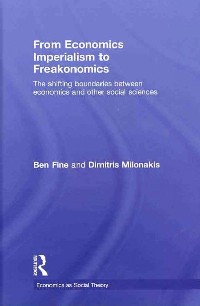
Is or has economics ever been the imperial social science? Could or should it ever be so? These are the central concerns of this book. It involves a critical reflection on the process of how economics became the way it is, in terms of a narrow and intolerant orthodoxy, that has, nonetheless, increasingly directed its attention to appropriating t... more 籬e subject matter of other social sciences through the process termed "economics imperialism". In other words, the book addresses the shifting boundaries between economics and the other social sciences as seen from the confines of the dismal science, with some reflection on the responses to the economic imperialists by other disciplines. Significantly, an old economics imperialism is identified of the "as if market" style most closely associated with Gary Becker, the public choice theory of Buchanan and Tullock and cliometrics. But this has given way to a more "revolutionary" form of economics imperialism associated with the information-theoretic economics of Akerlof and Stiglitz, and the new institutional economics of Coase, Wiliamson and North. Embracing one "new" field after another, economics imperialism reaches its most extreme version in the form of "freakonomics", the economic theory of everything on the basis of the most shallow principles. By way of contrast and as a guiding critical thread, a thorough review is offered of the appropriate principles underpinning political economy and its relationship to social science, and how these have been and continue to be deployed. The case is made for political economy with an interdisciplinary character, able to bridge the gap between economics and other social sciences, and draw upon and interrogate the nature of contemporary capitalism. ?less
目录
Table Of Contents:
Preface x
1 Introduction and overview 1
Preliminaries 1
From reductionism ... 2
... To expansionism 5
General outline 8
2 The historical logic of economics imperialism 11
Introduction 11
Questions raised by economics imperialism 13
Bringing back in the 'social'? 17
Concluding remarks 26
3 The economic approach: marginalism extended 29
Introduction 29
Becker and the pure, if rough,road to economics imperialism 32
Politics as public choice: Buchanan and Tullock 36
From the rational to the non-rational 42
Concluding remarks 51
4 New economics imperialism: the revolution portrayed 56
Introduction 56
The information-theoretic approach: from Akerlof to Stiglitz 58
Human capital, finance, development and space 66
Concluding remarks 74
5 From economics, through institutions, to society? 78
Introduction 78
New institutional economics ... 79
... Versus new economic sociology 87
Concluding remarks 91
6 From social capital to freakonomics 94
Introduction 94
Economic history and social capital 96
From Coase theorem to Coasean worlds 99
Freakonomics 鈥?abnormal economics as normal 106
Concluding remarks 110
7 Economics confronts the social sciences: resistance or smooth progression? 115
Introduction 115
From Becker to Akerlof and beyond 116
Economics: bright light or dim science? 122
Concluding remarks 126
8 Whither economics? 130
Introduction 130
How economics got its spots 131
The why and how 136
Concluding remarks 147
9 Whither social science? 149
Introduction 149
Beyond neoliberalism and postmodernism: social science at a crossroads 149
Structure and agency in social theory 153
Concluding remarks 158
10 Whither political economy? 161
Introduction 161
Historical and social economics versus value theory? 162
What is to be done? 165
Concluding remarks 172
References 176
Index 198
Preface x
1 Introduction and overview 1
Preliminaries 1
From reductionism ... 2
... To expansionism 5
General outline 8
2 The historical logic of economics imperialism 11
Introduction 11
Questions raised by economics imperialism 13
Bringing back in the 'social'? 17
Concluding remarks 26
3 The economic approach: marginalism extended 29
Introduction 29
Becker and the pure, if rough,road to economics imperialism 32
Politics as public choice: Buchanan and Tullock 36
From the rational to the non-rational 42
Concluding remarks 51
4 New economics imperialism: the revolution portrayed 56
Introduction 56
The information-theoretic approach: from Akerlof to Stiglitz 58
Human capital, finance, development and space 66
Concluding remarks 74
5 From economics, through institutions, to society? 78
Introduction 78
New institutional economics ... 79
... Versus new economic sociology 87
Concluding remarks 91
6 From social capital to freakonomics 94
Introduction 94
Economic history and social capital 96
From Coase theorem to Coasean worlds 99
Freakonomics 鈥?abnormal economics as normal 106
Concluding remarks 110
7 Economics confronts the social sciences: resistance or smooth progression? 115
Introduction 115
From Becker to Akerlof and beyond 116
Economics: bright light or dim science? 122
Concluding remarks 126
8 Whither economics? 130
Introduction 130
How economics got its spots 131
The why and how 136
Concluding remarks 147
9 Whither social science? 149
Introduction 149
Beyond neoliberalism and postmodernism: social science at a crossroads 149
Structure and agency in social theory 153
Concluding remarks 158
10 Whither political economy? 161
Introduction 161
Historical and social economics versus value theory? 162
What is to be done? 165
Concluding remarks 172
References 176
Index 198
- 名称
- 类型
- 大小
光盘服务联系方式: 020-38250260 客服QQ:4006604884
云图客服:
用户发送的提问,这种方式就需要有位在线客服来回答用户的问题,这种 就属于对话式的,问题是这种提问是否需要用户登录才能提问
Video Player
×
Audio Player
×
pdf Player
×
