

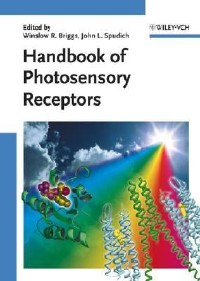
Handbook of photosensory receptors /
副标题:无
作 者:Winslow R. Briggs, John L. Spudich, eds.
分类号:
ISBN:9783527310197
微信扫一扫,移动浏览光盘
简介
This first complete resource on photosensory receptors from bacteria, plants and animals compiles the data on all known classes of photoreceptors, creating a must-have reference for students and researchers for many years to come. Among the editors are the current and a former president of the American Society for Photobiology.
目录
Table of Contents 7
Preface 19
List of Authors 21
1 Microbial Rhodopsins: Phylogenetic and Functional Diversity 27
1.1 Introduction 27
1.2 Archaeal Rhodopsins 28
1.3 Clues to Newfound Microbial Rhodopsin Function from Primary Sequence Comparison to Archaeal Rhodopsins 33
1.4 Bacterial Rhodopsins 36
1.4.1 Green-absorbing Proteorhodopsin (\u201cGPR\u201d) from Monterey Bay Surface Plankton 36
1.4.2 Blue-absorbing Proteorhodopsin (\u201cBPR\u201d) from Hawaiian Deep Sea Plankton 38
1.4.3 Anabaena Sensory Rhodopsin 39
1.4.4 Other Bacterial Rhodopsins 41
1.5 Eukaryotic Microbial Rhodopsins 42
1.5.1 Fungal Rhodopsins 42
1.5.2 Algal Rhodopsins 43
1.6 Spectral Tuning 44
1.7 A Unified Mechanism for Molecular Function? 45
1.8 Opsin-related Proteins without the Retinal-binding Site 46
1.9 Perspective 46
References 47
2 Sensory Rhodopsin Signaling in Green Flagellate Algae 51
2.1 Introduction 51
2.1.1 Retinylidene Receptors 51
2.1.2. Physiology of Algal Phototaxis and the Photophobic Response 52
2.1.3 Photoelectrical Currents and their Relationship to Swimming Behavior 53
2.2 The Photosensory Receptors: CSRA and CSRB 56
2.2.1 Genomics, Sequence, and Predicted Structure 57
2.2.2 Cellular Content and Roles in Phototaxis and Photophobic Behavior 58
2.2.3 Molecular Mechanism of Action 62
2.3 Other Algae 65
2.4 Conclusion and Future Perspectives 66
Acknowledgements 67
References 67
3 Visual Pigments as Photoreceptors 69
3.1 Introduction 69
3.1.1 General Considerations 69
3.1.2 Photoreceptors and Pigments 75
3.1.3 Non-photoreceptor or \u201cNon-rod\u201d, \u201cNon-cone\u201d Retinal Pigments 76
3.1.4 Retinal Photoisomerases 77
3.2 The Unphotolyzed State of Vertebrate Visual Pigments 77
3.2.1 Structure of Visual Pigments: the Chromophore 77
3.2.2 Overall Topology of the Pigment 78
3.2.3 Cytoplasmic Domain 80
3.2.4 The Hydrophobic Core of Rhodopsin and the Retinal Binding Pocket 81
3.2.5 The Extracellular Domain of Rhodopsin 82
3.2.6 Structure of Other Visual Pigments 82
3.2.7 Protonation State of Some of the Carboxylic Acids of Rhodopsin 83
3.2.8 Internal Waters in Visual Pigments 83
3.2.9 Is Rhodopsin a Dimer in vivo? 84
3.2.10 Functional Properties of the Unphotolyzed State of a \u201cGood\u201d Visual Pigment 84
3.2.11 Quantum Efficiency of Visual Pigment Photochemistry 88
3.2.12 Dark Noise Originating from the Photoreceptor Pigment 89
3.3 Activation of Vertebrate Visual Pigments 91
3.3.1 Introduction 91
3.3.2 The Primary Event, Photoisomerization 91
3.3.3 The Meta I 鈫?Meta II Transition 92
3.3.4 Molecular Changes upon the Formation of Meta I and Meta II 93
3.3.5 Internal Water Molecules 93
3.3.6 Required Steps for Rhodopsin Activation 93
3.3.7 The Transmembrane Signaling Pathway 94
3.4 The Unphotolyzed State of Invertebrate Visual Pigments 95
3.4.1 Introduction 95
3.4.2 Wavelength Regulation of Invertebrate Pigments 96
3.5 Mechanism of Activation of Invertebrate Visual Pigments 97
3.5.1 The Initial Photochemical Events 97
3.5.2 Formation of Acid Metarhodopsin 97
3.5.3 Required Steps for Photolyzed Octopus Rhodopsin to Activate its G-protein 97
3.5.4 Purification of the Active Form of an Invertebrate Visual Pigment 98
Acknowledgements 98
References 98
4 Structural and Functional Aspects of the Mammalian Rod-Cell Photoreceptor Rhodopsin 103
4.1 Introduction 103
4.2 Rhodopsin and Mammalian Visual Phototransduction 105
4.2.1 Signal Amplification by Light-activated Rhodopsin 105
4.2.2 Inactivation of Light-activated Rhodopsin 105
4.3 Properties of Rhodopsin 106
4.3.1 Isolation of Rhodopsin 106
4.3.2 Biochemical and Physicochemical Properties of Rhodopsin 107
4.3.3 Post-translational Modifications in Rhodopsin 108
4.3.4 Membrane Topology of Rhodopsin and Functional Domains 108
4.4 Chromophore Binding Pocket and Photolysis of Rhodopsin 111
4.5 Structure of Rhodopsin 112
4.5.1 Crystal Structure of Rhodopsin 112
4.5.2 Atomic Force Microscopy of Rhodopsin in the Disk Membrane 114
4.6 Activation Mechanism of Rhodopsin 114
4.7 Conclusions 115
Acknowledgements 116
References 116
5 A Novel Light Sensing Pathway in the Eye: Conserved Features of Inner Retinal Photoreception in Rodents, Man and Teleost Fish 119
Summary 119
5.1 Introduction 120
5.1.1 A Novel Photoreceptor within the Eye 120
5.1.2 Biological Clocks and their Regulation by Light 121
5.2 Non-rod, Non-cone Photoreception in Rodents 122
5.2.1 An Irradiance Detection Pathway in the Eye 122
5.2.2 The Discovery of a Novel Ocular Photopigment in Mice (OP(480)) 123
5.2.3 Melanopsin and Non-rod, Non-cone Photoreception 125
5.2.4 A Functional Syncitium of Directly Light-sensitive Ganglion Cells 127
5.3 Non-rod, Non-cone Photoreception in Humans 130
5.3.1 Introduction 130
5.3.2 Novel Photoreceptors Regulate Melatonin 131
5.3.3 Novel Photoreceptors Regulate the Primary Visual Cone Pathway 131
5.4 Non-rod, Non-cone Photoreception in Teleost Fish 133
5.4.1 Background 133
5.4.2 Vertebrate Ancient (VA) Opsin and Inner Retinal Photoreception in Teleost Fish 134
5.4.3 A Novel Light Response from VA-opsin- and Melanopsin-expressing Horizontal Cells 134
5.4.4 Action Spectra for the HC\u2013RSD Light Response Identify a Novel Photopigment 135
5.4.5 The Possible Function of HC\u2013RSD Neurones 137
5.5 Opsins can be Photosensors or Photoisomerases 138
5.6 Placing Candidate Genes and Photopigments into Context 139
5.7 Conclusions 140
References 141
6 The Phytochromes 147
6.1 Introduction 147
6.1.1 Photomorphogenesis and Phytochromes 147
6.1.2 The Central Dogma of Phytochrome Action 148
6.2 Molecular Properties of Eukaryotic and Prokaryotic Phytochromes 149
6.2.1 Molecular Properties of Plant Phytochromes 149
6.2.2 Molecular Properties of Cyanobacterial Phytochromes 151
6.3 Photochemical and Nonphotochemical Conversions of Phytochrome 153
6.3.1 The Phytochrome Chromophore 153
6.3.2 Phytochrome Photointerconversions 155
6.3.3 Dark Reversion 158
6.4 Phytochrome Biosynthesis and Turnover 159
6.4.1 Phytobilin Biosynthesis in Plants and Cyanobacteria 159
6.4.2 Apophytochrome Biosynthesis and Holophytochrome Assembly 164
6.4.3 Phytochrome Turnover 167
6.5 Molecular Mechanism of Phytochrome Signaling: Future Perspective 168
6.5.1 Regulation of Protein\u2013Protein Interactions by Phosphorylation 168
6.5.2 Regulation of Tetrapyrrole Metabolism 169
Acknowledgements 171
References 171
7 Phytochrome Signaling 177
7.1 Introduction 177
7.2 Photosensory and Biological Functions of Individual Phytochromes 178
7.3 phy Domains Involved in Signaling 180
7.4 phy Signaling Components 181
7.4.1 Second Messenger Hypothesis 181
7.4.2 Genetically Identified Signaling Components 182
7.4.3 phy-Interacting Factors 185
7.4.4 Early phy-Responsive Genes 188
7.5 Biochemical Mechanism of Signal Transfer 190
7.6 phy Signaling and Circadian Rhythms 191
7.7 Future Prospects 192
Acknowledgements 193
References 194
8 Phytochromes in Microorganisms 197
8.1 Introduction 197
8.2 Higher Plant Phys 198
8.3 The Discovery of Microbial Phys 200
8.4 Phylogenetic Analysis of the Phy Superfamily 202
8.4.1 Cyanobacterial Phy (Cph) Family 205
8.4.2 Bacteriophytochrome (BphP) Family 205
8.4.3 Fungal Phy (Fph) Family 210
8.4.4 Phy-like Sequences 211
8.5 Downstream Signal-Transduction Cascades 212
8.6 Physiological Roles of Microbial Phys 214
8.6.1 Regulation of Phototaxis 214
8.6.2 Enhancement of Photosynthetic Potential 215
8.6.3 Photocontrol of Pigmentation 217
8.7 Evolution of the Phy Superfamily 217
8.8 Perspectives 219
Acknowledgements 219
References 220
9 Light-activated Intracellular Movement of Phytochrome 223
9.1 Introduction 223
9.2 The Classical Methods 223
9.2.1 Spectroscopic Methods 223
9.2.2 Cell Biological Methods 224
9.2.3 Immunocytochemical Methods 224
9.3 Novel Methods 225
9.4 Intracellular Localization of PHYB in Dark and Light 226
9.5 Intracellular Localization of PHYA in Dark and Light 227
9.6 Intracellular Localization of PHYC, PHYD and PHYE in Dark and Light 228
9.7 Intracellular Localization of Intragenic Mutant Phytochromes 229
9.7.1 Hyposensitive, Loss-of-function Mutants 229
9.7.2 Hypersensitive Mutants 230
9.8 Protein Composition of Nuclear Speckles Associated with phyB 230
9.9 The Function of Phytochromes Localized in Nuclei and Cytosol 233
9.10 Concluding Remarks 234
References 235
10 Plant Cryptochromes: Their Genes, Biochemistry, and Physiological Roles 237
Summary 237
10.1 Cryptochrome Genes and Evolution 238
10.1.1 The Discovery of Cryptochromes 238
10.1.2 Distribution of Cryptochromes and their Evolution 239
10.2 Cryptochrome Domains, Cofactors and Similarities with Photolyase 240
10.3 Biological Function of Plant Cryptochromes 245
10.3.1 Control of Growth 246
10.3.2 Role of Cryptochromes in Circadian Clock Entrainment and Photoperiodism 249
10.3.3 Regulation of Gene Expression 254
10.4 Localization of Cryptochromes 258
10.5 Biochemical Properties of Cryptochromes 260
10.5.1 Protein Stability 260
10.5.2 Phosphorylation 262
10.5.3 DNA Binding 265
10.5.4 Electron Transfer 266
10.6 Summary 267
Acknowledgements 267
References 268
11 Plant Cryptochromes and Signaling 273
11.1 Introduction 273
11.2 Photolyases 273
11.3 Cryptochrome Photochemistry 274
11.4 Cryptochrome Action Spectra 275
11.5 Cryptochromes and Blue Light-dependent Inhibition of Cell Expansion 276
11.6 Signaling Mutants 277
11.7 Signaling by Cryptochrome CNT and CCT Domains 277
11.8 Arabidopsis Cryptochromes Exist as Dimers 278
11.9 COP1, a Signaling Partner of Arabidopsis Cryptochromes 279
11.10 Cryptochrome and Phosphorylation 279
11.11 Cryptochrome and Gene Expression 280
11.12 Concluding Thoughts 281
References 283
12 Animal Cryptochromes 285
12.1 Introduction 285
12.2 Discovery of Animal Cryptochromes 286
12.3 Structure\u2013Function Considerations 286
12.4 Drosophila melanogaster Cryptochrome 289
12.5 Mammalian Cryptochromes, Circadian Rhythmicity, and Nonvisual Photoreception 292
12.6 Cryptochromes of Other Animals 299
12.7. Conclusions and Future Directions 300
References 300
13 Blue Light Sensing and Signaling by the Phototropins 303
13.1 Introduction 303
13.2 Phototropin Structure and Function 304
13.2.1 Discovery of Phototropin 304
13.2.2 Phot1: a Blue Light-activated Receptor Kinase 305
13.2.3 Phot2: a Second Phototropic Receptor 306
13.2.4 Phototropins: Photoreceptors for Movement and More 307
13.2.5 Overview of Phototropin Activation 309
13.3 LOV Domain Structure and Function 310
13.3.1 Light Sensing by the LOV Domains 310
13.3.2 LOV is all Around 312
13.3.3 Are Two LOVs Better than One? 314
13.4 From Light Sensing to Receptor Activation 316
13.4.1 LOV Connection 316
13.4.2 Phototropin Autophosphorylation 317
13.4.3 Phototropin Recovery 318
13.5 Phototropin Signalling 320
13.5.1 Beyond Photoreceptor Activation 320
13.5.2 Phototropism 320
13.5.3 Stomatal Opening 322
13.5.4 Chloroplast Movement 323
13.5.5 Rapid Inhibition of Hypocotyl Growth by Blue Light 325
13.6 Future Prospects 326
References 326
14 LOV-domain Photochemistry 331
14.1 Introduction 331
14.2 The Chromoprotein Ground State Structure and Spectroscopy 332
14.2.1 Structure of the Chromoprotein and its Chromophore Environment 332
14.2.2 FMN Electrostatic Environment within the Protein 333
14.3 Photochemistry 338
14.3.1 Photocycle Kinetics and Structure of its Intermediates 338
14.3.2 Photo-backreaction 342
14.4 Reaction Mechanisms 342
14.4.1 Adduct Formation 342
14.4.2 Adduct Decay 345
14.4 Future Perspectives 346
References 347
15 LOV-Domain Structure, Dynamics, and Diversity 349
15.1 Overview 349
15.2 LOV Domain Architecture and Chromophore Environment 350
15.3 Photoexcited-State Structural Dynamics of LOV Domains 351
15.4 Comparative Structural Analysis of LOV Domains 354
15.5 LOV-Domain Diversity 356
Acknowledgements 360
References 361
16 The ZEITLUPE Family of Putative Photoreceptors 363
16.1 Introduction 363
16.2 Circadian Clocks 363
16.3 SCF Ubiquitin Ligases 366
16.4 Photoperception 367
16.5 The ZTL Gene Family 368
16.5.1 ZTL 369
16.5.2 FKF1 370
16.5.3 LKP2 371
16.6 Summary 372
References 372
17 Photoreceptor Gene Families in Lower Plants 375
17.1 Introduction 375
17.2 Cryptochromes 378
17.2.1 Adiantum capillus-veneris 378
17.2.2 Physcomitrella patens 380
17.2.3 Chlamydomonas reinhardtii 382
17.3 Phototropins 383
17.3.1 Adiantum capillus-veneris 383
17.3.2 Physcomitrella patens 384
17.3.3 Chlamydomonas reinhardtii 387
17.4 Phytochromes in Lower Plants 389
17.4.1 Conventional Phytochromes 389
17.4.2 Phytochrome 3 in Polypodiaceous Ferns 390
17.5 Concluding Remarks 392
Acknowledgements 392
References 393
18 Neurospora Photoreceptors 397
18.1 Introduction and Overview 397
18.2 The Photobiology of Fungi in General and Neurospora in Particular 397
18.2.1 Photoresponses are Widespread 397
18.2.2 Photobiology of Neurospora 398
18.3 Light Perception \u2013 the Nature of the Primary Blue Light Photoreceptor 401
18.3.1 Flavins as Chromophores 401
18.3.2 Genetic Dissection of the Light Response 401
18.3.3 New Insights into Photoreceptors from Genomics 402
18.4 How do the Known Photoreceptors Work? 403
18.4.1 WC-1 and WC-2 contain PAS Domains and Act as a Complex 403
18.4.2 WC-1 is the Blue Light Photoreceptor 404
18.4.3 Post-activation Regulation of WC-1 408
18.4.4 A Non-photobiological Role for WC-1 and the WCC 409
18.5 VIVID, a Second Photoreceptor that Modulates Light Responses 410
18.5.1 Types of Photoresponse Modulation 410
18.5.2 Proof of VVD Photoreceptor Function 412
18.6 Complexities in Light Regulatory Pathways 413
18.7 Summary and Conclusion 413
References 414
19 Photoactive Yellow Protein, the Xanthopsin 417
19.1 Introduction 417
19.1.1 Discovery of the Photoactive Yellow Protein 417
19.1.2 A Family of Photoactive Yellow Proteins: the Xanthopsins 418
19.1.3 Differentiation of Function among the Xanthopsins 418
19.1.4 PYP: The Prototype PAS Domain 419
19.2 Structure 420
19.2.1 Primary, Secondary, and Tertiary Structure 420
19.2.2 Solution Structure vs. Crystal Structure 421
19.2.3 The Xanthopsins Compared 422
19.3 Photoactivity of the Xanthopsins 423
19.3.1 The Basic Photocycle 423
19.3.2 Photocycle Nomenclature 425
19.3.3 Experimental Observation: Context Dependence 425
19.3.4 Mutants and Hybrids 426
19.3.5 Photo-activation in the Different Xanthopsins Compared 426
19.4 The Photocycle of Photoactive Yellow Protein 427
19.4.1 Initial Events 427
19.4.2 Signaling State Formation and Ground State Recovery 429
19.4.3 Structural Relaxation of pR 430
19.4.4 Protonation Change upon pB\u2019 Formation 430
19.4.5 Structural Change upon pB Formation 431
19.4.6 Recovery of the Ground State 433
19.5 Spectral Tuning of Photoactive Yellow Protein 434
19.5.1 Ground State Tuning 435
19.5.2 Spectral Tuning in Photocycle Intermediates 436
19.6 Summary and Future Perspective 437
References 438
20 Hypericin-like Photoreceptors 443
Abstract 443
20.1 Introduction 443
20.2 Ciliate Photoreceptors 446
20.2.1 Action Spectra 446
20.2.2 The Chromophores 447
20.2.3 Proteins and Localization 449
20.3 Photochemistry 451
20.3.1 Photosensitization? 451
20.3.2 Primary Photoprocesses 451
20.4 Photosensory Signal Transduction 453
20.4.1 Signal Generation 454
20.4.2 Signal Amplification 455
20.4.3 Signal Transduction 455
20.5 Concluding Remarks 456
Acknowledgements 456
References 457
21 The Antirepressor AppA uses the Novel Flavin-Binding BLUF Domain as a Blue-Light-Absorbing Photoreceptor to Control Photosystem Synthesis 459
21.1 Overview 459
21.2 Oxygen and Light Intensity Control Synthesis of the Bacterial Photosystem 460
21.2.1 PpsR is a DNA-binding Transcription Factor that Coordinates both Oxygen and Light Regulation 461
21.2.2 Discovery of AppA, a Redox Responding, Blue Light Absorbing, Antirepressor of PpsR 461
21.3 Mechanism of the BLUF Photocycle in AppA 464
21.4 Other BLUF Containing Proteins 467
21.5 Concluding Remarks 469
Acknowledgement 470
References 470
22 Discovery and Characterization of Photoactivated Adenylyl Cyclase (PAC), a Novel Blue-Light Receptor Flavoprotein, from Euglena gracilis 473
22.1 Introduction 473
22.2 Action Spectroscopy 473
22.3 PAC Discovery and its Identification as the Blue-light Receptor for Photoavoidance 475
22.4 PAC Involvement in Phototaxis 482
22.5 PAC Origin 483
22.6 Future Prospects 483
Acknowledgements 485
References 486
Index 487
Preface 19
List of Authors 21
1 Microbial Rhodopsins: Phylogenetic and Functional Diversity 27
1.1 Introduction 27
1.2 Archaeal Rhodopsins 28
1.3 Clues to Newfound Microbial Rhodopsin Function from Primary Sequence Comparison to Archaeal Rhodopsins 33
1.4 Bacterial Rhodopsins 36
1.4.1 Green-absorbing Proteorhodopsin (\u201cGPR\u201d) from Monterey Bay Surface Plankton 36
1.4.2 Blue-absorbing Proteorhodopsin (\u201cBPR\u201d) from Hawaiian Deep Sea Plankton 38
1.4.3 Anabaena Sensory Rhodopsin 39
1.4.4 Other Bacterial Rhodopsins 41
1.5 Eukaryotic Microbial Rhodopsins 42
1.5.1 Fungal Rhodopsins 42
1.5.2 Algal Rhodopsins 43
1.6 Spectral Tuning 44
1.7 A Unified Mechanism for Molecular Function? 45
1.8 Opsin-related Proteins without the Retinal-binding Site 46
1.9 Perspective 46
References 47
2 Sensory Rhodopsin Signaling in Green Flagellate Algae 51
2.1 Introduction 51
2.1.1 Retinylidene Receptors 51
2.1.2. Physiology of Algal Phototaxis and the Photophobic Response 52
2.1.3 Photoelectrical Currents and their Relationship to Swimming Behavior 53
2.2 The Photosensory Receptors: CSRA and CSRB 56
2.2.1 Genomics, Sequence, and Predicted Structure 57
2.2.2 Cellular Content and Roles in Phototaxis and Photophobic Behavior 58
2.2.3 Molecular Mechanism of Action 62
2.3 Other Algae 65
2.4 Conclusion and Future Perspectives 66
Acknowledgements 67
References 67
3 Visual Pigments as Photoreceptors 69
3.1 Introduction 69
3.1.1 General Considerations 69
3.1.2 Photoreceptors and Pigments 75
3.1.3 Non-photoreceptor or \u201cNon-rod\u201d, \u201cNon-cone\u201d Retinal Pigments 76
3.1.4 Retinal Photoisomerases 77
3.2 The Unphotolyzed State of Vertebrate Visual Pigments 77
3.2.1 Structure of Visual Pigments: the Chromophore 77
3.2.2 Overall Topology of the Pigment 78
3.2.3 Cytoplasmic Domain 80
3.2.4 The Hydrophobic Core of Rhodopsin and the Retinal Binding Pocket 81
3.2.5 The Extracellular Domain of Rhodopsin 82
3.2.6 Structure of Other Visual Pigments 82
3.2.7 Protonation State of Some of the Carboxylic Acids of Rhodopsin 83
3.2.8 Internal Waters in Visual Pigments 83
3.2.9 Is Rhodopsin a Dimer in vivo? 84
3.2.10 Functional Properties of the Unphotolyzed State of a \u201cGood\u201d Visual Pigment 84
3.2.11 Quantum Efficiency of Visual Pigment Photochemistry 88
3.2.12 Dark Noise Originating from the Photoreceptor Pigment 89
3.3 Activation of Vertebrate Visual Pigments 91
3.3.1 Introduction 91
3.3.2 The Primary Event, Photoisomerization 91
3.3.3 The Meta I 鈫?Meta II Transition 92
3.3.4 Molecular Changes upon the Formation of Meta I and Meta II 93
3.3.5 Internal Water Molecules 93
3.3.6 Required Steps for Rhodopsin Activation 93
3.3.7 The Transmembrane Signaling Pathway 94
3.4 The Unphotolyzed State of Invertebrate Visual Pigments 95
3.4.1 Introduction 95
3.4.2 Wavelength Regulation of Invertebrate Pigments 96
3.5 Mechanism of Activation of Invertebrate Visual Pigments 97
3.5.1 The Initial Photochemical Events 97
3.5.2 Formation of Acid Metarhodopsin 97
3.5.3 Required Steps for Photolyzed Octopus Rhodopsin to Activate its G-protein 97
3.5.4 Purification of the Active Form of an Invertebrate Visual Pigment 98
Acknowledgements 98
References 98
4 Structural and Functional Aspects of the Mammalian Rod-Cell Photoreceptor Rhodopsin 103
4.1 Introduction 103
4.2 Rhodopsin and Mammalian Visual Phototransduction 105
4.2.1 Signal Amplification by Light-activated Rhodopsin 105
4.2.2 Inactivation of Light-activated Rhodopsin 105
4.3 Properties of Rhodopsin 106
4.3.1 Isolation of Rhodopsin 106
4.3.2 Biochemical and Physicochemical Properties of Rhodopsin 107
4.3.3 Post-translational Modifications in Rhodopsin 108
4.3.4 Membrane Topology of Rhodopsin and Functional Domains 108
4.4 Chromophore Binding Pocket and Photolysis of Rhodopsin 111
4.5 Structure of Rhodopsin 112
4.5.1 Crystal Structure of Rhodopsin 112
4.5.2 Atomic Force Microscopy of Rhodopsin in the Disk Membrane 114
4.6 Activation Mechanism of Rhodopsin 114
4.7 Conclusions 115
Acknowledgements 116
References 116
5 A Novel Light Sensing Pathway in the Eye: Conserved Features of Inner Retinal Photoreception in Rodents, Man and Teleost Fish 119
Summary 119
5.1 Introduction 120
5.1.1 A Novel Photoreceptor within the Eye 120
5.1.2 Biological Clocks and their Regulation by Light 121
5.2 Non-rod, Non-cone Photoreception in Rodents 122
5.2.1 An Irradiance Detection Pathway in the Eye 122
5.2.2 The Discovery of a Novel Ocular Photopigment in Mice (OP(480)) 123
5.2.3 Melanopsin and Non-rod, Non-cone Photoreception 125
5.2.4 A Functional Syncitium of Directly Light-sensitive Ganglion Cells 127
5.3 Non-rod, Non-cone Photoreception in Humans 130
5.3.1 Introduction 130
5.3.2 Novel Photoreceptors Regulate Melatonin 131
5.3.3 Novel Photoreceptors Regulate the Primary Visual Cone Pathway 131
5.4 Non-rod, Non-cone Photoreception in Teleost Fish 133
5.4.1 Background 133
5.4.2 Vertebrate Ancient (VA) Opsin and Inner Retinal Photoreception in Teleost Fish 134
5.4.3 A Novel Light Response from VA-opsin- and Melanopsin-expressing Horizontal Cells 134
5.4.4 Action Spectra for the HC\u2013RSD Light Response Identify a Novel Photopigment 135
5.4.5 The Possible Function of HC\u2013RSD Neurones 137
5.5 Opsins can be Photosensors or Photoisomerases 138
5.6 Placing Candidate Genes and Photopigments into Context 139
5.7 Conclusions 140
References 141
6 The Phytochromes 147
6.1 Introduction 147
6.1.1 Photomorphogenesis and Phytochromes 147
6.1.2 The Central Dogma of Phytochrome Action 148
6.2 Molecular Properties of Eukaryotic and Prokaryotic Phytochromes 149
6.2.1 Molecular Properties of Plant Phytochromes 149
6.2.2 Molecular Properties of Cyanobacterial Phytochromes 151
6.3 Photochemical and Nonphotochemical Conversions of Phytochrome 153
6.3.1 The Phytochrome Chromophore 153
6.3.2 Phytochrome Photointerconversions 155
6.3.3 Dark Reversion 158
6.4 Phytochrome Biosynthesis and Turnover 159
6.4.1 Phytobilin Biosynthesis in Plants and Cyanobacteria 159
6.4.2 Apophytochrome Biosynthesis and Holophytochrome Assembly 164
6.4.3 Phytochrome Turnover 167
6.5 Molecular Mechanism of Phytochrome Signaling: Future Perspective 168
6.5.1 Regulation of Protein\u2013Protein Interactions by Phosphorylation 168
6.5.2 Regulation of Tetrapyrrole Metabolism 169
Acknowledgements 171
References 171
7 Phytochrome Signaling 177
7.1 Introduction 177
7.2 Photosensory and Biological Functions of Individual Phytochromes 178
7.3 phy Domains Involved in Signaling 180
7.4 phy Signaling Components 181
7.4.1 Second Messenger Hypothesis 181
7.4.2 Genetically Identified Signaling Components 182
7.4.3 phy-Interacting Factors 185
7.4.4 Early phy-Responsive Genes 188
7.5 Biochemical Mechanism of Signal Transfer 190
7.6 phy Signaling and Circadian Rhythms 191
7.7 Future Prospects 192
Acknowledgements 193
References 194
8 Phytochromes in Microorganisms 197
8.1 Introduction 197
8.2 Higher Plant Phys 198
8.3 The Discovery of Microbial Phys 200
8.4 Phylogenetic Analysis of the Phy Superfamily 202
8.4.1 Cyanobacterial Phy (Cph) Family 205
8.4.2 Bacteriophytochrome (BphP) Family 205
8.4.3 Fungal Phy (Fph) Family 210
8.4.4 Phy-like Sequences 211
8.5 Downstream Signal-Transduction Cascades 212
8.6 Physiological Roles of Microbial Phys 214
8.6.1 Regulation of Phototaxis 214
8.6.2 Enhancement of Photosynthetic Potential 215
8.6.3 Photocontrol of Pigmentation 217
8.7 Evolution of the Phy Superfamily 217
8.8 Perspectives 219
Acknowledgements 219
References 220
9 Light-activated Intracellular Movement of Phytochrome 223
9.1 Introduction 223
9.2 The Classical Methods 223
9.2.1 Spectroscopic Methods 223
9.2.2 Cell Biological Methods 224
9.2.3 Immunocytochemical Methods 224
9.3 Novel Methods 225
9.4 Intracellular Localization of PHYB in Dark and Light 226
9.5 Intracellular Localization of PHYA in Dark and Light 227
9.6 Intracellular Localization of PHYC, PHYD and PHYE in Dark and Light 228
9.7 Intracellular Localization of Intragenic Mutant Phytochromes 229
9.7.1 Hyposensitive, Loss-of-function Mutants 229
9.7.2 Hypersensitive Mutants 230
9.8 Protein Composition of Nuclear Speckles Associated with phyB 230
9.9 The Function of Phytochromes Localized in Nuclei and Cytosol 233
9.10 Concluding Remarks 234
References 235
10 Plant Cryptochromes: Their Genes, Biochemistry, and Physiological Roles 237
Summary 237
10.1 Cryptochrome Genes and Evolution 238
10.1.1 The Discovery of Cryptochromes 238
10.1.2 Distribution of Cryptochromes and their Evolution 239
10.2 Cryptochrome Domains, Cofactors and Similarities with Photolyase 240
10.3 Biological Function of Plant Cryptochromes 245
10.3.1 Control of Growth 246
10.3.2 Role of Cryptochromes in Circadian Clock Entrainment and Photoperiodism 249
10.3.3 Regulation of Gene Expression 254
10.4 Localization of Cryptochromes 258
10.5 Biochemical Properties of Cryptochromes 260
10.5.1 Protein Stability 260
10.5.2 Phosphorylation 262
10.5.3 DNA Binding 265
10.5.4 Electron Transfer 266
10.6 Summary 267
Acknowledgements 267
References 268
11 Plant Cryptochromes and Signaling 273
11.1 Introduction 273
11.2 Photolyases 273
11.3 Cryptochrome Photochemistry 274
11.4 Cryptochrome Action Spectra 275
11.5 Cryptochromes and Blue Light-dependent Inhibition of Cell Expansion 276
11.6 Signaling Mutants 277
11.7 Signaling by Cryptochrome CNT and CCT Domains 277
11.8 Arabidopsis Cryptochromes Exist as Dimers 278
11.9 COP1, a Signaling Partner of Arabidopsis Cryptochromes 279
11.10 Cryptochrome and Phosphorylation 279
11.11 Cryptochrome and Gene Expression 280
11.12 Concluding Thoughts 281
References 283
12 Animal Cryptochromes 285
12.1 Introduction 285
12.2 Discovery of Animal Cryptochromes 286
12.3 Structure\u2013Function Considerations 286
12.4 Drosophila melanogaster Cryptochrome 289
12.5 Mammalian Cryptochromes, Circadian Rhythmicity, and Nonvisual Photoreception 292
12.6 Cryptochromes of Other Animals 299
12.7. Conclusions and Future Directions 300
References 300
13 Blue Light Sensing and Signaling by the Phototropins 303
13.1 Introduction 303
13.2 Phototropin Structure and Function 304
13.2.1 Discovery of Phototropin 304
13.2.2 Phot1: a Blue Light-activated Receptor Kinase 305
13.2.3 Phot2: a Second Phototropic Receptor 306
13.2.4 Phototropins: Photoreceptors for Movement and More 307
13.2.5 Overview of Phototropin Activation 309
13.3 LOV Domain Structure and Function 310
13.3.1 Light Sensing by the LOV Domains 310
13.3.2 LOV is all Around 312
13.3.3 Are Two LOVs Better than One? 314
13.4 From Light Sensing to Receptor Activation 316
13.4.1 LOV Connection 316
13.4.2 Phototropin Autophosphorylation 317
13.4.3 Phototropin Recovery 318
13.5 Phototropin Signalling 320
13.5.1 Beyond Photoreceptor Activation 320
13.5.2 Phototropism 320
13.5.3 Stomatal Opening 322
13.5.4 Chloroplast Movement 323
13.5.5 Rapid Inhibition of Hypocotyl Growth by Blue Light 325
13.6 Future Prospects 326
References 326
14 LOV-domain Photochemistry 331
14.1 Introduction 331
14.2 The Chromoprotein Ground State Structure and Spectroscopy 332
14.2.1 Structure of the Chromoprotein and its Chromophore Environment 332
14.2.2 FMN Electrostatic Environment within the Protein 333
14.3 Photochemistry 338
14.3.1 Photocycle Kinetics and Structure of its Intermediates 338
14.3.2 Photo-backreaction 342
14.4 Reaction Mechanisms 342
14.4.1 Adduct Formation 342
14.4.2 Adduct Decay 345
14.4 Future Perspectives 346
References 347
15 LOV-Domain Structure, Dynamics, and Diversity 349
15.1 Overview 349
15.2 LOV Domain Architecture and Chromophore Environment 350
15.3 Photoexcited-State Structural Dynamics of LOV Domains 351
15.4 Comparative Structural Analysis of LOV Domains 354
15.5 LOV-Domain Diversity 356
Acknowledgements 360
References 361
16 The ZEITLUPE Family of Putative Photoreceptors 363
16.1 Introduction 363
16.2 Circadian Clocks 363
16.3 SCF Ubiquitin Ligases 366
16.4 Photoperception 367
16.5 The ZTL Gene Family 368
16.5.1 ZTL 369
16.5.2 FKF1 370
16.5.3 LKP2 371
16.6 Summary 372
References 372
17 Photoreceptor Gene Families in Lower Plants 375
17.1 Introduction 375
17.2 Cryptochromes 378
17.2.1 Adiantum capillus-veneris 378
17.2.2 Physcomitrella patens 380
17.2.3 Chlamydomonas reinhardtii 382
17.3 Phototropins 383
17.3.1 Adiantum capillus-veneris 383
17.3.2 Physcomitrella patens 384
17.3.3 Chlamydomonas reinhardtii 387
17.4 Phytochromes in Lower Plants 389
17.4.1 Conventional Phytochromes 389
17.4.2 Phytochrome 3 in Polypodiaceous Ferns 390
17.5 Concluding Remarks 392
Acknowledgements 392
References 393
18 Neurospora Photoreceptors 397
18.1 Introduction and Overview 397
18.2 The Photobiology of Fungi in General and Neurospora in Particular 397
18.2.1 Photoresponses are Widespread 397
18.2.2 Photobiology of Neurospora 398
18.3 Light Perception \u2013 the Nature of the Primary Blue Light Photoreceptor 401
18.3.1 Flavins as Chromophores 401
18.3.2 Genetic Dissection of the Light Response 401
18.3.3 New Insights into Photoreceptors from Genomics 402
18.4 How do the Known Photoreceptors Work? 403
18.4.1 WC-1 and WC-2 contain PAS Domains and Act as a Complex 403
18.4.2 WC-1 is the Blue Light Photoreceptor 404
18.4.3 Post-activation Regulation of WC-1 408
18.4.4 A Non-photobiological Role for WC-1 and the WCC 409
18.5 VIVID, a Second Photoreceptor that Modulates Light Responses 410
18.5.1 Types of Photoresponse Modulation 410
18.5.2 Proof of VVD Photoreceptor Function 412
18.6 Complexities in Light Regulatory Pathways 413
18.7 Summary and Conclusion 413
References 414
19 Photoactive Yellow Protein, the Xanthopsin 417
19.1 Introduction 417
19.1.1 Discovery of the Photoactive Yellow Protein 417
19.1.2 A Family of Photoactive Yellow Proteins: the Xanthopsins 418
19.1.3 Differentiation of Function among the Xanthopsins 418
19.1.4 PYP: The Prototype PAS Domain 419
19.2 Structure 420
19.2.1 Primary, Secondary, and Tertiary Structure 420
19.2.2 Solution Structure vs. Crystal Structure 421
19.2.3 The Xanthopsins Compared 422
19.3 Photoactivity of the Xanthopsins 423
19.3.1 The Basic Photocycle 423
19.3.2 Photocycle Nomenclature 425
19.3.3 Experimental Observation: Context Dependence 425
19.3.4 Mutants and Hybrids 426
19.3.5 Photo-activation in the Different Xanthopsins Compared 426
19.4 The Photocycle of Photoactive Yellow Protein 427
19.4.1 Initial Events 427
19.4.2 Signaling State Formation and Ground State Recovery 429
19.4.3 Structural Relaxation of pR 430
19.4.4 Protonation Change upon pB\u2019 Formation 430
19.4.5 Structural Change upon pB Formation 431
19.4.6 Recovery of the Ground State 433
19.5 Spectral Tuning of Photoactive Yellow Protein 434
19.5.1 Ground State Tuning 435
19.5.2 Spectral Tuning in Photocycle Intermediates 436
19.6 Summary and Future Perspective 437
References 438
20 Hypericin-like Photoreceptors 443
Abstract 443
20.1 Introduction 443
20.2 Ciliate Photoreceptors 446
20.2.1 Action Spectra 446
20.2.2 The Chromophores 447
20.2.3 Proteins and Localization 449
20.3 Photochemistry 451
20.3.1 Photosensitization? 451
20.3.2 Primary Photoprocesses 451
20.4 Photosensory Signal Transduction 453
20.4.1 Signal Generation 454
20.4.2 Signal Amplification 455
20.4.3 Signal Transduction 455
20.5 Concluding Remarks 456
Acknowledgements 456
References 457
21 The Antirepressor AppA uses the Novel Flavin-Binding BLUF Domain as a Blue-Light-Absorbing Photoreceptor to Control Photosystem Synthesis 459
21.1 Overview 459
21.2 Oxygen and Light Intensity Control Synthesis of the Bacterial Photosystem 460
21.2.1 PpsR is a DNA-binding Transcription Factor that Coordinates both Oxygen and Light Regulation 461
21.2.2 Discovery of AppA, a Redox Responding, Blue Light Absorbing, Antirepressor of PpsR 461
21.3 Mechanism of the BLUF Photocycle in AppA 464
21.4 Other BLUF Containing Proteins 467
21.5 Concluding Remarks 469
Acknowledgement 470
References 470
22 Discovery and Characterization of Photoactivated Adenylyl Cyclase (PAC), a Novel Blue-Light Receptor Flavoprotein, from Euglena gracilis 473
22.1 Introduction 473
22.2 Action Spectroscopy 473
22.3 PAC Discovery and its Identification as the Blue-light Receptor for Photoavoidance 475
22.4 PAC Involvement in Phototaxis 482
22.5 PAC Origin 483
22.6 Future Prospects 483
Acknowledgements 485
References 486
Index 487
Handbook of photosensory receptors /
- 名称
- 类型
- 大小
光盘服务联系方式: 020-38250260 客服QQ:4006604884
云图客服:
用户发送的提问,这种方式就需要有位在线客服来回答用户的问题,这种 就属于对话式的,问题是这种提问是否需要用户登录才能提问
Video Player
×
Audio Player
×
pdf Player
×
