

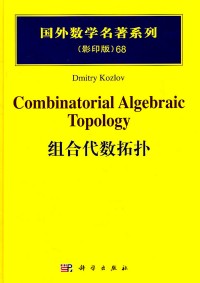
简介
Combinatorial algebraic topology is a fascinating and dynamic field at the crossroads of algebraic topology and discrete mathematics. This volume is the first comprehensive treatment of the subject in book form. The first part of the book constitutes a swirl walk through the main tools of algebraic topology, including Stiefel-Whitney characteristic classes, which are needed for the later parts. Readers - graduate students and working mathematicians alike - will probably find particularly useful the second part, which contains an in-depth discussion of the major research techniques of combinatorial algebraic topology. Our presentation of standard topics is quite different from that of existing texts. In addition, several new themes, such as spectral sequences, are included. Although applications are sprinkled throughout the second part, they are principal focus of the third part,which is entirely devoted to developing the topological structure theory for graph homomorphisms. The main benefit for the reader will be the prospect of fairly quickly getting to the forefront of modem research in this active field.
目录
《组合代数拓扑(英文影印版)》
1 overture
part i concepts of algebraic topology
2 cell complexes
2.1 abstract simplicial complexes
2.1.1 definition of abstract simplicial complexes and maps between them
2.1.2 deletion, link, star, and wedge
2.1.3 simplicial join
2.1.4 face posets
2.1.5 barycentric and stellar subdivisions
2.1.6 pulling and pushing simplicial structures
2.2 polyhedral complexes
2.2.1 geometry of abstract simplicial complexes
2.2.2 geometric meaning of the combinatorial constructions
2.2.3 geometric simplicial complexes
2.2.4 complexes whose cells belong to a specified set of polyhedra
2.3 trisps
2.3.1 construction using the gluing data
2.3.2 constructions involving trisps
2.4 cw complexes
.2.4.1 gluing along a map
2.4.2 constructive and intrinsic definitions
2.4.3 properties and examples
3 homology groups
3.1 betti numbers of finite abstract simplicial complexes
3.2 simplicial homology groups
3.2.1 homology groups of trisps with coefficients in 252
3.2.2 orientations
3.2.3 homology groups of trisps with integer coefficients.
3.3 invariants connected to homology groups
3.3.1 betti numbers and torsion coefficients
3.3.2 euler characteristic and the euler-poincard formula
3.4 variations
3.4.1 augmentation and reduced homology groups
3.4.2 homology groups with other coefficients
3.4.3 simplicial cohomology groups
3.4.4 singular homology
3.5 chain complexes
3.5.1 definition and homology of chain complexes
3.5.2 maps between chain complexes and induced maps on homology
3.5.3 chain homotopy
3.5.4 simplicial homology and cohomology in the context of chain complexes
3.5.5 homomorphisms on homology induced by trisp maps
3.6 cellular homology
3.6.1 an application of homology with integer coefficients: winding number
3.6.2 the definition of cellular homology
3.6.3 cellular maps and properties of cellular homology
4 concepts of category theory
4.1 the notion of a category
4.1.1 definition of a category, isomorphisms
4.1.2 examples of categories
4.2 some structure theory of categories
4.2.1 initial and terminal objects
4.2.2 products and coproducts
4.3 functors
4.3.1 the category cat
4.3.2 homology and cohomology viewed as functors
4.3.3 group actions as functors
4.4 limit constructions
4.4.1 definition of colimit of a functor
4.4.2 colimits and infinite unions
4.4.3 quotients of group actions as colimits
4.4.4 limits
4.5 comma categories
4.5.1 objects below and above other objects
4.5.2 the general construction and further examples
5 exact sequences
5.1 some structure theory of long and short exact sequences.
5.1.1 construction of the connecting homomorphism
5.1.2 exact sequences
5.1.3 deriving long exact sequences from short ones
5.2 the long exact sequence of a pair and some applications
5.2.1 relative homology and the associated long exact sequence
5.2.2 applications
5.3 mayer-vietoris long exact sequence
6 homotopy
6.1 homotopy of maps
6.2 homotopy type of topological spaces
6.3 mapping cone and mapping cylinder
6.4 deformation retracts and collapses
6.5 simple homotopy type
6.6 homotopy groups
6.7 connectivity and hurewicz theorems
7 cofibrations
7.1 cofibrations and the homotopy extension property
7.2 ndr-pairs
7.3 important facts involving cofibrations
7.4 the relative homotopy equivalence
8 principal f-bundles and stiefel-whitney characteristic classes
8.1 locally trivial bundles
8.1.1 bundle terminology
8.1.2 types of bundles
8.1.3 bundle maps
8.2 elements of the principal bundle theory
8.2.1 principal bundles and spaces with a free group action
8.2.2 the classifying space of a group
8.2.3 special cohomology elements
8.2.4 z2-spaces and the definition of stiefel-whitney classes
8.3 properties of stiefel-whitney classes
8.3.1 borsuk-ulam theorem, index, and coindex
8.3.2 stiefel-whitney height
8.3.3 higher connectivity and stiefel-whitney classes
8.3.4 combinatorial construction of stiefel-whitney classes.
8.4 suggested reading
part ii methods of combinatorial algebraic topology
9 combinatorial complexes melange
9.1 abstract simplicial complexes
9.1.1 simplieial flag complexes
9.1.2 order complexes
9.1.3 complexes of combinatorial properties
9.1.4 the neighborhood and lovasz complexes
9.1.5 complexes arising from matroids
9.1.6 geometric complexes in metric spaces
9.1.7 combinatorial presentation by minimal nonsimplices.
9.2 prodsimplicial complexes
9.2.1 prodsimplicial flag complexes
9.2.2 complex of complete bipartite subgraphs
9.2.3 horn complexes
9.2.4 general complexes of morphisms
9.2.5 discrete configuration spaces of generalized simplicial complexes
9.2.6 the complex of phylogenetic trees
9.3 regular trisps
9.4 chain complexes
9.5 bibliographic notes
10 acyclic categories
10.1 basics
10.1.1 the notion of acyclic category
10.1.2 linear extensions of acyclic categories
10.1.3 induced subcategories of cat
10.2 the regular trisp of composable morphism chains in an acyclic category
10.2.1 definition and first examples
10.2.2 functoriality
10.3 constructions
10.3.1 disjoint union as a coproduct
10.3.2 stacks of acyclic categories and joins of regular trisps
10.3.3 links, stars, and deletions
10.3.4 lattices and acyclic categories
10.3.5 barycentric subdivision and a-functor
10.4 intervals in acyclic categories
10.4.1 definition and first properties
10.4.2 acyclic category of intervals and its structural functor
10.4.3 topology of the category of intervals
10.5 homeomorphisms associated with the direct product construction
10.5.1 simplicial subdivision of the direct product
10.5.2 further subdivisions
10.6 the msbius function
10.6.1 msbius function for posets
10.6.2 msbius function for acyclic categories
10.7 bibliographic notes
11 discrete morse theory
11.1 discrete morse theory for posets
11.1.1 acyclic matchings in hasse diagrams of posets
11.1.2 poset maps with small fibers
11.1.3 universal object associated to an acyclic matching.
11.1.4 poset fibrations and the patchwork theorem
11.2 discrete morse theory for cw complexes
11.2.1 attaching cells to homotopy equivalent spaces
11.2.2 the main theorem of discrete morse theory for cw complexes
11.2.3 examples
11.3 algebraic morse theory
11.3.1 acyclic matchings on free chain complexes and the morse complex
11.3.2 the main theorem of algebraic morse theory
11.3.3 an example
11.4 bibliographic notes
12 lexicographic shellability
12.1 shellability
12.1.1 the basics
12.1.2 shelling induced subcomplexes
12.1.3 shelling nerves of acyclic categories
12.2 lexicographic shellability
12.2.1 labeling edges as a way to order chains
12.2.2 el-labeling
12.2.3 general lexicographic shellability
12.2.4 lexicographic shellability and nerves of acyclic categories
12.3 bibliographic notes
13 evasiveness and closure operators
13.1 evasiveness
13.1.1 evasiveness of graph properties
13.1.2 evasiveness of abstract simplicial complexes
13.2 closure operators
13.2.1 collapsing sequences induced by closure operators
13.2.2 applications
13.2.3 monotone poset maps
13.2.4 the reduction theorem and implications
13.3 further facts about nonevasiveness
13.3.1 ne~reduction and collapses
13.3.2 nonevasiveness of noncomplemented lattices
13.4 other recursively defined classes of complexes
13.5 bibliographic notes
14 colimits and quotients
14.1 quotients of nerves of acyclic categories
14.1.1 desirable properties of the quotient construction
14.1.2 quotients of simplicial actions
14.2 formalization of group actions and the main question
14.2.1 definition of the quotient and formulation of the main problem
14.2.2 an explicit description of the category c/g
14.3 conditions on group actions
14.3.1 outline of the results and surjectivity of the canonical map
14.3.2 condition for injectivity of the canonical projection.
14.3.3 conditions for the canonical projection to be an isomorphism
14.3.4 conditions for the categories to be closed under taking quotients
14.4 bibliographic notes
15 homotopy colimits
15.1 diagrams over trisps
15.1.1 diagrams and colimits
15.1.2 arrow pictures and their nerves
15.2 homotopy colimits
15.2.1 definition and some examples
15.2.2 structural maps associated to homotopy colimits
15.3 deforming homotopy colimits
15.4 nerves of coverings
15.4.1 nerve diagram
15.4.2 projection lemma
15.4.3 nerve lemmas
15.5 gluing spaces
15.5.1 gluing lemma
15.5.2 quillen lemma
15.6 bibliographic notes
16 spectral sequences
16.1 filtrations
16.2 contriving spectral sequences
16.2.1 the objects to be constructed
16.2.2 the actual construction
16.2.3 questions of convergence and interpretation of the answer
16.2.4 an example
16.3 maps between spectral sequences
16.4 spectral sequences and nerves of acyelic categories
16.4.1 a class of filtrations
16.4.2 m5bius function and inequalities for betti numbers
16.5 bibliographic notes
part iii complexes of graph homomorphisms
17 chromatic numbers and the kneser conjecture
17.1 the chromatic number of a graph
17.1.1 the definition and applications
17.1.2 the complexity of computing the chromatic number
17.1.3 the hadwiger conjecture
17.2 state graphs and the variations of the chromatic number
17.2.1 complete graphs as state graphs
17.2.2 kneser graphs as state graphs and fractional chromatic number
17.2.3 the circular chromatic number
17.3 kneser conjecture and lovasz test
17.3.1 formulation of the kneser conjecture
17.3.2 the properties of the neighborhood complex
17.3.3 lovasz test for graph colorings
17.3.4 simplicial and cubical complexes associated to kneser graphs
17.3.5 the vertex-critical subgraphs of kneser graphs
17.3.6 chromatic numbers of kneser hypergraphs
17.4 bibliographic notes
18 structural theory of morphism complexes
18.1 the scope of morphism complexes
18.1.1 the morphism complexes and the prodsimplicial flag construction
18.1.2 universality
18.2 special families of hem complexes
18.2.1 coloring complexes of a graph
18.2.2 complexes of bipartite subgraphs and neighborhood complexes
18.3 functoriality of horn (-, -)
18.3.1 functoriality on the right
18.3.2 aut (g) action on horn (t, g)
18.3.3 functoriality on the left
18.3.4 aut (t) action on horn (t, g)
18.3.5 commuting relations
18.4 products, compositions, and horn complexes
18.4.1 coproducts
18.4.2 products
18.4.3 composition of horn complexes
18.5 folds
18.5.1 definition and first properties
18.5.2 proof of the folding theorem
18.6 bibliographic notes
19 characteristic classes and chromatic numbers
19.1 stiefel-whitney characteristic classes and test graphs
19.1.1 powers of stiefel-whitney classes and chromatic numbers of graphs
19.1.2 stiefel-whitney test graphs
19.2 examples of stiefel-whitney test graphs
19.2.1 complexes of complete multipartite subgraphs
19.2.2 odd cycles as stiefel-whitney test graphs
19.3 homology tests for graph colorings
19.3.1 the symmetrizer operator and related structures
19.3.2 the topological rationale for the tests
19.3.3 homology tests
19.3.4 examples of homology tests with different test graphs
19.4 bibliographic notes
20 applications of spectral sequences to horn complexes
20.1 horn+ construction
20.1.1 various definitions
20.1.2 connection to independence complexes
20.1.3 the support map
20.1.4 an example: hom+(cm, kn)
20.2 setting up the spectral sequence
20.2.1 filtration induced by the support map
20.2.2 the 0th and the 1st tableaux
20.2.3 the first differential
20.3 encoding cohomology generators by arc pictures
20.3.1 the language of arcs
20.3.2 the corresponding cohomology generators
20.3.3 the first reduction
20.4 topology of the torus front complexes
20.4.1 reinterpretation of h*(a*t, d1) using a family of cubical complexes {φm,n,g }
20.4.2 the torus front interpretation
20.4.3 grinding
20.4.4 thin fronts
20.4.5 the implications for the cohomology groups of hom (cm, kn)
20.5 euler characteristic formula
20.6 cohomology with integer coefficients
20.6.1 fixing orientations on horn and horn+ complexes
20.6.2 signed versions of formulas for generators [as]
20.6.3 completing the calculation of the second tableau
20.6.4 summary: the full description of the groups h* (hom (cm, kn); z)
20.7 bibliographic notes and conclusion
references
index
1 overture
part i concepts of algebraic topology
2 cell complexes
2.1 abstract simplicial complexes
2.1.1 definition of abstract simplicial complexes and maps between them
2.1.2 deletion, link, star, and wedge
2.1.3 simplicial join
2.1.4 face posets
2.1.5 barycentric and stellar subdivisions
2.1.6 pulling and pushing simplicial structures
2.2 polyhedral complexes
2.2.1 geometry of abstract simplicial complexes
2.2.2 geometric meaning of the combinatorial constructions
2.2.3 geometric simplicial complexes
2.2.4 complexes whose cells belong to a specified set of polyhedra
2.3 trisps
2.3.1 construction using the gluing data
2.3.2 constructions involving trisps
2.4 cw complexes
.2.4.1 gluing along a map
2.4.2 constructive and intrinsic definitions
2.4.3 properties and examples
3 homology groups
3.1 betti numbers of finite abstract simplicial complexes
3.2 simplicial homology groups
3.2.1 homology groups of trisps with coefficients in 252
3.2.2 orientations
3.2.3 homology groups of trisps with integer coefficients.
3.3 invariants connected to homology groups
3.3.1 betti numbers and torsion coefficients
3.3.2 euler characteristic and the euler-poincard formula
3.4 variations
3.4.1 augmentation and reduced homology groups
3.4.2 homology groups with other coefficients
3.4.3 simplicial cohomology groups
3.4.4 singular homology
3.5 chain complexes
3.5.1 definition and homology of chain complexes
3.5.2 maps between chain complexes and induced maps on homology
3.5.3 chain homotopy
3.5.4 simplicial homology and cohomology in the context of chain complexes
3.5.5 homomorphisms on homology induced by trisp maps
3.6 cellular homology
3.6.1 an application of homology with integer coefficients: winding number
3.6.2 the definition of cellular homology
3.6.3 cellular maps and properties of cellular homology
4 concepts of category theory
4.1 the notion of a category
4.1.1 definition of a category, isomorphisms
4.1.2 examples of categories
4.2 some structure theory of categories
4.2.1 initial and terminal objects
4.2.2 products and coproducts
4.3 functors
4.3.1 the category cat
4.3.2 homology and cohomology viewed as functors
4.3.3 group actions as functors
4.4 limit constructions
4.4.1 definition of colimit of a functor
4.4.2 colimits and infinite unions
4.4.3 quotients of group actions as colimits
4.4.4 limits
4.5 comma categories
4.5.1 objects below and above other objects
4.5.2 the general construction and further examples
5 exact sequences
5.1 some structure theory of long and short exact sequences.
5.1.1 construction of the connecting homomorphism
5.1.2 exact sequences
5.1.3 deriving long exact sequences from short ones
5.2 the long exact sequence of a pair and some applications
5.2.1 relative homology and the associated long exact sequence
5.2.2 applications
5.3 mayer-vietoris long exact sequence
6 homotopy
6.1 homotopy of maps
6.2 homotopy type of topological spaces
6.3 mapping cone and mapping cylinder
6.4 deformation retracts and collapses
6.5 simple homotopy type
6.6 homotopy groups
6.7 connectivity and hurewicz theorems
7 cofibrations
7.1 cofibrations and the homotopy extension property
7.2 ndr-pairs
7.3 important facts involving cofibrations
7.4 the relative homotopy equivalence
8 principal f-bundles and stiefel-whitney characteristic classes
8.1 locally trivial bundles
8.1.1 bundle terminology
8.1.2 types of bundles
8.1.3 bundle maps
8.2 elements of the principal bundle theory
8.2.1 principal bundles and spaces with a free group action
8.2.2 the classifying space of a group
8.2.3 special cohomology elements
8.2.4 z2-spaces and the definition of stiefel-whitney classes
8.3 properties of stiefel-whitney classes
8.3.1 borsuk-ulam theorem, index, and coindex
8.3.2 stiefel-whitney height
8.3.3 higher connectivity and stiefel-whitney classes
8.3.4 combinatorial construction of stiefel-whitney classes.
8.4 suggested reading
part ii methods of combinatorial algebraic topology
9 combinatorial complexes melange
9.1 abstract simplicial complexes
9.1.1 simplieial flag complexes
9.1.2 order complexes
9.1.3 complexes of combinatorial properties
9.1.4 the neighborhood and lovasz complexes
9.1.5 complexes arising from matroids
9.1.6 geometric complexes in metric spaces
9.1.7 combinatorial presentation by minimal nonsimplices.
9.2 prodsimplicial complexes
9.2.1 prodsimplicial flag complexes
9.2.2 complex of complete bipartite subgraphs
9.2.3 horn complexes
9.2.4 general complexes of morphisms
9.2.5 discrete configuration spaces of generalized simplicial complexes
9.2.6 the complex of phylogenetic trees
9.3 regular trisps
9.4 chain complexes
9.5 bibliographic notes
10 acyclic categories
10.1 basics
10.1.1 the notion of acyclic category
10.1.2 linear extensions of acyclic categories
10.1.3 induced subcategories of cat
10.2 the regular trisp of composable morphism chains in an acyclic category
10.2.1 definition and first examples
10.2.2 functoriality
10.3 constructions
10.3.1 disjoint union as a coproduct
10.3.2 stacks of acyclic categories and joins of regular trisps
10.3.3 links, stars, and deletions
10.3.4 lattices and acyclic categories
10.3.5 barycentric subdivision and a-functor
10.4 intervals in acyclic categories
10.4.1 definition and first properties
10.4.2 acyclic category of intervals and its structural functor
10.4.3 topology of the category of intervals
10.5 homeomorphisms associated with the direct product construction
10.5.1 simplicial subdivision of the direct product
10.5.2 further subdivisions
10.6 the msbius function
10.6.1 msbius function for posets
10.6.2 msbius function for acyclic categories
10.7 bibliographic notes
11 discrete morse theory
11.1 discrete morse theory for posets
11.1.1 acyclic matchings in hasse diagrams of posets
11.1.2 poset maps with small fibers
11.1.3 universal object associated to an acyclic matching.
11.1.4 poset fibrations and the patchwork theorem
11.2 discrete morse theory for cw complexes
11.2.1 attaching cells to homotopy equivalent spaces
11.2.2 the main theorem of discrete morse theory for cw complexes
11.2.3 examples
11.3 algebraic morse theory
11.3.1 acyclic matchings on free chain complexes and the morse complex
11.3.2 the main theorem of algebraic morse theory
11.3.3 an example
11.4 bibliographic notes
12 lexicographic shellability
12.1 shellability
12.1.1 the basics
12.1.2 shelling induced subcomplexes
12.1.3 shelling nerves of acyclic categories
12.2 lexicographic shellability
12.2.1 labeling edges as a way to order chains
12.2.2 el-labeling
12.2.3 general lexicographic shellability
12.2.4 lexicographic shellability and nerves of acyclic categories
12.3 bibliographic notes
13 evasiveness and closure operators
13.1 evasiveness
13.1.1 evasiveness of graph properties
13.1.2 evasiveness of abstract simplicial complexes
13.2 closure operators
13.2.1 collapsing sequences induced by closure operators
13.2.2 applications
13.2.3 monotone poset maps
13.2.4 the reduction theorem and implications
13.3 further facts about nonevasiveness
13.3.1 ne~reduction and collapses
13.3.2 nonevasiveness of noncomplemented lattices
13.4 other recursively defined classes of complexes
13.5 bibliographic notes
14 colimits and quotients
14.1 quotients of nerves of acyclic categories
14.1.1 desirable properties of the quotient construction
14.1.2 quotients of simplicial actions
14.2 formalization of group actions and the main question
14.2.1 definition of the quotient and formulation of the main problem
14.2.2 an explicit description of the category c/g
14.3 conditions on group actions
14.3.1 outline of the results and surjectivity of the canonical map
14.3.2 condition for injectivity of the canonical projection.
14.3.3 conditions for the canonical projection to be an isomorphism
14.3.4 conditions for the categories to be closed under taking quotients
14.4 bibliographic notes
15 homotopy colimits
15.1 diagrams over trisps
15.1.1 diagrams and colimits
15.1.2 arrow pictures and their nerves
15.2 homotopy colimits
15.2.1 definition and some examples
15.2.2 structural maps associated to homotopy colimits
15.3 deforming homotopy colimits
15.4 nerves of coverings
15.4.1 nerve diagram
15.4.2 projection lemma
15.4.3 nerve lemmas
15.5 gluing spaces
15.5.1 gluing lemma
15.5.2 quillen lemma
15.6 bibliographic notes
16 spectral sequences
16.1 filtrations
16.2 contriving spectral sequences
16.2.1 the objects to be constructed
16.2.2 the actual construction
16.2.3 questions of convergence and interpretation of the answer
16.2.4 an example
16.3 maps between spectral sequences
16.4 spectral sequences and nerves of acyelic categories
16.4.1 a class of filtrations
16.4.2 m5bius function and inequalities for betti numbers
16.5 bibliographic notes
part iii complexes of graph homomorphisms
17 chromatic numbers and the kneser conjecture
17.1 the chromatic number of a graph
17.1.1 the definition and applications
17.1.2 the complexity of computing the chromatic number
17.1.3 the hadwiger conjecture
17.2 state graphs and the variations of the chromatic number
17.2.1 complete graphs as state graphs
17.2.2 kneser graphs as state graphs and fractional chromatic number
17.2.3 the circular chromatic number
17.3 kneser conjecture and lovasz test
17.3.1 formulation of the kneser conjecture
17.3.2 the properties of the neighborhood complex
17.3.3 lovasz test for graph colorings
17.3.4 simplicial and cubical complexes associated to kneser graphs
17.3.5 the vertex-critical subgraphs of kneser graphs
17.3.6 chromatic numbers of kneser hypergraphs
17.4 bibliographic notes
18 structural theory of morphism complexes
18.1 the scope of morphism complexes
18.1.1 the morphism complexes and the prodsimplicial flag construction
18.1.2 universality
18.2 special families of hem complexes
18.2.1 coloring complexes of a graph
18.2.2 complexes of bipartite subgraphs and neighborhood complexes
18.3 functoriality of horn (-, -)
18.3.1 functoriality on the right
18.3.2 aut (g) action on horn (t, g)
18.3.3 functoriality on the left
18.3.4 aut (t) action on horn (t, g)
18.3.5 commuting relations
18.4 products, compositions, and horn complexes
18.4.1 coproducts
18.4.2 products
18.4.3 composition of horn complexes
18.5 folds
18.5.1 definition and first properties
18.5.2 proof of the folding theorem
18.6 bibliographic notes
19 characteristic classes and chromatic numbers
19.1 stiefel-whitney characteristic classes and test graphs
19.1.1 powers of stiefel-whitney classes and chromatic numbers of graphs
19.1.2 stiefel-whitney test graphs
19.2 examples of stiefel-whitney test graphs
19.2.1 complexes of complete multipartite subgraphs
19.2.2 odd cycles as stiefel-whitney test graphs
19.3 homology tests for graph colorings
19.3.1 the symmetrizer operator and related structures
19.3.2 the topological rationale for the tests
19.3.3 homology tests
19.3.4 examples of homology tests with different test graphs
19.4 bibliographic notes
20 applications of spectral sequences to horn complexes
20.1 horn+ construction
20.1.1 various definitions
20.1.2 connection to independence complexes
20.1.3 the support map
20.1.4 an example: hom+(cm, kn)
20.2 setting up the spectral sequence
20.2.1 filtration induced by the support map
20.2.2 the 0th and the 1st tableaux
20.2.3 the first differential
20.3 encoding cohomology generators by arc pictures
20.3.1 the language of arcs
20.3.2 the corresponding cohomology generators
20.3.3 the first reduction
20.4 topology of the torus front complexes
20.4.1 reinterpretation of h*(a*t, d1) using a family of cubical complexes {φm,n,g }
20.4.2 the torus front interpretation
20.4.3 grinding
20.4.4 thin fronts
20.4.5 the implications for the cohomology groups of hom (cm, kn)
20.5 euler characteristic formula
20.6 cohomology with integer coefficients
20.6.1 fixing orientations on horn and horn+ complexes
20.6.2 signed versions of formulas for generators [as]
20.6.3 completing the calculation of the second tableau
20.6.4 summary: the full description of the groups h* (hom (cm, kn); z)
20.7 bibliographic notes and conclusion
references
index
Combinatorial algebraic topology
- 名称
- 类型
- 大小
光盘服务联系方式: 020-38250260 客服QQ:4006604884
云图客服:
用户发送的提问,这种方式就需要有位在线客服来回答用户的问题,这种 就属于对话式的,问题是这种提问是否需要用户登录才能提问
Video Player
×
Audio Player
×
pdf Player
×
