

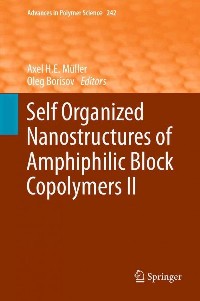
简介
Thomas Hellweg Block Copolymer Surfactant Mixtures in Aqueous Solution: Can we Achieve Size and Shape Control by Co-Micellization? Vladimir Aseyev Heikki Tenhu Fran莽oise Winnik Non-ionic Thermoresponsive Polymers in Water Yun Yan Arie de Keizer Martien A. Cohen Stuart Nicolaas A. M. Besseling From Coordination Polymers to Hierarchical Self-Assembled Structures Ioan Botiz Helmut Schlaad G眉nter Reiter Processes of Ordered Structure Formation in Polypeptide Thin Film Solutions Katarzyna Kita-Tokarczyk Mathias Junginger Serena Belegrinou Andreas Taubert Amphiphilic Polymers at Interfaces 聽
目录
Preface 9
Contents 13
Block Copolymer Surfactant Mixtures in Aqueous Solution: Can we Achieve Size and Shape Control by Co-Micellization? 15
1 Introduction 16
2 Triblock Copolymers 17
2.1 Ionic Surfactants 19
2.1.1 Systems with More Components 22
2.2 Nonionic Surfactants 24
3 Diblock Copolymers 25
3.1 Ionic Surfactants 26
3.2 Nonionic Surfactants 31
3.2.1 Systems with More Components 34
4 Other Systems 35
4.1 Amphiphilic Poly(p-phenylenes) 36
5 Summary and Outlook 36
References 38
Non-ionic Thermoresponsive Polymers in Water 42
1 Scope of the Review 44
2 Synthesis 45
3 Polymers in Aqueous Media: Selected Reviews 46
4 Thermal Responsiveness versus Hydrophobic Association 52
4.1 Sensitivity and Responsiveness 52
4.2 The LCST-Type Transition 54
4.3 Phenomenological Classification 56
4.4 The Hydrophobic Interaction 56
4.5 Cooperativity of the LCST Transition 57
4.6 Elastin-Like Polymers 59
5 Self-Organization versus Steric Stabilization 60
5.1 Colloidal Stability 60
5.2 Hydrophobic Self-Association 61
5.3 Protein-Like Copolymers 63
5.4 Mesoglobules of Homopolymers 63
6 List of Thermoresponsive Homopolymers 64
7 Some Generalizations 82
7.1 Structural Effects 82
7.2 Structural Isomers of PiPAAm 83
7.3 Hysteresis 84
7.4 Effect of Macromolecular Architecture 85
7.5 Cyclic Polymers 86
7.6 Telechelic Amphiphilic Polymers 87
7.7 Cononsolvency 88
8 Postscript 89
References 89
From Coordination Polymers to Hierarchical Self-Assembled Structures 103
1 Introduction 104
2 Reversible Coordination Polymers 105
2.1 Metal Ions and Ligands Suitable for Forming Coordination Polymers 105
2.2 Structure of Coordination Polymers 107
2.3 Properties of Reversible Coordination Polymers 110
2.3.1 Formation of Reversible Coordination Polymers 110
2.3.2 Concentration Dependence 111
2.3.3 pH Dependence 112
2.3.4 Charge Nature 113
3 Nanostructures Based on Coordination Polymers 114
3.1 Thin Layer-by-Layer Films 114
3.2 Langmuir and Langmuir\u2013Blodgett Films 116
3.3 Micelles 117
3.3.1 Micelle Formation 117
3.3.2 Critical Micellar Concentration 119
3.3.3 Stability 119
3.3.4 Wormlike Micelles 121
3.4 Microemulsions 121
3.5 Nanoribbons 122
4 Conclusions and Perspectives 125
References 126
Processes of Ordered Structure Formation in Polypeptide Thin Film Solutions 128
1 Introduction 129
2 Experimental 130
2.1 Polymers 130
2.2 Preparation and Observation of Thin Film Solutions 131
2.3 ``Equilibrium'' and ``Off-Equilibrium'' Experiments 131
2.4 Determining the Concentration of Thin Film Solutions 133
3 Results and Discussions 134
3.1 Nucleation in Solution Films in Dry Air 134
3.2 Nucleation in Solution Films in Ambient Air 137
3.3 Influence of Protic Non-Solvents on Nucleation in Thin Film Solutions 141
3.4 Reversible Influence of Protic Non-Solvents on Nucleation in Thin Film Solutions 142
3.5 Origin of Bimodal and Multimodal Distributions in Size of the Resulting Ordered Objects 146
3.6 Kinetics of Growing Ordered Objects 149
3.7 Origin of the Anisotropic Shape of the Resulting Ordered Objects 150
3.8 Growth in the Out-of-Plane Direction of the Resulting Ordered Objects 153
3.9 Concerted Changes of the Growth Direction: Dependence on Polymer Architecture 154
4 Conclusions 157
References 158
Amphiphilic Polymers at Interfaces 161
1 Amphiphilic Polymers at the Air\u2013Water Interface 164
1.1 Soluble and Insoluble Monolayers at the Air\u2013Water Interface 164
1.2 Characterization of Langmuir Monolayers 165
1.2.1 Surface Pressure\u2013Area Isotherms 165
1.2.2 Brewster Angle Microscopy 168
1.3 Polymer Monolayers 169
1.4 Monolayers from Amphiphilic Block Copolymers 170
1.4.1 Poly(ethylene oxide)\u2013Based Block Copolymers 170
1.4.2 Silicon-Containing Block Polymers 177
1.4.3 Charged and pH-Responsive Polymers 180
1.4.4 Acrylate-Based Polymers 182
2 Amphiphilic Block Copolymers on Solid Surfaces 185
2.1 Planar Thin Block Copolymer Films on (Planar) Solid Surfaces 185
2.1.1 Film Preparation 186
2.1.2 Planar Solid-Supported Amphiphilic Block Copolymer Membranes 187
2.1.3 Alteration of Surface Properties Through Modifications with Block Copolymers 188
2.1.4 Application in Biomaterials Science and Nanotechnology 188
2.2 Block Copolymer Aggregates on Planar Solid Surfaces 192
3 Mineralization of Amphiphilic Polymers and Related Compounds 196
3.1 Mineralization at the Air\u2013Water Interface 196
3.2 Mineralization at the Air\u2013Water Interface with Additives in the Subphase 200
3.3 Mineralization at the Solid\u2013Liquid Interface 201
References 206
Index 212
Contents 13
Block Copolymer Surfactant Mixtures in Aqueous Solution: Can we Achieve Size and Shape Control by Co-Micellization? 15
1 Introduction 16
2 Triblock Copolymers 17
2.1 Ionic Surfactants 19
2.1.1 Systems with More Components 22
2.2 Nonionic Surfactants 24
3 Diblock Copolymers 25
3.1 Ionic Surfactants 26
3.2 Nonionic Surfactants 31
3.2.1 Systems with More Components 34
4 Other Systems 35
4.1 Amphiphilic Poly(p-phenylenes) 36
5 Summary and Outlook 36
References 38
Non-ionic Thermoresponsive Polymers in Water 42
1 Scope of the Review 44
2 Synthesis 45
3 Polymers in Aqueous Media: Selected Reviews 46
4 Thermal Responsiveness versus Hydrophobic Association 52
4.1 Sensitivity and Responsiveness 52
4.2 The LCST-Type Transition 54
4.3 Phenomenological Classification 56
4.4 The Hydrophobic Interaction 56
4.5 Cooperativity of the LCST Transition 57
4.6 Elastin-Like Polymers 59
5 Self-Organization versus Steric Stabilization 60
5.1 Colloidal Stability 60
5.2 Hydrophobic Self-Association 61
5.3 Protein-Like Copolymers 63
5.4 Mesoglobules of Homopolymers 63
6 List of Thermoresponsive Homopolymers 64
7 Some Generalizations 82
7.1 Structural Effects 82
7.2 Structural Isomers of PiPAAm 83
7.3 Hysteresis 84
7.4 Effect of Macromolecular Architecture 85
7.5 Cyclic Polymers 86
7.6 Telechelic Amphiphilic Polymers 87
7.7 Cononsolvency 88
8 Postscript 89
References 89
From Coordination Polymers to Hierarchical Self-Assembled Structures 103
1 Introduction 104
2 Reversible Coordination Polymers 105
2.1 Metal Ions and Ligands Suitable for Forming Coordination Polymers 105
2.2 Structure of Coordination Polymers 107
2.3 Properties of Reversible Coordination Polymers 110
2.3.1 Formation of Reversible Coordination Polymers 110
2.3.2 Concentration Dependence 111
2.3.3 pH Dependence 112
2.3.4 Charge Nature 113
3 Nanostructures Based on Coordination Polymers 114
3.1 Thin Layer-by-Layer Films 114
3.2 Langmuir and Langmuir\u2013Blodgett Films 116
3.3 Micelles 117
3.3.1 Micelle Formation 117
3.3.2 Critical Micellar Concentration 119
3.3.3 Stability 119
3.3.4 Wormlike Micelles 121
3.4 Microemulsions 121
3.5 Nanoribbons 122
4 Conclusions and Perspectives 125
References 126
Processes of Ordered Structure Formation in Polypeptide Thin Film Solutions 128
1 Introduction 129
2 Experimental 130
2.1 Polymers 130
2.2 Preparation and Observation of Thin Film Solutions 131
2.3 ``Equilibrium'' and ``Off-Equilibrium'' Experiments 131
2.4 Determining the Concentration of Thin Film Solutions 133
3 Results and Discussions 134
3.1 Nucleation in Solution Films in Dry Air 134
3.2 Nucleation in Solution Films in Ambient Air 137
3.3 Influence of Protic Non-Solvents on Nucleation in Thin Film Solutions 141
3.4 Reversible Influence of Protic Non-Solvents on Nucleation in Thin Film Solutions 142
3.5 Origin of Bimodal and Multimodal Distributions in Size of the Resulting Ordered Objects 146
3.6 Kinetics of Growing Ordered Objects 149
3.7 Origin of the Anisotropic Shape of the Resulting Ordered Objects 150
3.8 Growth in the Out-of-Plane Direction of the Resulting Ordered Objects 153
3.9 Concerted Changes of the Growth Direction: Dependence on Polymer Architecture 154
4 Conclusions 157
References 158
Amphiphilic Polymers at Interfaces 161
1 Amphiphilic Polymers at the Air\u2013Water Interface 164
1.1 Soluble and Insoluble Monolayers at the Air\u2013Water Interface 164
1.2 Characterization of Langmuir Monolayers 165
1.2.1 Surface Pressure\u2013Area Isotherms 165
1.2.2 Brewster Angle Microscopy 168
1.3 Polymer Monolayers 169
1.4 Monolayers from Amphiphilic Block Copolymers 170
1.4.1 Poly(ethylene oxide)\u2013Based Block Copolymers 170
1.4.2 Silicon-Containing Block Polymers 177
1.4.3 Charged and pH-Responsive Polymers 180
1.4.4 Acrylate-Based Polymers 182
2 Amphiphilic Block Copolymers on Solid Surfaces 185
2.1 Planar Thin Block Copolymer Films on (Planar) Solid Surfaces 185
2.1.1 Film Preparation 186
2.1.2 Planar Solid-Supported Amphiphilic Block Copolymer Membranes 187
2.1.3 Alteration of Surface Properties Through Modifications with Block Copolymers 188
2.1.4 Application in Biomaterials Science and Nanotechnology 188
2.2 Block Copolymer Aggregates on Planar Solid Surfaces 192
3 Mineralization of Amphiphilic Polymers and Related Compounds 196
3.1 Mineralization at the Air\u2013Water Interface 196
3.2 Mineralization at the Air\u2013Water Interface with Additives in the Subphase 200
3.3 Mineralization at the Solid\u2013Liquid Interface 201
References 206
Index 212
- 名称
- 类型
- 大小
光盘服务联系方式: 020-38250260 客服QQ:4006604884
云图客服:
用户发送的提问,这种方式就需要有位在线客服来回答用户的问题,这种 就属于对话式的,问题是这种提问是否需要用户登录才能提问
Video Player
×
Audio Player
×
pdf Player
×
