

简介
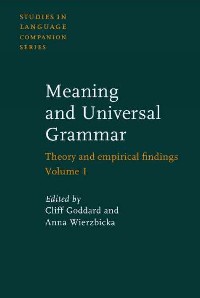
This two-volume set of studies takes as its starting point an old idea: the idea that universal grammar is based on meaning. It seeks to give this idea a solid theoretical foundation, and to explore its viability through detailed empirical studies in a set of typologically divergent languages (Lao, Malay, Mandarin Chinese, Mangaaba- Mbula, Polish and Spanish). As the twentieth century recedes, linguists seem increasingly to agree that the "anti-semantic turn" inaugurated by Leonard Bloomfield and continued by Noam Chomsky was a wrong turn. It is now widely believed that the grammatical properties of a word follow, at least in large measure, from its meaning. But it is true to say that in generative linguistics, semantics is still in a theoretically and methodologically underdeveloped state. It would not be going too far to compare much modern semantic work to phonology before the advent of phonemic analysis. There is little agreement on fundamental methodological problems such as how to distinguish semantic invariants from contextual effects, how to distinguish polysemy from semantic generality, and, above all, on the nature of semantic representation itself. All too often, individual researchers cobble together frameworks to suit their immediate needs, with little regard to how these frameworks can be integrated into a comprehensive system. Viewed against this background, the natural semantic metalanguage (NSM) framework stands out sharply (cf. Wierzbicka 1972, 1980, 1992, 1996; Goddard 1998; Goddard and Wierzbicka Eds 1994; and many other studies listed in this volume, chapter 1). It has been developed and refined over some thirty years. It provides a comprehensive system equally applicable to lexical, grammatical, and illocutionary meaning. It provides a clear and practical methodology for semantic analysis, which has proved itself in literally hundreds of studies in descriptive semantics.
目录
Table Of Contents:
Acknowledgements xi
List of Contributors xiii
List of Maps and Tables xv
Typographical Conventions and Symbols xv
Opening Statement 1(322)
Cliff Goddard
Anna Wierzbicka
Part 1: General
The Search for the Shared Semantic Core of All Languages 5(36)
Cliff Goddard
Introduction 5(8)
Identifying semantic primes and their exponents 13(3)
How were the primes identified in the first place? 16(4)
Allolexy and portmanteaus 20(4)
When the exponents of primes have secondary, polysemic meanings 24(2)
Non-compositional polysemy (motivated homonymy) between primes 26(5)
The syntax of semantic primes 31(10)
Semantic Primes and Universal Grammar 41(46)
Cliff Goddard
Anna Wierzbicka
Preliminaries 41(3)
Substantive phrase 44(3)
Specifiers 47(4)
Predicate and predicate phrases 51(15)
Temporal and locational adjuncts 66(5)
Other elements 71(8)
The textual structure of NSM explications 79(8)
Part 2: Individual Language Studies
Semantic Primes and Universal Grammar in Malay (Bahasa Melayu) 87(86)
Cliff Goddard
Introduction 87(2)
Substantives 89(10)
Mental predicates 99(6)
Speech 105(4)
Actions, events, and movement 109(5)
Existence and possession 114(4)
Life and death 118(3)
Determiners 121(5)
Quantifiers 126(6)
Evaluators 132(4)
Descriptors 136(1)
Time 136(10)
Space 146(5)
Logical concepts 151(6)
Augmentor 157(2)
Intensifier 159(1)
Taxonomy and partonomy 160(1)
Similarity 161(1)
Review 162(11)
Two NSM texts in Malay 164(4)
Exponents of semantic primes in Malay 168(5)
La Metalengua Semantica Natural: The Natural Semantic Metalanguage of Spanish 173(70)
Catherine Travis
Introduction 173(4)
Substantives 177(9)
Mental predicates 186(10)
Speech 196(2)
Actions, events and movement 198(4)
Existence and possession 202(2)
Life and death 204(1)
Determiners 204(3)
Quantifiers 207(3)
Evaluators 210(3)
Descriptors 213(2)
Time 215(6)
Space 221(4)
Logical concepts 225(5)
Augmentor 230(1)
Intensifier 230(1)
Taxonomy and partonomy 231(1)
Similarity 232(1)
Conclusion 233(10)
Two NSM texts in Spanish 234(4)
Exponents of semantic primes in Spanish 238(5)
The Universal Syntax of Semantic Primes in Mandarin Chinese 243(80)
Hilary Chappell
Typological features of Mandarin 243(5)
Substantives 248(4)
Determiners 252(6)
Quantifiers 258(5)
Evaluators 263(3)
Descriptors 266(1)
Mental predicates 267(5)
Speech 272(6)
Actions, events, and movement 278(7)
Existence and possession 285(2)
Life and death 287(3)
Time 290(5)
Space 295(6)
Logical concepts 301(5)
Intensifier 306(2)
Augmentor 308(1)
Taxonomy and partonomy 308(1)
Similarity 309(2)
Conclusion 311(12)
Two NSM texts in Mandarin 313(3)
Exponents of semantic primes in Mandarin 316(7)
Index of Languages and Language Families 323(2)
General Index 325
Acknowledgements xi
List of Contributors xiii
List of Maps and Tables xv
Typographical Conventions and Symbols xv
Opening Statement 1(322)
Cliff Goddard
Anna Wierzbicka
Part 1: General
The Search for the Shared Semantic Core of All Languages 5(36)
Cliff Goddard
Introduction 5(8)
Identifying semantic primes and their exponents 13(3)
How were the primes identified in the first place? 16(4)
Allolexy and portmanteaus 20(4)
When the exponents of primes have secondary, polysemic meanings 24(2)
Non-compositional polysemy (motivated homonymy) between primes 26(5)
The syntax of semantic primes 31(10)
Semantic Primes and Universal Grammar 41(46)
Cliff Goddard
Anna Wierzbicka
Preliminaries 41(3)
Substantive phrase 44(3)
Specifiers 47(4)
Predicate and predicate phrases 51(15)
Temporal and locational adjuncts 66(5)
Other elements 71(8)
The textual structure of NSM explications 79(8)
Part 2: Individual Language Studies
Semantic Primes and Universal Grammar in Malay (Bahasa Melayu) 87(86)
Cliff Goddard
Introduction 87(2)
Substantives 89(10)
Mental predicates 99(6)
Speech 105(4)
Actions, events, and movement 109(5)
Existence and possession 114(4)
Life and death 118(3)
Determiners 121(5)
Quantifiers 126(6)
Evaluators 132(4)
Descriptors 136(1)
Time 136(10)
Space 146(5)
Logical concepts 151(6)
Augmentor 157(2)
Intensifier 159(1)
Taxonomy and partonomy 160(1)
Similarity 161(1)
Review 162(11)
Two NSM texts in Malay 164(4)
Exponents of semantic primes in Malay 168(5)
La Metalengua Semantica Natural: The Natural Semantic Metalanguage of Spanish 173(70)
Catherine Travis
Introduction 173(4)
Substantives 177(9)
Mental predicates 186(10)
Speech 196(2)
Actions, events and movement 198(4)
Existence and possession 202(2)
Life and death 204(1)
Determiners 204(3)
Quantifiers 207(3)
Evaluators 210(3)
Descriptors 213(2)
Time 215(6)
Space 221(4)
Logical concepts 225(5)
Augmentor 230(1)
Intensifier 230(1)
Taxonomy and partonomy 231(1)
Similarity 232(1)
Conclusion 233(10)
Two NSM texts in Spanish 234(4)
Exponents of semantic primes in Spanish 238(5)
The Universal Syntax of Semantic Primes in Mandarin Chinese 243(80)
Hilary Chappell
Typological features of Mandarin 243(5)
Substantives 248(4)
Determiners 252(6)
Quantifiers 258(5)
Evaluators 263(3)
Descriptors 266(1)
Mental predicates 267(5)
Speech 272(6)
Actions, events, and movement 278(7)
Existence and possession 285(2)
Life and death 287(3)
Time 290(5)
Space 295(6)
Logical concepts 301(5)
Intensifier 306(2)
Augmentor 308(1)
Taxonomy and partonomy 308(1)
Similarity 309(2)
Conclusion 311(12)
Two NSM texts in Mandarin 313(3)
Exponents of semantic primes in Mandarin 316(7)
Index of Languages and Language Families 323(2)
General Index 325
- 名称
- 类型
- 大小
光盘服务联系方式: 020-38250260 客服QQ:4006604884
云图客服:
用户发送的提问,这种方式就需要有位在线客服来回答用户的问题,这种 就属于对话式的,问题是这种提问是否需要用户登录才能提问
Video Player
×
Audio Player
×
pdf Player
×
