

简介
`Here is a feast of diagrams, presented by many expert authors in a context of history of thought. It will be very useful for researchers, students and textbook writers.'
- Max Corden, University of Melbourne, Australia
`Francis Collins oversaw the human genome project. Mark Blaug and Peter Lloyd have done the same for economics, demonstrating that figures and diagrams are the DNA building blocks of the discipline. This book has them all: backward-bending labor supply, cobweb diagram, circular flow, production possibility frontier, Stolper-Samuelson box, IS/LM, the Phillips curve and many more. Each is portrayed, its importance explained, its origin revealed, and the reader often encounters Stigler's Law of Eponymy (No scientific discovery is named after its original discoverer).'
- Kenneth G. Elzinga, University of Virginia, US
`Both students and professors will welcome this original and unique collection. Analytically tighter and more complete expositions than much existing literature should be very welcome in graduate theory courses. Authors of history of economic thought texts will have to clarify and correct the historical record regarding who said what and when, and both reconfigure the assignment of credit and question use of the term "precursor": early users did more than hint at the full development; often creating tools.'
- Warren Samuels, Michigan State University, US
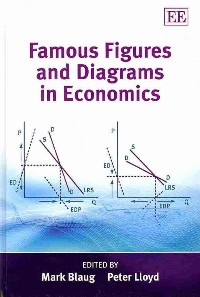
This is a unique account of the role played by 58 figures and diagrams commonly used in economic theory. These cover a large part of mainstream economic analysis, both microeconomics and macroeconomics and also general equilibrium theory.
The authoritative contributors have produced a well-considered and definitive selection including some from empirical research such as the Phillips curve, the Kuznets curve and the Lorenz curve. Almost all of them are still found in contemporary textbooks and research. Each entry presents an accurate and concise record of the history of the figure or diagram, including later developments and any controversy that arose in its development. As a whole, the book highlights how the use of geometric methods has played a central part in the development of economic theory and analysis; as a method of discovery, more commonly as a method of exposition and occasionally as a method of proof of propositions in economic theory and analysis.
This highly anticipated book will appeal to theorists in microeconomics or macroeconomics, scholars of economic theory and analysis, as well as students in microeconomics, general equilibrium theory or macroeconomics at the advanced undergraduate or graduate level who want a definitive account of some figure or diagram. Historians of economic thought and methodologists will also find this book an invaluable resource.
Contributors:S. Ashok, R.E. Backhouse, W.J. Baumol, M. Blaug, R. Boyer, L. Cameron, J.S. Chipman, A.J. Cohen, J.S. Cramer, J. Creedy, A.V. Deardorff, R.W. Dimand, A. Dixit, R. Dixon, B.C. Eaton, J. Eichberger, N. Erkal, R. F?¤re, L. Gangadharan, N. Giocoli, Y. Giraud, S. Grosskopf, H. Haller, D.W. Hands, G.C. Harcourt, T.M. Humphrey, R.W. Jones, N. Kakwani, M. Kemp, J.E. King, A.O. Krueger, D. Laidler, C. Lee, R.G. Lipsey, P. Lloyd, F. Maclachlan, R. Middleton, M. Nerlove, Y.-K. Ng, A. Panagariya, P. Rodenburg, R. Rothschild, M. Schneider, H.-l. Shi, A. Skinner, B.J. Spencer, H. Thompson, J. Whalley, R. Williams, W.C. Woo, A.D. Woodland, W. Young
目录
Table Of Contents:
List of figures ix
List of contributors xiv
Acknowledgements xvii
Introduction 1(28)
Mark Blaug
Peter Lloyd
Part I Single Market Analysis (Partial Equilibrium)
Basic tools of demand and supply curve analysis
1 Marshallian cross diagrams 29(9)
Thomas M. Humphrey
2 The stability of equilibrium 38(5)
Mark Blaug
3 Indifference curves and isoquants 43(7)
Mark Blaug
Peter Lloyd
4 The elasticity of substitution 50(8)
Robert Dixon
5 Substitution and income effects 58(6)
Hans Haller
6 Engel curves 64(5)
Ross Williams
7 Homothetic production and utility functions 69(4)
Rolf Fare
Shawna Grosskopf
8 Long-run and short-run cost curves 73(7)
Fiona MacLachlan
9 The product exhaustion theorem 80(3)
Cassey Lee
10 Classification of technical change 83(6)
Robert Dixon
11 Nash equilibrium 89(8)
Jurgen Eichberger
Welfare economics
12 Consumer surplus 97(7)
Yew-Kwang Ng
13 The Harberger triangle 104(6)
Yew-Kwang Ng
14 Community indifference curves and the Scitovsky `paradox' 110(11)
Richard G. Lipsey
15 The taxation of external costs 121(7)
Yew-Kwang Ng
16 Monopoly and price discrimination 128(9)
William J. Baumol
17 Duopoly reaction curves 137(8)
Nicola Giocoli
18 Monopolistic competition 145(9)
Andrew Skinner
19 Kinked demand curves 154(7)
R. Rothschild
Special markets and topics
20 Backward-bending labour supply curves 161(9)
John E. King
21 Location theory: the contributions of von Thunen and Losch 170(9)
B. Curtis Eaton
Richard G. Lipsey
22 Hotelling's model of spatial competition 179(5)
Nisvan Erkal
23 Cobweb diagrams 184(7)
Marc Nerlove
24 Reswitching and reversing in capital theory 191(8)
Avi J. Cohen
Geoffrey C. Harcourt
25 The Markowitz mean-variance diagram 199(5)
Fiona MacLachlan
26 Rent-seeking diagrams 204(5)
Anne O. Krueger
27 The logistic growth curve 209(3)
J.S. Cramer
28 Graph theory and networks 212(9)
Cassey Lee
Part II General Equilibrium Analysis
Basic tools of general equilibrium analysis
29 Circular flow diagrams 221(9)
Roger E. Backhouse
Yann Giraud
30 The unit simplex 230(3)
John Whalley
31 The Edgeworth box 233(6)
John Creedy
32 The role of numbers in competition 239(6)
John Creedy
33 Production possibilities frontiers 245(7)
Ronald W. Jones
34 The utility-possibility frontier 252(10)
John S. Chipman
35 The factor price frontier 262(10)
Alan D. Woodland
36 Pareto efficiency 272(8)
Peter Lloyd
37 The phase diagram technique for analyzing the stability of multiple-market equilibrium 280(6)
D. Wade Hands
38 The theory of second best and third best 286(9)
Wai Chiu Woo
Open economies
39 The offer curve 295(5)
Murray Kemp
40 The Stolper-Samuelson box 300(5)
Henry Thompson
41 The Lerner diagram 305(6)
Alan V. Deardorff
42 The trade theory diagram 311(6)
Peter Lloyd
43 The four-quadrant diagram for the two-sector Heckscher-Ohlin model 317(6)
Arvind Panagariya
44 The integrated world equilibrium diagram 323(5)
Avinash Dixit
45 The optimal tariff 328(9)
Murray Kemp
Part III Macroeconomics
Macroeconomic analysis and stabilisation
46 Keynesian income determination diagrams 337(11)
Michael Schneider
47 The IS-LM diagram 348(8)
Warren Young
48 The Fleming-Mundell diagram 356(9)
Russell Boyer
Warren Young
49 The aggregate demand aggregate supply diagram 365(12)
Richard G. Lipsey
50 The Phillips curve 377(16)
Richard G. Lipsey
51 The UV or Beveridge curve 393(8)
Peter Rodenburg
52 The demand curve for money 401(5)
David Laidler
53 Non-neutrality of money 406(6)
He-Ling Shi
54 The Laffer curve 412(9)
Roger Middleton
Growth, income distribution and other topics
55 Intertemporal utility maximization --- the Fisher diagram 421(5)
Thomas M. Humphrey
56 The diagrams of the Solow-Swan growth model 426(6)
Barbara J. Spencer
Robert W. Dimand
57 The Lorenz curve 432(7)
Nanak Kakwani
58 Kuznets curve 439(8)
Lisa Cameron
Lata Gangadharan
Sowmiya Ashok
Index 447
List of figures ix
List of contributors xiv
Acknowledgements xvii
Introduction 1(28)
Mark Blaug
Peter Lloyd
Part I Single Market Analysis (Partial Equilibrium)
Basic tools of demand and supply curve analysis
1 Marshallian cross diagrams 29(9)
Thomas M. Humphrey
2 The stability of equilibrium 38(5)
Mark Blaug
3 Indifference curves and isoquants 43(7)
Mark Blaug
Peter Lloyd
4 The elasticity of substitution 50(8)
Robert Dixon
5 Substitution and income effects 58(6)
Hans Haller
6 Engel curves 64(5)
Ross Williams
7 Homothetic production and utility functions 69(4)
Rolf Fare
Shawna Grosskopf
8 Long-run and short-run cost curves 73(7)
Fiona MacLachlan
9 The product exhaustion theorem 80(3)
Cassey Lee
10 Classification of technical change 83(6)
Robert Dixon
11 Nash equilibrium 89(8)
Jurgen Eichberger
Welfare economics
12 Consumer surplus 97(7)
Yew-Kwang Ng
13 The Harberger triangle 104(6)
Yew-Kwang Ng
14 Community indifference curves and the Scitovsky `paradox' 110(11)
Richard G. Lipsey
15 The taxation of external costs 121(7)
Yew-Kwang Ng
16 Monopoly and price discrimination 128(9)
William J. Baumol
17 Duopoly reaction curves 137(8)
Nicola Giocoli
18 Monopolistic competition 145(9)
Andrew Skinner
19 Kinked demand curves 154(7)
R. Rothschild
Special markets and topics
20 Backward-bending labour supply curves 161(9)
John E. King
21 Location theory: the contributions of von Thunen and Losch 170(9)
B. Curtis Eaton
Richard G. Lipsey
22 Hotelling's model of spatial competition 179(5)
Nisvan Erkal
23 Cobweb diagrams 184(7)
Marc Nerlove
24 Reswitching and reversing in capital theory 191(8)
Avi J. Cohen
Geoffrey C. Harcourt
25 The Markowitz mean-variance diagram 199(5)
Fiona MacLachlan
26 Rent-seeking diagrams 204(5)
Anne O. Krueger
27 The logistic growth curve 209(3)
J.S. Cramer
28 Graph theory and networks 212(9)
Cassey Lee
Part II General Equilibrium Analysis
Basic tools of general equilibrium analysis
29 Circular flow diagrams 221(9)
Roger E. Backhouse
Yann Giraud
30 The unit simplex 230(3)
John Whalley
31 The Edgeworth box 233(6)
John Creedy
32 The role of numbers in competition 239(6)
John Creedy
33 Production possibilities frontiers 245(7)
Ronald W. Jones
34 The utility-possibility frontier 252(10)
John S. Chipman
35 The factor price frontier 262(10)
Alan D. Woodland
36 Pareto efficiency 272(8)
Peter Lloyd
37 The phase diagram technique for analyzing the stability of multiple-market equilibrium 280(6)
D. Wade Hands
38 The theory of second best and third best 286(9)
Wai Chiu Woo
Open economies
39 The offer curve 295(5)
Murray Kemp
40 The Stolper-Samuelson box 300(5)
Henry Thompson
41 The Lerner diagram 305(6)
Alan V. Deardorff
42 The trade theory diagram 311(6)
Peter Lloyd
43 The four-quadrant diagram for the two-sector Heckscher-Ohlin model 317(6)
Arvind Panagariya
44 The integrated world equilibrium diagram 323(5)
Avinash Dixit
45 The optimal tariff 328(9)
Murray Kemp
Part III Macroeconomics
Macroeconomic analysis and stabilisation
46 Keynesian income determination diagrams 337(11)
Michael Schneider
47 The IS-LM diagram 348(8)
Warren Young
48 The Fleming-Mundell diagram 356(9)
Russell Boyer
Warren Young
49 The aggregate demand aggregate supply diagram 365(12)
Richard G. Lipsey
50 The Phillips curve 377(16)
Richard G. Lipsey
51 The UV or Beveridge curve 393(8)
Peter Rodenburg
52 The demand curve for money 401(5)
David Laidler
53 Non-neutrality of money 406(6)
He-Ling Shi
54 The Laffer curve 412(9)
Roger Middleton
Growth, income distribution and other topics
55 Intertemporal utility maximization --- the Fisher diagram 421(5)
Thomas M. Humphrey
56 The diagrams of the Solow-Swan growth model 426(6)
Barbara J. Spencer
Robert W. Dimand
57 The Lorenz curve 432(7)
Nanak Kakwani
58 Kuznets curve 439(8)
Lisa Cameron
Lata Gangadharan
Sowmiya Ashok
Index 447
- 名称
- 类型
- 大小
光盘服务联系方式: 020-38250260 客服QQ:4006604884
云图客服:
用户发送的提问,这种方式就需要有位在线客服来回答用户的问题,这种 就属于对话式的,问题是这种提问是否需要用户登录才能提问
Video Player
×
Audio Player
×
pdf Player
×
