

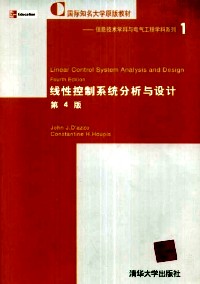
Linear control system analysis and design
副标题:无
作 者:(美)D’Azzo,J. J. ,(美)Houpis, C. H.著
分类号:
ISBN:9787302041368
微信扫一扫,移动浏览光盘
简介
由John J.Dazzo和Constantine H.Houpis编著的“Linear Control system Analysis and Design”五书,初版本出版于1975年,现今的第四版出版于1995年。《线性控制系统分析与设计》的定位是为期望获得控制理论的坚实基础的工程系科本科生提供一本内容智谋和可读性好的教材。在安排上覆盖了经典控制理论和现代控制理论的基础部分;在对象上包括了连续控制系统和数字控制系统;在方法上兼顾了频率响应法、根轨迹法和状态空间法;在论述上涉及到控制系统模型的建立、系统特性和性能的分析、以及基于状态反馈和输出反馈的控制器的设计等基本部分。
《线性控制系统分析与设计》问世以来,以其内容的基础性,论述的严谨性,教学的适用性,内容的不断删旧更新,而被症状国多所知名大学采用作为控制理论与控制工程专业方向的本科层次的控制理论教材或主要教学参考书。
目录
contents
preface
1 introduction
1 .l introdaction
l .2 introduction to control systems
l .3 definitions
l .4 historical background
l .5 digital control development
1 .6 mathematical backgmund
l .7 general nature of the engineering control problem
l .8 computer literacy
1 .9 outline of text
2 writing system equations
2.l introduction
2.2 elecuic circuits and components
2.3 basic linear matrix algebra
2.4 state concepts
2.5 transfer function and block diagram
2.6 mechanical translation systems
2.7 analogous circuits
. 2.8 mechanical rotational systems
2.9 thermal systems
2.1o hydraulic linear actuator
2.11 liquid-level system
2.l2 rotating power amplifiers
2.13 dc servomotor
2.14 ac servomotor
2.l5 lagrange's equation
2.l6 summary
3 solution of differential equations
3.1 introduction
3.2 standard inputs to control systems
3.3 steady-state response: sinasoidal input
3.4 steady-state response: polynomial input
3.5 transient response: classical method
3.6 definition of time constant
3.7 example: second-order system-mechanical
3.8 example: second-order system-electrical
3.9 second-order transients
3. 10 time-response specifications
3. 11 cad accuracy checks (cadac)
3. l2 state-variable equations
3. l3 characteristic values
3. 14 evaluating the state transition matrix
3. l5 complete solution qf the state equation
3. i6 summary
4 laplace transform
4.1 introduction
4.2 definition of the laplace transform
4.3 deriva!ion of laplace transforms of simple functions
4.4 laplace transform theorems
4.5 cad accuracy checks: cadac
4.6 application of the laplace transform to differential equations
4.7 inverse transformation
4.8 heaviside panial-fraction expansion theorems
4.9 matlab panial-fraction example
4.10 pahial-fraction shoncuts
4.ll graphical interpretation of panial-fraction coefficients
4.l2 frequency response from the pole-zero diagram
4.13 location of poles and stability
4.14 laplace transform of the impulse function
4.15 second-order system with impulse excitation
4.16 additional matrix operations and propenies
4.17 solution of state equation
4.18 evaluation of the transfer-function matrix
4.19 summary
5 system representation
5.1 introduction
5.2 block diagrams
5.3 determination of the overall transfer fanction
5.4 standard block diagram terminology
5.5 position control system
5.6 simulation diagrams
5.7 signal flow graphs
5.8 state transition signal flow graph
5.9 parallel state diagrams from transfer functions
5.1o diagonalizing the a matrix
5.ll use of state transformation for the state equation solution
5.l2 transforming a matrix with complex eigenvalues
5.l3 transforming an a matrix into companion form
5.14 summary
6 control-system characteristics
6.1 introduction
6.2 routh's stability criterion
6.3 mathematical and physical forms
6.4 feedback system types
6.5 analysis of system types
6.6 example: type 2 system
6.7 steady-state ehof coefficients
6.8 cad accuracy checks: cadac
6.9 use of steady-state enor coefficients
6.1o nonunity-feedback system
6.ll summary
7 root locus
7.1 introduction
7.2 plotting roots of a characteristic equation
7.3 qualitative analysis of the root locus
7.4 procedure outline
7.5 open-loop transfer function
7.6 poles of the control ratio c(s)/r(s)
7.7 application of the magqitude and angle conditions
7.8 geometrical propehies (construction rules)
7.9 cad accuracy checks (cadac)
7.10 examples
7.l1 example l : matlab root locus
7.12 pe40rmance characteristics
7.l3 transpoh lag
7.14 synthesis
7.15 summary of root-locus construction rules for negative feedback
7.l6 summary
8 frequency response
8.1 introduction
8.2 comelation of the sinusoidal and time responses
8.3 frequency-response curves
8.4 bode plots (logarithmic plots)
8.5 general frequency-transfer-function relationships
8.6 drawing the bode plots
8.7. example of drawing a bode plot
8.8 system type and gain as related to log magnitude curves
8.9 cad accuracy check (cadac)
8.10 experimental determination of transfer functions
8.1l direct polar plots
8.l2 summary: direct polar plots
8.l3 nyquist's stability criterion
8.14 examples of nyquist's criterion using direct polar plot
8.15 nyquist's stability criterion applied to systems haviog dead time
8.16 definitions of phase margin and gain margin and their relation to stability
8.17 stability characteristics of the log magnitude altd phase diagram
8.18 stability from the nichols plot (log magnitude-angle diagram)
8.l9 summary
9 closed-loop tracking performance based on the frequency response
9.1 introduction
9.2 direct polar plot
9.3 determination of rlm and a}m fof a simple second-order system
9.4 correlation of sinusoidal and time responses
9.5 constant m(w) and a(w) contours of c(jw)/r(jw) on the complex plane (direct plot)
9.6 constant l/m and a contonrs (unity feedback) in the inverse polar plane
9.7 gain adjustment for a desired mm of a unity-feedback system:direct polar plot
9.8 coostant m and a curves on the log magnitude-angle diagram (nichols chart)
9.9 generation of matlab ( 1992 student version) bode and nyqoist plots
9.1o aajustment of gain by use of the log magnitude-angle diagram
9.ll comelation of pole-zero diagram with freqnency and time responses
9.l2 summary
1o root-locus compensation: design
l0.l introduction to design
1o.2 transient response: dominant complex poles
1o.3 additiooal significant poles
1o.4 root-locus design considerations
1o.5 reshaping the root locus
1o.6 cad accuracy checks (cadac)
1o.7 ideal integral cascade compensation (pi controller)
1o.8 cascade lag compensation design using passive elements
1o.9 ideal derivative cascade compensation (pd conuoller)
1o.1o lead compensation design using passive elements
1o.l1 general lead-compensator design
1o.l2 lag-lead cascade compensation design
1o.l3 comparison of cascade compensators
1o.14 pid controller
1o.15 introduction to feedback compensation
10.16 feedback compensation: design procedures
10.l7 simplified rate feedback compensation: a design approach
1o.18. design of rate feedback
1o.19 design: feedback of second derivative of ootput
1o.20 results of feedback compensation design
1o.21 rate feedback: plants with dominant complex poles
1o.22 summary
11 frequency-response compensation design
ll.l introductiqn to feedback compensation design
ll.2 selection of a cascade compensator
1l.3 cascade lag compensator
1l.4 design example: cascade lag compensation
1l.5 lead compensator
11.6 design example: cascade lead compensation
ll.7 lag-lead compensator
11.8 design example: cascade lag-lead compensation
11.9 feedback compensation design using log plots
11.1o design example: feegback compensatioo (log plots)
11.ll application goidelines: basic minor-loop feedback compensators
11.12 summary
12 control-ratio modeling
l2.l inuoduction
l2.2 modeling a desired tracking conuol ratio
l2.3 guillen}in-truxal design procedure
l2.4 inuoduction to distorbance rejection
l2.5 a second-order disturbance-rejection model
l2.6 disturbance-rejection design principles for siso systems
12.7 disturbance-rejection design example
12.s disturbance-rejection models
l2.9 summary
13 design: closed-loop pole-zero assignment(state-variable feedback)
l3.1 introduction
13.2 controllability and observability
13.3 state feedback for siso systems
13.4 state-feedback design for siso systems using the control canonical (phase-variables) form
l3.5 state-variable feedback (physical variables)
i3.6 general profenies of state feedback (using phase variables)
13.7 state-variable feedback: steady-state ehof analysis
l3.8 use of steady-state enor coefficients
l3.9 state-variable feedback: aii-pole plant
13.1o plants with complex poles
13.l1 compensator containing a zero
13.l2 state-variable feedback: pole-zero plant
13.13 summary
14 parameter sensitivity and state space trajectories
l4.1 introduction
14.2 sensitivity
14.3 sensitivity analysis
14.4 parameter sensitivity examples
14.5 inaccessible st'ates
14.6 state-space trajectories
14.7 linearization (jacobian m'atrix)
14.8 summary
15 digital control systems
15.l introduction
l5.2 sampling
15.3 ideal sampling .
15.4 z-transform theorems
15.5 synthesis in the z domain (direct method)
15.6 the inverse z transform
l5.7 zero-order hold
l5.8 limitations
15.9 tustin transformation
15.l0 tustin transformation propenies
15.11 pseudo-continuous-time (pct) control system (dig method)
15.12 analysis of a basic (unc'ompensated) system
15.l3 design of digitai control systems
15.14 direct (dir) design technique
i5.15 lead controller (compensator): dir design method
15.16 lag and lag-lead controllers: dir design method
15.l7 digitization (dig) design technique
15.18 summary
16 entire eigenstructure assignment for multivariable systems
16.l introduction
16.2 effect of eigenstructure on time response
16.3 entire eigenstruc!ure assignment
16.4 examples of entire eigenstructure assignment for regulators
l6.5 matlab eigenvectors
16.6 uncontrollable systems
16.7 tracking systems
16.8 tracking-system design example
16.9 matlab example of tracker design in sec. 16.8
16.1o summary
17 design of tracking systems using output feedback
17. i introduction
17.2 outpat .feedback tracking system
17.3 block diagonalization
17.4 analysis of closed-loop system performance
17.5 design procedure for regular plants
17.6 regular system design example
l7.7 lrregular plant characteristics
17.8 irregular system performance
l7.9 design of the measarement matrix m
17. io irregutar system design example
17.1l tracker simulation '
17.12 summary
18 quantitative feedback theory (qrr) technique
18.1 introduction -
l8.2 frequency responses with parameter variations
18.3 introduction to the qrr method (single-loop system)
18.4 minimum-phase system performance specifications
18.5 multiple-input multiple-output (mimo) uncenain plants
l8.6 plant templates of p(s), sp(jwi)
18.7 u-contour
18.8 tracking bounds lm br(jw) on the nc
18.9 disturbance bounds bo(jwi): case l [d2(t) = dou-1(t), dl(t) = 0]
18.1o disturbance bounds bo(jaji): case 2 fdl(r) = dou_1 (f),d2(t) = 0]
18.1l the composite boundary bo(jml)
l8.12 shaping of lo(jw)
l8.l3 ouidelines tbr shaping lo(jal)
18.14 design ot the prefilter f(s)
18.15 basic design procedure for a miso system
18.16 design example 1
18.17 design example 2
18.18 template generation for unstable plants
18.19 summary
appendixes
a table of laplace transform pairs
b interactive comput.er-aided design programs for digital and continuous control-system analysis and synthesis
b.1 introduction
b.2 overview of icecap-pc and total-p6
b.3 overview of matlab
b.4 qrr cad packages
b.5 computer-aided design accuracy checks (cadac)
b.6 other computer-aided design packages
problems
answers to selected problems
index
preface
1 introduction
1 .l introdaction
l .2 introduction to control systems
l .3 definitions
l .4 historical background
l .5 digital control development
1 .6 mathematical backgmund
l .7 general nature of the engineering control problem
l .8 computer literacy
1 .9 outline of text
2 writing system equations
2.l introduction
2.2 elecuic circuits and components
2.3 basic linear matrix algebra
2.4 state concepts
2.5 transfer function and block diagram
2.6 mechanical translation systems
2.7 analogous circuits
. 2.8 mechanical rotational systems
2.9 thermal systems
2.1o hydraulic linear actuator
2.11 liquid-level system
2.l2 rotating power amplifiers
2.13 dc servomotor
2.14 ac servomotor
2.l5 lagrange's equation
2.l6 summary
3 solution of differential equations
3.1 introduction
3.2 standard inputs to control systems
3.3 steady-state response: sinasoidal input
3.4 steady-state response: polynomial input
3.5 transient response: classical method
3.6 definition of time constant
3.7 example: second-order system-mechanical
3.8 example: second-order system-electrical
3.9 second-order transients
3. 10 time-response specifications
3. 11 cad accuracy checks (cadac)
3. l2 state-variable equations
3. l3 characteristic values
3. 14 evaluating the state transition matrix
3. l5 complete solution qf the state equation
3. i6 summary
4 laplace transform
4.1 introduction
4.2 definition of the laplace transform
4.3 deriva!ion of laplace transforms of simple functions
4.4 laplace transform theorems
4.5 cad accuracy checks: cadac
4.6 application of the laplace transform to differential equations
4.7 inverse transformation
4.8 heaviside panial-fraction expansion theorems
4.9 matlab panial-fraction example
4.10 pahial-fraction shoncuts
4.ll graphical interpretation of panial-fraction coefficients
4.l2 frequency response from the pole-zero diagram
4.13 location of poles and stability
4.14 laplace transform of the impulse function
4.15 second-order system with impulse excitation
4.16 additional matrix operations and propenies
4.17 solution of state equation
4.18 evaluation of the transfer-function matrix
4.19 summary
5 system representation
5.1 introduction
5.2 block diagrams
5.3 determination of the overall transfer fanction
5.4 standard block diagram terminology
5.5 position control system
5.6 simulation diagrams
5.7 signal flow graphs
5.8 state transition signal flow graph
5.9 parallel state diagrams from transfer functions
5.1o diagonalizing the a matrix
5.ll use of state transformation for the state equation solution
5.l2 transforming a matrix with complex eigenvalues
5.l3 transforming an a matrix into companion form
5.14 summary
6 control-system characteristics
6.1 introduction
6.2 routh's stability criterion
6.3 mathematical and physical forms
6.4 feedback system types
6.5 analysis of system types
6.6 example: type 2 system
6.7 steady-state ehof coefficients
6.8 cad accuracy checks: cadac
6.9 use of steady-state enor coefficients
6.1o nonunity-feedback system
6.ll summary
7 root locus
7.1 introduction
7.2 plotting roots of a characteristic equation
7.3 qualitative analysis of the root locus
7.4 procedure outline
7.5 open-loop transfer function
7.6 poles of the control ratio c(s)/r(s)
7.7 application of the magqitude and angle conditions
7.8 geometrical propehies (construction rules)
7.9 cad accuracy checks (cadac)
7.10 examples
7.l1 example l : matlab root locus
7.12 pe40rmance characteristics
7.l3 transpoh lag
7.14 synthesis
7.15 summary of root-locus construction rules for negative feedback
7.l6 summary
8 frequency response
8.1 introduction
8.2 comelation of the sinusoidal and time responses
8.3 frequency-response curves
8.4 bode plots (logarithmic plots)
8.5 general frequency-transfer-function relationships
8.6 drawing the bode plots
8.7. example of drawing a bode plot
8.8 system type and gain as related to log magnitude curves
8.9 cad accuracy check (cadac)
8.10 experimental determination of transfer functions
8.1l direct polar plots
8.l2 summary: direct polar plots
8.l3 nyquist's stability criterion
8.14 examples of nyquist's criterion using direct polar plot
8.15 nyquist's stability criterion applied to systems haviog dead time
8.16 definitions of phase margin and gain margin and their relation to stability
8.17 stability characteristics of the log magnitude altd phase diagram
8.18 stability from the nichols plot (log magnitude-angle diagram)
8.l9 summary
9 closed-loop tracking performance based on the frequency response
9.1 introduction
9.2 direct polar plot
9.3 determination of rlm and a}m fof a simple second-order system
9.4 correlation of sinusoidal and time responses
9.5 constant m(w) and a(w) contours of c(jw)/r(jw) on the complex plane (direct plot)
9.6 constant l/m and a contonrs (unity feedback) in the inverse polar plane
9.7 gain adjustment for a desired mm of a unity-feedback system:direct polar plot
9.8 coostant m and a curves on the log magnitude-angle diagram (nichols chart)
9.9 generation of matlab ( 1992 student version) bode and nyqoist plots
9.1o aajustment of gain by use of the log magnitude-angle diagram
9.ll comelation of pole-zero diagram with freqnency and time responses
9.l2 summary
1o root-locus compensation: design
l0.l introduction to design
1o.2 transient response: dominant complex poles
1o.3 additiooal significant poles
1o.4 root-locus design considerations
1o.5 reshaping the root locus
1o.6 cad accuracy checks (cadac)
1o.7 ideal integral cascade compensation (pi controller)
1o.8 cascade lag compensation design using passive elements
1o.9 ideal derivative cascade compensation (pd conuoller)
1o.1o lead compensation design using passive elements
1o.l1 general lead-compensator design
1o.l2 lag-lead cascade compensation design
1o.l3 comparison of cascade compensators
1o.14 pid controller
1o.15 introduction to feedback compensation
10.16 feedback compensation: design procedures
10.l7 simplified rate feedback compensation: a design approach
1o.18. design of rate feedback
1o.19 design: feedback of second derivative of ootput
1o.20 results of feedback compensation design
1o.21 rate feedback: plants with dominant complex poles
1o.22 summary
11 frequency-response compensation design
ll.l introductiqn to feedback compensation design
ll.2 selection of a cascade compensator
1l.3 cascade lag compensator
1l.4 design example: cascade lag compensation
1l.5 lead compensator
11.6 design example: cascade lead compensation
ll.7 lag-lead compensator
11.8 design example: cascade lag-lead compensation
11.9 feedback compensation design using log plots
11.1o design example: feegback compensatioo (log plots)
11.ll application goidelines: basic minor-loop feedback compensators
11.12 summary
12 control-ratio modeling
l2.l inuoduction
l2.2 modeling a desired tracking conuol ratio
l2.3 guillen}in-truxal design procedure
l2.4 inuoduction to distorbance rejection
l2.5 a second-order disturbance-rejection model
l2.6 disturbance-rejection design principles for siso systems
12.7 disturbance-rejection design example
12.s disturbance-rejection models
l2.9 summary
13 design: closed-loop pole-zero assignment(state-variable feedback)
l3.1 introduction
13.2 controllability and observability
13.3 state feedback for siso systems
13.4 state-feedback design for siso systems using the control canonical (phase-variables) form
l3.5 state-variable feedback (physical variables)
i3.6 general profenies of state feedback (using phase variables)
13.7 state-variable feedback: steady-state ehof analysis
l3.8 use of steady-state enor coefficients
l3.9 state-variable feedback: aii-pole plant
13.1o plants with complex poles
13.l1 compensator containing a zero
13.l2 state-variable feedback: pole-zero plant
13.13 summary
14 parameter sensitivity and state space trajectories
l4.1 introduction
14.2 sensitivity
14.3 sensitivity analysis
14.4 parameter sensitivity examples
14.5 inaccessible st'ates
14.6 state-space trajectories
14.7 linearization (jacobian m'atrix)
14.8 summary
15 digital control systems
15.l introduction
l5.2 sampling
15.3 ideal sampling .
15.4 z-transform theorems
15.5 synthesis in the z domain (direct method)
15.6 the inverse z transform
l5.7 zero-order hold
l5.8 limitations
15.9 tustin transformation
15.l0 tustin transformation propenies
15.11 pseudo-continuous-time (pct) control system (dig method)
15.12 analysis of a basic (unc'ompensated) system
15.l3 design of digitai control systems
15.14 direct (dir) design technique
i5.15 lead controller (compensator): dir design method
15.16 lag and lag-lead controllers: dir design method
15.l7 digitization (dig) design technique
15.18 summary
16 entire eigenstructure assignment for multivariable systems
16.l introduction
16.2 effect of eigenstructure on time response
16.3 entire eigenstruc!ure assignment
16.4 examples of entire eigenstructure assignment for regulators
l6.5 matlab eigenvectors
16.6 uncontrollable systems
16.7 tracking systems
16.8 tracking-system design example
16.9 matlab example of tracker design in sec. 16.8
16.1o summary
17 design of tracking systems using output feedback
17. i introduction
17.2 outpat .feedback tracking system
17.3 block diagonalization
17.4 analysis of closed-loop system performance
17.5 design procedure for regular plants
17.6 regular system design example
l7.7 lrregular plant characteristics
17.8 irregular system performance
l7.9 design of the measarement matrix m
17. io irregutar system design example
17.1l tracker simulation '
17.12 summary
18 quantitative feedback theory (qrr) technique
18.1 introduction -
l8.2 frequency responses with parameter variations
18.3 introduction to the qrr method (single-loop system)
18.4 minimum-phase system performance specifications
18.5 multiple-input multiple-output (mimo) uncenain plants
l8.6 plant templates of p(s), sp(jwi)
18.7 u-contour
18.8 tracking bounds lm br(jw) on the nc
18.9 disturbance bounds bo(jwi): case l [d2(t) = dou-1(t), dl(t) = 0]
18.1o disturbance bounds bo(jaji): case 2 fdl(r) = dou_1 (f),d2(t) = 0]
18.1l the composite boundary bo(jml)
l8.12 shaping of lo(jw)
l8.l3 ouidelines tbr shaping lo(jal)
18.14 design ot the prefilter f(s)
18.15 basic design procedure for a miso system
18.16 design example 1
18.17 design example 2
18.18 template generation for unstable plants
18.19 summary
appendixes
a table of laplace transform pairs
b interactive comput.er-aided design programs for digital and continuous control-system analysis and synthesis
b.1 introduction
b.2 overview of icecap-pc and total-p6
b.3 overview of matlab
b.4 qrr cad packages
b.5 computer-aided design accuracy checks (cadac)
b.6 other computer-aided design packages
problems
answers to selected problems
index
Linear control system analysis and design
- 名称
- 类型
- 大小
光盘服务联系方式: 020-38250260 客服QQ:4006604884
云图客服:
用户发送的提问,这种方式就需要有位在线客服来回答用户的问题,这种 就属于对话式的,问题是这种提问是否需要用户登录才能提问
Video Player
×
Audio Player
×
pdf Player
×
