

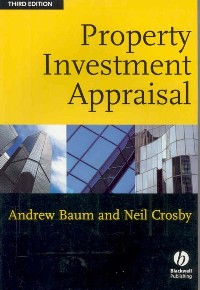
Property investment appraisal / 3rd ed.
副标题:无
作 者:Andrew Baum and Neil Crosby.
分类号:
ISBN:9781405135559
微信扫一扫,移动浏览光盘
简介
Summary:
Publisher Summary 1
Intended as a comprehensive guide to appraising property investments in the United Kingdom, Baum and Crosby (U. of Reading, UK) have written the third edition of this book to reflect drastic fluctuations in the recent real estate market. After stressing fundamental investment and real estate theory, the authors then devote the body of this book to market evaluation models before concluding with basic investment materials for appraisers in the field. Conventional appraising techniques, market growth models, freehold and leasehold market evaluations and investment values are explored in depth. Annotation 漏2008 Book News, Inc., Portland, OR (booknews.com)
Publisher Summary 2
This book explains the process of property investment appraisal 鈥?estimating both the most likely selling price (market value) and the worth of property investments to individual or groups of investors (investment value).
Valuations are important: they are used as a surrogate for transactions in the construction of investment performance and they influence investors and other market operators when transacting property. Valuations need to be trusted by their clients and valuers therefore need to produce rational and objective solutions.
In a style that makes the theory as well as the practice of valuation accessible to students and practitioners, the authors provide a valuable critique of conventional valuation methods and argue for the adoption of more contemporary cash-flow methods. They explain how such valuation models are constructed and give useful examples throughout.
The UK property investment market has been through periods of both boom and bust since the first edition of this text was produced in 1988 and the book includes examples generated by the different market states: for example, complex reversions, over-rented situations and leasehold examples are in ready supply and are examined fully by the authors. They have retained the book's basic structure and thrust, setting out fundamental investment and appraisal theory in Part One of the book, but adding a new chapter on building and modelling cash flows as a precursor to the investment material in Part Three.
The heart of the book remains the critical examination of market valuation models addressed in Part Two 鈥?it remains the case that no other book addresses this issue in detail.
目录
PART ONE
INTRODUCTION
Chapter 1 PROPERTY INVESTMENT APPRAISAL IN ITS CONTEXT
1.1 What is appraisal?
1.2 What makes a good appraisal?
1.3 Conventional and DCF approaches to appraisal
1.4 Property investment appraisal and the capital markets
1.5 The appraisal process
1.5.1 Accuracy and bias
1.5.2 Client influence
Chapter 2 PRINCIPLES OF INVESTMENT ANALYSIS
2.1 Investment
2.2 Investments
2.2.1 Bank deposits
2.2.2. Fixed interest securities
`2.2.3 Index-linked gilts
2.2.4 Ordinary shares (equities)
2.2.5 Property
2.2.6 Summary
2.3 Qualities of Investments
2.3.1 Income and capital growth
2.3.2 Operating expenses
2.3.3 Liquidity, marketability, transfer costs
2.3.4 Real options
2.3.5 Tax efficiency
2.3.6 Risk
Introduction
Systematic and specific risk
Systematic risks
Systematic/specific risks
Semi-systematic risks
Specific risks
Business and financial risk
Nominal or real risk?
Systematic or specific risk?
2.4 Initial yield analysis and construction
2.5 Comparing investment opportunities: NPV and IRR
Chapter 3 THE DCF APPRAISAL MODEL
3.1 The cash flow model
3.1.1 The inputs
3.1.2 holding periods
3.1.3 The lease
3.2 The cash flow
3.2.1 The gross income
3.2.2 Forecasting : the challenge
3.2.3 The resale price
3.2.4 Estimated rental value at resale
3.2.5 Capitalisation rate
3.2.6 Depreciation
3.2.7 Expenses
3.3 The discount rate
3.3.1 The risk free rate
3.3.2 The risk premium
3.4 Examples
PART TWO
MARKET VALUATION MODELS
Chapter 4 THE THEORY AND PRACTICE OF CONVENTIONAL
APPRAISAL TECHNIQUES
4.1 Introduction
4.2 The evolution of conventional techniques
4.2.1 The changing perception of investors
4.2.2 Historical application of the basic valuation model
4.3 Rationale of the pre-1960 appraisal approach
4.4 The current conventional market valuation model
4.4.1 The fully let freehold
4.4.2 The reversionary freehold
Term and reversion
Layer
Equivalent yield
Conclusions
4.4.3 Leaseholds
Dual rate tax adjusted
Dual rate unadjusted for tax
Single rate
Conclusions : leasehold valuations
4.4.4 Over-rented valuations
4.5 Conclusions
Chapter 5 CONTEMPORARY GROWTH-EXPLICIT MARKET
VALUATION MODELS
5.1 Introduction
5.2 Analysing transactions
5.2.1 Implied rental growth rate analysis
5.2.2 Calculation of the implied rental growth rate
5.3 Short cut DCF valuations
5.3.1 Introduction
5.3.2 An explicit cash flow model
5.3.3 DCF by formula
5.3.4 The rational model
5.4 Real Value models
5.4.1 Real value theory
5.4.2 A real value/short cut DCF hybrid
5.5 Arbitrage Model
5.6 Summary
Chapter 6 CONTEMPORARY FREEHOLD MARKET VALUATIONS
6.1 Introduction
6.2 Rack rented freeholds
6.3 Two stage reversionary freeholds
6.3.1 Short reversions
6.3.2 long reversions
6.3.3 Over-rented
6.4 More complex reversionary freeholds
6.4.1 Lease events
6.4.2 Alternative review forms - indexation and fixed increases
6.5 Comparing conventional and contemporary techniques
6.5.1 Defending conventional techniques
6.5.2 Target rate choice
6.5.3 Fully let freeholds: contemporary v conventional valuations
6.5.4 Reversionary freeholds contemporary v conventional valuations
6.6 Taxation and market valuation
6.7 Conclusions
Chapter 7 CONTEMPORARY LEASEHOLD MARKET VALUATIONS
7.1 Introduction
7.2 Fixed leasehold profit rents
7.3 Geared leasehold profit rents
7.4 Synchronized reviews in head and sub leases
7.5 Reversionary leaseholds
7.6 Reviewable rent received, unsynchronized reviewable rent paid
7.7 Over-rented leaseholds
7.8 Conventional v contemporary techniques
7.9 The limitations of the contemporary models for leaseholds
7.9.1 Analysis and valuation using leasehold comparables
7.9.2 Analysis and valuation using freehold comparables.
7.7 Taxation and the market valuation of leaseholds
7.8 Conclusions
PART THREE
INVESTMENT VALUE AND WORTH
Chapter 8 PROPERTY INVESTMENT VALUE: THE ASSESSMENT OF
WORTH
8.1 Introduction
8.2 Risk/return analysis
8.2.1 Introduction
8.2.2 NPV or IRR?
8.2.3 Sensitivity analysis
8.2.4 Risk adjustment techniques
8.2.5 Mean variance criterion
8.2.6 The coefficient of IRR/NPV variation
8.2.7 Standard deviations in risk analysis: some problems
8.3 Portfolio risk
8.4 Summary
Appendix to Chapter Eight - Pricing the options inherent in leased
commercial property: a UK case study
A8.1 Introduction
A8.2 Factors affecting the value effects of lease variations
A8.2.1 Rental valuation
The landlord perspective
The tenant perspective
A8.2.2 Capital valuation
A8.3 Developing a model for pricing cash flows
A8.3.1 Introduction
A8.3.2 Simulation approaches
A8.3.3 Analytical approaches ¿ using option pricing theory
A8.3.4 OPRent ¿ the system
A8.3.5 Valuation
A8.4 The impact of rental growth volatility on pricing and returns
Chapter 9 VALUATION AND PRICE - A CASE STUDY
9.1 Introduction
9.2 The Investment
9.2.1 The property
9.2.2 The economic background
9.2.3 The property market background
9.2.4 The investment: equity of bond?
9.2.5 The cash flow
9.2.6 The discount rate
9.2.7 The property: cash flow and discount rate
9.3 Market valuation
9.4 Investment Value
9.4.1 Cash flow
9.4.2 Discount rate
9.5 The UK perspective
9.6 The international perspective
9.7 Investment performance
9.8 2006 : on the market again
9.9 Summary
Chapter 10 CONCLUSIONS
References and bibliography
Property investment appraisal / 3rd ed.
- 名称
- 类型
- 大小
光盘服务联系方式: 020-38250260 客服QQ:4006604884
云图客服:
用户发送的提问,这种方式就需要有位在线客服来回答用户的问题,这种 就属于对话式的,问题是这种提问是否需要用户登录才能提问
Video Player
×
Audio Player
×
pdf Player
×
