

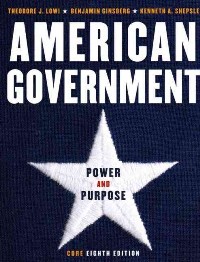
American government : power and purpose / Core 8th ed.
副标题:无
作 者:Theodore J. Lowi, Benjamin Ginsberg, and Kenneth A. Shepsle.
分类号:
ISBN:9780393924831
微信扫一扫,移动浏览光盘
简介
Summary:
Publisher Summary 1
This textbook covers the basics of American government, its institutions, and the politics that shape it. Chapters specifically discuss the Constitution, federalism and the separation of powers, civil liberties and civil rights, congress, the presidency, bureaucracy, the federal courts, pubic opinion, elections, parties, interest groups, and the media. The authors teach at Cornell, Johns Hopkins, and Harvard. Annotation 漏2004 Book News, Inc., Portland, OR (booknews.com)
Publisher Summary 2
In the Eighth Edition, American Government: Power and Purposemaintains the analytical rigor, focused pedagogy, and judicious use of relevant history that have distinguished it as the authoritative text for American government courses. Retaining the analytical framework that first appeared in the Seventh Edition, the Eighth Edition emphasizes five core "Principles of Politics": 1. All political behavior has a purpose 2. All politics is collective action 3. Institutions matter 4. Political outcomes are the products of individuals' preferences and institutional procedures 5. History matters By drawing on these principles throughout the text, the authors expose students to repeated applications of core ideas in their discussion of political concepts and history. The result is a refined, accessible portrait of America's government institutions and political life that encourages students to think critically and analytically.
目录
Table Of Contents:
Preface xvii
PART 1 FOUNDATIONS 1(156)
1 Five Principles of Politics 2(32)
What Is Government, and Why Is It Necessary? 8(5)
Forms of Government 8(1)
Foundations of Government 8(2)
Why Is Government Necessary? 10(2)
Influencing the Government: Politics 12(1)
Why Do Governments Do What They Do? 13(15)
Principle 1: All Political Behavior Has a Purpose 14(1)
Principle 2: All Politics Is Collective Action 15(4)
Principle 3: Institutions Matter 19(4)
Principle 4: Political Outcomes Are the Products of Individual Preferences and Institutional Procedures 23(2)
Principle 5: History Matters 25(3)
The Paradoxes of American Democracy 28(2)
Delegating Authority in a Representative Democracy 29(1)
The Trade-off between Freedom and Order 29(1)
Instability of Majority Rule 30(1)
Summary 30(1)
For Further Reading 31(3)
2 Constructing a Government: The Founding and the Constitution 34(42)
The First Founding: Interests and Conflicts 37(4)
British Taxes and Colonial Interests 37(2)
Political Strife and the Radicalizing of the Colonists 39(1)
The Declaration of Independence 40(1)
The Articles of Confederation 40(1)
The Second Founding: From Compromise to Constitution 41(8)
International Standing and Balance of Power 41(1)
The Annapolis Convention 42(1)
Shays's Rebellion 43(1)
The Constitutional Convention 43(6)
The Constitution 49(8)
The Legislative Branch 50(1)
The Executive Branch 51(1)
The Judicial Branch 52(1)
National Unity and Power 53(1)
Amending the Constitution 54(1)
Ratifying the Constitution 54(1)
Constitutional Limits on the National Government's Power 54(3)
The Fight for Ratification: Federalists versus Antifederalists 57(7)
Representation 60(1)
The Threats Posed by the Majority 61(1)
Governmental Power 62(2)
Changing the Institutional Framework: Constitutional Amendment 64(6)
Amendments: Many Are Called, Few Are Chosen 64(2)
The Twenty-seven Amendments 66(4)
Reflections on the Founding: Principles or Interests? 70(2)
Summary 72(1)
For Further Reading 73(3)
3 The Constitutional Framework: Federalism and the Separation of Powers 76(38)
Federalism and the Separation of Powers as Political Institutions 78(2)
Who Does What? The Changing Federal Framework 80(20)
Federalism in the Constitution 80(4)
The Slow Growth of the National Government's Power 84(4)
Cooperative Federalism and Grants-in-Aid 88(2)
Regulated Federalism and National Standards 90(4)
New Federalism and the National-State Tug-of-War 94(6)
The Separation of Powers 100(7)
Checks and Balances 101(1)
Legislative Supremacy 101(2)
The Role of the Supreme Court 103(4)
Altering the Balance of Power: What Are the Consequences? 107(1)
Summary 108(2)
For Further Reading 110(4)
4 The Constitutional Framework and the Individual: Civil Liberties and Civil Rights 114(43)
Civil Liberties: Nationalizing the Bill of Rights 117(11)
Dual Citizenship 118(1)
The Fourteenth Amendment 119(4)
The Constitutional Revolution in Civil Liberties 123(3)
Rehnquist: A De-nationalizing Trend? 126(2)
Civil Rights 128(22)
Plessy v. Ferguson: "Separate but Equal" 128(1)
Racial Discrimination after World War II 129(2)
Civil Rights after Brown v. Board of Education 131(6)
The Rise of the Politics of Rights 137(5)
Affirmative Action 142(8)
Summary 150(2)
For Further Reading 152(5)
PART 2 INSTITUTIONS 157(206)
5 Congress: The First Branch 158(62)
Representation 161(14)
House and Senate: Differences in Representation 163(2)
The Electoral System 165(10)
The Organization of Congress 175(19)
Cooperation in Congress 176(1)
Other Underlying Problems 177(2)
Party Leadership in the House and the Senate 179(5)
The Committee System: The Core of Congress 184(9)
The Staff System: Staffers and Agencies 193(1)
Informal Organization: The Caucuses 194(1)
Rules of Lawmaking: How a Bill Becomes a Law 194(8)
Committee Deliberation 194(1)
Debate 195(1)
Conference Committee: Reconciling House and Senate Versions of a Bill 196(1)
Presidential Action 197(1)
The Distributive Tendency in Congress 197(5)
How Congress Decides 202(8)
Constituency 202(1)
Interest Groups 202(1)
Party Discipline 203(6)
Weighing Diverse Influences 209(1)
Beyond Legislation: Additional Congressional Powers 210(2)
Advice and Consent: Special Senate Powers 210(1)
Impeachment 211(1)
Power and Representation 212(2)
Summary 214(2)
For Further Reading 216(4)
6 The President: From Chief Clerk to Chief Executive 220(52)
The Constitutional Basis of the Presidency 223(15)
The President as Head of State 225(2)
The Domestic Presidency: The President as Head of Government 227(11)
The Rise of Presidential Government 238(7)
The Legislative Epoch, 1800-1933 239(3)
The New Deal and the Presidency 242(3)
Presidential Government 245(17)
What Are the Formal Resources of Presidential Power? 246(8)
What Are the Informal Resources of Presidential Power? 254(8)
Is a Parliamentary System Better? 262(5)
Governmental Arrangements 264(1)
The Government Formation Process 265(2)
Summary 267(2)
For Further Reading 269(3)
7 The Executive Branch: Bureaucracy in a Democracy 272(40)
Why Bureaucracy? 275(7)
Bureaucratic Organization Enhances Efficiency 276(1)
Bureaucracies Allow Governments to Operate 277(1)
Bureaucrats Fulfill Important Roles 278(4)
How Is the Executive Branch Organized? 282(8)
Clientele Agencies Serve Particular Interests 285(1)
Agencies for Maintenance of the Union Keep the Government Going 285(2)
Regulatory Agencies Guide Individual Conduct 287(1)
Agencies of Redistribution Implement Fiscal/Monetary and Welfare Policies 288(2)
Who Controls the Bureaucracy? 290(9)
The President as Chief Executive Can Direct Agencies 290(2)
Congress Promotes Responsible Bureaucracy 292(3)
Control of the Bureaucracy Is a Principal-Agent Problem 295(4)
How Can Bureaucracy Be Reduced? 299(8)
Termination 302(1)
Devolution 303(3)
Privatization 306(1)
Summary 307(1)
For Further Reading 308(4)
8 The Federal Courts: Least Dangerous Branch or Imperial Judiciary? 312(51)
The Judicial Process 315(2)
The Organization of the Court System 317(8)
Types of Courts 317(2)
Federal Jurisdiction 319(1)
The Lower Federal Courts 320(1)
The Appellate Courts 320(1)
The Supreme Court 321(1)
How Judges Are Appointed 321(4)
How Do Courts Work as Political Institutions? 325(3)
Dispute Resolution 325(1)
Coordination 326(1)
Rule Interpretation 327(1)
The Power of Judicial Review 328(7)
Judicial Review of Acts of Congress 328(2)
Judicial Review of State Actions 330(1)
Judicial Review of Federal Agency Actions 331(2)
Judicial Review and Lawmaking 333(2)
The Supreme Court In Action 335(10)
How Cases Reach the Supreme Court 335(4)
Controlling the Flow of Cases 339(1)
The Case Pattern 340(2)
The Supreme Court's Procedures 342(3)
Judicial Decision Making 345(7)
The Supreme Court Justices 345(4)
Other Institutions of Government 349(3)
Judicial Power and Politics 352(4)
Traditional Limitations on the Federal Courts 352(1)
Two Judicial Revolutions 353(3)
Summary 356(2)
For Further Reading 358(5)
PART 3 POLITICS 363
9 Public Opinion 364(48)
What Are the Origins of Public Opinion? 367(12)
Common Fundamental Values 367(3)
Political Socialization 370(7)
Political Ideology 377(2)
How Are Political Opinions Formed? 379(11)
Knowledge and Information 381(3)
Government and Political Leaders 384(4)
Private Groups 388(1)
The Media and Public Opinion 389(1)
How Is Public Opinion Measured? 390(14)
Directly from People 391(2)
Surveys 393(5)
Limits to Assessing Public Opinion with Polls 398(5)
Public Opinion, Political Knowledge, and the Importance of Ignorance 403(1)
How Does Public Opinion Influence Government Policy? 404(3)
Summary 407(1)
For Further Reading 408(4)
10 Elections 412(50)
How Does Government Regulate the Electoral Process? 416(16)
Electoral Composition 417(4)
Translating Voters' Choices into Electoral Outcomes 421(5)
Insulating Decision-Making Processes 426(5)
Direct Democracy: The Referendum and Recall 431(1)
How Do Voters Decide? 432(4)
Partisan Loyalty 432(1)
Issues 433(2)
Candidate Characteristics 435(1)
The 2000 Elections 436(5)
The 2002 Elections: A Referendum on Presidential Leadership 440(1)
Campaign Finance 441(7)
Sources of Campaign Funds 442(5)
Campaign Finance Reform 447(1)
Implications for Democracy 447(1)
Do Elections Matter? 448(9)
Why Is There a Decline In Voter Turnout? 449(6)
Why Do Elections Matter as Political Institutions? 455(2)
Summary 457(1)
For Further Reading 458(4)
11 Political Parties 462(42)
Why Do Political Parties Form? 464(3)
To Facilitate Collective Action in the Electoral Process 465(1)
To Resolve Collective Choice in the Policy-Making Process 466(1)
To Deal with the Problem of Ambition 467(1)
What Functions Do Parties Perform? 467(9)
Recruiting Candidates 467(1)
Nominations 468(2)
Getting Out the Vote 470(1)
Facilitating Mass Electoral Choice 471(1)
Influencing National Government 472(4)
Party Systems 476(14)
The First Party System: Federalists and Democratic-Republicans 477(2)
The Second Party System: Democrats and Whigs 479(2)
The Third Party System, 1860-1896: Republicans and Democrats 481(2)
The Fourth Party System, 1896-1932 483(1)
The Fifth Party System: The New Deal Coalition, 1932-1968 484(1)
The Sixth Party System? 485(1)
American Third Parties 486(4)
How Strong Are Political Parties Today? 490(8)
High-Tech Politics and the Rise of Candidate-Centered and Capital-Intensive Politics 490(3)
Contemporary Party Organizations 493(4)
The Contemporary Party as Service Provider to Candidates 497(1)
Parties and Democracy 497(1)
Summary 498(2)
For Further Reading 500(4)
12 Groups and Interests 504(38)
What Are the Characteristics of Interest Groups? 507(7)
Interest Groups Enhance Democracy... 507(1)
...but Also Represent the Evils of Faction 507(1)
Organized Interests Are Predominantly Economic 508(1)
All Groups Require Money and Leadership, and Most Need Members 509(1)
Group Membership Has an Upper-Class Bias 510(1)
Groups Form in Response to Changes in the Political Environment 511(3)
How and Why Do Interest Groups Form? 514(8)
Interest Groups Facilitate Cooperation 515(4)
Selective Benefits: A Solution to the Collective Action Problem 519(2)
Political Entrepreneurs Organize and Maintain Groups 521(1)
How Do Interest Groups Influence Policy? 522(14)
Direct Lobbying 524(4)
Using the Courts 528(1)
Mobilizing Public Opinion 529(2)
Using Electoral Politics 531(5)
Groups and Interests: The Dilemma of Reform 536(1)
Summary 537(2)
For Further Reading 539(3)
13 The Media 542
The Media Industry and Government 545(8)
Types of Media 545(3)
Regulation of the Broadcast and Electronic Media 548(1)
Freedom of the Press 549(1)
Organization and Ownership of the Media 550(2)
Nationalization of the News 552(1)
What Affects News Coverage? 553(8)
Journalists 553(2)
Politicians 555(4)
Consumers 559(2)
What Are the Sources of Media Power In American Politics? 561(5)
Agenda Setting 562(1)
Framing 562(1)
Priming 563(1)
The Rise of Adversarial Journalism 564(2)
Media Power and Responsibility 566(1)
Summary 567(2)
For Further Reading 569(544367407)
Appendices A1
The Declaration of Independence A3
The Articles of Confederation A7
The Constitution of the United States of America A13
Amendments to the Constitution A25
Federalist Papers A35
No. 10 A35
No. 51 A40
Glossary of Terms A44
Index A59
Preface xvii
PART 1 FOUNDATIONS 1(156)
1 Five Principles of Politics 2(32)
What Is Government, and Why Is It Necessary? 8(5)
Forms of Government 8(1)
Foundations of Government 8(2)
Why Is Government Necessary? 10(2)
Influencing the Government: Politics 12(1)
Why Do Governments Do What They Do? 13(15)
Principle 1: All Political Behavior Has a Purpose 14(1)
Principle 2: All Politics Is Collective Action 15(4)
Principle 3: Institutions Matter 19(4)
Principle 4: Political Outcomes Are the Products of Individual Preferences and Institutional Procedures 23(2)
Principle 5: History Matters 25(3)
The Paradoxes of American Democracy 28(2)
Delegating Authority in a Representative Democracy 29(1)
The Trade-off between Freedom and Order 29(1)
Instability of Majority Rule 30(1)
Summary 30(1)
For Further Reading 31(3)
2 Constructing a Government: The Founding and the Constitution 34(42)
The First Founding: Interests and Conflicts 37(4)
British Taxes and Colonial Interests 37(2)
Political Strife and the Radicalizing of the Colonists 39(1)
The Declaration of Independence 40(1)
The Articles of Confederation 40(1)
The Second Founding: From Compromise to Constitution 41(8)
International Standing and Balance of Power 41(1)
The Annapolis Convention 42(1)
Shays's Rebellion 43(1)
The Constitutional Convention 43(6)
The Constitution 49(8)
The Legislative Branch 50(1)
The Executive Branch 51(1)
The Judicial Branch 52(1)
National Unity and Power 53(1)
Amending the Constitution 54(1)
Ratifying the Constitution 54(1)
Constitutional Limits on the National Government's Power 54(3)
The Fight for Ratification: Federalists versus Antifederalists 57(7)
Representation 60(1)
The Threats Posed by the Majority 61(1)
Governmental Power 62(2)
Changing the Institutional Framework: Constitutional Amendment 64(6)
Amendments: Many Are Called, Few Are Chosen 64(2)
The Twenty-seven Amendments 66(4)
Reflections on the Founding: Principles or Interests? 70(2)
Summary 72(1)
For Further Reading 73(3)
3 The Constitutional Framework: Federalism and the Separation of Powers 76(38)
Federalism and the Separation of Powers as Political Institutions 78(2)
Who Does What? The Changing Federal Framework 80(20)
Federalism in the Constitution 80(4)
The Slow Growth of the National Government's Power 84(4)
Cooperative Federalism and Grants-in-Aid 88(2)
Regulated Federalism and National Standards 90(4)
New Federalism and the National-State Tug-of-War 94(6)
The Separation of Powers 100(7)
Checks and Balances 101(1)
Legislative Supremacy 101(2)
The Role of the Supreme Court 103(4)
Altering the Balance of Power: What Are the Consequences? 107(1)
Summary 108(2)
For Further Reading 110(4)
4 The Constitutional Framework and the Individual: Civil Liberties and Civil Rights 114(43)
Civil Liberties: Nationalizing the Bill of Rights 117(11)
Dual Citizenship 118(1)
The Fourteenth Amendment 119(4)
The Constitutional Revolution in Civil Liberties 123(3)
Rehnquist: A De-nationalizing Trend? 126(2)
Civil Rights 128(22)
Plessy v. Ferguson: "Separate but Equal" 128(1)
Racial Discrimination after World War II 129(2)
Civil Rights after Brown v. Board of Education 131(6)
The Rise of the Politics of Rights 137(5)
Affirmative Action 142(8)
Summary 150(2)
For Further Reading 152(5)
PART 2 INSTITUTIONS 157(206)
5 Congress: The First Branch 158(62)
Representation 161(14)
House and Senate: Differences in Representation 163(2)
The Electoral System 165(10)
The Organization of Congress 175(19)
Cooperation in Congress 176(1)
Other Underlying Problems 177(2)
Party Leadership in the House and the Senate 179(5)
The Committee System: The Core of Congress 184(9)
The Staff System: Staffers and Agencies 193(1)
Informal Organization: The Caucuses 194(1)
Rules of Lawmaking: How a Bill Becomes a Law 194(8)
Committee Deliberation 194(1)
Debate 195(1)
Conference Committee: Reconciling House and Senate Versions of a Bill 196(1)
Presidential Action 197(1)
The Distributive Tendency in Congress 197(5)
How Congress Decides 202(8)
Constituency 202(1)
Interest Groups 202(1)
Party Discipline 203(6)
Weighing Diverse Influences 209(1)
Beyond Legislation: Additional Congressional Powers 210(2)
Advice and Consent: Special Senate Powers 210(1)
Impeachment 211(1)
Power and Representation 212(2)
Summary 214(2)
For Further Reading 216(4)
6 The President: From Chief Clerk to Chief Executive 220(52)
The Constitutional Basis of the Presidency 223(15)
The President as Head of State 225(2)
The Domestic Presidency: The President as Head of Government 227(11)
The Rise of Presidential Government 238(7)
The Legislative Epoch, 1800-1933 239(3)
The New Deal and the Presidency 242(3)
Presidential Government 245(17)
What Are the Formal Resources of Presidential Power? 246(8)
What Are the Informal Resources of Presidential Power? 254(8)
Is a Parliamentary System Better? 262(5)
Governmental Arrangements 264(1)
The Government Formation Process 265(2)
Summary 267(2)
For Further Reading 269(3)
7 The Executive Branch: Bureaucracy in a Democracy 272(40)
Why Bureaucracy? 275(7)
Bureaucratic Organization Enhances Efficiency 276(1)
Bureaucracies Allow Governments to Operate 277(1)
Bureaucrats Fulfill Important Roles 278(4)
How Is the Executive Branch Organized? 282(8)
Clientele Agencies Serve Particular Interests 285(1)
Agencies for Maintenance of the Union Keep the Government Going 285(2)
Regulatory Agencies Guide Individual Conduct 287(1)
Agencies of Redistribution Implement Fiscal/Monetary and Welfare Policies 288(2)
Who Controls the Bureaucracy? 290(9)
The President as Chief Executive Can Direct Agencies 290(2)
Congress Promotes Responsible Bureaucracy 292(3)
Control of the Bureaucracy Is a Principal-Agent Problem 295(4)
How Can Bureaucracy Be Reduced? 299(8)
Termination 302(1)
Devolution 303(3)
Privatization 306(1)
Summary 307(1)
For Further Reading 308(4)
8 The Federal Courts: Least Dangerous Branch or Imperial Judiciary? 312(51)
The Judicial Process 315(2)
The Organization of the Court System 317(8)
Types of Courts 317(2)
Federal Jurisdiction 319(1)
The Lower Federal Courts 320(1)
The Appellate Courts 320(1)
The Supreme Court 321(1)
How Judges Are Appointed 321(4)
How Do Courts Work as Political Institutions? 325(3)
Dispute Resolution 325(1)
Coordination 326(1)
Rule Interpretation 327(1)
The Power of Judicial Review 328(7)
Judicial Review of Acts of Congress 328(2)
Judicial Review of State Actions 330(1)
Judicial Review of Federal Agency Actions 331(2)
Judicial Review and Lawmaking 333(2)
The Supreme Court In Action 335(10)
How Cases Reach the Supreme Court 335(4)
Controlling the Flow of Cases 339(1)
The Case Pattern 340(2)
The Supreme Court's Procedures 342(3)
Judicial Decision Making 345(7)
The Supreme Court Justices 345(4)
Other Institutions of Government 349(3)
Judicial Power and Politics 352(4)
Traditional Limitations on the Federal Courts 352(1)
Two Judicial Revolutions 353(3)
Summary 356(2)
For Further Reading 358(5)
PART 3 POLITICS 363
9 Public Opinion 364(48)
What Are the Origins of Public Opinion? 367(12)
Common Fundamental Values 367(3)
Political Socialization 370(7)
Political Ideology 377(2)
How Are Political Opinions Formed? 379(11)
Knowledge and Information 381(3)
Government and Political Leaders 384(4)
Private Groups 388(1)
The Media and Public Opinion 389(1)
How Is Public Opinion Measured? 390(14)
Directly from People 391(2)
Surveys 393(5)
Limits to Assessing Public Opinion with Polls 398(5)
Public Opinion, Political Knowledge, and the Importance of Ignorance 403(1)
How Does Public Opinion Influence Government Policy? 404(3)
Summary 407(1)
For Further Reading 408(4)
10 Elections 412(50)
How Does Government Regulate the Electoral Process? 416(16)
Electoral Composition 417(4)
Translating Voters' Choices into Electoral Outcomes 421(5)
Insulating Decision-Making Processes 426(5)
Direct Democracy: The Referendum and Recall 431(1)
How Do Voters Decide? 432(4)
Partisan Loyalty 432(1)
Issues 433(2)
Candidate Characteristics 435(1)
The 2000 Elections 436(5)
The 2002 Elections: A Referendum on Presidential Leadership 440(1)
Campaign Finance 441(7)
Sources of Campaign Funds 442(5)
Campaign Finance Reform 447(1)
Implications for Democracy 447(1)
Do Elections Matter? 448(9)
Why Is There a Decline In Voter Turnout? 449(6)
Why Do Elections Matter as Political Institutions? 455(2)
Summary 457(1)
For Further Reading 458(4)
11 Political Parties 462(42)
Why Do Political Parties Form? 464(3)
To Facilitate Collective Action in the Electoral Process 465(1)
To Resolve Collective Choice in the Policy-Making Process 466(1)
To Deal with the Problem of Ambition 467(1)
What Functions Do Parties Perform? 467(9)
Recruiting Candidates 467(1)
Nominations 468(2)
Getting Out the Vote 470(1)
Facilitating Mass Electoral Choice 471(1)
Influencing National Government 472(4)
Party Systems 476(14)
The First Party System: Federalists and Democratic-Republicans 477(2)
The Second Party System: Democrats and Whigs 479(2)
The Third Party System, 1860-1896: Republicans and Democrats 481(2)
The Fourth Party System, 1896-1932 483(1)
The Fifth Party System: The New Deal Coalition, 1932-1968 484(1)
The Sixth Party System? 485(1)
American Third Parties 486(4)
How Strong Are Political Parties Today? 490(8)
High-Tech Politics and the Rise of Candidate-Centered and Capital-Intensive Politics 490(3)
Contemporary Party Organizations 493(4)
The Contemporary Party as Service Provider to Candidates 497(1)
Parties and Democracy 497(1)
Summary 498(2)
For Further Reading 500(4)
12 Groups and Interests 504(38)
What Are the Characteristics of Interest Groups? 507(7)
Interest Groups Enhance Democracy... 507(1)
...but Also Represent the Evils of Faction 507(1)
Organized Interests Are Predominantly Economic 508(1)
All Groups Require Money and Leadership, and Most Need Members 509(1)
Group Membership Has an Upper-Class Bias 510(1)
Groups Form in Response to Changes in the Political Environment 511(3)
How and Why Do Interest Groups Form? 514(8)
Interest Groups Facilitate Cooperation 515(4)
Selective Benefits: A Solution to the Collective Action Problem 519(2)
Political Entrepreneurs Organize and Maintain Groups 521(1)
How Do Interest Groups Influence Policy? 522(14)
Direct Lobbying 524(4)
Using the Courts 528(1)
Mobilizing Public Opinion 529(2)
Using Electoral Politics 531(5)
Groups and Interests: The Dilemma of Reform 536(1)
Summary 537(2)
For Further Reading 539(3)
13 The Media 542
The Media Industry and Government 545(8)
Types of Media 545(3)
Regulation of the Broadcast and Electronic Media 548(1)
Freedom of the Press 549(1)
Organization and Ownership of the Media 550(2)
Nationalization of the News 552(1)
What Affects News Coverage? 553(8)
Journalists 553(2)
Politicians 555(4)
Consumers 559(2)
What Are the Sources of Media Power In American Politics? 561(5)
Agenda Setting 562(1)
Framing 562(1)
Priming 563(1)
The Rise of Adversarial Journalism 564(2)
Media Power and Responsibility 566(1)
Summary 567(2)
For Further Reading 569(544367407)
Appendices A1
The Declaration of Independence A3
The Articles of Confederation A7
The Constitution of the United States of America A13
Amendments to the Constitution A25
Federalist Papers A35
No. 10 A35
No. 51 A40
Glossary of Terms A44
Index A59
American government : power and purpose / Core 8th ed.
- 名称
- 类型
- 大小
光盘服务联系方式: 020-38250260 客服QQ:4006604884
云图客服:
用户发送的提问,这种方式就需要有位在线客服来回答用户的问题,这种 就属于对话式的,问题是这种提问是否需要用户登录才能提问
Video Player
×
Audio Player
×
pdf Player
×
